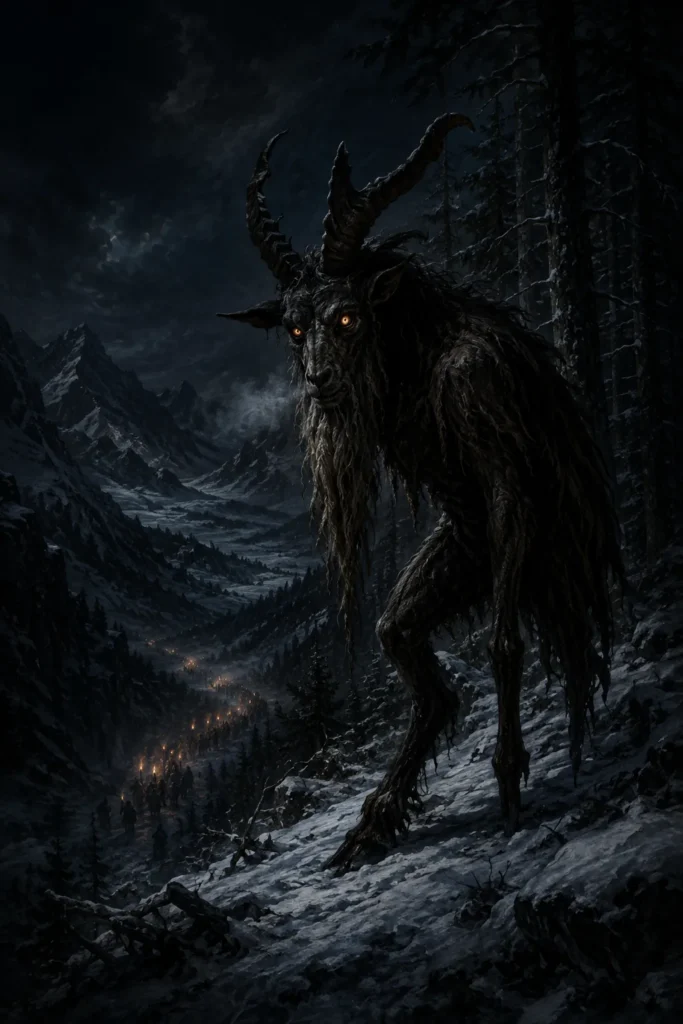
Krampus, horned companion of Saint Nicholas
By Ralf Ittermann · last reviewed on
Krampus is a demon of the Alpine tradition.
Horned winter demon with a birch rod, chain and basket.
Krampus is the sinister companion of Saint Nicholas in the Eastern Alpine region: horned, hairy, and equipped with a chain and birch rod, while Nicholas rewards well-behaved children. An early record of processions of this kind is a Perchten hunt of 1582 in Dießen am Ammersee; as an independent postcard figure, Krampus is attested only from the mid-19th century onward.
In the Krampus runs from Salzburg to Carinthia, he still appears today as a loud, terrifying demonic figure of the winter season, with a carved wooden mask, rattling chain, and birch-twig rod. The night of December 5, preceding Saint Nicholas Day, remains his fixed date of appearance.
Type: Winter demon and companion figure of Saint Nicholas
Origin: Eastern Alpine region, early record of a Perchten hunt in 1582 in Dießen am Ammersee
Texts: church prohibition records since the 17th century, Krampus postcards from around 1850
Period: as a postcard figure since the mid-19th century, the custom remains alive today
Appearance: horned, hairy figure with wooden mask, chain, birch rod, and basket

Historical Background
Period of the Texts
Early record of processions of this kind: a Perchten hunt in 1582 in Dießen am Ammersee; as an independent postcard figure only from the mid-19th century onward. Church prohibition records date back to the 17th century.
Range of Distribution
Salzburg, Tyrol, Carinthia, Styria, Bavaria, and South Tyrol: Krampus is widespread throughout the entire Eastern Alpine region and its neighboring Bavarian areas.
State of Sources
Well documented through church prohibition records since the 17th century, Krampus postcards from around 1850 onward, and folkloric descriptions of the Krampus and Perchten runs.
Name and Variants
Bavarian-Austrian: The name is usually traced back to Krampen, a word for something withered or claw-like, related to Middle Low German krampe, meaning hook. The exact derivation is considered not fully established.
Appearance and Symbolism
Appearance
Horned, long-tongued, and covered in fur, the mask traditionally carved from Swiss pine or linden wood; each group tends to maintain its own mask style. Characteristic features are the rattling chain, the birch-twig rod, and the basket carried on the back.
Effect
The combination of noise, fur, and chain makes him both a tamed and a menacing being at once: a winter demon in the service of Saint Nicholas who visibly retains his original threatening nature. In some places, a harness of bells further amplifies the noise of his appearance.
Profile: Krampus
The most important aspects of the rod-wielding figure at a glance.
Wintry companion figure of Saint Nicholas in the Eastern Alpine region, established since the Counter-Reformation as a fixed pairing of reward and punishment.
Naughty children as the declared target of the threat, alongside the entire assembled audience of the Krampus runs during the procession.
Carved wooden mask, fur, chain, birch-twig rod, and the basket carried on the back; the shape of the horns and the length of the tongue vary from group to group.
Punishing counterpart to the rewarding Saint Nicholas, with an older role as a wandering winter spirit feared during the Rauhnächte.
Incense fumigation, the noise of bells and chains, the church’s Blochsegen blessing, and holy water around Saint Nicholas Day.
The Japanese Oni as a distant example of ritual demon expulsion, along with regional relatives such as Klaubauf and Buttnmandl.
Krampus Night on December 5
Krampus Night falls on December 5, the eve of Saint Nicholas Day. On this night, the Krampuses roam through villages and towns, alone, in small groups, or as part of a large procession. In many places, the visit of Saint Nicholas and his companion to the home follows on December 6.
The house-visiting custom follows fixed rules. The family receives the pair, children recite poems, and Saint Nicholas reads from his book. Krampus stays by the door or in the background. His frightening effect works precisely because he appears tamed.
Krampus and Saint Nicholas: a well-established pair
No Krampus without Saint Nicholas. The figure emerged as the saint’s counterpart and servant and remains tied to his feast day. This is what distinguishes the custom from a pure masked spectacle.
The pairing embodies a simple order: the saint represents goodness and moderation, the fearsome figure the consequence of disregarding them. From a folklore perspective, this is an educational figure of the kind found in many cultures. Comparable threatening figures range from the French Père Fouettard to the alpine Budelfrau.
Krampus, Perchten, Knecht Ruprecht: the differences
Krampus and Perchten are often confused, but they belong to different customs. Krampus is tied to Saint Nicholas Day. Perchten appear around the Rauhnächte, that is around the turn of the year and the end of winter, and derive from the legendary figure of Percht. Modern events mix both figures, but historically they are separate.
Knecht Ruprecht, in turn, is Saint Nicholas’s companion in central and northern Germany. He wears a robe instead of fur, comes from the tradition of Christmas plays, and appears noticeably milder. Where Ruprecht admonishes, Krampus rages.
A short formula for everyday use: Saint Nicholas Eve plus fur and horns equals Krampus. The turn of the year plus a masked procession equals Perchten. A robe plus a sack equals Knecht Ruprecht.
Distribution: Austria, Bavaria, South Tyrol, and their neighbors
The heartland of the custom is Austria, with centers in Salzburg, Tyrol, East Tyrol, Carinthia, and Styria. There, Krampus is a fixed part of Advent, from school celebrations to major events.
In Bavaria, the custom lives on mainly in the Alpine region. The Berchtesgadener Land has its own variant of Saint Nicholas’s companion, the Buttnmandl, bound in straw. South Tyrol maintains the custom in many valleys, often with elaborate processions.
Beyond German-speaking areas, the figure extends to Slovenia, where it is called parkelj, and to western Hungary as krampusz. The custom’s range thus follows the old cultural regions of the eastern Alpine arc rather than today’s state borders.
Krampus runs: the custom as a major event
At a Krampus run, dozens to hundreds of masked figures parade through the streets. Groups, known as Passen, appear with uniformly designed masks and costumes. Spectators line the barriers, and the clatter of bells fills the town.
Major runs take place in and around Salzburg, in Carinthia, and in East Tyrol, among other places. Many communities also hold smaller processions with a long local history. Dates almost always fall between late November and December 6.
The shift from a household custom to a public event is viewed critically in some parts of the Alpine region. Discussions center on alcohol, violence at the edges of the runs, and the question of how much spectacle a custom can bear. Most Passen respond with fixed rules, numbered masks, and distance from the audience.
Masks and costume: the craft behind the fright
The Larve, as the carved wooden mask is called, is made by hand. Swiss pine and linden wood are common, along with real horns from goats or rams. Good Larven come from workshops with long experience and fetch considerable prices as collector’s items.
The costume includes fur, a belt with heavy bells, a switch, and a chain. Anyone who accompanies a Passe can recognize the handiwork of individual carvers in the features and painting of the masks. This craftsmanship is a distinct part of the custom and keeps it alive.
From the Perchten hunt to the Krampus card
The oldest known record of a procession of this kind dates to 1582 in Dießen am Ammersee, where participants in a Perchten hunt were paid for driving out evil winter spirits. The pairing of Saint Nicholas and Krampus as counterparts of reward and punishment took shape during the Counter-Reformation, when the Catholic Church sought to strengthen the cult of Saint Nicholas. In the 17th and 18th centuries, Perchten and Krampus processions in Bavaria, Salzburg, and Tyrol were repeatedly banned as breaches of public order and religious propriety, since they tended to degenerate into drinking bouts.
From the mid-19th century onward, so-called Krampus cards emerged, used to jokingly wish acquaintances a beating from Krampus. Regionally, related figures appear under other names, such as Klaubauf or Buttnmandl. In the 20th and 21st centuries, Krampus spread beyond the Alpine region and was also taken up internationally.
From card motif to present-day winter custom
The Krampus cards of the late 19th century carried the figure into private correspondence early on. In the 21st century, Krampus runs grew into a winter custom of considerable touristic interest, featuring elaborate costumes weighing several kilograms and finely carved masks. Internationally, the figure became known in part through the American feature film Krampus (2015), which portrays a heavily altered version of him as a pure horror demon; in Austria itself, however, he remains primarily a locally rooted club tradition.
Krampus embodies the principle of the contrasting figure: only in opposition to the rewarding Saint Nicholas does the threatening figure unfold its full educational effect. From a religious studies perspective, the custom can be read as a winter expulsion ritual that combined older, pre-Christian notions of roaming winter spirits with the legend of the Bishop of Myra. The early modern bans also show that the authorities feared the procession as an occasion for excess and transgression, a tendency that lives on in today’s mix of fear and folk festival.
Krampus in film and popular culture
The figure also became internationally known through cinema. The 2015 American feature film “Krampus” by Michael Dougherty introduced the figure to a worldwide audience as a horror creature. Since then, Krampus has appeared in television series, comics, and video games.
In the United States, this has given rise to its own forms, from Krampus parties to processions modeled on the Alpine tradition. The pop-culture Krampus is considerably more monstrous than his original model. He shares his name and silhouette with the Alpine house-visiting custom, but hardly its function.
Rauhnächte protection and the Blochsegen
In tradition, the Krampus is regarded less as an adversary to be warded off than as an invited, if feared, part of the Rauhnächte period (the twelve nights between Christmas and Epiphany). Protection was primarily aimed at the household as a whole: rooms and stables were fumigated with incense to keep wandering winter spirits away, while bells and whip-cracking served to drive off misfortune in general. The church’s Bloch blessing and the sprinkling of holy water around St. Nicholas’s Day complemented this protection. Children were above all advised to behave well throughout the year, since according to legend the switch struck precisely those who had misbehaved all year long.
Interpretation: fear with a function
Religious studies read the Krampus as an ordered figure of fear. The custom enacts fear in a controlled way, binds it to rules, and ultimately resolves it. The child experiences the threat, but also learns that it passes and that the saint has the final word.
There is also an apotropaic reading, that is, an interpretation of noise and mask as means against misfortune. Bells, shouting, and the frightening face are thought to keep the darkness of winter at bay. This interpretation is widespread, but as a historical explanation of the custom it remains a hypothesis.
The figure’s dual role is notable: the Krampus embodies the threatening and at the same time banishes it. Whoever wears the mask makes fear manageable. This very logic connects the alpine custom with protective practices found in many cultures that give misfortune a face in order to control it.
Demon expulsion in cultural comparison
No direct equivalent of the Krampus outside the Alpine region is documented, though a related underlying pattern of ritual demon expulsion does exist. At Japan’s Setsubun festival, roasted soybeans are thrown at the beginning of spring to drive away the horned Oni, likewise fearsome figures whose yearly appearance is meant to restore order. Unlike the Krampus, the Oni appears purely as an adversary, not as a tamed companion of a benevolent figure. Within the Alpine region, the Wild Man (Wilder Mann) and Rübezahl stand close to him as related figures of fear and nature.
Frequently asked questions about the Krampus
Is the Krampus a devil or a nature spirit?
Both interpretations occur in scholarship. The chain he appears with points to an older notion of a tamed, originally wilder winter spirit, while the horns and church classification brought him closer to the devil from the Counter-Reformation onward. Within the custom, he is not a devil in the church’s sense: he acts on behalf of St. Nicholas and remains subordinate to him.
Why does the Krampus appear together with St. Nicholas?
The pairing arose mainly to give children a clear contrasting pair of reward and punishment. Historically, however, the Krampus is documented earlier than this fixed pairing and originally also appeared independently of St. Nicholas customs.
Do people actually get struck at Krampus runs?
Yes, being struck with the switch is part of the living custom and is deliberately sought out by many spectators. The runners usually follow the behavioral rules of their particular group (Passe), making it a consensual, if rough, ritual.
What does the Krampus do?
The Krampus accompanies St. Nicholas on December 5 and 6. He threatens naughty children with a switch and chain, while St. Nicholas rewards the well-behaved. During Krampus runs, masked figures in fur and carved wooden masks parade through the streets. During house visits it remains a threat, while at the runs the switch strike is, in many places, part of the custom.
When does the Krampus come?
Krampus Night is December 5, the eve of St. Nicholas’s Day. In many places the Krampus also accompanies St. Nicholas on December 6 during house visits. Krampus runs usually take place between late November and December 6.
What is the Krampus called in Germany?
In Bavaria the figure is also known as Krampus, while in the Berchtesgadener Land the Buttnmandln also appear. In central and northern Germany, Knecht Ruprecht takes on the role of St. Nicholas’s companion, as an independent and milder figure.
Further links
Further reading:
- Alpine Region – all beings of alpine legend
- Frau Perchta, Habergeiß, Nachtkrapp – further figures of the Rauhnächte (the twelve nights between Christmas and Epiphany)
- Smudging, Bells, Holy Water, House Protection, Protective Fire – traditional forms of protection
- Protection Compass – protective items at a glance
Anyone wishing to follow the logic of banished terror further will find neighbors of Krampus in the lexicon: the Alp as a nocturnal oppressive spirit of German folk belief, the Tatzelwurm as a fearsome being of the Alpine region, and the Klabautermann as a warning spirit of sailors. An overview of the tradition can be found on the page about Germanic tradition.
Literature (Selection)
Further standard works in the bibliography.
Known as the rod-bearing figure of the Alps, Krampus remains closely tied to the night of December 5th, and in today’s Krampuslauf custom his wintry interplay of fear and folk festivity lives on to this day.