Anti-gods, forces of chaos and adversaries
Cosmic opponents in various mythologies. Powers regarded as the counterpole to deities of creation or order.
These forces of chaos and adversaries of the established order form the counter-pantheon.
Table of contents
Quick overview (definition list)
Type: God / cosmic opposition Class: anti-gods Distribution: All major pantheons and monotheistic traditions Main characteristics: embodiment of chaos, rebellion, ambivalence, often intelligent and powerful Related sub-categories: high deities, demons, deities of the dead
Concept and distinction
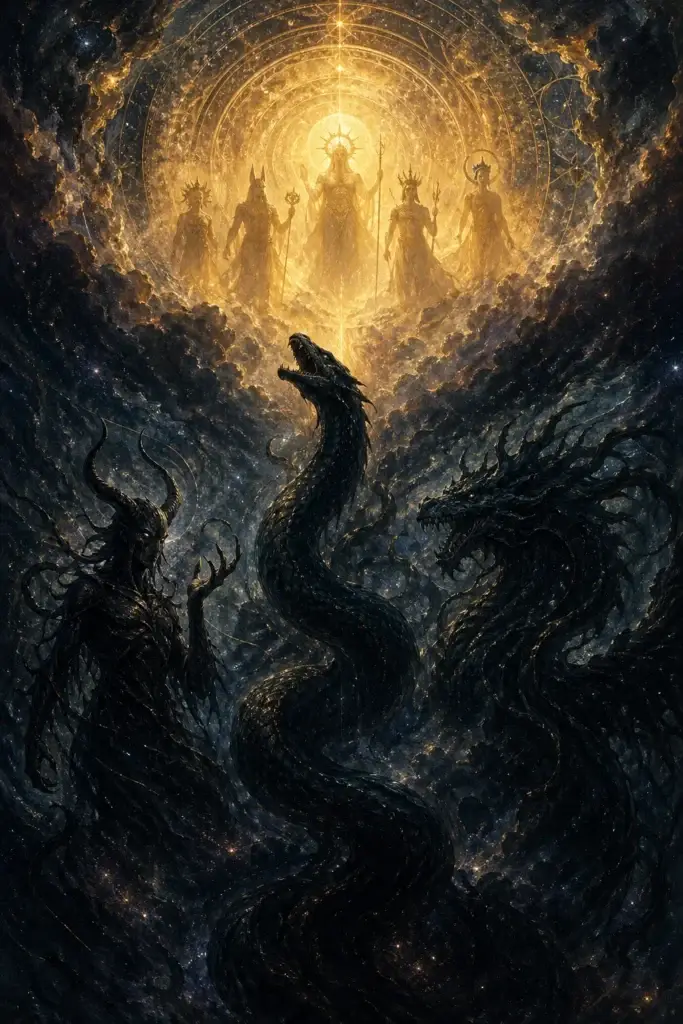
Anti-gods differ from mere demons in that they are cosmically equal or almost equal to established deities. A demon is subordinate, manipulable, ultimately weaker. An anti-god acts on its own authority and can shake the cosmic order.
In contrast to merely evil deities (which are still part of an established hierarchy), anti-gods embody fundamental opposition. They can be rationalized as necessary (dualism), or as ultimately surmountable (monotheistic framework).
Structural logic of the anti-gods
In the history of religion, the category of anti-gods is an analytical construction that makes visible structural parallels between beings of different pantheons that function in their respective tradition as cosmic opponents of positive gods.
In contrast to demons, anti-gods are typologically divine beings with their own pantheon status; in contrast to demons of harm or illness, they do not act selectively but on a cosmic scale.
The phenomenology of religion concerning anti-gods was described by Mircea Eliade in Die Religionen und das Heilige (1949) as a manifestation of the coincidentia oppositorum principle: in the developed religious pantheons, world-preserver and world-destroyer stand opposed as necessary poles.
Cultural-historical examples
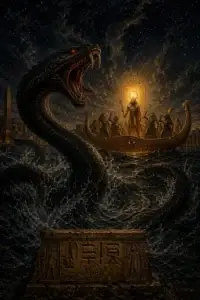
The Egyptian Apophis (also Apep) is the serpent of chaos that tries every day to devour the sun god Ra during his nightly journey through the underworld. Apophis is older than the established order, the primordial force of destruction.
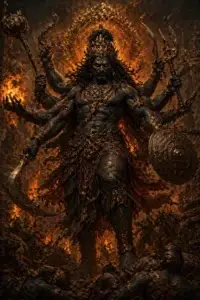
The Hindu Asura is an entire class of beings that enter into the dualism of Hindu cosmology: they fight against the Devas (gods) for cosmic supremacy. Some Asuras are intelligent, noble, even sympathetic, not mere monsters.
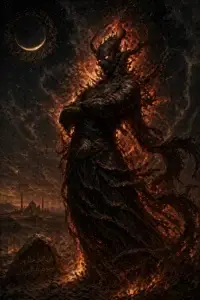
The Abrahamic Lucifer (Latin for “morning star”) was originally a high-ranking angel who rebelled, disobedience as a cosmic tragedy. The Islamic Iblis (Satan in Islam) is similar: a jinn or angel who refused God’s command, out of pride or fidelity to principle.
The Mesopotamian Tiamat (female goddess of chaos) was defeated by Marduk in order to create the cosmic order, her body forming earth and sky. The Scandinavian Loki is trickster and anti-god at once: intelligent, fascinating, ultimately destructive, but indispensable in the cosmic drama.
Comparative overview
The Egyptian tradition sets Apophis (Apep) against Ra: Apophis is the serpent of chaos that tries every night to devour the solar barque, and every night is driven back by Ra and his allies.
This cosmic battle repeats daily; it cannot be resolved by a final victory but persists as a cyclical drama. The Mesopotamian tradition knows Tiamat as the chaotic primeval waters that are defeated by Marduk in the act of creation and formed into the world (Enuma Elish, ca. 12th century BCE).
The Norse tradition knows the Jotnar (giants) as cosmic opponents of the Aesir gods, who finally confront one another in the battle of Ragnarok.
The Hindu tradition knows the Asuras as opponents of the Devas, with continuous conflicts in the Puranas. The Persian-Zoroastrian tradition knows Ahriman (Angra Mainyu) as the cosmic opponent of Ahura Mazda in an elaborate dualistic system.
Source situation
Anti-gods are documented in all ancient and religious sources. Egyptian literature describes the battles against Apophis in detail. Hindu mythology devotes entire epics to the Asura-Deva conflict (Mahabharata, Ramayana, Puranas). The Abrahamic religions have produced a vast body of theological literature on Satan/Lucifer/Iblis. The Scandinavian tradition describes Loki’s role in Ragnarok in detail.
Research position
Academic religious studies established the concept of the anti-god as an analytical category in the 20th century (Mircea Eliade, Georges Dumezil, Karl Kerenyi).
Research today recognizes three structural sub-types: first, the cosmic serpent tradition with Apophis, Tiamat, Vritra, Jormungandr and Leviathan as a connecting line; second, the divine brother rivalry with Set and Osiris, Loki and Baldr, Krishna and Kamsa; third, the dualistic world rivalry in Manichaeism, Zoroastrianism and in some Gnostic traditions.
These sub-types are not sharply separable, but they assist in the comparative religious analysis of individual anti-god figures.
Present-day significance / related beings
Concepts of anti-gods continue to shape Western dualistic philosophy to this day: the idea of good and evil as cosmic counterpoles. In modern horror and fantasy, anti-gods are central, dark lords, gods of chaos, cosmic threats.
Psychologically, anti-gods represent human ambivalence toward order: the necessity of structure and the longing to overcome it. In modern Satanism and Luciferianism, anti-gods are reclaimed as symbols of freedom and rebellion. Related beings are demons (subordinate opposition), high deities (counterpole), and deities of the dead (rulers of a special order).
In depth
Concept formation and distinction
The term anti-god is not an ancient category but a modern collective term for those mythological opponents who actively challenge the divine principle of order of a tradition. Anti-gods typically stand on the same level of power as the main gods of their pantheon, yet act in the opposite direction.
In the Mesopotamian tradition this is shown impressively in Tiamat and Apsu, the primeval pair against which Marduk takes the field in the Enuma Elish. In the Germanic north, the giants (Jotunn) take on this role, in Hinduism the Asuras against the Devas, in Zoroastrianism Angra Mainyu (Ahriman) against Ahura Mazda.
Function in mythological cosmology
Anti-gods fulfill a double function: they embody the threat to the cosmic order and only thereby make it possible for that order to appear as an achievement. Without Tiamat, no creation by Marduk; without Loki, no Ragnarok, which determines the pantheon in its finitude.
The narratives revolve around battles of creation and of the end, anti-gods mark the beginning and end of mythological time. In traditions understood cyclically they return regularly; in linear traditions they lead to the final battle.
Modern reception and misunderstandings
In popular perception, anti-gods are often conflated with the Christian concept of the devil. This misses their mythological meaning. Tiamat is not evil but chaotic primeval matter.
Loki is not satanic but liminal, he stands between the Aesir and the giants and eludes dual classification. The Asuras are not the opposite of the good but competitors of the Devas for power and worship.
Source situation and research
Further standard works in the literature index.
iWell Guard and protective traditions
The anti-gods compiled here and their traditions of defense are described within religious studies.
iWell Guard ties into the millennia-old line of wearable protective objects, from Pazuzu pendants in Mesopotamia through Hamsa and evil-eye amulets in the Mediterranean region to the Mezuzah on Jewish doorposts and to Christian protective medallions.
A contemporary form of this, made in Germany, with a clearly documented material architecture (41 layers, solid gold, platinum, silver). 30-day right of return.
Not a medical device. No promise of healing. Personal perceptions may vary.