iWell Guard

Mesoamerica, the mythology of the Olmecs, Maya and Aztecs

The Mesoamerican high cultures, the Olmecs (about 1500 to 400 BCE), the Maya (classic phase 250 to 900 CE), the Toltecs and the Aztecs (14th to 16th century), developed religious systems of extraordinary complexity.

Despite the continental separation from Eurasia, they share structural features with other high religions: a multilayered pantheon, creation myths, calendrical rituals, sacrificial practice and portable protective objects.

The mythology of Mesoamerica and its protective practice are presented here in overview.

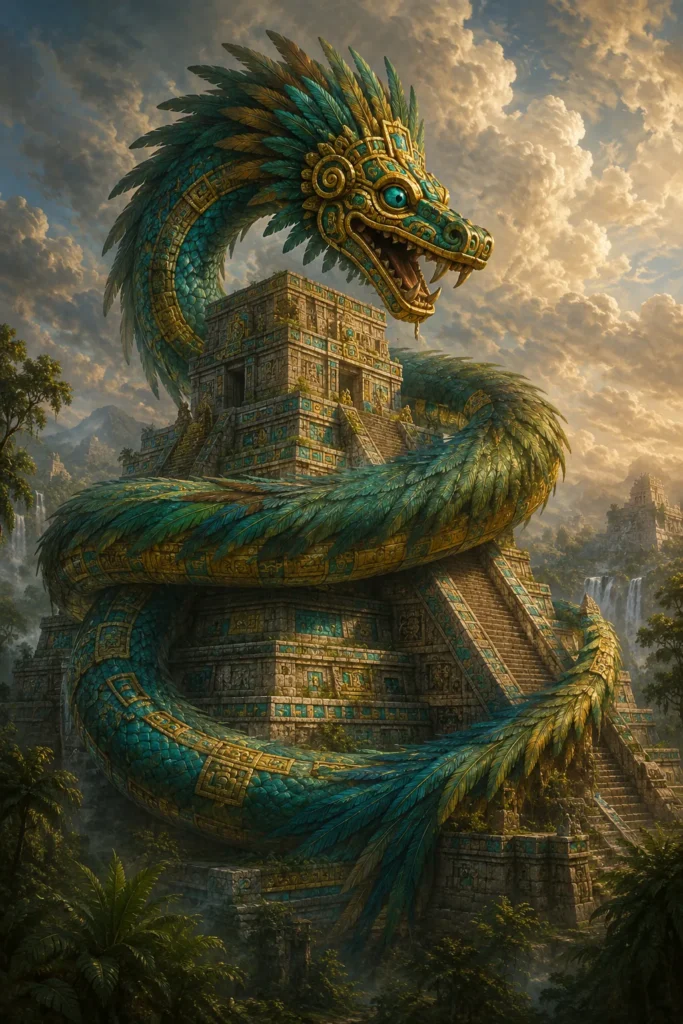
Quetzalcoatl - Gods from the Mesoamerican mythology tradition, historical and illustrative

The Olmecs, the mother culture

The Olmecs in southern Veracruz and Tabasco (about 1500 to 400 BCE) are regarded as the „mother culture“ of Mesoamerica. Their colossal basalt heads, the jaguar-shaman iconography and the first beginnings of a calendrical and writing notation shaped all subsequent cultures.

From the perspective of religious studies, Olmec religion is accessible only iconographically; the central divine figures, the were-jaguar, the feathered serpent as an early forerunner of Quetzalcoatl, and a rain figure, recur structurally later on.

The Maya, pantheon and creation

The Maya have a multilayered pantheon: Itzamna as the old creator god and writer, Kukulkan (feathered serpent, parallel to Quetzalcoatl) as a cosmic mediator, Chac as rain god in four manifestations of the cardinal directions, Ah Puch as god of the underworld, and Ix Chel as moon and healing goddess.

The Popol Vuh, the sacred book of the Quiché Maya (16th century, but building on older traditions), transmits a fourfold creation and the hero myth of the twins Hunahpu and Xbalanque, who descend into the underworld Xibalba and triumph, a cosmological parable about the victory of light.

The Aztecs, Mexica religion and sacrificial practice

The Aztecs (Mexica) understood their religion as participation in the cosmic drama of preservation: in order for the sun to rise, the sun god Huitzilopochtli needed blood and hearts.

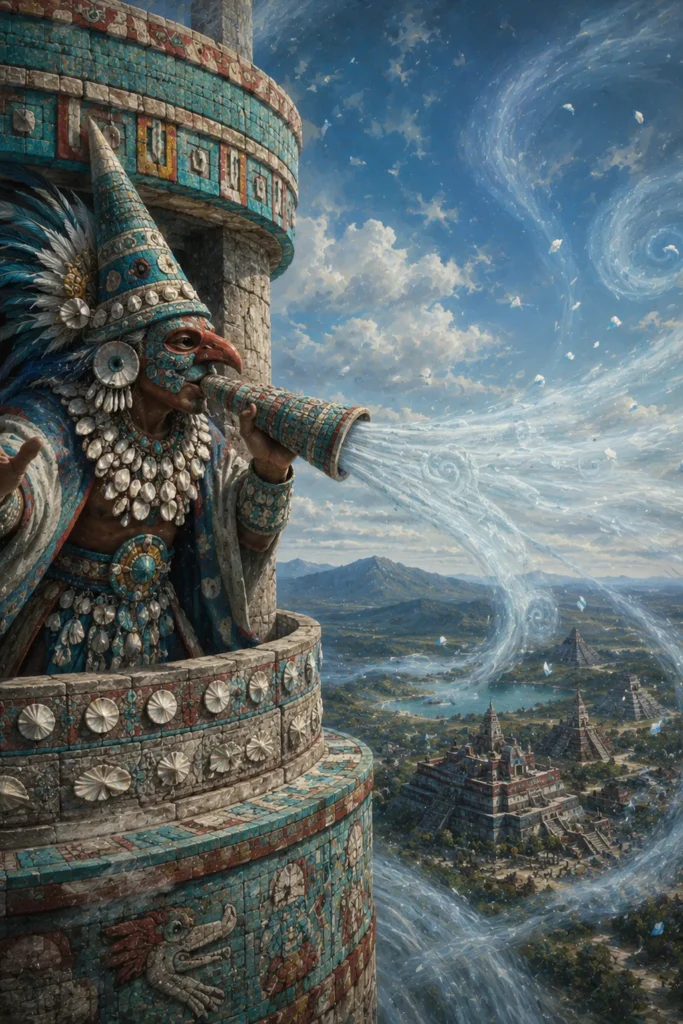
Quetzalcoatl appears alongside as culture hero and creator, Tezcatlipoca (smoking mirror) as antagonist and god of fate, Tlaloc as god of rain and mountains, and Mictlantecuhtli as ruler of the underworld.

Coatlicue is the earth mother, Tonatiuh the personified sun. The tonalpohualli (260-day ritual calendar) and the xiuhpohualli (365-day solar calendar) structured the course of the year; their combination produced the 52-year cycle.

Cosmology and world ages

Aztec cosmology knows five world ages (suns): four past suns that ended through water, fire, wind or jaguars, and the fifth sun, our present, which will end through earthquakes.

The vertical layering of the world comprises thirteen heavens and nine underworlds. Among the Maya, similar structures are found: thirteen heavens, nine underworlds, and a world ceiba at the centre. These concepts shape the placement of gods and protective beings.

Protective objects and material culture

Portable protective objects of the region were worked from jade, obsidian, turquoise, rock crystal, feathers and ceramics. Jade was regarded, in analogy to the Chinese tradition, as the most precious material, with an otherworldly, cosmological function.

Jade pendants in the form of divine faces were given to the deceased. Feather crowns (penacho), jewellery with turquoise mosaic and the painting of ceremonial wearers marked status and a claim to protection. Pulque cups and incense burners (copal) were portable ritual objects.

Calendar, codices and writing

The Maya developed a logographic writing system with over 800 glyphs, which was largely deciphered only in the 20th century (Tatiana Proskouriakoff, Yuri Knorozov, David Stuart). Surviving codices: the Dresden, Madrid, Paris and Grolier codices.

Among the Aztecs, the Boturini Codex, the Mendoza Codex and the Borgia group are important sources, supplemented by Spanish chronicles (Sahagún, Durán, Motolinía). The Calendar Round dates allow precise historical dating.

Present-day significance and research

Maya languages are still spoken today by millions of people in Mexico (Yucatán, Chiapas), Guatemala and Belize. Aztec descendants (Nahua) live in central Mexico. Research in religious studies: David Carrasco, Karl Taube, Susan Gillespie, Michael Coe, Mary Miller. Current indigenist movements are revitalising parts of the pre-colonial traditions.

The cultures of Mesoamerica in overview

Mesoamerica designates a cultural area that roughly comprises central and southern Mexico as well as parts of Guatemala, Belize, Honduras and El Salvador.

Over several millennia, various cultures developed there that exchanged religious ideas, calendar systems and visual languages without ever being politically united. To speak in general terms of the Mesoamerican religion obscures considerable regional and temporal differences.

Regarded as early and formative are the Olmecs on the Gulf coast, whose visual motifs found wide distribution from about the second millennium before our era.

In the following centuries the lowland cultures of the Maya arose, along with the highland metropolis of Teotihuacan, the Zapotecs in Oaxaca and the culture of Monte Albán. Later came the Toltecs and finally, in the late phase before the Spanish conquest, the Mexica, who in the older literature are mostly called Aztecs.

These cultures shared basic features such as a double calendar system, stepped pyramids, ball-court complexes and the idea of recurring world ages.

At the same time, they had their own languages, their own divine hierarchies and their own emphases. The Maya, for instance, developed a fully formed script, whereas for Aztec Mexico mainly pictorial manuscripts have been transmitted.

Research mostly distinguishes a preclassic, a classic and a postclassic period. The decline of the classic Maya cities around the 9th century was, however, not the end of Maya culture.

Maya communities exist to this day. Related topics are treated in the hubs Andes and Inca as well as in individual being pages of this cultural area.

Time, calendar and the world view

At the centre of the Mesoamerican religions stands a highly developed conception of time. Widespread was a ritual cycle of 260 days, called tzolkin among the Maya and tonalpohualli among the Mexica, which was combined with a solar year of 365 days.

Both cycles meshed together and returned to the same position only after 52 years. The end of such a 52-year bundle was regarded as a critical moment, which among the Mexica was managed in the New Fire ritual.

The Maya additionally developed the so-called Long Count, with which they could continuously indicate days since a mythical starting date. This made it possible to date historical events and mythical primordial occurrences precisely. This computational art shows how closely calendar, mathematics, astronomy and religion were connected.

Time was conceived not as a uniform flow but as a sequence of world ages, each ending through a catastrophe. The Aztec myth of the five suns tells of several earlier worlds that were destroyed by water, wind, fire or beasts of prey. The present world is accordingly unstable and dependent on ritual support.

Space was structured just as much as time. Widespread was the conception of a world with four cardinal directions and a centre, each associated with its own colours, trees and divine bearers.

Above the earth lay several heavenly levels, below it the stages of an underworld, called Xibalba among the Maya, which is described in detail in the creation text Popol Vuh. This vertical and horizontal order gave the cosmos its form.

Writing, pictorial manuscripts and transmission

The transmission of Mesoamerican religion rests on very different sources. The Maya possessed a script of logograms and syllabic signs, which was recorded on stone monuments, ceramics and in folding books.

Of these books, the book burnings of the colonial period allowed only a few to survive, among them the Dresden, Madrid and Paris Maya codices, which contain above all astronomical and ritual content.

The decipherment of the Maya script was a long process. A breakthrough came in the 1950s through the Russian scholar Yuri Knorozov, who recognised the syllabic character of the script, against the resistance of the leading Mayanists of his time.

Later work, for instance by Tatiana Proskouriakoff on the historical reading of the inscriptions, made it clear that the texts report real history of rulers, not only myth and calendar.

For central Mexico, by contrast, hardly any pre-Spanish books are preserved. Transmitted are above all pictorial manuscripts, which arose partly still in pre-Spanish, partly in early colonial times, such as the Codex Borgia or the Codex Borbonicus. They work with standardised pictorial signs that a trained viewer could read.

A source genre of its own are the colonial-period accounts. The Franciscan Bernardino de Sahagún compiled in the 16th century, together with indigenous collaborators, the extensive Codex Florentinus in Nahuatl and Spanish.

Such works are irreplaceable, but must be read critically, because they arose out of missionary interest and order the material through a Spanish lens. Research therefore combines archaeology, pictorial sources, deciphered inscriptions and colonial texts, and remains aware of the gaps.

Indigenous present and the afterlife of the tradition

The Spanish conquest ended the great pre-Spanish states, but not the indigenous societies of Mesoamerica. To this day, millions of people speak Maya languages, Nahuatl, Zapotec, Mixtec and other indigenous languages. Their religious practice is mostly a combination of Catholic forms and older conceptions, which turns out very differently depending on the region.

In many Maya communities of Guatemala and the Mexican highlands of Chiapas there exist offices and brotherhoods that organise saints’ feasts, field rituals and life-cycle rites.

Specialists, often referred to as daykeepers, continue the 260-day calendar and use it for divination and healing. Such traditions are no museum memory, but part of a living, changing everyday life.

Since the late 20th century there have also been movements of cultural reappropriation. Maya organisations in Guatemala, after the end of the civil war there, pursue language cultivation, calendar research and the care of sacred sites.

In Mexico, indigenous activists connect with conflicts over land, autonomy and recognition. These movements are charged both politically and religiously.

At the same time, the pre-Spanish heritage is claimed by actors who do not themselves come from indigenous communities, for instance in national myth, tourism and the esoteric scene.

The media stir around the supposed end of the Maya calendar in 2012 showed how strongly modern projections can shape the image. Religious studies therefore distinguishes carefully between the historical traditions, today’s indigenous practice and its appropriation by outsiders, without confusing one level with another.

Related key terms: Quetzalcoatl Tezcatlipoca Huitzilopochtli Tlaloc Itzamna Kukulkan Olmec Tikal Tenochtitlan Popol Vuh Codex tonalpohualli.

Protective objects in this cultural tradition

Mesoamerican cultures, the Olmecs, Maya and Aztecs, used jade pendants, feather-crown insignia and divine figurines of stone, turquoise and obsidian as everyday protective objects.

iWell Guard takes its place in this cultural-historical line of portable protective objects, in a contemporary material architecture, manufactured in Germany. 41 layers, solid gold, platinum, silver. 30-day right of return.

Personal experiences may vary. Not a medical device. No promise of healing.