


Goetia, the 72 Demons of Solomon
The Goetia is the most important collection of ritual-magical conjuration instructions in the early modern European tradition of magic. This overview presents the manuscript history of the Lemegeton, the structure of the work, the hierarchy of the 72 spirits, and the most important editions since Weyer and Mathers.
Table of Contents
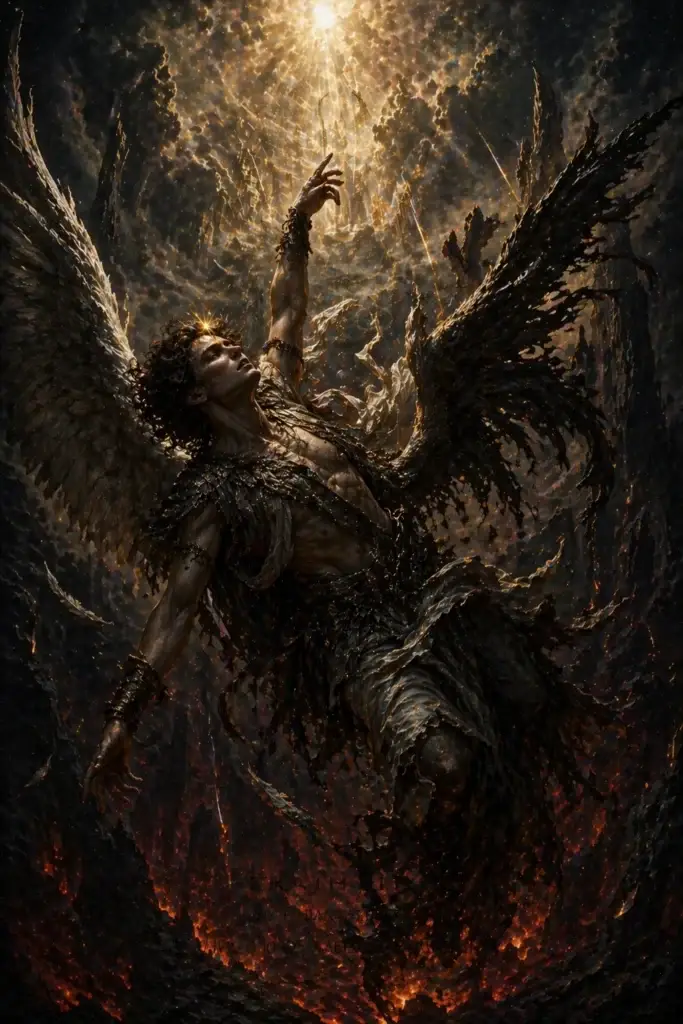
Goetia
Goetia (from Gr. goeteia, sorcery) is part of medieval high magic and describes the invocation of 72 demons from the Lemegeton (Key of Solomon). The tradition combines Jewish demonology with early modern Hermeticism.
At iWell Guard, we treat the Goetia on the one hand as a phenomenon in the history of religion with a dense corpus of sources and a long reception history, and on the other hand as a methodological reference point for the later ritual-magical tradition of Europe.
The individual demons of the Goetia have their own entries in our lexicon with hierarchy, the Lemegeton (Lesser Key of Solomon) is a compilation work from the 17th century comprising five parts: Goetia, Theurgia-Goetia, Ars Paulina, Ars Almadel, and Ars Notoria.
The Goetia is the first and most widely received part. The other parts deal with angelic and mediating beings, with temporal constellations of the heavenly bodies, and with mnemonic practices; they are equally significant in the history of religion, but less present in practice-oriented reception.
The standard English edition from the early 20th century (Mathers, Crowley) effectively separated the Goetia from the other parts, a separation that has been reversed in scholarly editing since Joseph Peterson’s work (Weiser 2001).
The term goeteia itself carries a value judgment. In late antique philosophical literature, for example in Iamblichus‘s De mysteriis, it is used as a delimiting counter-concept to theurgia, which is regarded as the legitimate, god-near form of magical action.
Goetia here denotes the lower form of magic that works with impure spirits, in contrast to the pure ascent practice of theurgy.
This ancient distinction was adopted by the Lemegeton itself: the second part is called, not by chance, Theurgia-Goetia and deals with a middle class of spirits that are partly friendly, partly hostile in disposition. The Goetia in the narrower sense works exclusively with the 72 listed demons from the first part.
Anyone approaching the Goetia in practice should keep the historical layering in view: behind the 72 demon names stand biblical, Jewish-apocryphal, Mesopotamian, Hellenistic, and medieval Arabic predecessor figures.
Bael, Asmoday, Astaroth, and Belial are not an invention of the 17th century; they carry sediments of meaning from two millennia of religious history. This depth is the reason why the Goetia remains, to this day, more than a list of conjuration instructions.
Context and Background
Lemegeton (Key of Solomon), 72 demons, sigils, ritual magic, Eliphas Levi reception.
Practical significance today
The Goetia is today a living magical system that continues to be used by individual practitioners, ritual-magical orders, and the broader chaos magic scene. It is at the same time an object of research in religious studies and in early modern magic research.
Anyone seeking a Goetia example will find detailed individual treatments in the entries on the single demons among the 72, with hierarchical position, sigil, area of competence, and religious-historical prehistory.
Caution with the source editions
The English Mathers edition of 1904 is the most widely used standard edition; however, it contains methodological flaws: Mathers edited the text according to his own conception and supplemented it with Crowley’s “Preliminary Invocation.” Anyone wishing to work with the original Lemegeton should additionally consult the critical editions of more recent scholarship (Joseph Peterson, “The Lesser Key of Solomon,” Weiser 2001) and take into account the manuscript predecessors of the printed text.
A complete philological edition has not yet appeared; this research gap is one of the known unfinished projects of early modern magic research.
Cross-connections to other grimoires
The Goetia is not the only grimoire of the early modern tradition. Related works include the Sworn Book of Honorius, the Heptameron of Pseudo-Petrus de Abano, and the Grimorium Verum; from the 18th century comes the Grand Grimoire.
Anyone wishing to situate the Goetia within the tradition should know the cross-connections to these other texts: they use partly the same demon lists, partly different ones; the sigil traditions vary as much as the invocation formulas.
The research of Owen Davies (especially “Grimoires,” Oxford 2009) gives a good overview of the genre as a whole.
Solomon as reference figure
The Solomon attribution of the Lemegeton is an established pseudepigraphic pattern. From the first century CE onward, the biblical king Solomon was regarded in Jewish, Christian, and later Islamic sources as a ruler of demons, equipped with a signet ring that gave him power over all spirits.
The oldest surviving texts of this tradition, the Greek Testamentum Salomonis from the 1st to 3rd centuries as well as the rabbinic and Islamic Solomon legends, form the narrative foundation on which medieval grimoire authors built their own conjuration collections and which they legitimized through attribution to Solomon.
The 17th-century Lemegeton manuscripts continue this tradition without carrying it on unbroken: they combine Solomonic material with contemporary Hermetic and Kabbalistic magic, with Pseudomonarchia lists from the 16th century, and with the individual compilation decisions of the respective scribes.
Tradition and Sources
The Goetia is a component of the Lemegeton (Lesser Key of Solomon), a compilation manuscript of early modern ritual magic. It lists 72 demons with names, sigil, rank, and specific effect. The oldest surviving manuscripts date from the 17th century; an older printed version, however, does not exist.
Manuscript history
Textual scholarship today knows several 17th-century Lemegeton manuscripts held in English and French libraries. Among the key witnesses are Sloane MS 2731 and Sloane MS 3825 in the British Library, Harley MS 6483, Wellcome MS 2842, as well as the Lansdowne MS 1202 preserved in Paris.
These manuscripts vary considerably in order, sigil form, and linguistic version.
In 2001, Joseph Peterson presented the first synoptic comparison of the most important witnesses in his critical edition The Lesser Key of Solomon (Weiser); Stephen Skinner and David Rankine have further broken down the manuscript transmission with the source series Sourceworks of Ceremonial Magic.
Pseudomonarchia Daemonum
In its oldest surviving form, the list of 72 spirits goes back to the Pseudomonarchia Daemonum, an appendix to Johann Weyer’s main work De praestigiis daemonum (1577). Weyer (Latinized Wierus) was a Dutch-German physician and demonologist who presumably took the list of spirits from an older, now lost manuscript.
Reginald Scot translated the Pseudomonarchia into English in his Discoverie of Witchcraft (1584), thereby making it accessible to the English-speaking world. The 17th-century Lemegeton adopted the list, supplemented it with sigils, and filled it up to 72 with additional spirits. Weyer’s list originally comprised 69 spirits.
Editorial history
The most frequently cited edition today is The Goetia: The Lesser Key of Solomon the King, published in 1904 by Aleister Crowley on the basis of an English translation prepared by Samuel Liddell MacGregor Mathers.
Mathers was a co-founder of the Hermetic Order of the Golden Dawn and worked primarily with Sloane MS 2731. The Crowley-Mathers edition contains editorial interventions and a Preliminary Invocation added by Crowley from the Greek Magical Papyri, which does not occur in the original manuscript.
Anyone working with the original Lemegeton should therefore consult the Peterson edition or the Skinner-Rankine series, since the Crowley-Mathers version contains readings that are more attributable to the 19th and 20th centuries than to the 17th century.
Structure
The Lemegeton is a compilation of five books, each containing its own magical system. They were brought together into a unit in the 17th century, but in their substance they are independent texts with differing prehistories.
The five books of the Lemegeton
The first part, the Goetia (also Ars Goetia), deals with the conjuration of the 72 demons. The second part, Theurgia-Goetia, describes 31 spirits of the cardinal directions that are partly good, partly evil in disposition and are distributed across the hours of day and night.
The third part, Ars Paulina, is an angelic magic according to planetary and hourly correspondences and invokes a vision of the Apostle Paul.
The fourth part, Ars Almadel, describes the invocation of 20 spirits at a waxen tablet (Almadel) in four quarters of the heavens.
The fifth part, Ars Notoria, is the oldest layer of the collection; in its oldest witnesses it goes back to the 13th century and describes a mnemonic and prayer practice for attaining encyclopedic learning.
Hierarchy of the 72 spirits
The 72 demons of the Goetia are divided into fixed ranks modeled on the courtly order of early modern Europe. Nine spirits bear the rank of king, among them Bael in first place, Paimon, Beleth, Purson, Asmoday, Vine, Balam, Zagan, and Belial.
The largest group is formed by the dukes with more than twenty representatives, joined by princes, counts, marquises, presidents, and a single knight (Furcas, the fifty-first spirit).
The rank designations affect the ritual form: higher-ranking spirits demand more elaborate conjurations, shorter appearance times, and more respectful address; lower ranks are considered more accessible, but also more unreliable.
Functional domains and correspondences
In the Lemegeton text, each spirit is assigned a list of competences ranging from practical concerns such as finding treasure, learning languages, and healing, through prophetic information, to love and war purposes. In addition, the text assigns some spirits a number of legions of subordinate spirits, which further develops the hierarchical conception.
English editorial practice since Mathers has additionally introduced a correspondence to the 72 names of God (Kabbalah the 72-letter name of God, derived from Exodus 14:19, 21; basis of its own 72-angel hierarchy.”>Shemhamphorasch), a Kabbalistic assignment that was not contained in the original Lemegeton and was transmitted through Athanasius Kircher’s Oedipus Aegyptiacus (1652, 1654) as well as through Eliphas Levi and the Golden Dawn tradition.
This Shemhamphorasch-Goetia connection is, in the history of religion, a secondary synthesis, but it is established in modern practice.
Modern Reception
Eliphas Levi (19th c.) and Aleister Crowley (early 20th c.) popularized the Goetia in Western esotericism. Crowley’s edited edition of 1904 is today the standard reference. In chaos magic, the Goetia is frequently interpreted psychologically.
Historical deep layer
The Goetia did not arise out of nothing. It draws on Jewish Solomon apocrypha that circulated from the first century CE onward, such as the Testamentum Salomonis, a Greek text that presents Solomon as a ruler of demons and lists individual demons with their names, competences, and binding formulas.
In addition, Mesopotamian and Hellenistic magic traditions flow in: the Akkadian conjuration tablets (Maqlu, Surpu), the Greek Magical Papyri (Karl Preisendanz, Papyri Graecae Magicae), and the Arabic magic of the Middle Ages (in particular the Picatrix and the writings of pseudo-Apollonius) form the substrate from which the Lemegeton was compiled in the 16th and 17th centuries.
The sigils
In the Goetia text, each of the 72 demons is assigned a specific sigil, a graphic sign that in ritual-magical practice serves as the address symbol of the respective being.
The sigil tradition reaches back into Jewish magic (comparable graphic signs are found in the Hekhalot texts and in early medieval Jewish magic); in the Goetia corpus they are systematically bound to the individual demons. The pact with demons, as a violation of the First Commandment, as a practice of turning away from God.
In the Jewish-rabbinic context, the invocation of demons was likewise problematic, though in Kabbalah it was in part treated more differentiatedly.
At iWell Guard, we report on the Goetia as a phenomenon in the history of religion, without recommending or evaluating it. The ethical question of whether a modern practitioner should apply the Goetia lies outside our field of activity; it demands an engagement with one’s own religious, ethical, and psychological premises, which we cannot take over.
Related entries
A topically related comparison can be found in the entries on individual demons listed in the Goetia, Asmodeus, Bael, Paimon, Belial. The methodological classification within Western esotericism can be found in Chaos Magic and in the bibliography under Literature.
Anyone wishing to place the Goetia in the broader religious-historical context will find the Solomonic-apocryphal prehistory in the entry on the Jewish tradition.
iWell Guard and Traditions of Protection
Across all documented cultures, protective objects can be traced that people wore on the body, from Pazuzu amulets in Mesopotamia, through the Hamsa in the Mediterranean region, to the Mezuzah on Jewish doorposts and to Christian protective medals. iWell Guard takes up this tradition in contemporary material architecture, manufactured in Germany, 41 layers, solid gold, platinum, silver. 30-day right of return.
Personal experiences may vary. Not a medical device. No promise of healing.


