Astral beings, subtle entities and light bodies
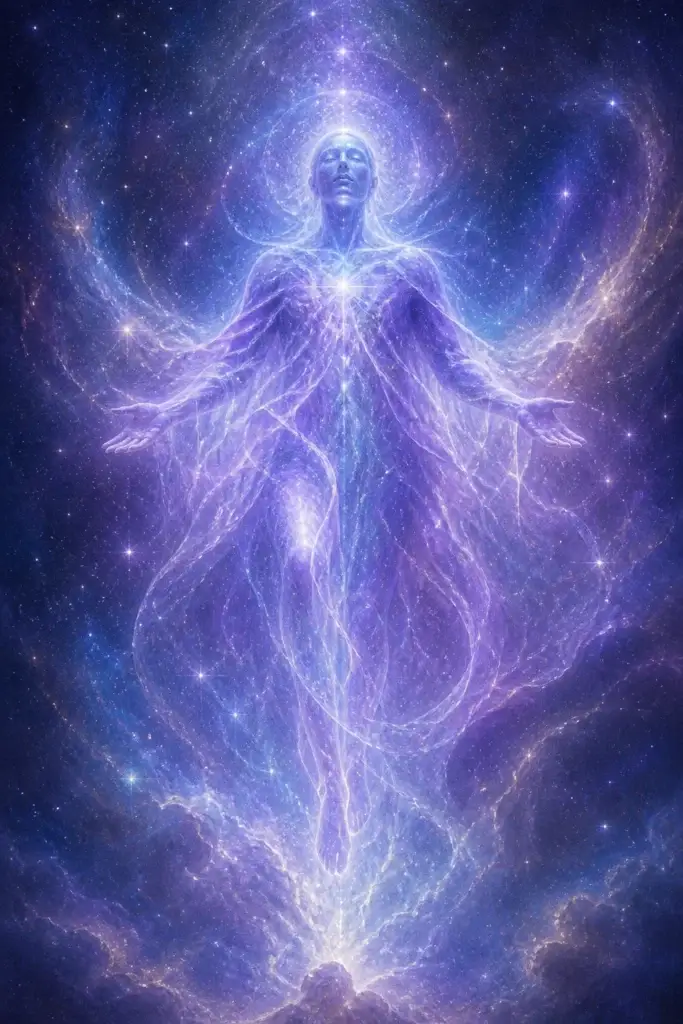
Astral beings is the collective term for subtle entities and light bodies, which in the theosophical and anthroposophical tradition are located between the gross material world and the divine origin.
Astral beings are supernatural beings beyond the material world that, in the esoteric tradition, inhabit subtle spheres.
Astral beings are entities that metaphysical worldviews locate on the astral plane or in intermediate realms: autonomous forms of consciousness between the material and spiritual spheres, with an independent capacity to act.
Conceptually they are rooted in the theosophical, anthroposophical and spiritualist systems of the 19th and 20th centuries, as well as in older shamanic notions of spirit doubles.
Their ontology is empirically contested, but it is documented and systematised consistently within the history of religion. This conceptualisation arose in parallel within the theosophical and esoteric movements of the late 19th century.
Table of contents
Concept and distinction
Astral beings are subtle entities within systems that assume a multi-layered cosmology. They differ from ghosts in that ghosts are typically deceased humans, whereas astral beings are native existences of the subtle planes.
Distinction from light beings: light beings are often a subcategory, emphasising the luminous or spiritually progressive nature. Astral beings is the broader and more neutral term.
Distinction from demons: demons are often conceptualised as dangerous or of low frequency. In theosophical systems, astral beings are often understood as progressive or helpful.
One important point: astral beings are not physically verifiable, they are metaphysical postulates. Their “reality” is cosmological, not empirical.
Astral beings are a central motif of modern esotericism.
Cultural and historical examples
Theosophy (Helena Blavatsky, 19th century): Blavatsky set out a hierarchy of subtle planes, the astral plane, mental planes and causal planes (in Sanskrit terms: kama-loka, rupa-loka, etc.). Astral beings are the inhabitants of these planes: devas, followers, deceased masters. They are real but invisible, consciousness without a physical body.
Anthroposophy (Rudolf Steiner, 20th century): Steiner modified and criticised Blavatsky, but developed a similar system of hierarchies. His angelology is explicit: archangels, archangeloi and exousiai are cosmic intelligences that govern or guide.
Theosophical astral travel: Theosophy taught that the human astral body can leave the physical one (astral projection), an ability that can be developed through training. The astral plane is therefore something to be experienced, not merely conceptual.
Western occultism traditions: the Golden Dawn, the Hermetic Order and related schools anchored astral beings in their teaching; the sephiroth of the Kabbalah have astral correspondences and protective beings.
Hindu devas: Indian traditions have long had a system of subtle divinities; devas are divine beings of non-physical spheres. This is older than Theosophy, but Theosophy linked it with Western occultism.
Modern spiritual movements: New Age, modern shamanism and channeling movements operate with an understanding of astral beings. “Spirit guides”, “ascended masters” and “light beings” are modern astral beings.
The theosophical astral plane: Leadbeater and the subtle worlds
The modern conception of astral beings stems primarily from the Theosophical Society (founded in 1875 by Helena Petrovna Blavatsky). Charles Webster Leadbeater, a leading theosophist, described in works such as The Inner Life (1917) an invisible astral plane, a subtle reality parallel to the physical one.
This plane is populated by human astral shells (unconscious projections of those who are asleep), the deceased and non-human entities.
Leadbeater’s descriptions, precisely mapped with hierarchies, colours and functions, still shape the Western conception of the astral plane today.
He stresses that only trained faculties of consciousness can perceive these beings, and warns of dangers (parasitic lower beings). This theosophical cosmology is not biblical, but syncretistic, assembled from Indian Tantrism, Buddhist cosmologies and Western occultism.
Sources
Theosophical: Blavatsky (The Secret Doctrine, Isis Unveiled), Annie Besant, Charles Leadbeater (The Astral Plane). Anthroposophical: Rudolf Steiner (collected works, especially on hierarchies and angels). Occultism: Golden Dawn teachings, Hermetic texts. Hindu: Upanishads, Vedanta philosophy, Tantra texts. Modern: New Age literature, channeling texts, modern spirituality authors.
New Age channeling and extraterrestrial narratives: the Pleiades and reptilians
With the hippie movement of the 1960s, the teaching of the astral plane underwent a renaissance. New Age mediums began to channel, that is, to receive messages from otherworldly beings.
One prominent narrative strand concerns the Pleiades, a star system 400 light-years away: channelers such as Barbara Marciniak (Bringers of the Dawn, 1992) claim to receive messages from Pleiadian beings that function as advanced guides.
In parallel, the reptilian theory arose (popularised by David Icke from the 1990s), according to which a reptilian race rules the Earth.
These narratives are not scientific, but they are culturally powerful: they allow alternative explanations for asymmetries of power and position channelers as speakers of truth. These discourses on astral beings show that modern Western religiosity has integrated the extraterrestrial.
Present-day significance / related beings
Astral beings remain central to modern New Age thought, spiritualism and occult circles. They offer a cosmology in which consciousness and magical influence are possible on several planes.
Psychologically, astral beings can be understood as archetypes or projections of the subconscious, without requiring the metaphysical interpretation. In cultures with a long subtle cosmology (Hinduism, Taoism), concepts akin to astral beings remain philosophically alive.
Related practices: light beings (higher-ranking), angelology (where a separate page exists), meditation on the subtle planes, astral projection.
Contact experiences and UFO religiosity
In popular culture, astral beings merge with UFO discourses. People who believe they have had extraterrestrial contact experiences (abductions, communication, physical encounters) often interpret these as astral-plane phenomena, because the boundary between the physical and the subtle is porous in astral thinking.
UFO religions such as the Raelian Movement (founded in 1974) or earlier flying-saucer cults use an astral-being cosmology to understand extraterrestrials as redeemer-like beings.
Psychologically, astral-being experiences can be interpreted as unconscious projections (psychologists speak of hypnagogic hallucinations and sleep-paralysis dreams); culturally speaking, astral beings are a symptom of the modern Western consciousness that seeks contact with the other.
Beings in this category