Archangel Michael, being of light
By Ralf Ittermann · last reviewed on
Leader of the heavenly hosts in the Jewish, Christian and Islamic tradition. Patron saint, dragon-slayer, companion of the dying.
This page situates Archangel Michael as a being of light concept.
Profile: Michael
Michael: the most important aspects at a glance. The following fields summarise origin, function, appearance, veneration, symbols and parallels.
Michael appears in the Book of Daniel as the prince of angels who stands up for the people of Israel, in the Epistle of Jude as a combatant against the devil, and in the Book of Revelation as the leader of the heavenly hosts in the battle against the dragon. The Book of Enoch also names him; in Islam he is called Mikail.
Michael is regarded as a protector against everything that contradicts the divine order and as an active defender of humanity. In Christian popular piety he accompanies souls into the afterlife and weighs them. In iWell Guard his blue flame serves to seal weak points in the protective field.
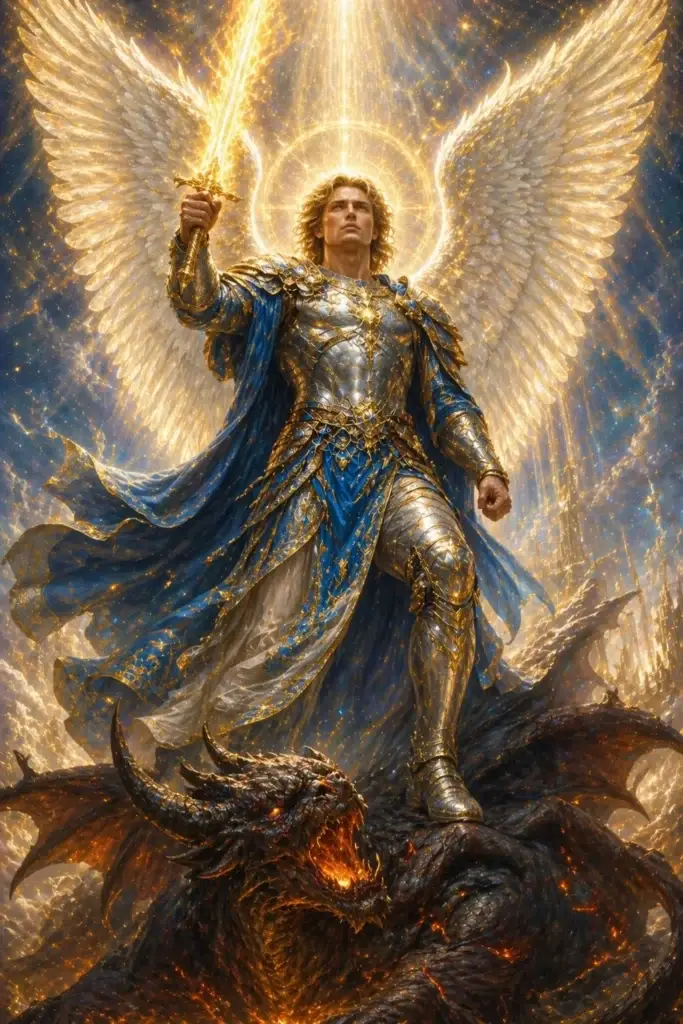
Christian art shows Michael as a dragon slayer in armour with a lance or sword above a subdued dragon, and as a weigher of souls with a pair of scales. Byzantine images show him as a dignitary, Western ones increasingly as a knight. Esoterically he appears as a blue being of light with a flaming sword.
The feast of the archangel on 29 September goes back to the dedication of a basilica on the Via Salaria in Rome in the 5th century. Important sanctuaries are Monte Gargano in Apulia, Mont-Saint-Michel in Normandy and Chonai in Asia Minor. Many churches of St Michael stand on hilltops.
His symbols include the blue flame, the flaming sword, the breastplate, wings of victory and the scales of the weigher of souls. His colour is sapphire blue, sometimes interwoven with white. Occasionally he carries a shield bearing the name of God.
Related warriors and dragon slayers are Horus, Apollo in his fight with Python, Mithra in the bull-slaying, Thor against the Midgard Serpent, Indra, Saint George and Mars. Scholarship traces the dragon fight back to the ancient Near Eastern myth of Marduk against Tiamat and Baal against Yam.
Quick overview: Archangel Michael
Type: Archangel, commander of the host, sword-bearer Tradition: Judaism (Talmud, Kabbalah), Christianity (New Testament, angelology), Islam (Quran) Function: Protection, warding off the negative, enforcement of divine justice Main attributes/symbols: Blue flame, flaming sword, armor, wings of victory Distribution: Worldwide in religious and esoteric traditions, patron saint of many countries
Classification
Tradition
Archangel Michael appears in Daniel 10 and 12 of the Old Testament as an intercessor for the people of Israel. In the Book of Enoch he is named as one of the four foremost archangels. Christianity venerated him as the leader against Satan (Revelation 12:7-9).
In the Kabbalah, Michael is one of the archangels of the Sephirah Chokmah (wisdom) or Gevurah (strength), depending on the system. The Islamic tradition knows him as Mikail, protector and bringer of salvation.
Western angelology integrated Michael as the protector against the negative and against evil powers, as the embodiment of the divine will toward order.
Sources
Biblical texts are the oldest sources (the Old Testament books of Daniel, the Enochic apocrypha, the New Testament). Talmudic and kabbalistic writings deepen his role (Zohar, Sefer Hekhalot, Merkavah mysticism).
Christian churches dedicated numerous sanctuaries to Michael (Mont-Saint-Michel, churches of St. Michael all across Europe). Modern esoteric literature, Theosophy and New Spirituality movements have secularized and psychologized the veneration of Michael, yet consistently emphasize his protective function and power.
Biblical and apocryphal sources
Archangel Michael is, alongside Gabriel, the only angelic figure named by his own name in the Hebrew Tanakh. He appears in the Book of Daniel in three places (Daniel 10:13, 21 and 12:1) as one of the chief princes who stands by the people of Israel against the Persian and Greek angel-princes.
In the intertestamental apocryphal literature (1 Enoch, the Testaments of the Twelve Patriarchs, 2 Enoch) Michael is developed into the leader of the four or seven archangels.
In the New Testament he appears in Jude 9 as the contender against Satan over the body of Moses, and in Revelation 12:7 as the leader of the heavenly hosts in the battle with the dragon, the central iconographic layer of the later tradition.
Liturgical and iconographic tradition
The Michaelmas feast on 29 September goes back to the consecration of a basilica dedicated to him on the Via Salaria in Rome in the 5th century, and has since been a fixed part of the calendar of saints in the Catholic, Orthodox and, in part, Anglican Church.
The high medieval sanctuary on Mont-Saint-Michel in Normandy and the southern Italian grotto of St. Michael on Monte Sant’Angelo in Apulia are the oldest western places of pilgrimage; along the line between Skellig Michael in Ireland, Mont-Saint-Michel, the Sacra di San Michele in Piedmont and Monte Sant’Angelo as far as Mount Carmel and Stella Maris, the sanctuaries of Michael form a well-known ley line of European Marian and angel pilgrimage.
Appearance and symbols
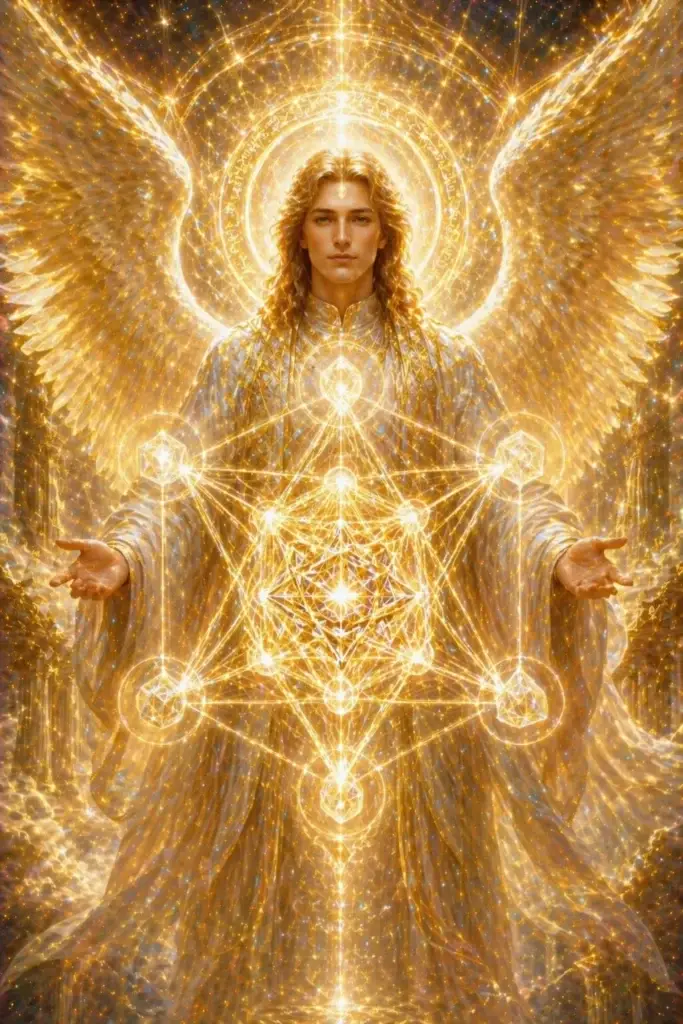
Michael is consistently depicted as a strong, androgynous being of light in armor or in flowing robes of light-substance. His color is electric blue or deep sapphire blue, sometimes interwoven with white.
He carries a flaming sword or sword of light, sometimes together with a shield bearing the name of God (YHWH or modern sigils).
Wings of light-energy sprout from his shoulders. He is sometimes depicted standing with one foot on Satan or a demonic being, the subjection of evil to the cosmic order. Energetically, Michael is experienced as an intense, penetrating blue flame that purifies and makes transparent.
Function and meaning
Michael is the protector against all that contradicts the divine order. He is not passive but actively defending: he fights battles in order to preserve humanity. In psychological readings he symbolizes willpower, courage and the ability to set boundaries.
He embodies the principle that negativity may and must not simply be accepted but actively transformed. His blue energy is used to identify and seal weak spots in the protective field. Michael shows that light is gentle, and at the same time strength and structure.
Comparative history of religion
Michael stands functionally within a broader line of combative protective angels and dragon-slayers. Structurally related are the Egyptian Horus with his lance, the Greek Apollo in his battle with Python, the Persian Mithra in the slaying of the bull, the Norse Thor tradition against the Midgard Serpent, and Indra in the Vedic tradition.
Research in the history of religion (Hans Schwarzenbach, Frederic Manns) reads the dragon-battle layer of the Michael tradition as an adoption from the ancient Near Eastern combat myth (Marduk against Tiamat, Baal against Yam), which migrated into Christian angelology by way of Jewish apocalypticism.
In the protective mantra, Michael is implicitly present in the iWell Guard tradition, because the cross of light and the archangelic tetractys structure the protective field; he is explicitly invoked in the classical banishing rituals of the Golden Dawn tradition as guardian of the southern cardinal direction.
Practice / invocation / meaning in the iWell Guard context
In iWell Guard, Michael is invoked as the active protector of the protective field. His blue flame is visualized in order to ward off negative influences, to clear psychic attachments and to strengthen the will. A common practice is the lighting of a blue candle and the mental invitation of Michael’s power.
His sword is understood as a tool for energetically removing “dirt.” Michael is the protector who says: “This far and no further.” His power is indispensable for iWell Guard as the active, defensive principle alongside the other beings of light, and as the mediation between heaven and the human will.
Invocation and protective practice
The Catholic tradition knows the Prayer to Saint Michael the Archangel, introduced in the 19th century by Leo XIII, as a prayer of protection against the wickedness and snares of the devil; from 1886 to 1965 it was a fixed part of the Leonine Prayers after every low Mass and has been permitted again since John Paul II. In the ritual-magical tradition, Michael is the archangel of the south and of the sphere Tiphereth (Sun) on the Tree of Life of the Kabbalah.
In the iWell Guard context he is one of the four archangels whose protective effect is activated indirectly in the mantra by way of the archangel-Gabriel clause (see function overview) and through the geometry of the cross of light.
Parallels
Michael in biblical and apocryphal tradition
Archangel Michael is named only in a few places in the Hebrew Bible, all in the Book of Daniel.
There he appears as the great angelic prince who stands up for the people of Israel, and as a heavenly contender in the eschatological confrontation. His name is a question in the form of a confession, Hebrew mi-ka-el, who is like God.
In the New Testament, Michael appears in two places. The Letter of Jude mentions a dispute of Michael with the devil over the body of Moses, which draws on an apocryphal Moses tradition.
The Revelation of John describes in its twelfth chapter the battle of Michael and his angels against the dragon, who is defeated and cast out of heaven. This scene became decisive for the Christian conception of Michael as the vanquisher of Satan.
The figure of Michael was richly elaborated in the apocryphal and pseudepigraphal literature of ancient Judaism, for instance in the Ethiopian Book of Enoch, where Michael belongs to the four or seven highest archangels.
Research has shown that the conception of named archangels with clearly delimited functions developed only in the post-exilic period, possibly under the influence of Persian angel conceptions. In this development, Michael is from the outset the leading figure, the heavenly patron of the people of God.
The cult of Michael: sanctuaries from Chonai to Monte Gargano
The cult of Archangel Michael spread rapidly from late antiquity onward and was closely bound to particular sanctuaries, frequently to caves and mountain peaks. An early center lay in Chonai in Asia Minor, the ancient Colossae, where an apparition of Michael at a spring was venerated.
In the West, Monte Gargano in Apulia became the most important sanctuary of Michael. A legend from the 5th or 6th century reports apparitions of the archangel in a mountain cave, which thereupon became a place of worship.
From Gargano the cave cult spread across Europe. The most famous example of this succession is Mont-Saint-Michel in Normandy, whose foundation in the 8th century is expressly traced back to the model of Gargano.
Striking is Michael’s connection with heights. Numerous chapels and churches dedicated to him stand on mountains, hills or elevated sites, often in exposed locations. The study of religion explains this partly from Michael’s function as a heavenly contender and conductor of souls, partly from the adoption of older cults of high places.
In Christian popular piety, Michael was furthermore regarded as the companion of souls in their passage into the beyond and as the one who weighs the souls.
This function of the weigher of souls, which iconographically places a pair of scales in Michael’s hand, has parallels in older conceptions of the afterlife, among them the Egyptian judgment of the dead.
Michael in art: the weigher of souls and slayer of the dragon
In Christian visual art, Michael is among the most frequently depicted angels, and his iconography is relatively firmly defined. Two pictorial types dominate.
The first shows Michael as a slayer of the dragon or vanquisher of the devil, in armor, with lance or sword, standing over a subdued dragon or a satanic figure. This type goes back to the scene from the Revelation of John and presents Michael as a heavenly warrior.
The second pictorial type shows Michael as the weigher of souls, psychostasis. He holds a pair of scales, in whose pans the souls or their works are weighed, while a demon often tries to weigh down the scales in favor of damnation.
This pictorial type was especially widespread in the Middle Ages, for example in the depictions of the Last Judgment on church portals.
As an archangel, Michael is often depicted with wings, a halo and a mixture of military and liturgical clothing. Byzantine art frequently showed him as a courtly dignitary, western art increasingly as an armored knight.
Famous works of the Renaissance and the Baroque, for instance by Raphael and Guido Reni, shaped the image of the youthfully beautiful, triumphant angel.
Through heraldry, the patronage of numerous countries, cities and professions, as well as countless place names, Michael remains culturally present to this day.
Research sees in the persistence of this iconography a testimony to how an originally text-poor biblical figure became, by way of cult, legend and art, one of the best-known figures of Christianity.
Frequently asked questions about Archangel Michael
Who is Archangel Michael?
Michael (Hebrew Mi-cha-el, who is like God?) is the most important archangel of the Jewish, Christian and Islamic tradition. In the Apocalypse of John (Revelation 12) he leads the heavenly host against the dragon Satan.
Michael is regarded as the protector of Israel (Book of Daniel), the leader of the heavenly hosts and the patron of warriors, police officers and bankers. His feast day is 29 September (Michaelmas).
How do you invoke Archangel Michael?
Classic invocations are the Prayer to Saint Michael for protection (by Pope Leo XIII, 1886) and shorter petitions before difficult tasks or confrontations.
In modern angel esotericism, Michael is often visualized with the sword of light that cuts through negative energies. Classic symbols: the sword, the pair of scales (for the weighing of souls at the Last Judgment), the defeated dragon at his feet.