High Deities in Comparison
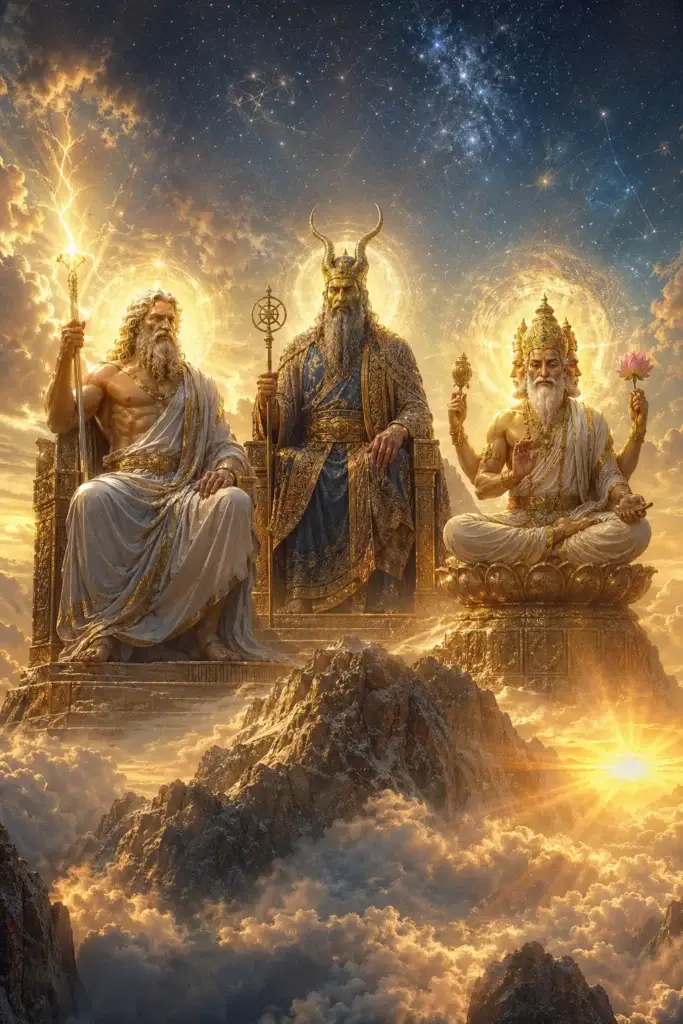
Principal deities of cultural pantheons. Zeus, Anu, Brahma, Odin, the highest powers of their respective mythologies.
In comparison, the functions of high deities emerge across cultures.
Table of Contents
Quick overview (list of definitions)
Type: God / Supreme Deity Class: High deities Distribution: All major pantheons (Greek, Mesopotamian, Egyptian, Hindu, Germanic, etc.) Main characteristics: Cosmic power, supreme authority, often male, distant Related sub-categories: Death deities, anti-gods, protective deities
Concept and Distinction
High deities differ from local or regional deities in that they represent cosmic or cultural supremacy. They are not the „oldest“ or „most original“ (although they are often depicted as primordial), but the most authoritative.
In polytheistic systems there is typically one high deity that rules over an assembly of other gods, Zeus over the Olympian gods, Anu over the Mesopotamian pantheon.
Their power is absolute, their moods have cosmic consequences. They differ from anti-gods, which threaten order, and from death deities, which rule over specific domains (the underworld, death).
The high-god concept in comparative religious studies
The concept of the high deity is a central category of comparative religious studies, above all in the line of Wilhelm Schmidt (Der Ursprung der Gottesidee, 12 volumes, 1912, 1955) and Mircea Eliade (Die Religionen und das Heilige, 1949).
Both argued that practically all archaic religions know a high-god concept: a supreme creator deity that stands at the beginning of the mythology in many traditions, but in ongoing religious practice often recedes behind more specific gods.
This observation is critically discussed in current religious research (Brian Morris, Religion and Anthropology, 2006), yet it remains useful as an analytical tool.
Examples from Cultural History
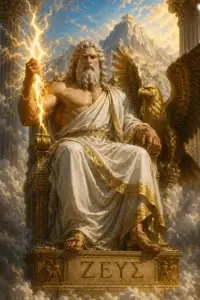
The Greek Zeus rules from Olympus with the thunderbolt and paternal authority; he is at the same time capricious, obsessed with sex and fundamentally enigmatic, not a mere allegorical figure but a complexly characterized force.
The Mesopotamian Anu, by contrast, is even more distant: „heaven“ personified, above the pantheon, but hardly in direct mythological contact with humans or other gods.
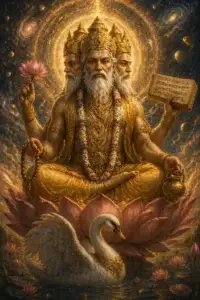
The Hindu Brahma is the creator of the universe, but paradoxically one of the less venerated gods in everyday Hindu life; his creative power is so absolute that it operates beyond human devotion.
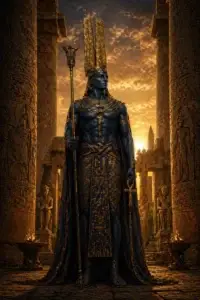
The Germanic Odin is high deity, sage and war god at once, a wanderer who pursues his knowledge without compromise. The Egyptian Ra / Amun-Ra is the sun itself, which travels through the underworld daily and defeats chaos, a cosmic labor without rest.
The Babylonian Marduk became a high deity only after a revolt against older gods; his victory over the chaos monster Tiamat establishes the order of the world.
Examples from the High Cultures
High deities include, for instance, the Mesopotamian Anu (sky god), the Egyptian Ra/Atum, the Greek Zeus, the Vedic Dyaus Pita and his Roman counterpart Jupiter, the Germanic Tyr/Tiwaz and the Celtic Lugh.
In the Abrahamic traditions, the high-god position corresponds to the biblical-Jewish YHWH, the Christian Father-God and the Islamic Allah, each as the supreme and sole instance of creation.
In the history of religion, this concentration on a single high god is the monotheistic exception, laid out in the Jewish tradition since the late second millennium BCE.
Source Situation
High deities are documented in all ancient mythological sources: Hesiod’s Theogony (Greek), the Enuma Elish (Babylonian), the Rigveda (Hindu), the Prose Edda (Germanic), the Egyptian Pyramid Texts and temple inscriptions.
Research in religious studies has shown that high-deity concepts often correlate with political centralization: the stronger the central power of a state, the more dominant its supreme deity.
Significance Today / Related Beings
High deities in the iWell Guard pantheon
In the iWell Guard classification, high deities are a specific tradition pill of the gods class. Pages with this pill include, for example, Anu, Zeus, Jupiter, Odin, Brahma.
The classification is not moral but structural: it marks the highest level of the respective pantheon hierarchy without making a statement about the relationship to protective practice.
In the iWell Guard protective field, high deities are neither invoked across the board nor warded off across the board; their function within the respective religious tradition is documented respectfully.
Further standard works in the literature index.
Frequently Asked Questions about Beelzebub
Who is Beelzebub?
Beelzebub (Hebrew Baal-Zebub, Lord of the Flies) was originally the city god of Philistine Ekron, mocked in the Second Book of Kings (1:2-6). In the New Testament, Beelzebub is one of the epithets of Satan (Mark 3:22).
In the medieval grimoire system (Lemegeton, Witches’ Hammer), Beelzebub appears as one of the highest princes of hell, often as second after Satan or Lucifer.
What role does Beelzebub play in demonological literature?
In the Witches’ Hammer (Malleus Maleficarum, 1487) and in the Lemegeton (Book of Solomon), Beelzebub is one of the most powerful of the 72 princes of hell.
Johann Weyer assigns him the supreme command over the eastern army of hell in his Pseudomonarchia Daemonum (1577). In Christian-popular imagination he is the Lord of the Flies, which mythically refers to the smell of decay and disease.