Brahma, god of the Hindu tradition
By Ralf Ittermann · last reviewed on
High deity of creation in Hinduism, maker of the universe and of the Vedas, member of the Trimurti. Brahma stands at the centre of Hindu cosmology as the origin of all things.
He embodies the principle of creation itself, not as a personal craftsman in the Western sense, but as a manifestation of the impersonal Brahman, the absolute world principle. His role differs fundamentally from Vishnu, the preserver, and Shiva, the destroyer and renewer.
Brahma
At a Glance: Brahma
Type: High deity, creator god, manifestation of Brahman
Pantheon: Hinduism (Trimurti)
Function: creation of the universe, revelation of the Vedas, cosmic order
Main attributes: four heads, four arms, swan mount, Veda books, lotus
Main cult sites: Pushkar (Rajasthan), Saraswati temples
Related deities: Vishnu (preserver), Shiva (destroyer and renewer), Saraswati (consort, wisdom and music)
Context
Period of the Texts
The tradition concerning Brahma extends from the Rigveda (ca. 1500-1200 BCE) to the Puranas (ca. 300 BCE to 900 CE). In the Rigveda the impersonal concept of Brahman (neuter: the world principle) appears first.
Only in the later Vedic texts (Upanishads, Brahmanas) is Brahman conceived as a person, and from this abstract principle the figure of the creator god Brahma (masculine) develops. The Puranas, in particular the Brahma Purana, Brahmaanda Purana and Markandeya Purana, give the most detailed information about his appearance, his deeds and his worship.
Mythological classification
Brahma, the creator god, is one of the oldest concepts in Hinduism, with roots in the Vedic Brahman (the absolute principle).
Although conceived as the first person of the Trimurti, Brahma’s active worship is paradoxically rare. His theology emphasises the Vedic conception of creation as cyclical: Brahma creates, Vishnu preserves, Shiva destroys, in endless repetition.
Geographic Distribution
Worshipped throughout the Indian subcontinent from the Vedic period to the present, with concentrations in northern India (Rajasthan, Uttar Pradesh, the Ganges plain). With the spread of Hinduism to Southeast Asia (Cambodia, Thailand, Bali) Brahma also reaches these regions, although there he often remains in the shadow of Vishnu and Shiva.
The most significant cult site is the Brahma temple in Pushkar (Rajasthan), one of the few places where Brahma stands at the centre of worship.
Source Situation
The core comes from the Rigveda, the Yajurveda, the Upanishads (in particular the Brahma Upanishad and the Mundaka Upanishad) and the Manusmriti (Code of Manu, ca. 200 BCE to 200 CE). The narrative elaboration is found in the Puranas, the Mahabharata and the Ramayana.
Later commentaries by Advaita Vedanta philosophers such as Adi Shankara (ca. 788-820 CE) primarily emphasise the impersonal Brahman and explain Brahma (the person) as the lotus-born creator within the framework of cosmic play (Lila).
Name and Variants
Sanskrit: ब्रह्मा (Brahmā, masculine, the creator), distinguished from ब्रह्मन् (Brahman, neuter, the world principle) and ब्राह्मण (Brahmin, the priest). Epithets: Hiranyagarbha (“Golden Embryo”, born from the golden egg), Lokadhyaksha (Lord of the Worlds), Chaturmukha (Four-Faced), Vedavahana (Veda-Bearer), Srashtri (Creator), Svayambhu (“Self-existent”), Pitamaha (“Grandfather”).
Vedic precursor: Brahman as impersonal world principle; the hypostasis to Brahma (the person) takes place from late Vedic to Puranic times. Related terms: Brahma-sutras (aphoristic explanations of Brahman in philosophy), Brahmi script (writing system).
Description
Appearance
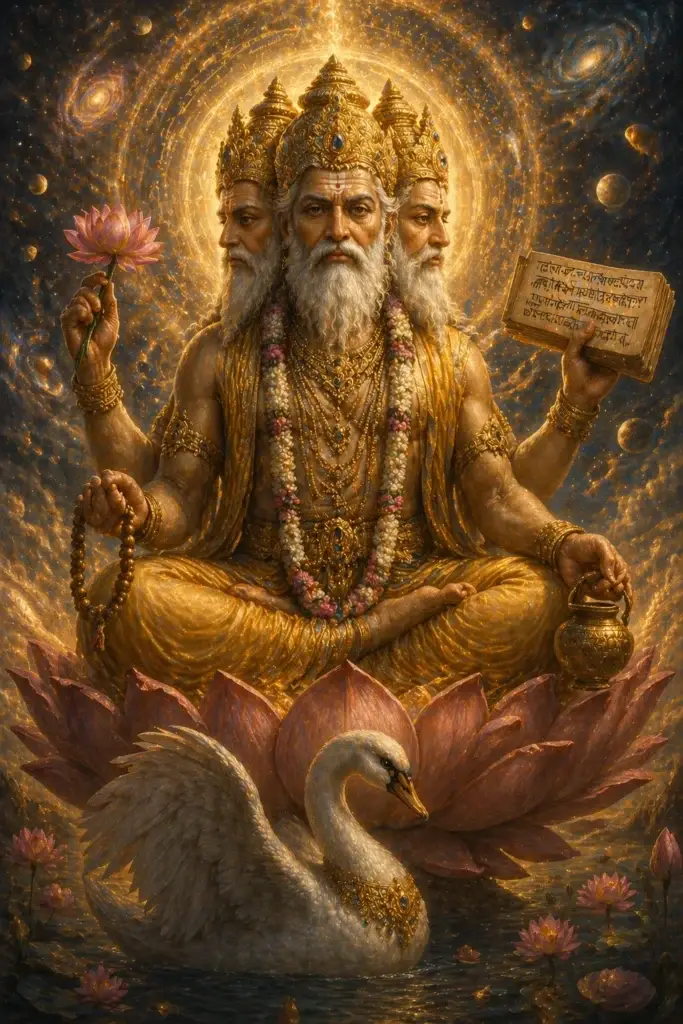
In Hindu iconography Brahma is consistently depicted with four heads, looking in the four cardinal directions, a symbol of his omniscience and his connection with the four cardinal directions, but also with the four Vedas. Each head bears a beard and often a red or golden skin tone.
He sits on a pink lotus (a symbol of purity and unfolding) and rides a swan (Hamsa), the bearer of his wisdom and discernment.
His four arms hold various attributes: in one hand the Vedas (books or scrolls), in another a prayer chain (Mala), in the third a water vessel (Kamandalu) and sometimes a lotus. His clothing is often white or red, symbolising purity and creativity respectively.
Nature and activity
Brahma is not the eternal or indestructible; this role is taken by Brahman itself. Brahma is rather the time-bound executor of cosmic functions. In every cosmic cycle (Kalpa) he creates the universe from the cosmic egg (Hiranyagarbha), imprints the Vedas and orders space and time.
After a Brahma aeon (about 4.32 billion human years) the universe dissolves, and Brahma himself withdraws into Brahman, only to be born again in a new cycle.
This distinguishes Brahma radically from the monotheistic creator god of the West: he is not omnipotent, but an actor within an eternal, cyclical cosmology. His action follows cosmic laws, not arbitrary will.
Appearance and symbolism
Brahma is depicted with four heads, four arms and reddish or golden skin tone; each head recites one of the four Vedas. He carries a prayer chain, a water pot, a Vedic text and sometimes a sceptre. The swan is his mount, bearer of knowledge. His red colour underlines the active and the creative.
Profile: Brahma
The most important aspects of Brahma at a glance. The table summarises origin, function, appearance, worship, symbols and parallels.
Born from the cosmic egg (Hiranyagarbha) or arisen from Brahman itself (Puranic variants). In some narratives: son of Shiva and Shakti; in others, directly manifested from Brahman. His existence is not eternal but cosmically cyclical; he is created anew in every Brahma aeon and returns at the end into the unmanifest.
Creator of the visible universe, interpreter and disseminator of the four Vedas, mediator between the absolute Brahman and the manifested world.
He sets cosmic laws into force, creates space, time, the elements and all living beings, gods, humans and animals. His creativity is, however, not arbitrary, but bound to cosmic karma and to the eternal laws of nature.
Four heads, four arms, white or reddish beard, lotus seat and swan mount. Veda books or scrolls in one hand, Mala (prayer chain) in the second, water vessel (Kamandalu) in the third, lotus or sceptre in the fourth. Seated on a pink lotus, often accompanied by the swan (Hamsa).
Brahma's Worship
Today less widespread than that of Vishnu and Shiva, a phenomenon that believers explain with a legend: a young Brahma fell in love with his own daughter Saraswati and was thereupon cursed to receive hardly any worship.
The main cult site is the Brahma temple in Pushkar (Rajasthan), a significant pilgrimage site with annual festivals (Kartik Purnima in October/November).
Further sanctuaries are found in Saraswati temples, since Saraswati (Brahmani, the consort) embodies wisdom and music. Offerings are traditionally flowers, milk and plant-based presentations. Outside of Pushkar there are very few temples to Brahma, and active worship is minimal compared with that of the other major Hindu deities.
Brahma's Symbols
The Vedas (Rigveda, Yajurveda, Samaveda, Atharvaveda), often depicted as four scrolls or books. The lotus (purity, emergence), the swan (discernment, wisdom), the prayer chain (meditation, cyclical time), the water vessel (origin, fertility), the crown or diadem (cosmic authority).
Worship in Everyday Life
Brahma occupies a more modest place in lived Hindu practice today than Vishnu (with his avatars Krishna and Rama) or Shiva (the destroyer and renewer).
This is connected with philosophical shifts: the medieval Bhakti movement concentrated on emotional love for Vishnu or Shiva, while Brahma as cosmic craftsman belongs rather to the domain of abstract meditation and philosophy.
In daily life Hindus turn to Brahma in moments of intellectual recreation or learning, for example in schools or in rituals connected with the opening of a new enterprise or with foundation acts.
His protective function relates to artistic and intellectual undertakings. At his main festival, Brahma Jayanti (in April), temples are adorned with flowers and lamps, and pilgrims visit Pushkar for ritual bathing in the sacred waters.
Brahma: Parallels in Other Cultures
Vedic and philosophical tradition: the concept of Brahman itself is timeless and transcendent, a more abstract version of the “world stuff” than Zeus’s rule of the heavens. The development from Brahman (neuter) to Brahma (personal) reflects a philosophical compromise: how can the Absolute manifest itself? Brahma is the answer of the Puranas.
Mesopotamian tradition: Anu (Sumerian An, Akkadian Anu) as the most original sky god, later replaced by Marduk (Babylon), who activates the creator function. As with Brahma, Anu is omnipotent but not actively creative in a narrative sense; only Marduk becomes the demiurge of order.
Egyptian tradition: Amun-Ra, particularly worshipped in the New Kingdom as universal god. Amun is the hidden power, Ra the manifestation, similar to the Brahman-Brahma dichotomy. Ptah as creator through word and thought (in the Memphite theology) shares with Brahma the connection to the spiritual force behind matter.
Gnostic and Neoplatonic philosophy: the Demiurge in Gnostic thought as world creator, often, however, judged critically as imperfect or trapped in matter. Brahma, by contrast, is understood metaphysically as neutral: as a necessary cosmic function, not as evil or ignorant, but as temporary and cyclical.
Birth from the Lotus: Cosmogonic Narratives
The best-known mythical depiction of Brahma shows him at the creation of the world. In a version widespread in the Puranas, the god Vishnu lies upon the world serpent Shesha in the cosmic primal waters.
From his navel grows a lotus, and upon this lotus blossom appears Brahma, who now unfolds the creation. This pictorial form, Brahma on the lotus from Vishnu’s navel, belongs to the firm iconographic motifs of Hinduism and at the same time subordinates Brahma to Vishnu.
An older conception, tangible in the Brahmanas and in parts of the Upanishads, links to the figure of the creator Prajapati, who was largely equated with Brahma.
Here the world comes into being through offering, through the heat of ascesis (tapas) or through the division of a primal egg, the brahmanda, the “egg of Brahma”.
In some narratives Brahma brings forth the world by dividing himself or by causing various beings to come into existence from his body and his spirit, among them the “mind-born sons”, from whom the lineages of the sages descend.
Scholarship emphasises that these various creation narratives do not belong to a single contradiction-free system, but reflect different layers and schools of Indian religious history. They share the fact that Brahma embodies the personified creator function, that is to say the aspect of bringing forth within a larger cosmic cycle of arising and passing away.
Why Brahma Is Hardly Worshipped
Despite his position as creator god, Brahma in today’s Hinduism possesses almost no cult of his own. While Vishnu and Shiva are worshipped by great currents with countless temples, there are only very few temples dedicated to Brahma.
The best-known is the temple in Pushkar in Rajasthan. This striking disproportion has prompted various attempts at explanation in scholarship.
Several Puranas transmit stories that contain a curse motif and are intended to explain why Brahma is not worshipped. In one widespread narrative Brahma is cursed by a sage or by Shiva because he had lied or behaved arrogantly; in other versions his consort is angry with him.
From the standpoint of religious history such narratives are, however, to be understood as a retrospective justification of an already existing situation, not as its cause.
The more probable explanation lies in the development of Hindu piety. With the rise of the great theistic currents, Vaishnavism and Shaivism, in each of which a single highest deity unites all functions, including that of creation, an independent creator god lost his cultic significance.
Brahma remained important as a theological and cosmological figure, for example in the doctrine of the world ages and in the triad with Vishnu and Shiva, but he did not become the object of widespread devotion. Religious scholarship shows by this that theological rank and actual cultic worship can diverge in Hinduism.
Brahma's Day: The Reckoning of the World Ages
One of the most significant functions of Brahma in Hindu cosmology is his measure of time. The Puranic tradition develops a graded system of immensely long periods of time linked to the lifespan of Brahma.
The basic units are the four yugas, the world ages, which together form a mahayuga. One thousand mahayugas make up a kalpa, which corresponds to one day in the life of Brahma.
A kalpa is divided into fourteen sections, the manvantaras, each of which is ruled by a Manu, an ancestor of humanity.
At the end of Brahma’s day follows a night of equal length, in which the created world rests or perishes, in order to be brought forth anew on the next morning.
According to this reckoning Brahma himself lives one hundred such “years”; after that he too comes to an end, and the entire cycle begins anew.
The exact numbers vary among the texts, yet the basic principle is uniform. It yields a conception of time that is not linear but cyclical and encompasses periods of many billions of years.
From the standpoint of religious scholarship this system is important for several reasons. It places creation in an endless cycle of arising and passing away, in which even the creator god himself is subject to transience. It thereby relativises the significance of every single world creation.
And it forms the framework for the doctrine of the present age, the kaliyuga, which is regarded as the last and worst of the four yugas. Brahma’s lifespan is thus less an object of devotion than a scaffold that gives Hindu thought about time, transience and recurrence its form.
Further Links
Sources and Literature
In the classical Hindu tradition, Brahma appears as the creator god of the Trimurti, to whom the bringing forth of the world is ascribed, while Vishnu preserves it and Shiva dissolves it. His profile as creator god is elaborated in the Puranas and Brahmanas, but in lived cult he has receded behind Vishnu and Shiva; active Brahma temples are rare, the best-known example being Pushkar in Rajasthan.
Frequently Asked Questions about Brahma
Who is Brahma in Hinduism?
Brahma is the creator god in Hinduism and part of the Trimurti (together with Vishnu, the preserver, and Shiva, the destroyer).
He is typically depicted with four heads (for the observation of all four cardinal directions) and four arms in which he holds the four Vedas, a lotus blossom, a water vessel and a prayer chain.
His consort is Saraswati, the goddess of wisdom and of the arts. His mount is the swan or the wild goose.
Why are there so few Brahma temples in Hinduism?
Despite his central cosmological role, in India there is practically only one major Brahma temple: Pushkar in Rajasthan. Several myths explain this. In one, Brahma’s consort Saraswati curses him after a quarrel. In another, Brahma lied before Shiva and was cursed not to be worshipped.
Theologically more significant is this: Brahma fulfils his function (creation) once per world age, after which his work is done. Vishnu and Shiva are continuously active and therefore stand at the centre of the cult.