


Geomancy, Divination from Earth and Signs
Geomancy is a divinatory practice that uses earth forces, the geometry of place, and territorial energies for divination or spatial design. It is rooted in the Arabic geomantia tradition, Chinese feng shui systems, and European earth radiation traditions.
Documented since the ninth century in the Islamic cultural sphere, it spread across medieval Europe and was reinterpreted in esoteric and ecological terms in the modern era. The practice combines cartography, intuition, and ritual spatial ecology. It is based on assumptions about earth conduit systems and place-bound cosmic energies.
Table of Contents
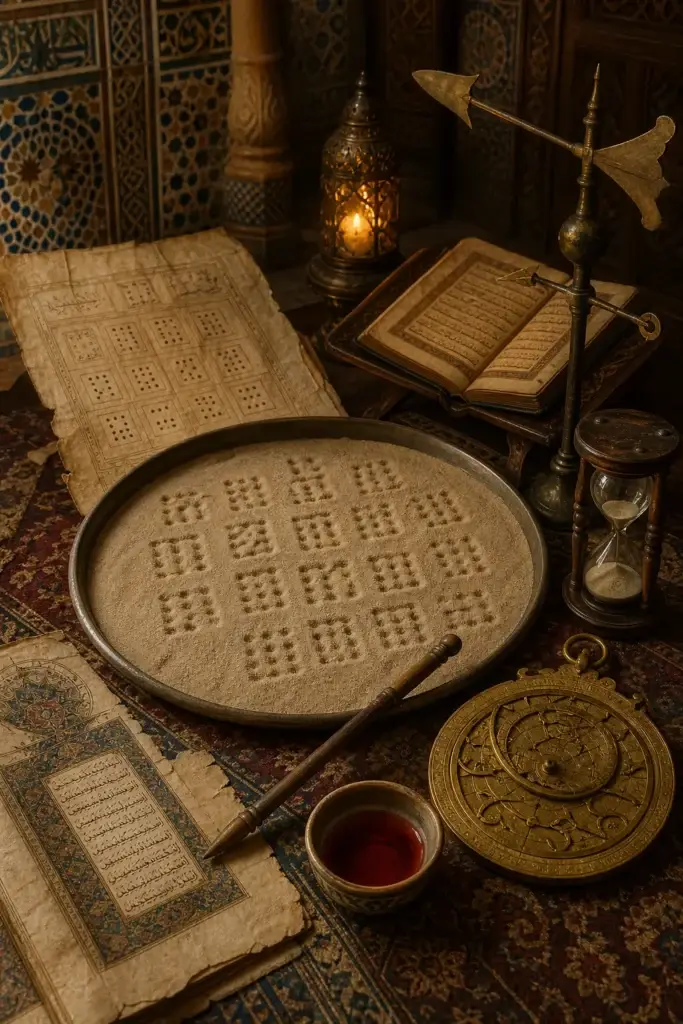
This page gives an overview of geomantic practices.
Quick Overview (Definition List)
Type: Divination practice Class: Geomancy Distribution: Arabic, African, Renaissance European, modern global Main features: Patterns of dots or lines, 16 figures, square arrangement, interpretation, astrological correlation Related sub-categories: Practices, divination, astrology, tarot
Significance in the esoteric tradition
Geomancy is the methodologically most productive of the medieval and Renaissance divination arts. It is mathematically rigorous, hermeneutically rich, and well documented in the history of religion. Anyone seeking a historically grounded approach to the Western divination tradition will find in geomancy the standard example of a fully elaborated practice transmitted in writing.
As an earth oracle, geomancy combines divination with the reading of ground signs in numerous traditions.
Concept and Distinction
Geomancy is specifically a divination system that reads and interprets physical patterns (lines, dots) in order to extrapolate information. It differs from astrology (which reads stars and positions), from tarot (which reads card archetypes), and from the I Ching (which interprets hexagrams produced by coin tosses), although all of these are divinatory.
Geomancy is also speculative in historical terms: the precise origin and transmission between Arabic and European traditions remain unclear. Arabic al-raml is possibly older and was transmuted into European geomancy, or the two may be separate parallel traditions. The mechanism remains enigmatic: whether chance carries a message, or whether intention shapes the patterns.
Examples from Cultural History
Arabic al-raml (al-raml means “sand”) is documented at least since the twelfth and thirteenth centuries and continues to be practiced in Arabic and African countries. The Persian-Arabic scholar al-Biruni wrote about al-raml in the eleventh century with technical detail.
European geomancy emerged in the Renaissance (possibly the thirteenth and fourteenth centuries) and was documented and systematized by scholars such as Agrippa, John Dee, and later John Michael Greer.
The 16 figures (Populus, Via, Carcer, Fortuna, etc.) were developed with astrological attributes, planetary correspondences, meanings, and positions within the square. The English occultist John Michael Greer popularized modern geomancy teaching.
In Africa a related divination practice (Ifa, Ifá, African geomancy) is practiced, with its own patterns (16 Odu) and traditions, possibly related to Arabic origins through historical contact.
Source Situation
Geomancy is documented in Arabic texts (al-Biruni, later works), in Renaissance European grimoire collections (Agrippa, Compendium Geomantiae), in ethnographic studies of African divination (Ifá), and in modern geomancy handbooks.
The connection between the Arabic and European systems is historically disputed: some historians see direct transmission through Andalusia and medieval trade, others see parallel development. Academic treatment is limited but growing.
Mathematical rigor
What made geomancy particularly interesting from the perspective of early modern science was its mathematical unambiguity. From the four “mothers,” the four “daughters” are derived through a column operation, the four “grandchildren” through pairwise addition, the two “witnesses” through addition of the grandchildren, and the “judge” through addition of the witnesses.
In total, a constellation of 16 figures arises, which is arranged in 12 astrological houses. This structural clarity made geomancy a prototypical example of the connection between mathematical method and divinatory practice, and it makes geomancy especially accessible to an analytical approach even today.
Significance Today / Related Beings
Further standard works in the literature index.
iWell Guard and Protective Traditions
Across all documented cultures, protective objects can be found that people carried on their bodies, from Pazuzu amulets in Mesopotamia, to the Hamsa in the Mediterranean region, to the Mezuzah on Jewish doorposts and Christian protective medallions. iWell Guard takes up this tradition in contemporary material architecture, made in Germany, with 41 layers, genuine gold, platinum, and silver. 30-day right of return.
Personal experiences may vary. Not a medical device. No promise of healing.