iWell Guard

Daoist Gods, Laozi and the Three Pure Ones

The Daoist tradition arose in China during the Later Han period as a religious and philosophical movement around Laozi and the Daodejing. It encompasses a multilayered pantheon of celestial officials, a pronounced talisman practice and a ritualised everyday repertoire for the protection of house and person.

This overview presents the central protective talismans of Daoism and their role in everyday practice.

The Daoist pantheon places the Three Pure Ones at its summit alongside countless immortals.

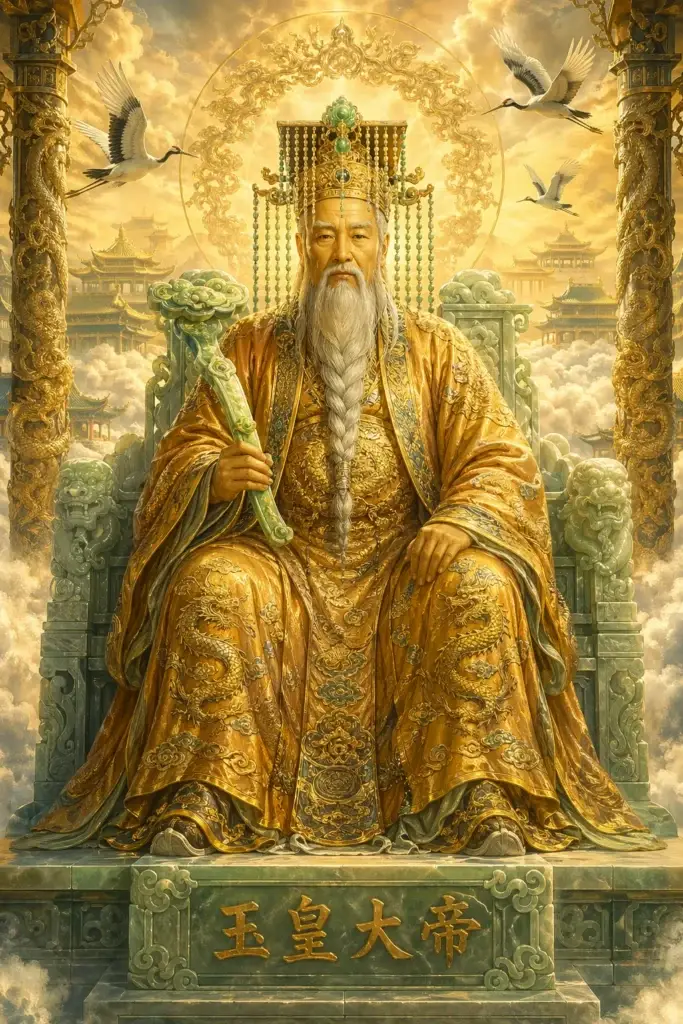
Jade Emperor - gods from the Chinese tradition, historical and illustrative

Historical Development

In terms of religious history, Daoism took shape from several strands. The philosophical foundation was laid by Laozi (6th century BCE) in the Daodejing and by Zhuangzi (4th century BCE) in the work of the same name.

Daoism first became institutionalised as a religion with the Celestial Masters (Tianshi Dao) under Zhang Daoling in the 2nd century CE. Later schools, Shangqing, Lingbao and Quanzhen, each developed their own liturgies, protective practices and notions of salvation.

Within the Chinese religious landscape, Daoism was always in interplay with Buddhism and Confucianism, without the boundaries being drawn strictly in popular religion.

The Pantheon: Celestial Officials and Immortals

At the head of the Daoist pantheon stands Yuhuang Shangdi, the Jade Emperor, as ruler of heaven. Beneath him, the Three Pure Ones (Sanqing), Yuanshi Tianzun, Lingbao Tianzun and Daode Tianzun, form the highest theological triad.

The celestial bureaucracy comprises city gods (Chenghuang), earth gods (Tudi), the kitchen god (Zaoshen), door gods (Menshen) and countless specialised functional deities. The Eight Immortals (Baxian), Han Xiangzi, Zhongli Quan, Lü Dongbin and others, are the most popular figures of folk religion, each with their own attributes and protective functions.

Protective Objects and Talisman Practice

Daoist protective practice centres on Fu talismans (符): calligraphed red or yellow paper strips whose formulaic inscriptions, written in bureaucratic language, encode a specific intended effect. They are consecrated, hung at doors, kept in the house or carried on the body, or ritually burned.

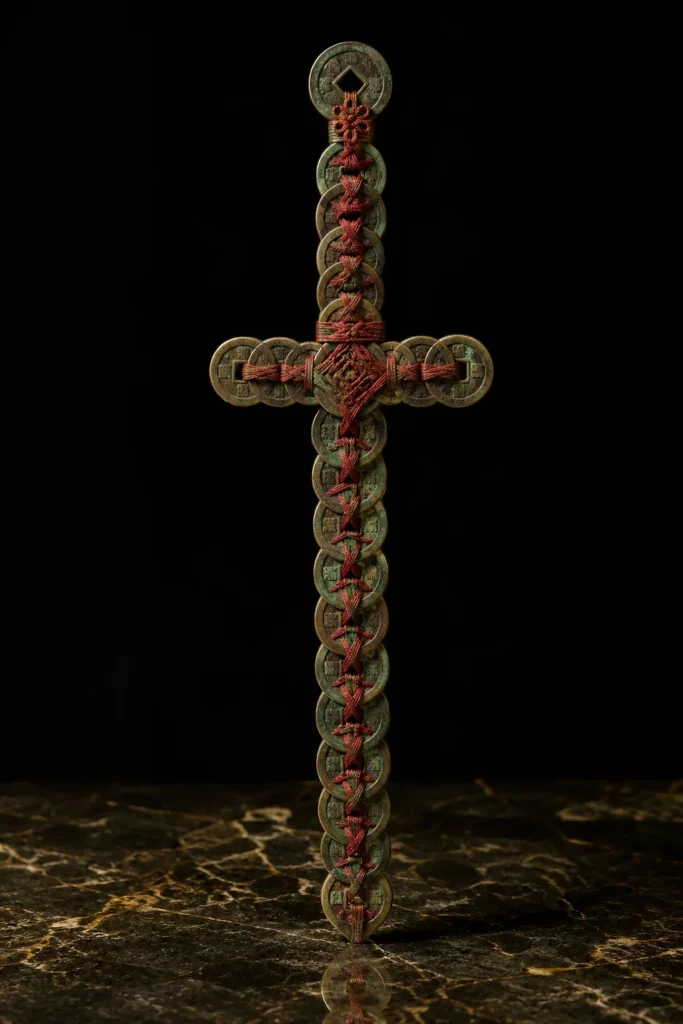
Bagua mirrors above the entrance reflect harmful energies, while peachwood swords (taomujian) and small bells are used in exorcism rituals. Consecrated varieties of incense accompany the household altars. Portable protective objects include pendants bearing characters for good fortune, jade plaques and official characters on cloth.

Inner Alchemy and Wai-Dan

A distinct current is inner alchemy (Neidan): meditation, breathing and visualisation practices aimed at immortality or the refinement of vital energy.

It stands in contrast to outer alchemy (Waidan), which experimented with metallurgical and plant-based substances and was historically a precursor of East Asian pharmacology. Central here is the notion of the body as a microcosm with its own pantheon of inner deities.

Interrelation with Buddhism and Folk Religion

Daoism, Buddhism and the Confucian tradition often coexist within the same household in Chinese religious history. Popular religious practice draws on elements from all three strands: Daoist talismans alongside Buddhist mantra recitations, and Confucian ancestor veneration at household altars. Cross-references in the encyclopedia to China and Buddhism complement this culture.

Frequently Asked Questions about Daoism

What is Daoism?

Daoism is a Chinese religion and philosophy founded in the 6th century BCE by Laozi. Its central concept is the Dao (the Way). Religious Daoism (from the 2nd century CE) developed a rich pantheon and rites of immortality.

What are the Three Pure Ones?

The Three Pure Ones (San Qing) are the highest gods of Daoism: Yuanshi Tianzun, Lingbao Tianzun and Daode Tianzun. They dwell in the three highest heavens and are the source of all creation.

Who is Laozi?

Laozi (the Old Master, 6th century BCE) is the legendary founder of Daoism and author of the Daodejing. In religious Daoism he was deified as a cosmic manifestation of the Tao.

What is Wuwei?

Wuwei (non-action) is a central Daoist concept, not passive idleness but spontaneous, effortless action in harmony with the Dao. The Daoist does not act against the natural order; their action is like water.

Present-Day Practice and State of Research

Today, Daoism as an organised religion is present above all in Taiwan, Hong Kong and mainland China. The Quanzhen monastic order (with its main centre at Baiyun Guan in Beijing) and the Tianshi tradition (seated at Longhushan) form the most important institutions.

Religious studies research, Kristofer Schipper, Livia Kohn and Isabelle Robinet, has methodically differentiated Daoism as a tradition in its own right from Confucian and Buddhist religious history.

Source Material

The Daoist canon, the Daozang, comprises over 1,400 works from two millennia, liturgies, hagiographies, alchemical treatises, talisman collections and philosophical texts. The most important translations into German and English are: Schipper/Verellen, The Taoist Canon (2004), and Kohn, Daoism Handbook (2000). For accounts of practice: Saso, Lagerwey, Andersen.

The Schools of Religious Daoism

Religious Daoism, in Chinese daojiao, is not a uniform institution but a web of schools with their own lineages, scriptures and rites.

The earliest organised movement is held to be the Tianshi dao, the Way of the Celestial Masters, which according to tradition arose in 142 CE through a revelation to Zhang Daoling in Sichuan.

This tradition developed its own priesthood, which to this day is mostly passed from father to son, and knows no celibate monks.

In the medieval period the revelation traditions of Shangqing (Highest Clarity) and Lingbao (Numinous Treasure) were added. Shangqing, which goes back to the visions of the medium Yang Xi in the years around 364 to 370, emphasises inner meditation, the contemplation of the stellar deities and the perfection of the individual adept.

Lingbao, by contrast, adopted collective rituals and notions of universal salvation, in part under Buddhist influence. Both corpora form core holdings of the Daoist canon.

During the Song and Yuan periods the Quanzhen school (Complete Reality) emerged, founded by Wang Chongyang in the 12th century. It introduced a monastic, celibate form of monkhood and combined Daoist inner alchemy with elements of Chan Buddhism and Confucian ethics.

Its principal monastery, the White Cloud Temple in Beijing, remains to this day the seat of the state-recognised Daoism Association of the People’s Republic.

The Daoist landscape today is broadly divided into two main lineages: the married ritual specialists of the Zhengyi tradition, regarded as heirs of the Celestial Masters, and the monastic communities of the Quanzhen school.

Alongside these exist countless local variants, such as the ritual masters of southern China and Taiwan, whose practice cannot be neatly assigned to one of the major schools.

Scholarship, such as the work of Kristofer Schipper and John Lagerwey, has shown how closely Daoist liturgy is interwoven with local folk religion. Related currents are treated in the hubs Buddhism and China.

Cosmology: Dao, Qi and the Order of the World

In the Daoist worldview, the Dao, literally the Way, stands for an unnameable primal ground from which all that exists emerges.

According to the classic scheme of the Daodejing, the One first arises from the Dao, from this the twofold, then the threefold and finally the ten thousand things. This bringing-forth is conceived not as a single act of creation but as an ongoing process in which order and dissolution alternate.

The working medium of this process is qi, a kind of life-breath or subtle energy that pulses in all phenomena. Qi polarises into yin and yang, two complementary aspects whose interplay gives rise to the phases of transformation, in Chinese wuxing: wood, fire, earth, metal and water.

These phases are not substances but functional patterns by which the seasons, the cardinal directions, the organs and social processes are interpreted.

In Daoism the human body is regarded as a miniature image of the cosmos. Numerous deities dwell within it, and the same energy currents flow through it as through heaven and earth.

From this developed inner alchemy, neidan, which seeks through meditation, breath control and ethical discipline to refine the vital energies and ultimately to produce an immortal embryo.

The older outer alchemy, waidan, pursued the same goal through mineral elixirs and receded over the course of the Tang period in favour of the inner practice.

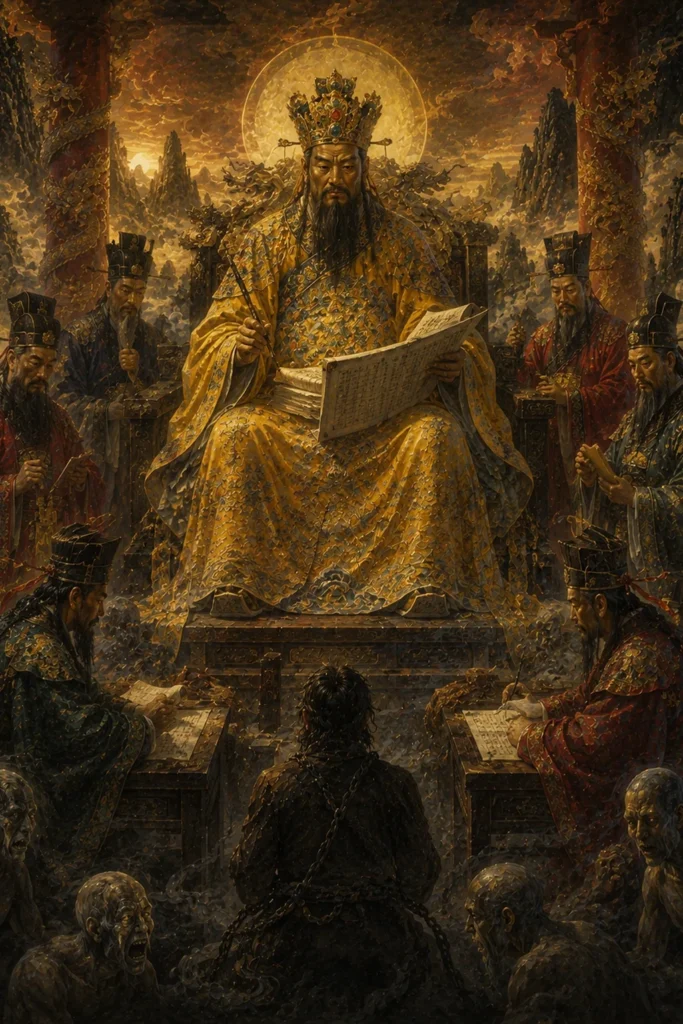
The afterlife is conceived in strongly bureaucratic terms in Daoism. The world of the dead and the spirits is administered by a celestial bureaucracy that keeps registers, imposes punishments and receives petitions.

In their rituals, Daoist priests act as intermediaries before this apparatus, submitting written memorials and thereby ordering the relationship between the living, the dead and the gods. This administrative view also shapes the conception of demons and restless deceased, who are treated in dedicated entity pages of this cultural sphere.

The Daoist Canon and Its Transmission

The scriptures of Daoism are gathered in the Daozang, the Daoist canon. Its authoritative present-day version was compiled in 1444 to 1445 under the Ming dynasty and supplemented by an addendum in 1607. It comprises around 1,500 individual texts, including philosophical classics, ritual manuals, alchemical treatises, hagiographies and revelation scriptures.

Earlier canon collections of the Tang and Song periods survive only in fragments or catalogues.

The canon is arranged according to the scheme of the three caverns and four supplements, which originally reflected the corpora of Shangqing, Lingbao and the Three Sovereigns tradition.

This organisation became confusing over time, as ever new texts were added without the old structure being adapted. For modern scholarship, opening up the canon was therefore a major undertaking in its own right.

A turning point came with The Taoist Canon, initiated by Kristofer Schipper and edited together with Franciscus Verellen, a three-volume analytical catalogue that appeared in 2004. It describes every text of the Daozang by dating, school and content, and for the first time made the canon systematically usable.

Textual finds also played an important role, above all the manuscripts from the caves of Dunhuang, which preserve numerous Daoist scriptures in versions predating the Ming redaction.

Alongside the Daozang there are extensive holdings that were never incorporated into the official canon: local ritual manuscripts, manuscripts guarded by priestly families, and printed popular writings.

It is precisely these materials, often documented only in recent decades through fieldwork, that show how far lived practice extends beyond the canonised holdings. The transmission situation is thus doubly characterised: by a relatively well-edited core and by a barely surveyable, regionally fragmented periphery.

Daoism in the Present

The Daoism of the 20th century was affected by profound upheavals. The Republican period brought religion-critical reform movements, and the Cultural Revolution between 1966 and 1976 led to the destruction of many temples, the dissolution of monasteries and the breaking of transmission lineages.

Only since the late 1970s has limited religious practice again become possible in the People’s Republic, supervised by the state-recognised Chinese Daoism Association.

In Taiwan, Hong Kong and among the Chinese diaspora in Southeast Asia, the tradition was preserved in a more living form.

Taiwan in particular is regarded as a stronghold of the Zhengyi liturgy, because there priestly families were able to preserve their ritual books and their knowledge through the political upheavals. A considerable part of what scholarship knows about Daoist liturgy rests on fieldwork in southern Taiwan since the 1960s.

Since the 1980s a cautious revitalisation has been observable. Temples are being rebuilt, monasteries are admitting novices, and large communal renewal rituals, called jiao, are once again being held regularly in many regions.

At the same time, the tourism industry is transforming sacred mountains such as Wudang or Qingcheng, which stand somewhere between pilgrimage site and excursion destination.

In the West, Daoism has been received since the 19th century above all through the Daodejing and the Zhuangzi, often detached from ritual practice and institutional history. From this arose a popular image of a purely philosophical or nature-mystical Daoism, which religious studies has long recognised as reductive.

Practices such as taiji quan, qigong and parts of traditional medicine carry Daoist thought into global health and esoteric culture, though mostly in heavily reshaped form. A critical assessment must take this history of appropriation into account rather than mistaking it for authentic tradition.

Related key terms: Laozi Daodejing Wuwei Yuhuang Bagua Fu talisman Celestial Officials Three Pure Ones Baxian Wai-Dan Nei-Dan.

Protective Objects in This Cultural Tradition

The Daoist tradition works with Fu scrolls, Bagua mirrors, peachwood swords and the tending of household gods; portable talismans are calligraphed official characters on paper or cloth.

iWell Guard fits into this cultural-historical line of portable protective objects, in a contemporary material architecture, made in Germany. 41 layers, solid gold, platinum, silver. 30-day right of return.

Personal experiences may vary. Not a medical device. No promise of healing.

iWell Guard is not a medical device and does not replace medical or psychotherapeutic treatment. The religious studies content is cultural-historical contextualisation, not a recommendation for spiritual practice.

Protective Symbols from Daoism

The encyclopedia of protective symbols treats several signs and objects from Daoism on dedicated pages: Fu talisman. A cross-cultural overview is offered by the page on protective symbols.