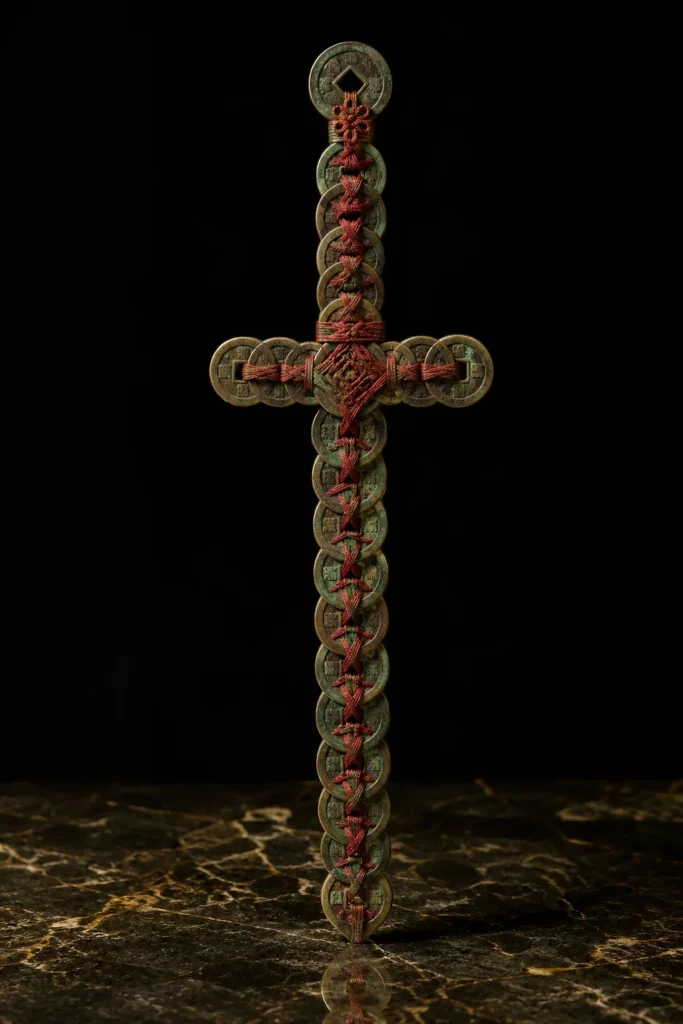
The Coin Sword is a sword that consists not of a blade but of strung-together Chinese bronze coins. In the Daoist tradition of China it is regarded as a warding object that keeps harmful spirits and misfortune away.
The Coin Sword is a Daoist warding object made of ritually strung-together coins.
The Coin Sword is a protective object from the tradition of China. It is a sword that, however, consists not of a forged blade but of Chinese bronze coins.
The coins are joined together on a frame of wire or a rod so that their arrangement forms the shape of a sword. The result is an object that looks like a sword but is built entirely of coins.
The Coin Sword is not a real weapon. It is not meant for fighting but is an object with a protective purpose.
In the Daoist tradition and in Chinese folk religion, the Coin Sword is regarded as a warding object. It is meant to keep harmful spirits and misfortune away from a place.
In religious studies the Coin Sword is a good example of a protective object that combines several meanings. The shape of the sword, the material of the coins, and the religious reference work together.
This page presents the Coin Sword as a warding object. It describes its form, its meaning, and its use, and places it within the Daoist protective tradition.
The building block of the Coin Sword is the Chinese coin. For a long time the Chinese coin had a distinctive form: round with a square hole in the middle.
This square hole served a practical purpose. Through the hole, many coins could be strung onto a cord and thus carried in larger numbers.
It is precisely this feature that makes the coin a suitable building block of the Coin Sword. The coins can be threaded through the hole and joined into a solid structure.
Beyond its monetary value, the Chinese coin carried a meaning of its own. The page on the coin amulet shows how the round coin with the square hole became a sign of good fortune and protection.
For the Coin Sword, old coins are often preferred, sometimes coins from the reign of particular rulers to whom an especially favorable meaning was attributed.
The coin is thus not merely a convenient building block. It brings its own meaning as a sign of good fortune and protection into the Coin Sword and makes it more than a mere sword shape.
The Coin Sword has a distinctive form. It reproduces the shape of a straight Chinese sword, with a blade, a hilt, and a pommel.
To make it, a framework is first created, often a rod or a stiff wire. On this framework the coins are arranged so that together they form the shape of a sword.
Along the blade the coins are usually run in two rows, so that a broad, flat blade shape results. At the hilt the arrangement narrows.
The coins are held together by a cord, often a red cord, drawn through the square holes. The color red is regarded in China as powerful and bringing good fortune.
The hilt often ends in a loop from which the Coin Sword can be hung. Some Coin Swords also carry tassels or further ornamentation.
The finished form thus combines two things. It is recognizably a sword and at the same time recognizably made of coins. It is precisely this duality that makes the Coin Sword the special object that it is.
One layer of meaning in the Coin Sword is the sword itself. In the Chinese tradition the sword is an effective sign of warding.
In the Daoist conception the sword is the weapon against harmful spirits. Sword combat against demons is among the images with which the Daoist tradition describes the warding off of misfortune.
The Daoist priest, too, uses a sword or a sword sign in certain rites. The sword is thus a familiar instrument of ritual warding.
The Coin Sword takes up this image. As a sword it is a sign of defensive warding, an object that confronts harmful spirits.
Unlike a real sword, however, the Coin Sword is not a weapon for combat. It is a sword sign, an object that carries the warding meaning of the sword without possessing a sharp blade.
In this sense the Coin Sword belongs among the sword signs of many cultures. Just as elsewhere the sword stands for defensive, protective power, so the Coin Sword stands in China for the warding off of misfortune.
The second layer of meaning in the Coin Sword lies in the coins. The coins give the protective object a meaning of its own and an added one.
The Chinese coin is regarded as a sign of good fortune. It stands for prosperity, for success, and for a favorable fate. Each individual coin brings this meaning into the Coin Sword.
The multitude of coins reinforces this meaning. A single sign of good fortune is favorable; the large number of strung-together coins joins into a dense accumulation of the favorable.
For Coin Swords, coins from various reigns are often used. Some tradition sees in this a linking of protection across several periods of rule.
The exact number of coins is often observed. Certain numbers were regarded in the Chinese tradition as especially favorable, and a Coin Sword could be deliberately brought to such a number.
In the Coin Sword, then, two powers are combined. The warding power of the sword and the fortune-bringing power of the coins work together. The Coin Sword wards off misfortune and at the same time draws in the favorable.
The Coin Sword is used in a particular way. It is usually hung up, not worn or held in the hand.
A common place is the wall of the living space. Mounted above the bed, on a wall, or above a door, the Coin Sword is meant to protect the room and its occupants.
The Coin Sword is often hung so that its point faces downward. This orientation is regarded as the warding position of the sword.
The Coin Sword can also be used to protect particularly vulnerable spots. It is mounted in places to which an unfavorable position is attributed, in order to ward off harmful influences there.
In the context of the Chinese teaching about the favorable arrangement of living spaces, the Coin Sword has a firm place. It is among the objects recommended for warding off unfavorable influences.
In all these uses the Coin Sword remains an object of place. It protects a room, a house, or a spot, and is therefore above all a hung-up protective object.

The Coin Sword belongs to a rich protective tradition of China. This tradition is closely connected with Daoism and with Chinese folk religion.
This tradition includes further protective objects. The paper Fu talisman, the bagua mirror, and the coin amulet likewise serve to ward off misfortune.
Within this tradition the Coin Sword holds a place of its own. It combines warding by means of the sword with the fortune sign of the coin, and thus belongs among the multilayered protective objects.
Several of these protective objects are often used together. A house may at the same time carry a talisman at the door, a mirror at the entrance, and a Coin Sword on the wall.
This joint use reveals a basic feature of Chinese protective practice. Different means of protection are understood not as opposites but as means that complement one another.
The Coin Sword is thus a readily graspable example of the Daoist and folk-religious protective tradition of China. In it one sees how form, material, and religious reference grow together into a single protective object.
A particular feature of the Coin Sword lies in its relationship to history. It is built from old coins and thus carries a piece of the past within it.
The coins of a Coin Sword are often old. They come from earlier reigns and were once valid money. In the Coin Sword they have taken on a new, protective purpose.
A meaning of its own is attributed to this age. Old coins that have passed through many hands and have endured for a long time were regarded as charged, as it were, by history.
Some tradition connects the coins of a particular reign with the standing or the capability of the ruler of that time. The coin then carries something of this standing within it.
The Coin Sword thus becomes an object that links several times. It brings the coins of the past together in the present into a new, protective whole.
In this linking of history and protection lies a particular appeal of the Coin Sword. It is not only a warding object but also an object in which the long monetary history of China is reflected.
The Coin Sword remains a well-known protective object to the present day. In China and in Chinese communities all over the world it continues to be used.
The Coin Sword is widespread in connection with the Chinese teaching about the favorable design of living and business spaces. There it is among the recommended means against unfavorable influences.
Coin Swords are produced and offered today in various forms. Besides pieces made from old coins, there are also those made from specially manufactured coin replicas.
For religious studies the Coin Sword is an instructive object. It shows how a protective object can unite several meanings within itself, warding by means of the sword and good fortune by means of the coin.
A factual account names the Coin Sword as what it is, a protective object of the Daoist and folk-religious tradition of China, to which in this context a warding and a favorable meaning are attributed.
The Coin Sword is thus a striking example of a Chinese warding object. In it the defensive form of the sword, the fortune-bringing power of the strung-together coins, and the wish to preserve a place from misfortune are combined.
Related key terms: Coin Sword bronze coins warding object Daoism Chinese sword protective object evil spirits China red cord.
iWell Guard stands within the cultural-historical line of wearable protective objects to which the Coin Sword also belongs. A modern companion for people who live with protective symbols: made in Germany, 41 layers of solid gold, platinum, and silver, with a 30-day right of return.
Personal experiences may vary. Not a medical device. No healing promise.