Beings from the Islamic tradition on iWell Guard. The Islamic tradition since the 7th century. Angels, jinn and shaytan figures alongside strict monotheism.
Islam is strictly monotheistic: Allah is the one, sole and indivisible God (tawhid). Yet the Quran itself knows a differentiated world of spiritual beings: angels made of light, jinn made of smokeless fire, Iblis as a fallen angel or jinn (disputed), and at the margins the shayatin as his servants.
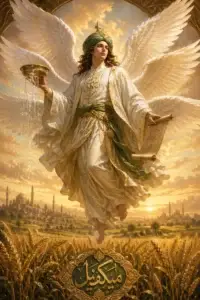
The angels have clearly defined functions in Islam. Jibril (Gabriel) delivers revelations, Mikail (Michael) is the angel of weather and provision, Israfil blows the trumpet on the Day of Judgement, and Azrail is the angel of death.
They have no free will; they only carry out Allah’s commands. For this reason the veneration of angels is forbidden.
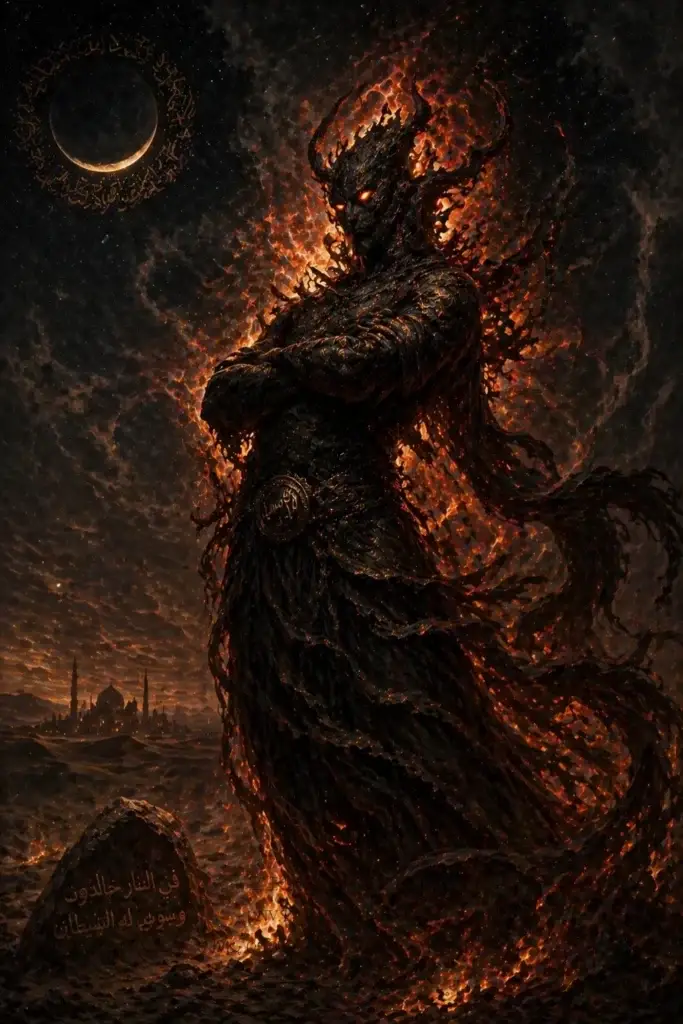
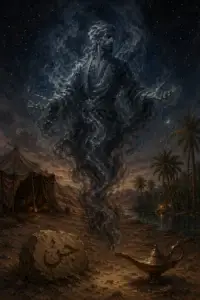
The jinn, by contrast, are free beings with will and responsibility; they can be believing or unbelieving, good or evil. They live in parallel with the human world and can conceal themselves or appear in animal form.
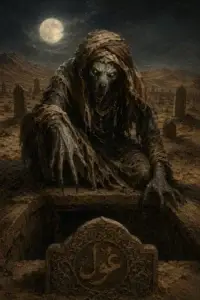
In popular religion, very different regional conceptions of beings have developed from this: ghul, ifrit, marid, and the “evil eye” (the eye of envy). Despite its monotheistic framework, the Islamic world of beings is diverse in religious practice (Fahd, Lebling, Schimmel).

Period: Since the 7th century CE.
Distribution: Middle East, North Africa, Central and South Asia, Southeast Asia, worldwide diaspora.
Sources: the Quran, hadith collections, tafsir literature, and the popular One Thousand and One Nights.
Pantheon and classes of beings: angels (Mikail, Jibril, Israfil, Azrael), jinn (marid, ifrit, ghul), Iblis and the shayatin.
Islam emerged in the 7th century as a monotheistic world religion centred on Allah as the only God. In contrast to Christian culture, the supernatural in Islam is hierarchical and systematised: malaika (angels) are pure, serving beings without free will.
Angelology is less developed than in Christianity or Judaism, but structurally coherent. Alongside this exists a pre-Islamic Arabian tradition concerning the jinn: beings made of fire, with intelligence, free will and moral responsibility.
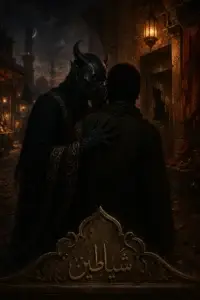
According to Islamic orthodoxy, they are neither gods nor demons. Satan (Iblis) is a fallen being whose nature and status vary among theological schools.
The Quran mentions jinn and angels and leaves room for the supernatural, while later theologians refined these doctrines. Popular Islam in numerous cultures integrates local spirit and demon traditions with Islamic orthodoxy.
Islamic practice emphasises protective rituals through Quranic verses: reciting Ayat al-Kursi (the Throne Verse) or Surah al-Falaq against evil jinn is an everyday matter. The use of amulets (taweez) and magical formulas (ruqya) is widespread, especially in non-Arab cultures. Incantations against the evil eye (nazar) are very common.
Sufi mystical orders practise ecstatic rituals and invocatory techniques to come into contact with the supernatural. Holy men (wali) are often venerated as mediators between human beings and God, despite theological rejection by purists.
Popular belief in the supernatural and in spirit beings varies greatly by region and is often syncretised with pre-Islamic traditions.
With around 1.9 billion adherents, Islam is the second-largest world religion. Angelology remains conceptually stable, while practical demonology varies by region. Orthodox Islamic theology formally rejects magical practices, while they are widespread in folk Islam. Western reception focuses on outward practices (prayer, dress) and ignores the supernatural dimensions.
In academic terms, Islamic angelology and the doctrine of the jinn remain a point of comparison with Christian and Jewish demonology. Jihadist escalation has instrumentalised evil and spiritual practice. Esoteric Western circles romanticise Sufism and Islamic magic.
Islam holds to strict monotheism (tawhid): Allah is absolutely unique.
Yet the Quran and the hadith collections recognise several classes of created supernatural beings: angels (malaika) made of light, jinn (djinn) made of smokeless fire, and the fallen Iblis (Satan), who originates from the jinn and refused to bow before Adam.
Islamic angelology is strongly functional. Jibril (Gabriel) conveys revelation. Mika’il (Michael) distributes rain and grace. Israfil blows the trumpet on the Day of Judgement. Azrael separates soul and body at death. Munkar and Nakir examine the dead in the grave. The Hafaza are the personal guardian angels of every person.
The jinn are a creation alongside human beings; they have will, intellect and religious responsibility; some are Muslims, others are not. The marid, ifrit, ghul and shayatin form subgroups. Popular Islamic religion knows numerous formulas of protection and defence, above all the ruqyah, the therapeutic recitation of the Quran.
In Islamic popular tradition, the Hand of Fatima (Hamsa) accompanies the wearer against the evil eye; nazar boncuk eyes and pendants bearing Quranic verses complement the protective practice.
iWell Guard fits into this culturally historical line of wearable means of protection, in contemporary material architecture, made in Germany. 41 layers, genuine gold, platinum, silver. 30-day right of return.
Personal experiences may vary. Not a medical device. No promise of healing.
The mythology of Islam is closely intertwined with the Quranic worldview and the tradition of the hadith. Alongside angels and prophets, it knows its own classes of beings such as the jinn and the shayatin, whose role in creation, temptation and the end of time is described.
In terms of religious studies, both Old Arabian conceptions and Jewish and Christian references can be traced within this mythology.
The lexicon of protective symbols treats several signs and objects from Islam on their own pages: Ayat al-Kursi, Buduh, Mashallah, Ta’wiz and Zulfiqar. The page on protective symbols offers a cross-cultural overview.