Mashallah: the formula and the sign against the evil eye
By Ralf Ittermann · last reviewed on
Mashallah is a short Arabic formula that means something like what God has willed. Spoken at the sight of something beautiful, it attributes the good to God and wards off the evil eye.
Classification
Mashallah is a short formula from the Arabic language and the world of Islam. It consists of a few words and is among the most widespread expressions of everyday Islamic life.
The formula means something like what God has willed or as God has willed it. It thereby attributes whatever it refers to to the will of God.
Mashallah is spoken above all at the sight of something beautiful or good. Whoever sees a healthy child, a success or something beautiful speaks the formula.
In this use Mashallah has a protective meaning. The formula wards off the evil eye, which can be bound up with admiration and with envy.
Beyond the spoken formula, Mashallah is also written and worn as a sign. In this form it is a visible protective sign.
In religious studies, Mashallah is a good example of a protective formula that is at the same time a pious expression of everyday life. Protection and piety interlock within it.
The Meaning of the Formula
The formula Mashallah is short, yet its meaning is rich. It attributes the good that a person sees to the will of God.
Whoever speaks Mashallah at the sight of something beautiful is saying, in effect, that this beauty is as it is because God willed it so. The good is attributed not to the human being alone, but to God.
In this attribution lies a pious attitude. The speaker acknowledges that the good is a gift of God and not the sole merit of the human being.
Mashallah is therefore first of all a pious exclamation. It is an expression of gratitude and of acknowledgment toward God, the giver of all good.
Only on this pious foundation does the protective meaning of the formula rest. Because the good is attributed to God, human envy and the evil eye cannot strike it so easily.
The meaning of the formula and its protective effect thus belong inseparably together. Mashallah protects by withdrawing the good from the sphere of human envy and placing it in the hand of God.
The Evil Eye and Envy
To understand the protective effect of Mashallah, one must know the belief in the evil eye. This belief is widespread in the Islamic world and is also acknowledged in the tradition.
According to this notion, a glance can cause harm. The evil eye is frequently connected with envy. Whoever regards something with ill will can harm it.
According to this notion, however, it is not only the envious glance that is especially dangerous, but also the admiring one. Whoever looks at something beautiful with full admiration can harm it unintentionally.
It is precisely here that Mashallah comes in. The formula is spoken at the moment of admiration. It is meant to prevent admiration from turning into a harmful glance.
By speaking Mashallah, the admirer redirects their admiration. They admire not the person or the thing for itself, but recognize in it the working of God.
Mashallah is thus a means of rendering one’s own glance harmless. Whoever speaks the formula ensures that their admiration does not harm the one admired.
Mashallah at the Sight of the Beautiful
The most frequent occasion for speaking Mashallah is the sight of something beautiful or good. This applies in particular to the sight of children.
A healthy, beautiful child was considered especially endangered by the evil eye. Whoever praises or admires such a child therefore speaks Mashallah in order to protect it.
The formula is spoken in the same way at the sight of other good things, at the sight of a success, a piece of work well done, a beautiful object or a happy person.
In all these cases the formula fulfills the same task. It accompanies praise and admiration and ensures that these do not harm the one admired.
Mashallah is thus a formula of polite and at the same time pious admiration. Whoever praises something adds Mashallah and thereby makes clear that their praise intends no harm.
This use makes Mashallah a formula of everyday life. It is spoken countless times a day, everywhere people praise and admire one another and their possessions.
Mashallah as a Written Sign
Beyond the spoken formula, Mashallah is also written and depicted. In this form the formula becomes a visible protective sign.
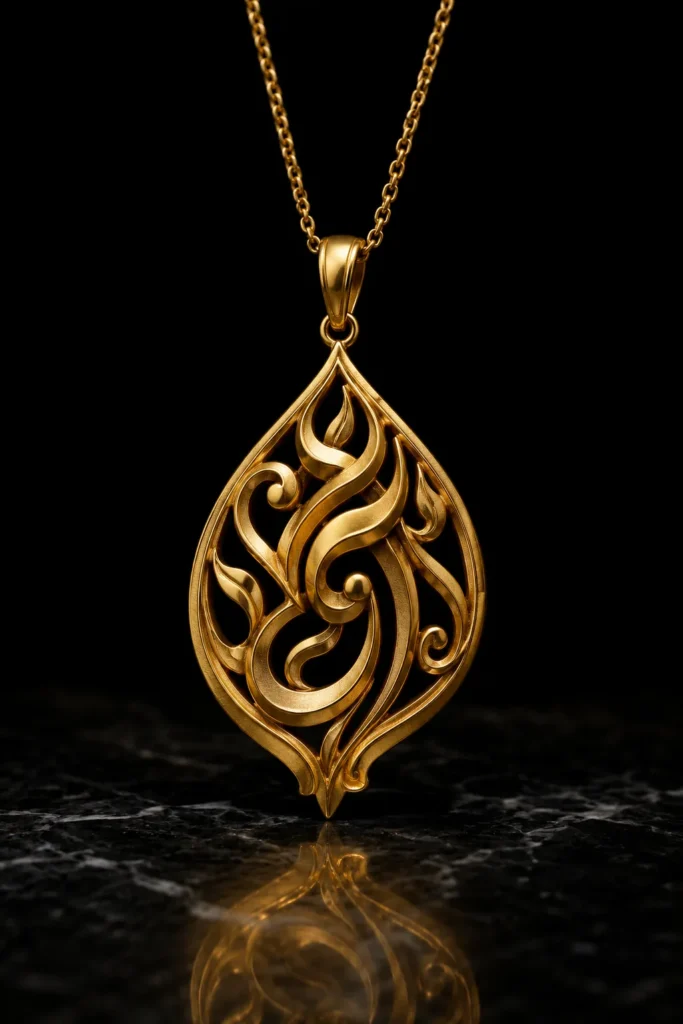
Mashallah appears as a pendant and as a piece of jewelry. In artful calligraphy the word is rendered on small plaques that are worn on the body.
The sign is frequently pinned to children’s clothing. In this way the formula accompanies the child and is meant to guard it from the evil eye.
Mashallah is also widespread as wall decoration and in vehicles. The written word places the location or the traveler under the protective thought that all good comes from God.
In this written form Mashallah belongs to the script and word signs. Like the Chai in Judaism, a single word has itself become a sign.
Mashallah thus combines two forms. It is a spoken formula of everyday life and at the same time a written, worn protective sign. In both forms the same fundamental idea is at work.
Mashallah, Nazar and Hamsa
Mashallah belongs to a whole family of means of protection against the evil eye. This family is widespread in the Mediterranean region and in the Islamic world.
To it belongs the blue glass eye, the Nazar Boncuğu. It wards off the evil eye by catching it. It is presented in more detail on the page about the Nazar Boncuğu.
The Hamsa likewise belongs to this family, the hand amulet that frequently bears an eye in its center. It too is directed against the evil eye.
Mashallah stands alongside these objects as the spoken and written formula. While the Nazar Boncuğu and the Hamsa are objects, Mashallah is first of all a word.
These means of protection are frequently combined with one another. There are pendants that unite the word Mashallah with the blue eye or with the hand. The various means of protection reinforce one another.
Mashallah thus shows that the warding off of the evil eye took place with several means at once. The spoken word, the written sign and the worn object worked together.
Protection Through the Pious Word
Mashallah follows a principle of its own. It does not ward off the evil eye through a frightening image, nor does it catch it like an eye amulet. It works through the pious word.
The idea behind it is a redirection. Through the formula, the admiring glance is led away from the object and toward God. What is admired is no longer the object, but the working of God.
In this way the harmful edge is taken from the admiration, as it were. According to this notion, an admiration that gives the honor to God cannot turn into a harmful glance.
Mashallah thus protects by establishing a pious attitude. The formula reorders the glance and the praise, and in this reordering lies the protection.
In this Mashallah differs from the warding and the catching means of protection. It is a protection that works through confession and through the right attitude.
Mashallah is thus a good example of the fact that protection can also lie in the word and in the attitude. Here the means of protection is not an object but a pious formula.
A Formula of Everyday Life
Mashallah is not only a protective sign but a living formula of everyday life. In the Islamic world it is spoken countless times a day.
The formula accompanies praise and acknowledgment. Whoever praises another adds Mashallah. Whoever hears of a success responds with Mashallah.
In this use Mashallah is an expression of politeness and of sympathy. It shows that the praise is kindly meant and wishes the other nothing bad.
Mashallah thus belongs to a group of pious expressions that run through everyday Islamic life. Such expressions accompany many moments of the day and connect the everyday with the thought of God.
In this embedding in everyday life lies a strength of Mashallah. It is not a rare, special means of protection, but a familiar formula that is available at any time.
Mashallah thus connects protection with daily life. It is a protective formula and a polite expression at once, and it is precisely this connection that makes it so widespread and so alive.
Reception Today
Mashallah is to this day extraordinarily present in the Islamic world. As a spoken formula it belongs to the fixed stock of everyday life and is used daily by many people.
As a written sign Mashallah is likewise widespread. As a pendant, as wall decoration and as an ornament in vehicles, the formula is frequently to be seen.
Beyond the Islamic world, the word Mashallah has also entered other languages. In regions with a Muslim population it is widely used, at times also by people of other backgrounds.
In this broader use the precise religious meaning can recede into the background. Mashallah is then used in a general way as an expression of acknowledgment or admiration.
At its core, however, Mashallah remains what it always was, a pious formula that attributes the good to God and thereby wards off the evil eye.
Mashallah is thus a striking example of a means of protection that lies in the word. In it a pious attitude, the warding off of the evil eye and a formula that accompanies the everyday life of many people come together.
Literature (Selection)
Related key terms: Mashallah protective formula evil eye envy will of God word sign Nazar Islam.
iWell Guard and Protective Traditions
iWell Guard stands in the cultural-historical line of wearable protective objects, to which the Mashallah formula also belongs. A modern companion for people who live with protective symbols: made in Germany, 41 layers of solid gold, platinum and silver, with a 30-day right of return.
Personal experiences may vary. Not a medical device. No healing promise.