


Vengeful Spirits, Retribution from the Beyond
Spirits that seek retribution for unatoned misdeeds. Erinyes, Kikimora, Onryo: beings of unresolved guilt across cultures.
From the beyond, vengeful spirits arise to take retribution for wrongs suffered.
Table of Contents
Quick Overview (Glossary)
Type: spirit / demon Class: vengeful spirits Distribution: Cross-cultural (antiquity, Middle Ages, modern folklore) Main features: intent to avenge, emotional intensity, pursuer behaviour, often female or collective Related sub-categories: spirits of the dead, vengeful spirits (own class), haunting
Definition and Distinction
Vengeful spirits differ from mere spirits of the dead in that they act with an explicit intent to avenge. While a spirit of the dead may be confused or simply unable to leave, a vengeful spirit deliberately pursues its target.
In the classical sense, vengeful spirits are also often stronger and more dangerous: they have the power to cause accidents, bring illness or even kill. They cannot be appeased by simple calming rituals; what is needed is genuine justice or a more decisive magical binding.
Greek Erinyes and Roman Dirae: cosmic avengers
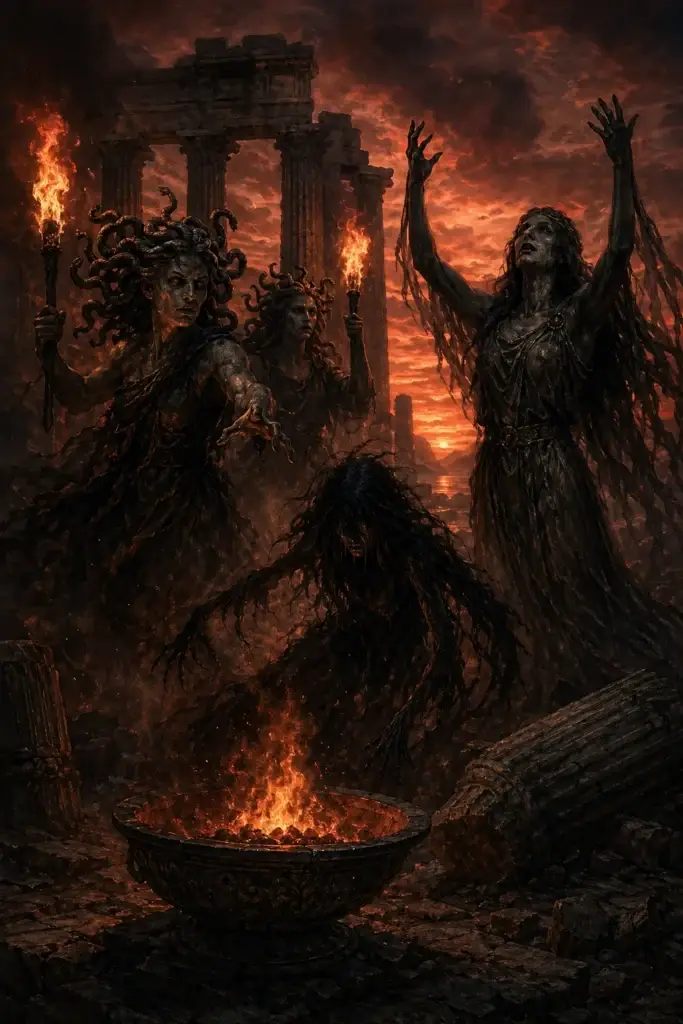
In ancient Greek religiosity the Erinyes (also called the Furies) were not figures of demonic arbitrariness but cosmic forces of justice.
They pursued murderers and breakers of curses across generations, not out of malice but out of metaphysical necessity: the universe does not tolerate certain crimes, and the Erinyes are the executive arm of this order.
Aeschylus’ trilogy Oresteia depicts this process: Orestes kills his mother Clytemnestra to avenge his father, but is pursued by the Erinyes; only through Athena’s intervention and a court trial are they appeased and turned into a protective force for the city.
The Roman Dirae (curse goddesses) functioned similarly. Both traditions show that vengeful spirits are not evil but the embodiment of karma or divine balance.
Cultural-Historical Examples
The ancient Greek Erinyes (Latin Furies) are collective vengeful spirits with cosmic authority; they pursue murderers, especially matricides, without mercy across generations. The tragedy of the Oresteia portrays the Erinyes as relentless, loud and overwhelming.
In ancient Rome the Dirae were similar supernatural agents of vengeance. In Japanese folklore the Onryo (vengeful spirit) embodies the most extreme form: a woman fatally wronged who, after her death, systematically and with supernatural power haunts those responsible, bringing illness, madness, accident.
Onryo stories run through Kabuki theatre and classical literature. In the Germanic context there are reports of spirits of the dead who avenge a murder by repeatedly appearing before a court and pointing to their punishment.
In the European Middle Ages, skeletons walled up with “curses of revenge” were found: human remains used as a magical binding. In Haiti and the Vodou context, a Zombi or summoned spirits can be employed as tools of revenge against enemies.
East Asian lines of tradition: Japanese Onryo and Korean Cheonyeo-gwishin
In East Asian Buddhism and Shinto, similar concepts emerged. The Japanese Onryo (demonic vengeful spirits) are people who died too early or by violence and carried their rage with them.
A famous Onryo is Sugawara no Michizane, a scholar who was unjustly persecuted and, after his death, caused catastrophes until a shrine was built to give him satisfaction.
Similar is the Korean Cheonyeo-gwishin, the spirit of a woman who died young (especially through murder), who takes revenge and brings misfortune. These spirits are not easy to banish; their integration requires an acknowledgement of their injustice and ritual appeasement. The practice shows that, psychologically speaking, vengeful spirits embody unresolved trauma energy.
Source Situation
Vengeful spirits are documented in classical literature (Greek tragedy, Roman literature), in Japanese classics, in medieval chronicles and in folklore collections. Psychologically, vengeful-spirit narratives are often interpreted as an externalisation of guilt or as collective justifications for misfortunes (this village was damned because it committed a murder).
Cosmic versus personal revenge: distinction and ethical questions
A vengeful spirit differs from a merely evil demon by motivation: a demon is nihilistically destructive, whereas a vengeful spirit executes a logic of guilt.
This raises ethical questions: is revenge legitimate justice or the perpetuation of a cycle? The Greek tragedians were pessimistic (the Oresteia shows that only divine intervention breaks cycles of revenge), while Buddhist traditions emphasise compassion (even the vengeful spirit can be liberated through teaching of the dharma).
Modern psychological thinking interprets vengeful spirits as externalised feelings of guilt: the sacrifice becomes the perpetrator, and revenge embodies unconscious guilt. This reinterpretation emphasises healing over retribution. See also Erinyes.
Significance Today / Related Beings
Vengeful-spirit archetypes dominate modern horror film and literature: the motif of the “white lady” or “woman in white” at accident sites is often a vengeful-spirit narrative. Paranormal research regularly documents accounts of people who experience inexplicable accidents or illnesses after breaking a taboo or harming someone: a modern activation of the vengeful-spirit belief.
Poltergeist phenomena are often explained by unconscious impulses of revenge. Related beings are spirits of the dead (without intent to avenge) and demons, which harm deliberately but without personal injury.
In Depth
Typology of the Act of Revenge
Vengeful spirits form a category of their own among the restless dead. They differ from ordinary hauntings through their directed aggression: their action is aimed at particular persons or families, often across generations.
Classic examples are the Greek Erinyes, who take revenge for bloodshed within their own kin, as well as the Japanese Onryō, mostly women who suffered injustice during their lifetime and, after death, systematically seek retribution.
Mythological and Legal Function
Vengeful spirits are more than a narrative motif: in pre-Christian societies they functioned as a religious-legal authority. Where human law failed, or where deed and perpetrator were beyond reach, the belief in vengeful spirits guaranteed that the wrong did not remain unatoned.
The Erinyes pursued Orestes for the murder of his mother until Athena created the Areopagus, a court of human beings, as an institutional substitute.
Reconciliation Instead of Defence
Since vengeful spirits can usually not be driven away by mere defence, but are grounded in a wrong, traditional rituals focus on reconciliation and restitution. In the Japanese Onryō cult, destructive spirits are pacified through deification and the establishment of their own shrine; Sugawara no Michizane thus became Tenjin, a kami of scholarship.
Modern Reading
Further standard works in the literature index.
iWell Guard and Traditions of Protection
The vengeful spirits gathered here are figures described in religious studies, drawn from various cultures.
iWell Guard ties in with the millennia-old line of portable protective objects, from Pazuzu pendants in Mesopotamia through the Hamsa and evil-eye amulets in the Mediterranean region to the Mezuzah on Jewish doorposts and to Christian protective medals.
A contemporary form of this, made in Germany, with a clearly documented material architecture (41 layers, solid gold, platinum, silver). 30-day right of return.
Not a medical device. No promise of healing. Personal perceptions may vary.
Vengeful Spirits in Cross-Cultural Comparison
Well-known vengeful spirits in the iWell Guard lexicon: Erinyes (Greek goddesses of revenge, pursuing oath-breakers and shedders of kindred blood), Dirae (the Roman counterpart), Keres (Greek spirits of death and ruin), Yūrei (Japanese spirits with unresolved resentment), Banshee (Irish wailing and death messenger), Cheonyeo-gwishin (Korean maiden spirits), Mahr (Germanic nightmare spirit).
The majority are female-connoted, which structurally points to the position of women in patriarchal societies: often empowered to speak and act only in death.
Frequently Asked Questions about Vengeful Spirits in Cross-Cultural Comparison
What are vengeful spirits in mythology?
Vengeful spirits are supernatural beings that return to the world of the living in response to unatoned acts of injustice. Unlike general spirits of the dead, they have a concrete cause: betrayal, murder, breach of oath, unatoned disgrace. They find rest only once the deed has been atoned for or the honour owed has been restored. Well-known examples are the Greek Erinyes, the Japanese Yūrei and the Irish Banshee.
Why are vengeful spirits frequently female?
The frequent female connotation has structural reasons: in patriarchal societies, women were often empowered to speak and act only after their death. The Erinyes, Yūrei, Cheonyeo-gwishin or Banshee thus function as symbolic instances of atonement for injustice that befell the women during their lifetime, against a husband, family, rapist or social norm. In death they become inescapable accusers.