


Seduction Demons: Lust, Allure and Sexual Assault
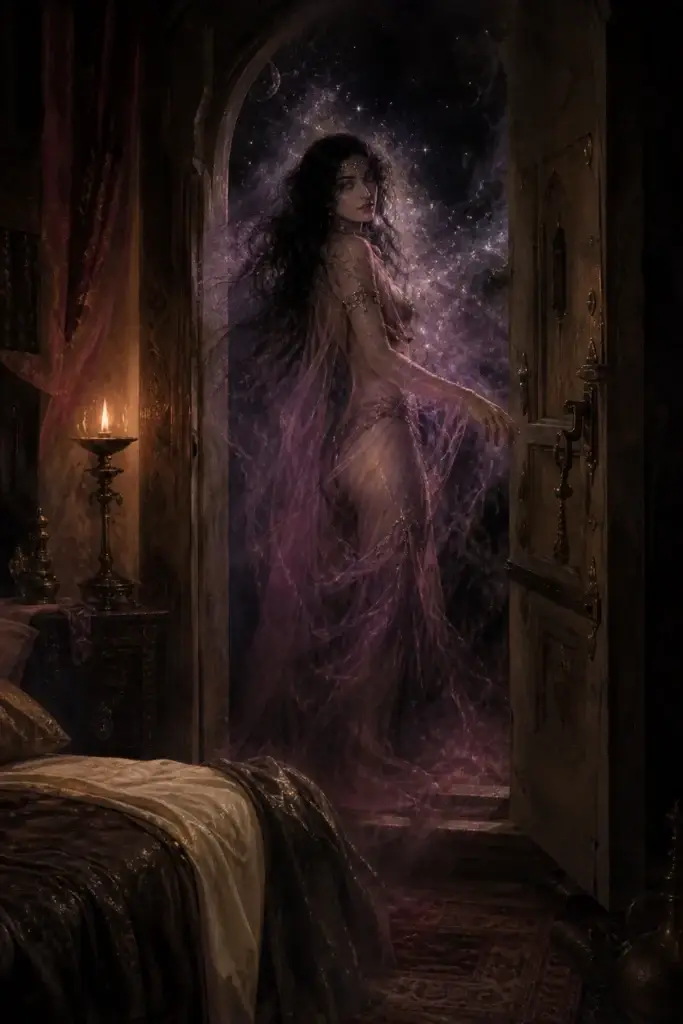
Seduction demons act through lust and allure, often as a sexual assault in states of sleep and half-sleep, a theme that ranges from the succubus and incubus through Lilith and Empusa to sirens and yakshini.
This overview covers incubi, succubi and sirens as worldwide figures of seduction.
Seduction demons are supernatural beings whose primary function lies in manipulation, deception or libidinal seduction, succubi, Jinn seducers or lustful demons with sexually predicative logic of action. Sources come from Arabian Nights traditions, European witch-hammer texts and African as well as Indian occult traditions.
Their portrayal often correlates with sexual anxiety, female autonomy and transgressive concepts of physicality in different cultural contexts. In numerous cultures they embody transgressive female sexuality and a cosmic power of seduction.
Table of contents
Term and Definition
Seduction demons differ from general demons through their specialization in erotic power as a weapon. They do not seduce at random; it is their strategy. They may appear physically, carry out sexual violence, or act purely psychically: dreams, possession, madness through love.
Distinction from vampires: vampires drink blood, seduction demons consume life force, semen, or the soul through a sexual act. Distinction from Lilith as the mother of all demonesses: Lilith also has aspects as a seductress, but is primarily a symbol of disobedience and wildness. Seduction demons are more purely specialized.
The motif appears wherever sexuality is interwoven with the supernatural, which is frequently the case for archaic societies.
Seduction Demons as a Class of Beings
In the iWell Guard classification, seduction demons are a sub-class of demons whose primary logic of effect is the sexual or erotic seduction of living humans.
The class comprises the succubus-incubus family of the Jewish-Christian tradition, the Greco-Roman Lamia and Empusa, the siren tradition, the Islamic Si’lat and Ghaddar, the Japanese Yuki-Onna and the Slavic Rusalka.
The structural constants of the class are a nocturnal or isolated appearance, sexual attraction as a lure, and the draining of energy or death as the consequence of the encounter.
Examples from Cultural History
Lilith in the Jewish-Kabbalistic tradition is a seductress: she seduced Adam, refused to submit, was demonized, and has since begotten demonic offspring in the dark. At the same time she is an embodiment of female autonomy and sensuality.
The succubus (Latin succubare = to lie under, to sink beneath something) is a female demon who visits sleeping men, documented in hundreds of medieval and early modern reports. She draws out life force and can beget offspring.
Empusa in the mythology of Greece is a demon with a copper leg, courtesan, demon, woman of the night, who seduces and devours men. She is primarily a sexual being with a destructive aim.
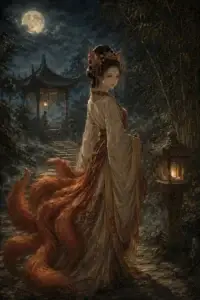
The Huli-Jing (狐狸精, Chinese: nine-tailed fox in female form) seduces emperors, nobles and learned men. She is intelligent, beautiful and ruinous, a classic motif of Chinese literature (Fengshen Yanyi, Strange Tales of Liaozhai).
The Yuki-Onna (雪女, Japanese: snow woman) also has aspects of seduction: she appears beautiful, draws travelers into snowfields, and lets them freeze to death. The seduction here works through beauty and supernatural fascination.
Source Situation
Jewish sources: Talmud, Zohar, Kabbalah works (16th to 18th century). Christian: Malleus Maleficarum, demonology treatises (Bodin, Demonolatry), priestly interrogations, trial records. Greek: Strabo, Libanius, Antiphanes. Chinese: Fengshen Yanyi, Liaozhai Zhiyi (浦松齡, 17th century), classical novels. Japanese: Kwaidan collections, Noh drama. Folkloristic secondary literature: Walter Scott, montanus magiae collections.
Depth in the History of Religion
The oldest evidence of the seduction-demon class is found in the Mesopotamian Lilitu tradition (Akkadian incantations, 2nd millennium BCE).
The Jewish Lilith tradition (Talmud Bavli Niddah 24b, Zohar 19b and in detail in the Alphabet of Ben Sira, 8th to 10th c.) develops this template into the succubus mother who besets men in sleep and threatens infants.
The Greco-Roman tradition develops in parallel the Lamia-Empusa-Mormo triad as nocturnal seductresses of men with a connection to infants.
Christian-medieval theology systematizes the class with Augustine (De civitate Dei XV,23) and Thomas Aquinas (Summa Theologiae I, q. 51, a. 3) into the succubus-incubus dual solution: the same demon appears successively as a succubus, collects seed, and as an incubus transmits it. This construction remains central in the Malleus Maleficarum (1487) and in the theology of the witch trials.
More recent research (Walter Stephens, Demon Lovers, 2002) has reconstructed the significance of this construction for early modern persecution practice.
Present-Day Significance / Related Beings
Seduction demons remain present in modern popular culture, from gothic literature (Anne Rice) to contemporary supernatural horror series. They symbolize the danger of desire and the supernatural quality of the sexual. Psychologically they are often projections of feelings of guilt, suppressed desire and fear of femininity or sexuality.
Related pages: Lilith, Empusa, Succubus, Incubus, Yuki-Onna, Huli-Jing.
The Deeper Layer of the Psychology of Religion
From the perspective of the psychology of religion, seduction demons are one of the most rewarding classes of beings, because in them the cultural processing of sexuality in religious language becomes especially clear.
The constancy of the profiles of these beings across different cultures, the Jewish Lilith, the Greek Empusa, the Syrian Lilitu, the Slavic Mara, the Japanese Yuki-onna, the African Asiman, points to universal psychological functions.
Research in the anthropology of religion often sees in these beings a reflex of the cultural tension between sexuality and religion: what could not be canonized into legitimate religious sexuality was constructed as a threatening demonic power.
Modern Readings
In the modern reading the meaning of seduction demons has shifted markedly. In feminist theology (the Lilith adaptation since the 1970s), in fantasy literature and in modern occult practice, these beings are often reinterpreted positively, as symbols of female self-determination, sexual power or spiritual autonomy.
This reinterpretation is new in the history of religion and stands in contrast to the older patriarchal construction. On iWell Guard we hold both readings in parallel and name the methodological framework.
Sleep Paralysis and the Cultural Layer
The phenomenology of the seduction-demon reports coincides in central points with modern sleep paralysis research (David Hufford, The Terror that Comes in the Night, 1982; Owen Davies, Paranormal, 2009).
The typical descriptions (pressure on the chest, inability to move, the presence of a being, a sexual component) are similar across all cultures, which naturalizes the phenomenological layer.
The cultural layer (why does the figure appear in almost all cultures as female or male, sexual, nocturnal, dangerous to infants?) can only be explained through the history of religion and depth psychology (Carl Gustav Jung, James Hillman, Marie-Louise von Franz).
The consensus position in religious studies is that the phenomenological layer provides a necessary, but not sufficient, explanation; the cultural charging follows its own logics.
Beings in This Category









iWell Guard and Protective Traditions
The seduction demons described here are placed in parallel within the contexts of religious studies, theology and psychology.
iWell Guard ties in with the millennia-old line of portable protective objects, from Pazuzu pendants in Mesopotamia through Hamsa and evil-eye amulets in the Mediterranean region to the Mezuzah on Jewish doorposts and to Christian protective medallions.
A contemporary form of this, made in Germany, with a clearly documented material architecture (41 layers, solid gold, platinum, silver). 30-day right of return.
Not a medical device. No promise of healing. Personal perceptions may vary.