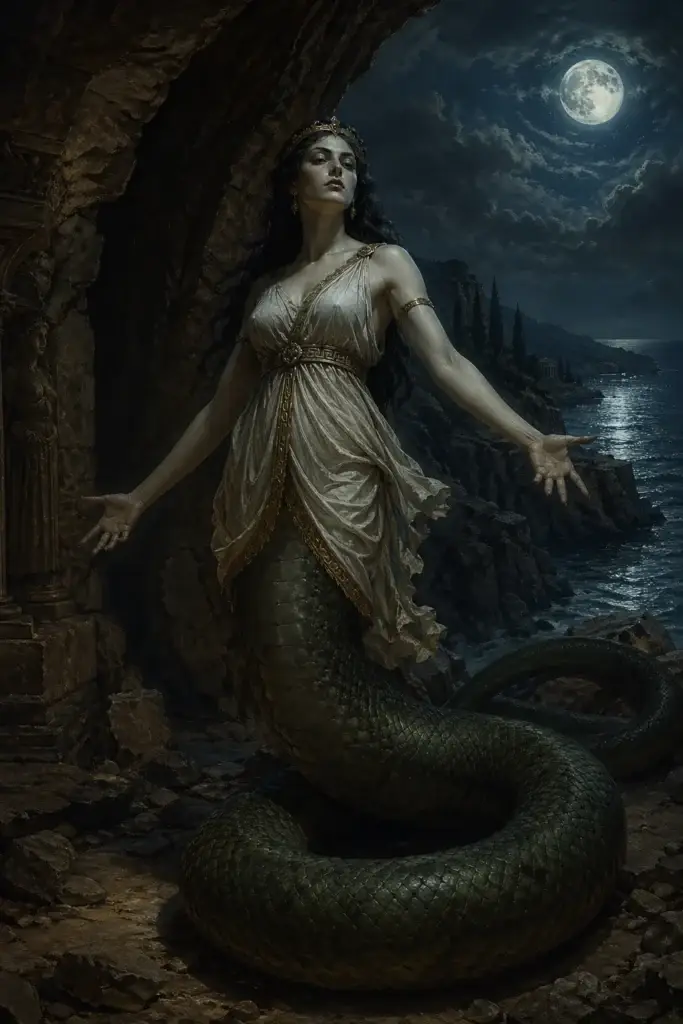
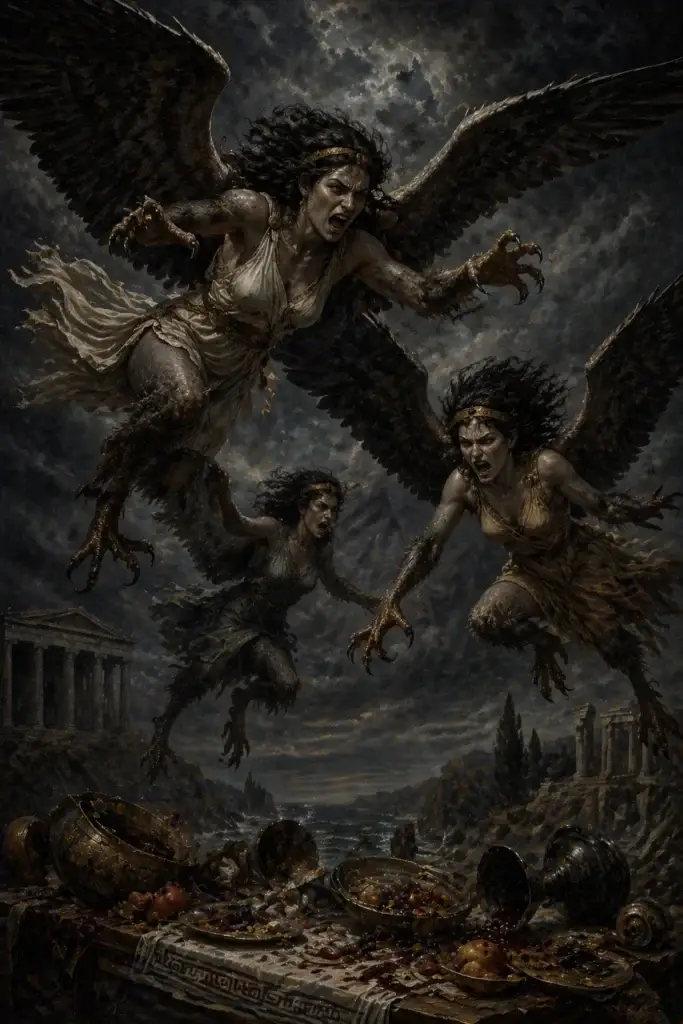
Sirens, demoness of the Greek tradition
By Ralf Ittermann · last reviewed on
Sirens are a demoness of the Greek tradition.
Bird-women with an unearthly song, seductresses to death, masters of allurement. The Sirens are notorious from the Odyssey, their voices luring sailors into madness and shipwreck. They are not evil, but fatal: it is their nature to seduce and to lure. Whoever hears their song wishes only to find them, and dies at sea.
Sirens
Sirens in Homer’s Odyssey and early Greek literature
In Homer’s Odyssey 12.158-200 the Sirens have beautiful voices, but Homer does not describe their appearance; the bird form comes from visual art, and they only become fish-tailed beings in the later tradition.
Homer does not name them, only their location (an island before Scylla and Charybdis) and their deadly function: they lure sailors with their song in order to kill them. Odysseus stops his men’s ears with wax and binds himself to the mast to withstand their song.
Homer’s Sirens have no individual identity or mythology; they are pure predator functions. The Hesiodic catalogue likewise mentions Sirens in a similar manner: as demonic singers whose essence is seduction and destruction. Their closeness to the Muses (also singers) is striking; they are a corrupted or deviant form of divine song.
Short Profile: Sirens
Type: Mythical being (bird-women, hybrid)
Tradition: Greek mythology
Class: Spirits of the undead / supernatural being
Role: Lurers, death demons
Sources: Homer Odyssey XII, Hesiod Catalogue of Women, Ovid Metamorphoses
Sphere of influence: Sea, music, love, death, memory
Central conflict: Desire vs. reason, life vs. death
Historical Classification
The earliest literary mention of the Sirens is the Odyssey, usually dated to the eighth or seventh century BC. It is followed by the Argonautica of Apollonius of Rhodes in the third century BC, in which Orpheus drowns out the Sirens’ song. Pictorial evidence begins in archaic vase painting, and the material was still being carried forward in Roman and late antique literature, for instance in Ovid.
Mythological classification
The Sirens are female hybrid beings from Greek mythology, originally not mermaids but bird-beings with the upper body of a woman. They lived on an island near the coast and were notorious for their bewitching music and song, which lured sailors to their ruin.
The best-known episode involving the Sirens concerns Odysseus: he was clever enough to seal his men’s ears with wax and to bind himself to the mast in order to withstand their song.
The Sirens are often interpreted as messengers of death, not evil but deadly. They embody the seduction through art and beauty that draws one away from the path of life. According to some sources the Sirens died of despair, because no mortal could resist their song. They are ambivalent: beautiful and terrible at once.
The Siren myth is at home in the Greek cultural sphere and radiated through the Homeric Odyssey across the entire Mediterranean region.
Already in antiquity the localizations varied: the Sirens were frequently placed on the southern Italian coast, for instance at the Sirenuse Islands off the Sorrento peninsula and around Naples, whose foundation legend is connected with the stranded Siren Parthenope.
Through Roman reception and medieval bestiary literature the image of the Siren reached all of Europe; in the process the originally bird-shaped Siren increasingly merged with the image of the fish-tailed mermaid. In this form she became a fixed motif of European art, heraldry and seafaring culture.
Primary sources:
Homer, Odyssey XII, 165, 200
Hesiod, Catalogue of Women (fragment)
Apollodorus, Bibliotheca I, 3, 4
Ovid, Metamorphoses V, 551, 563
Plutarch, On the Odyssey
Secondary sources: Burkert; Kerényi; Bremmer; Sourvinou-Inwood
Name and Variants
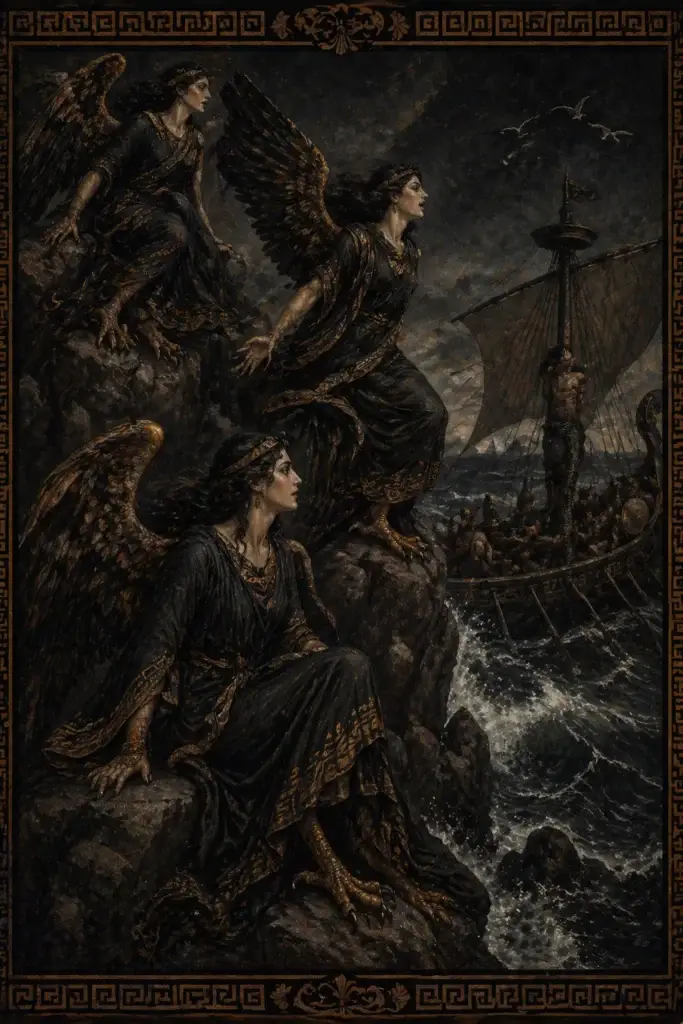
In antiquity the Sirens are depicted as bird-woman hybrid beings: the upper body of a beautiful woman, the lower body of a large bird (often an eagle or owl). They sometimes carry instruments (lyre, flute).
Later, in the Middle Ages, they become blended with fish-tailed mermaids, a confusion with other sea beings. Their symbols are the unearthly song, seduction, the cliff by the sea (where they sit and sing). They are music-dominated.
Characteristics
The Sirens are not worshipped but used as a warning and a metaphor. Odysseus seals his men’s ears with wax so that they will not hear their voices; only he is bound to the mast so that he may hear them without being able to succumb.
They embody temptation and death. They are not actively evil, they do not try to hunt down ships, but are present and alluring. It is their nature to sing, and that people die is a by-product. In later cultures they become metaphors for allurement in general: lust, wealth, fame.
Appearance and symbolism
The Sirens are originally depicted as women with bird bodies, wings, feathers, bird legs. Later they became mermaids with fish tails, a confusion or new construction that prevailed through medieval reception. Their hair is long and wild, sometimes garlanded with flowers. They hold musical instruments, lyres, flutes, tambourines.
Their eyes are alluring and knowing. The shell and the lyre are their primary attributes. Sometimes they wear crowns or jewelry. Their color varies, sometimes golden like the sun, sometimes silver like the moon. They embody beauty and seduction, but also danger and the unconscious urge of death.
Siren iconography and Hellenistic transformation
Between Homer and the Hellenistic period (from the 4th century BC) Sirens underwent an iconographic shift. Vase painting and coins show them as bird-women; fish-tailed Sirens are not attested there, they only emerge in the Middle Ages.
In Hellenistic literary sources Sirens are sometimes described as nymphs or daughters of the Nereids; a marine component is added to their genealogical position.
On grave monuments and in funerary art the Siren became a symbol of mourning, sweet death and transition. Their ambivalent nature, beautiful and deadly at once, made them perfect metaphors for the liminality of death itself.
Profile: Sirens
Sirens are hybrid creatures of Greek mythology, originally imagined as women with the body of a bird, whose song lures seafarers to their doom. Their best known story appears in the Odyssey: Odysseus has himself bound to the mast while his companions row past with wax in their ears. It was only the Middle Ages that reinterpreted the Sirens as fish creatures, bringing them close to the mermaids.
Genealogy: Daughters of the sea god Phorcys or of the river god Achelous. Mother in various versions Gaia or an Oceanid. Ovid: originally nymphs, companions of Persephone, given wings in order to search for her.
Number/Names: Homer gives no names; later: Parthenope, Ligeia, Leucosia.
Function: Lurers and death demons. They sing an irresistible song that draws men in and leads them to death (shipwreck, drowning, obsessive love). Not actively murderous like predatory spirits, but seductive, desire becomes the weapon.
Target group: Mainly seafarers and warriors (Odysseus, the Argonauts).
Archaic and classical art shows the Sirens as birds with a woman’s head, often with musical instruments such as the lyre or the double flute. Homer himself does not describe their appearance; the bird form is attested through vase paintings and sculpture. The image familiar today, a woman with a fish tail, arose only in medieval tradition and blended the Sirens with water women.
Mythic effect: The classic episode Odyssey XII: Odysseus has himself bound to the mast and seals his men’s ears with wax to resist.
The Sirens’ song promises knowledge and fame, a pure contrast of intellect (binding) vs. desire. Argonauts: Orpheus outsings them with his own song. Ovid: after the abduction they become death demons over the sea.
Symbols/animal forms: Lyre or harp, wings (ability to fly), shell (connection to the sea). Originally bird-women (Greek vase paintings).
Apotropaic objects: Music itself, songs of Orpheus or the Muses as protection. The conch trumpet (κόχλος) drowns out the Sirens’ song.
Counterparts to the Sirens can be found in several cultures. Within Greek mythology, the Harpies stand near them as related bird-women, though they snatch rather than beguile. Functionally comparable are water beings of other traditions that draw people into the water by voice or beauty, such as the Slavic rusalki or the German legend of the Lorelei; in the course of the medieval reinterpretation, the Sirens themselves finally merged into the idea of the mermaid.
Practical defense
Rituals and defense
Seafarers performed rituals to appease or avoid them. Offerings to the Nereids and Poseidon before a voyage. Singing of protective hymns (Orpheus) during the sea journey. Music contests as a ritual.
Conjurations and invocations
No invocations toward the Sirens, but banishing formulas against their presence. Late antique magical texts: banishing formulas against the “swift singers” invoking the Oceanids and Poseidon. The Orphic hymn for overcoming them.
Amulets and protective symbols
The conch trumpet (κόχλος) a popular amulet of sailors. Depictions of Orpheus as protective talismans. Pompeian examples: wax seals with Odysseus at the mast, a symbol of overcoming.
Sirens, parallels in other cultures
Seductress demonesses and song deities exist everywhere: the Lorelei (Germanic, singer of the Rhine), Naiads (Greece, water nymphs), Apsaras (India, allurement). The blending of song and death resembles the Banshees (Ireland, song of death) or Valkyries (Scandinavia, lurers of battle).
The Sirens differ in that they are not supernaturally evil; their dangerousness is a by-product of their beauty and voice. They are natural forces, not moral agents.
Sirens in Christian allegoresis and the Middle Ages
When Christianity reinterpreted Greek mythology, Sirens became symbols of temptation and falsehood, especially of carnal sin.
Church Fathers such as Jerome saw in them demonic seductresses who lead men from the right path, a Christian recoding of their original function of death. In the Middle Ages Sirens were cited in bestiaries and theological works as exempla of morbid sensuality.
Interestingly, the bestiaries wavered back and forth between the ancient bird form and the new fish form. Throughout the Middle Ages northern European mermaid traditions merged with Greek Siren lore, which explains the modern association of Sirens with fish tails.
Chronologically this is a reshaping: the ancient Siren was a bird demon, the medieval one became a marine nymph.
The Sirens in the Odyssey
The oldest detailed account of the Sirens stands in the twelfth book of the Odyssey. The sorceress Circe warns Odysseus about them before he passes their island.
She describes how the Sirens enchant everyone who approaches them, how around them lies a great heap of bones of decaying men, and how no one who hears their song and sails on ever again sees wife and children.
Circe gives Odysseus a precise instruction. He is to plug his companions’ ears with soft wax, but if he himself wishes to hear the song, he should have himself bound to the mast, by hands and feet, and he should instruct his men to bind him still more tightly should he beg them to release him.
So it happens. Odysseus hears the song, which draws him irresistibly, but he cannot free himself, and the ship escapes.
Remarkable is what the Sirens in Homer’s text actually offer. They do not lure with beauty or love, but with knowledge.
In their song they promise Odysseus to tell him everything that happened before Troy, and indeed everything that happens on earth. In the oldest version the danger of the Sirens is thus the allurement of all-knowing hearing, not erotic seduction.
Homer does not state the number of the Sirens unambiguously and does not describe their appearance; he does not say that they have a bird or fish form. These traits come from other, in part later sources. The Odyssey provides the basic motif: the deadly song and the cunning of self-binding, which became proverbial.
Bird-women, not fish-women: the ancient form of the Siren
One of the most persistent confusions in the reception of myths concerns the form of the Sirens. In Greek and Roman antiquity the Sirens were not fish beings but hybrid beings of woman and bird.
The usual depiction shows a bird body with a woman’s head, often also with a woman’s arms, sometimes holding musical instruments.
This bird form is broadly attested in ancient art, on vases, in terracottas and above all on grave monuments. Particularly revealing are Sirens as grave ornament: on Attic grave stelae and as sculptural finials of grave monuments the Siren appears as a mourning, lamenting figure.
The geographer Pausanias mentions a group of statues in which the Sirens are defeated in a contest with the Muses, and this motif too is tangible in pictorial works.
Ancient writers gave the Sirens names and genealogies. They were mostly regarded as daughters of the river god Achelous and one of the Muses.
Various sources tell that the Sirens were originally companions of Persephone and after her abduction by Hades received wings to search for her, or that they were transformed into bird form as punishment.
The fusion with the image of the fish-woman, the mermaid, occurred only in the Middle Ages. In medieval bestiaries and in the visual arts the fish-tailed type gradually prevailed, and the languages supported this: in the Romance languages the word derived from sirena today denotes the mermaid.
Scholarship traces this shift back to the blending of various water-spirit conceptions. Anyone who wishes to understand the ancient Sirens must deliberately set aside the medieval and modern image of the fish-woman.
Sirens, the Argonauts and the end through Orpheus
Besides Odysseus, the Greek tradition knows a second great encounter with the Sirens, and it took an entirely different course.
The Argonauts too, who were traveling with Jason in search of the Golden Fleece, had to pass the Sirens’ island. The account stands in detail in the Argonautica of Apollonius of Rhodes from the 3rd century BC.
On board the ship Argo was the singer Orpheus. When the Sirens struck up their song, Orpheus took up his lyre and sang louder and more beautifully, so that the sound of the Sirens was drowned out by the sound of his song.
The crew sailed past unhindered. Only a single Argonaut, Butes, was nonetheless lured by the song of the Sirens, leaped into the sea and swam toward the island; according to the account he was rescued by Aphrodite.
A widespread ancient tradition connected the fate of the Sirens with a prophecy: they would die as soon as a ship passed them unharmed.
Some sources relate this death to the passage of Odysseus, others to that of the Argonauts. It is told that the Sirens thereupon threw themselves into the sea and turned to rocks.
The two episodes form a revealing pair of opposites. Odysseus withstands the Sirens through cunning and self-restraint, by having himself bound. The Argonauts withstand them through a superior art, through the song of Orpheus. Ancient and later interpreters have repeatedly juxtaposed and interpreted these two paths, that of discipline and that of higher beauty.
Further links
- Nereids, protective goddesses of the sea
- Persephone, originally mistress of the Sirens
Sources and Literature
- Kerényi, Karl: The Gods of the Greeks. 1951
- Bremmer, Jan N.: Greek Religion. 1994
- Sourvinou-Inwood, Christiane: Reading Greek Death. 1995
- Dodds, E.R.: The Greeks and the Irrational. 1951
Further standard works in the literature index.
The protective practice described here is a religious-studies classification of historical traditions. iWell Guard ties in with this cultural-historical line of wearable protective objects and represents a contemporary form of it. More about the iWell Guard →