Persephone, Goddess of the Greek Tradition
By Ralf Ittermann · last reviewed on
Daughter of fertility, queen of the underworld, embodiment of change. Persephone (also called Kore) is the daughter of Demeter and the link between earth and underworld.
Her abduction by Hades shapes the understanding of death, rebirth and the annual cycle in Greek culture. She rules as a dignified consort at Hades’ side, a goddess who unites severity and compassion within herself.
Persephone is a goddess of the Greek tradition, daughter of Demeter and queen of the underworld.
Quick Overview: Persephone
Type: Greek major deity, goddess of the underworld and vegetation
Pantheon: Greece (Olympus and underworld)
Function: Queen of the underworld, growth and dying of vegetation, mysteries
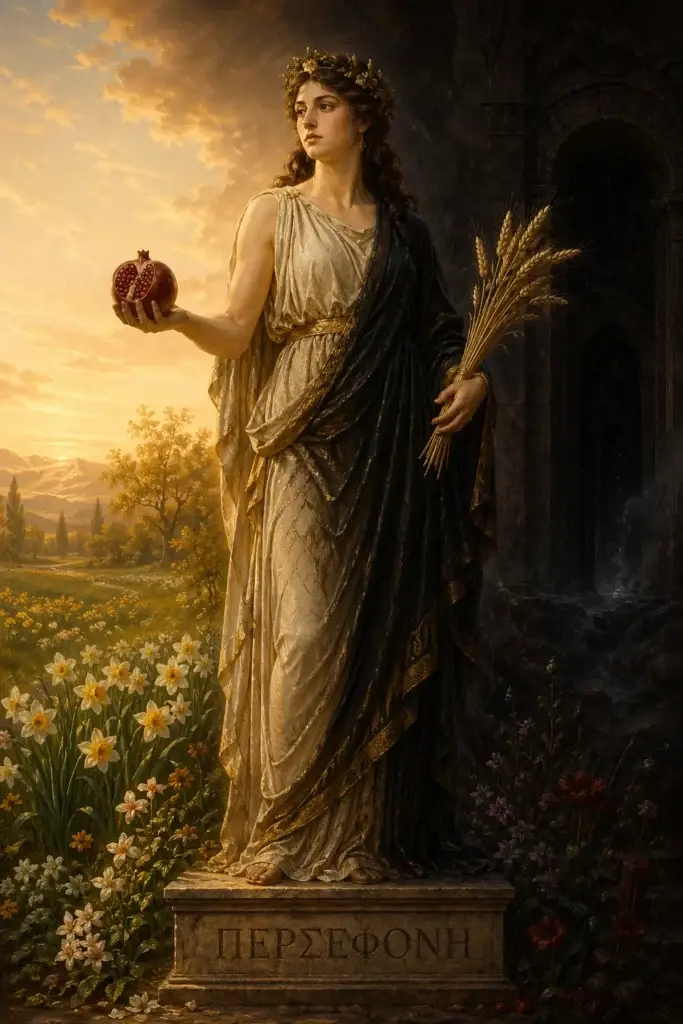
Main attributes: pomegranate, torch, wreath of grain
Main cult sites: Eleusis, Lokroi Epizephyrioi, Sicily (Enna)
Roman equivalent: Proserpina
Context
Period of the Texts
Persephone myths are attested in literature from Homer onward (8th century BC); the main myth (abduction by Hades) is recounted in detail in the Homeric Hymn to Demeter.
The Eleusinian Mysteries, one of the most important mystery cults of the ancient world, centred on the mother-daughter story of Demeter and Persephone. They ran continuously for almost 2000 years, until Theodosius closed them in 392 AD.
Area of Distribution
Most important cult site: Eleusis near Athens (the most famous mysteries). In addition: Sicily (Enna as the setting of the abduction), Lokroi Epizephyrioi (a southern Italian special cult with pinakes), Corinth, Thebes. In the Hellenistic-Roman period, the identification of Persephone as Proserpina spread throughout the Mediterranean region.
Source Situation
Central sources: the Homeric Hymn to Demeter (the longest ancient account of the myth), Hesiod’s Theogony, the Hesychius glosses on the Eleusinia rites, the Lokroi pinakes (clay relief tablets), Pausanias’ Description of Greece (Eleusis chapter).
Secondary literature: Burkert, Ancient Mystery Cults; Foley, The Homeric Hymn to Demeter; Clinton, The Eleusinian Mysteries.
Name
Persephone is depicted as a dignified woman, often with a crown or diadem, frequently enthroned beside Hades. Her attributes are the pomegranate (symbol of her bond to the underworld), the torch (Demeter searched for her with a torch), poppy and grain.
In the underworld she wears regal garments; during her stay on earth she is depicted as young and blooming.
Characteristics
Persephone reigns together with Hades over the underworld. She is not cruel but just; she hears the petitions of the deceased and urges her consort toward kindness.
At Eleusis, mystery rites were performed that re-enacted Persephone’s descent and return and promised believers hope of redemption in the afterlife. Persephone’s return from Hades to the earth heralds spring; her departure into the depths heralds autumn. Her story interprets suffering as necessary and transforms it through dignity.
Appearance and Symbolism
Persephone is depicted as a beautiful, elegant woman, sometimes young and adorned with flowers (as Kore), sometimes more mature and crowned with a tiara (as queen of the underworld).
The pomegranate is her primary attribute, the fruit whose seeds she ate and which sealed her bond to Hades. The torch (like Demeter’s) symbolizes her journeys of return between the worlds.
Grain and poppy are sacred to her, as is the narcissus (the flower she was picking when Hades abducted her). Her colour varies: white or cream as a maiden, dark red or black as queen of the underworld. She embodies transformation itself, not loss or restoration, but the experience of both states.
Profile: Persephone
The most important aspects of Persephone at a glance. The following fields summarize origin, function, appearance, veneration, symbols and parallels.
Persephone is the daughter of Zeus and Demeter. In the central myth she is forcibly abducted by Hades, the ruler of the underworld; her mother Demeter searches for her in despair and lets the vegetation wither.
Eventually a compromise is brokered: Persephone spends one third of the year with Hades (winter) and two thirds with Demeter (summer). The pomegranate she eats in the underworld binds her to Hades.
Queen of the underworld (Kore aspect vs. Persephone aspect, maiden and ruler). In the Eleusinian tradition, a mediator between life and death; the mysteries promised the initiated a happy afterlife under her patronage.
Connection with the fertility cycle: the growth and withering of the plant world through her presence and absence on earth. In Sicily, protective goddess of maidens.
Young woman, often with a pomegranate in her hand, a wreath of grain or a torch. In her underworld form, enthroned beside Hades, often with a serious facial expression.
On the Lokroi pinakes she is frequently depicted in the scene of the wedding with Hades. As Kore (maiden) with a polos crown (tall cylindrical headdress). Frequently accompanied by Hecate (with a torch) and Hermes (as escort back to the upper world).
Area of effect: Persephone was central to the Eleusinian Mysteries; initiates from across the Mediterranean travelled to Eleusis to experience the nine-day secret rite.
In personal cult she was invoked by women before marriage (the aspect of the maiden passing into a new phase of life). In the cult of the dead, she was patroness of the deceased; grave goods with pomegranate symbolism are common in Greek graves.
Pomegranate (the symbol of the bond to the underworld), torch (Demeter’s search), wreath of grain (vegetation aspect), polos crown, asphodel (the flower of the underworld), sword (Lokroi tradition). Plants: pomegranate, ears of grain, asphodel, poppy. Sacred animals: snake.
Proserpina (Rome, a nearly identical adoption), Inanna/Ishtar (Mesopotamia, descent to the underworld), Ereshkigal (Mesopotamia, queen of the underworld), Hel (Germanic, ruler of the underworld), Sita (Hinduism, connection to the earth, disappearance into the earth), Izanami (Japan, creator goddess trapped in Yomi).
Practical Defence
Rituals of Defence
Persephone, the ruler of the underworld, was the object of conciliatory rather than defensive rites. Because her name was spoken with caution in everyday life, she was often referred to euphemistically as Kore, “the maiden”, a linguistic form of reverence toward the chthonic powers.
In the Eleusinian Mysteries, the focus was not on defence but on the hope for a good lot in the afterlife.
A markedly apotropaic tradition is formed by the Orphic-Bacchic gold tablets: thin, inscribed gold leaves placed in the graves of the deceased, containing instructions for the path through the underworld as well as addresses to Persephone. They were meant to secure the deceased’s passage, a protective object in the literal sense.
Invocations
The Eleusinian Mysteries offered the most important cultic way of standing on good terms with Persephone and Demeter: initiates hoped to gain a better lot after death from them. In addition, the Orphic gold tablets contain formulas that put the correct address to the queen into the mouth of the soul in the underworld, so that it will be received graciously. The myth of the pomegranate, whose seeds bound Persephone to the underworld, also served as a warning to be wary of food from the realm of the dead.
Amulets and Protective Symbols
This section will be filled with further material from the history of religion.
Cult and Veneration
Persephone was central to the Eleusinian Mysteries, perhaps even more so than her mother Demeter. Her abduction and return were dramatically re-enacted, and initiates experienced this journey in ritual form. The Anthesteria, a festival for Dionysus with commemoration of the dead, was a time when the boundary between life and death became thin.
Women prayed to Persephone during puberty and marriage, as patroness of the transition into womanhood. The Kore depiction was venerated as patroness of virginity; the Hades queen as patroness of marriage and motherhood. Priestesses conveyed her duality, not as contradiction, but as integration.
Persephone, Parallels in Other Cultures
Similar underworld goddesses are found in other cultures: Inanna/Ishtar (Mesopotamia) likewise passes through the underworld; Izanami (Japan) rules over the realm of the dead. Persephone’s pomegranate episode recalls Celtic underworld enchantments and Indian abduction myths. The annual-cycle aspect connects her with vegetation deities such as Osiris or Dionysus.
The Abduction of Persephone in the Homeric Hymn to Demeter
The most detailed ancient account of Persephone is found in the so-called Homeric Hymn to Demeter, a text that probably originated in the 7th or 6th century BC. It describes how the maiden, mostly called Kore in the hymn, meaning simply the maiden, is picking flowers in a meadow.
As she reaches for a particularly beautiful narcissus, the earth opens and Hades abducts her on his chariot into the underworld.
Demeter searches for her daughter across the whole earth for nine days and finally learns from Helios, the all-seeing sun god, what has happened.
Out of anger and grief she withdraws from the gods, lets the fields become barren and threatens to let the human race starve. Only this forces Zeus to relent and to send Hermes into the underworld to bring Persephone back.
The episode with the pomegranate seed is decisive. Before Persephone leaves the underworld, Hades gives her a pomegranate seed to eat. Whoever has tasted the food of the dead is bound to the underworld. Thus arises the compromise that Persephone must spend part of the year with Hades and part with her mother.
The hymn thereby connects the myth directly with the change of the seasons and with the growth and decay of vegetation. At the same time it forms the foundation myth for the Eleusinian Mysteries, whose establishment the text attributes to Demeter herself.
Queen of the Underworld
As much as the abduction myth shapes the image of Persephone, in lived Greek religion she is above all the ruler of the realm of the dead.
At Hades’ side she reigns over the deceased, and in this role she appears more frequently and more reverently than in the figure of the abducted maiden. The Greeks sometimes spoke her name only reluctantly and referred to her in circumlocution, for instance as the Hagne, the Pure One, or simply the goddess.
In this function Persephone appears in numerous literary scenes. In the Odyssey it is Persephone who sends up the hosts of the dead to Odysseus and drives them away again.
In the Orpheus myth it is she who is moved by the singer’s song and grants the return of Eurydice. In curse tablets, the so-called defixiones placed in graves, she is invoked as a power that commands the shades.
This dual role, daughter of the vegetation goddess and mistress of the dead, has long occupied scholarship. In his Greek Religion, Walter Burkert emphasized that both aspects belong together: the grain must go into the earth, down into the dark, so that new life can arise.
Persephone thus embodies not two unconnected functions but the connection between death and fertility, which was directly experienced in agriculture. The dignity with which the Greeks approached her in her underworld role shows that she was understood less as the victim of a crime than as a serious cosmic power.
Persephone in the Eleusinian Mysteries
The sanctuary of Eleusis near Athens was the most significant place of Persephone and Demeter veneration in the Greek world.
There, the Eleusinian Mysteries were celebrated over more than a thousand years, an initiation cult that promised the initiated, the mystai, a better prospect for their fate after death. The Hymn to Demeter traces the foundation of this cult back to Demeter’s search for her daughter.
Little is known about the precise course of the secret rites, because the initiates were sworn to silence and adhered to it remarkably consistently.
The outer framework is certain: a procession from Athens to Eleusis along the Sacred Way, periods of fasting, a special drink, the kykeon, and nocturnal celebrations in the Telesterion, the great initiation hall. At the centre stood, apparently, the presentation or re-enactment of the fate of the two goddesses, from separation to reunion.
Scholarship has long debated what was actually promised to the initiates there and what the experience consisted of. Ancient testimonies from Pindar to Christian authors suggest that the mysteries offered consolation in the face of death.
Persephone’s return from the underworld served as an image for the hope that human death, too, is not the final word.
Sober assessment requires admitting that we do not know the central act of display. All modern interpretations, from rationalist ones to those that suspect a plant-based intoxicant in the kykeon, remain hypotheses that work against a deliberately incomplete source situation.
Iconography and Cult in Sicily and Southern Italy
In the visual arts, Persephone appears in two basic types. As Kore she is a youthful female figure, often with ears of grain, a torch or flowers, scarcely distinguishable from other young goddesses.
As queen of the underworld she is enthroned beside Hades, often with a sceptre, sometimes with the pomegranate as attribute. Vase paintings of the 5th and 4th centuries BC repeatedly show the abduction by Hades, the chariot, the open earth and the searching Demeter.
Veneration was especially dense in Sicily and in the Greek cities of southern Italy. Sicily was regarded as the preferred setting of the abduction; the area around Lake Pergusa near Enna was identified with the flower meadow.
In Lokroi Epizephyrioi in Calabria, a large number of clay tablets were found, the so-called pinakes, which show scenes from the Persephone myth and her cult. They provide a rare insight into the world of ideas of a local community and there also connect Persephone with marriage and married life.
The importance of Persephone in this region is connected with the economic structure. Sicily was one of the great granaries of the ancient world, and a goddess responsible for grain and for the realm beneath the earth had a firm place here.
In his speeches against Verres, Cicero reports at length on the famous sanctuary of the goddess near Enna and on the sacrilege of the Roman governor against it. Such testimonies show that Persephone was not merely a figure of poetry but a power whose sanctuaries still possessed prestige and wealth in Roman times.
Further Links
Sources and Literature
In Greek mythology, Persephone embodies the change of the seasons: as daughter of Demeter and consort of Hades, she divides her year between the upper world and the underworld and is venerated as Kore in the Eleusinian Mysteries.
Frequently Asked Questions about Persephone
Who is Persephone in Greek mythology?
Persephone (Roman Proserpina) is the daughter of Demeter (goddess of the harvest) and Zeus. The central myth: Persephone is abducted by Hades, the ruler of the underworld. Demeter grieves so deeply that the earth becomes barren.
Zeus mediates, and Persephone may spend two thirds of the year with her mother (spring, summer, autumn) and one third as queen of the underworld (winter). This myth is the religious explanation of the annual cycle and the basis of the Eleusinian Mysteries.
What were the Eleusinian Mysteries?
The Eleusinian Mysteries were the most important mystery cult of ancient Greece, practised over almost two thousand years (roughly 1500 BC to 392 AD).
In the sanctuary of Eleusis near Athens, initiates experienced the drama of Demeter and Persephone as initiation, as a promise that even death does not mean the end. The exact rites were the strictest secret (Eleusinian vow of silence). Famous initiates included Sophocles, Plato, Cicero, Augustus and Marcus Aurelius.