Hecate, Goddess of the Greek Tradition
By Ralf Ittermann · last reviewed on
Goddess of the crossroads, mistress of spirits and magic.
Hesiod already describes her as a goddess with power over sky, earth and sea. In the mystery cult and in the magic of the Hellenistic-Roman period she becomes a central recipient of invocations, especially at crossroads and on moonless nights.
From there she passes into late antique magical papyri and into the grimoires of the Middle Ages.
Hecate’s role in ancient magic
In the Hellenistic magical papyri (2nd to 4th century AD) Hecate appears as a central figure of invocation in conjurations, dream magic and protective rituals. The papyri PGM IV and VII (in Karl Preisendanz, Papyri Graecae Magicae, 1928, 1931) name her explicitly as a director of demonic forces and a mediator between worlds.
Her threefold form, with three bodies or three faces, is linked in these magical texts to her ability to be present in several realms at once. Ancient practitioners of magic invoked her to gain access to hidden knowledge or to secure protection in dangerous places.
The repeated epithets in the papyri (phosphoros, the light-bringing; chthonia, the subterranean; propylaia, she before the gates) point to an ambivalent deity whose power was effective yet not uncomplicated to handle.
Brief Profile: Hecate
Type: Goddess with a key demonological function
Origin: Pre-Greek or Carian, taken into the Greek pantheon at an early date
Texts: Hesiod, Orphic Hymns, magical papyri, Chaldean Oracles
Period: Archaic to late antiquity
Distribution: Greece, the Hellenistic world, the Roman Empire
Cult: Hekataia at crossroads, house entrances, temple forecourts
Classification
The earliest attestations are found in Hesiod (Theogony). Developed cult and invocation texts appear from the Hellenistic period onward. They are particularly dense in the Greek magical papyri and the Chaldean Oracles (2nd century AD). In the Byzantine period she remained alive as a demonological mistress.
Mythological classification
Hecate is one of the great deities of Greek mysticism and later of European occultism. She is goddess of magic, of transition, of boundaries and of the underworld. Originally Titanic, she attained high rank. She is threefold or appears in distinct forms. Her power exceeds categories.
Originally probably Asia-Minor and Carian. Firmly established in the Greek pantheon in the Archaic period. In the Hellenistic-Roman epoch pan-European, with a particularly dense cult in Athens, Miletus and Eleusis.
Abundant: literary (Hesiod, the tragedians, Apollonius), cultic (Hecataeon statuettes, inscriptions), magical (magical papyri, defixiones) and philosophical (Chaldean Oracles, Neoplatonists).
Name and Variants
Greek: Ἑκάτη (Hecate).
Epithets: Trivia (“goddess of the three ways”), Phosphoros (light-bringer), Chthonia (of the underworld), Enodia (goddess of the way).
Functionally related figures: Artemis, Persephone, Selene, sometimes identified with her, sometimes clearly distinguished.
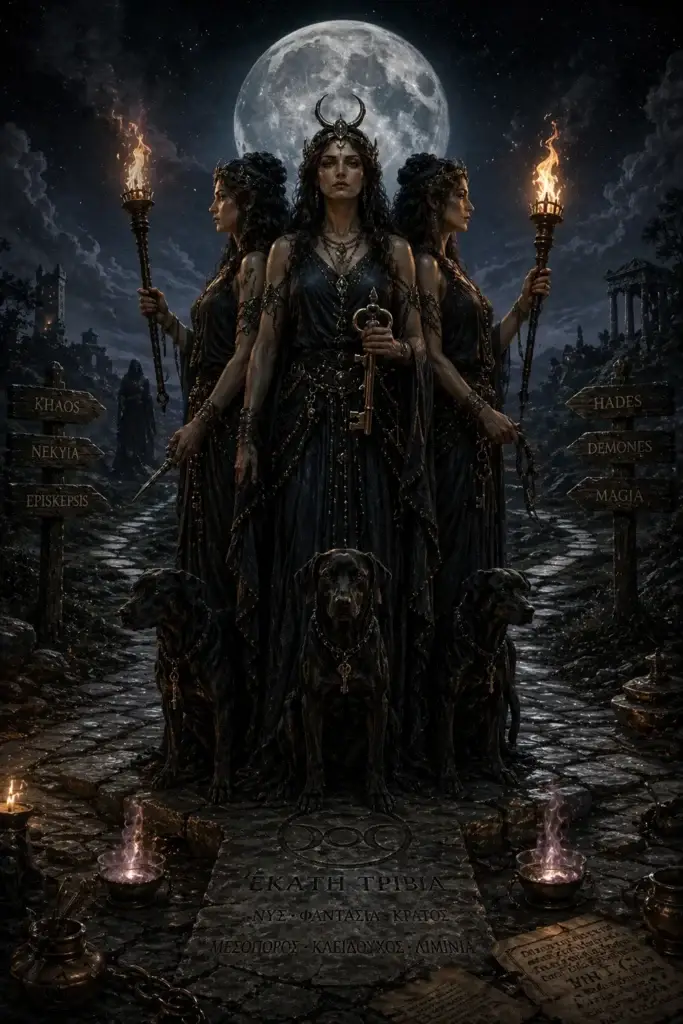
The name is formed in Greek as the female counterpart to Hekatos, an epithet of Apollo. Hecate’s frequent three-formed shape, three women back to back, is an important visual programme and signals her intermediate position between the three realms of sky, earth and sea.
Characteristics
Appearance
Three young women back to back, holding torches, keys, swords and serpents. Dogs as companions. In later reception increasingly darker in tone, with reference to the underworld and magic.
Behaviour
Hecate does not act demonically herself, but as an intermediary figure. She opens transitions, escorts souls, directs spirits. Whoever enters her domain, crossroads, the moonless night, magic, must reckon with her presence.
Sphere of influence
Crossroads, thresholds, graves, the sea. The liminal is her element: everything that does not clearly belong to a single place or state.
Mythological origin
In Hesiod, daughter of Perses and Asteria, granddaughter of Titans. She is thus older than the younger Olympians, while being especially honoured by Zeus. In mythic narrative she retains an independent position that is not fully integrated into the Olympian hierarchy.
Appearance and symbolism
Hecate is depicted as a torch-bearing woman at crossroads, often threefold. She carries a torch, a key and sometimes a dagger. The dog and the colour red are sacred to her. Crossroads are her domains. Power radiates from her.
Hecate in Roman and private reception
The Romans adapted Hecate as Trivia, the threefold goddess of the forks in the road and of those who roam at night. Under this name she was venerated in household cults, especially as protector of boundaries and of domestic order. In the Metamorphoses Ovid describes her connection to sorcery and lost things.
Private mystery cults of the late Empire integrated her into syncretic theurgies that mixed Greek, Egyptian and Eastern elements.
The Roman adaptation shifted the emphasis: less the cosmological being of transition, more the practical guardian of doors, junctions and nocturnal operations. Tomb inscriptions from Rome and the provinces name her as a protective deity against curses and evil spirits.
Profile: Hecate
The most important aspects of Hecate at a glance. The detailed account of her name, description, cult and parallels can be found in the following sections.
Daughter of the Titan Perses, a Titanic power. Honoured by Zeus, but never fully incorporated into the Olympian order.
Magicians, travellers, the dead, witches and lovers. All those whose concerns lie at thresholds or in the liminal.
Three-formed goddess, back to back, with torches, keys, serpents. Dogs as companions. In later tradition coloured darker and more magical.
Opens thresholds, escorts souls, empowers or threatens magicians. Rarely openly harmful, more dangerous through withdrawal or through the withholding of protection.
Not defence but invocation and reconciliation: Hekataia at crossroads, offerings (black animals, eggs, flat cakes), ritual meals at the end of the month (“Hecate’s supper”).
Diana Trivia (Rome), Ereshkigal (Mesopotamia, partly identified with her in the magical papyri), Persephone; later, in the Kabbalah, Lilith associations, and in the modern Wicca tradition as a mother goddess.
Cult and Magic
Cultic rituals
On the last day of each month a meal was set out for her at crossroads, leftovers, eggs and flat cakes, which the family left behind to offer to the goddess and her retinue. House entrances bore small Hekataia, niches with a three-formed figure and a lamp.
Conjurations
The Greek magical papyri contain numerous invocations of Hecate. The Chaldean Oracles develop a philosophical and mystical theology in which Hecate becomes the world soul. Defixiones invoke her against opponents, love spells ask her to bind two people together.
Amulets and protective symbols
Hecate statuettes with torches and keys; the “wheel of Hecate” (strophalos) as a magical instrument; Hecate dogs as apotropaic images. The famous columnar depiction of the three-formed Hecate shapes the conception of her into modern times.
Parallels and Afterlife
Rome: Diana Trivia unites Diana’s woodland function with Hecate’s three-way nature and nocturnal aspect. Roman magic takes over many motifs directly.
Late antiquity and the Middle Ages: In the Byzantine tradition Hecate remains present in folk magic and philosophical literature. Medieval grimoires take up elements of her cult, often reinterpreting them, in Christian opposition, as a demonic figure.
Modern era: In the Neopagan movement, and especially in Wicca, Hecate is present as one of the “Triple Goddesses.” Her role as goddess of magic and of the threshold is largely preserved in this.
Hecate in modern Wicca and esoteric tradition
The contemporary Wicca movement, especially through Gerald Gardner’s work from the 1950s onward and later authors such as Doreen Valiente, rehabilitated Hecate as a goddess of female power and of magic.
Robert Graves’ The White Goddess (1948) shaped an influential interpretation that placed Hecate within a triple-goddess system (maiden, mother, crone), a structure that became ubiquitous in modern paganism.
This reading, however, diverges considerably from ancient sources. Contemporary witchcraft traditions emphasise Hecate’s autonomy, her connection to the boundary between life and death, and her function as a mistress of the knowledge of transition.
She is often understood not as a punishing goddess but as a teacher of occult practices and a protector of those who travel between worlds.
Hecate in Hesiod's Theogony
The most detailed and at the same time most unusual early appreciation of Hecate is found in Hesiod’s Theogony. There the poet devotes a strikingly long and laudatory passage to her, a so-called hymn within the epic of the gods.
Hecate appears here as daughter of the Titans Perses and Asteria and thus as a member of the Titan generation, which is older than the Olympian gods.
It is remarkable that Hesiod does not portray her as a subjugated or displaced Titaness. On the contrary: he stresses that Zeus honours her and that she retains a share in sky, earth and sea.
She can grant people success and prosperity, in the public assembly, in court, in war, in athletic contest, in animal husbandry and in fishing. She thus appears as a far-reaching, almost universal benevolent power.
This Hesiodic passage has been much discussed in scholarship because it is difficult to reconcile with the later image of Hecate.
Some scholars have suspected that the section is a later interpolation; others see in it a reference to a particular, perhaps regionally rooted cult to which Hesiod was close; a connection to Asia Minor, where Hecate was later strongly venerated, is frequently considered.
What is certain is that the earliest detailed testimony about Hecate shows her as a respected, versatile and helpful goddess and not as the uncanny figure she became in later tradition. This tension is an important starting point for any understanding of the goddess.
Goddess of the Crossroads and the Thresholds
In lived Greek cult, Hecate was associated above all with transitions, boundaries and thresholds. Her proper place was the crossroads, especially the three-way fork, which is why she bore the epithet Trioditis or, in Latin, Trivia.
At such places small sanctuaries were erected to her and food offerings were regularly laid out, the so-called Hecate meals, which were presented at the end of the month.
The house door, too, was a place of Hecate. Before the entrances of houses stood Hecate columns or Hecate images, the Hekataia, which were meant to protect the house.
Hecate thus belonged to the deities frequently invoked in everyday life, not because they were feared but because their protection was sought at vulnerable points. In Greek thought the crossroads and the doorway threshold are places of transition and therefore places of heightened danger; a goddess who governs these places can offer protection there.
Many further traits of Hecate can be understood from this threshold function. She becomes the companion of nocturnal apparitions, the mistress of spirits and restless dead, because these too dwell in the border regions.
Her connection to dogs, which are sacred to her and were sacrificed to her, fits this picture, as does her torch, with which she lights up the darkness of the threshold.
Religious studies sees in Hecate a clear example of a deity of the border regions, whose seemingly contradictory aspects can be explained from this single basic function.
Hecate in Magic and Theurgy
In the Hellenistic and Roman periods Hecate moved to the centre of the magical imagination. In the surviving magical texts, above all in the Greek magical papyri, she is frequently invoked.
There she appears as a powerful, three-formed goddess of the night, of spirits and of the underworld, associated with the moon, with dogs and with figures of terror.
In the literary depiction of sorcery, too, for example with the sorceress Medea or with the witch in Theocritus’ poem, Hecate is the goddess whom the practitioner of magic invokes.
A field of its own is theurgy, a religious-philosophical current of late antiquity that sought through ritual practices to establish a connection to the world of the gods. In the Chaldean Oracles, a collection of didactic verses from the 2nd century AD, Hecate occupies a prominent cosmological position.
There she is understood as a kind of world soul or as a mediating power between the highest spiritual reality and the material world. The late antique Neoplatonic philosophers took up these ideas and developed them further.
For religious studies this development is particularly interesting because it shows how adaptable a deity could be. Out of Hesiod’s versatile, helpful goddess and the approachable threshold goddess of the classical cult, late antiquity made a cosmic power of learned theology and at the same time the central figure of practical magic.
This is not a falsification but an unfolding of various possibilities that were present from the outset in Hecate’s connection with night, boundary and transition.
Sources and Literature
Within the pantheon of the Greek gods, Hecate occupies an independent position as a deity of the crossroads, of the night and of the mysteries.
Already in Hesiod’s Theogony she is portrayed as a god to whom a share is granted across the realms of sky, earth and sea. In the Hellenistic period her cult image becomes connected with magic, dog cult and threshold symbolism.
Frequently Asked Questions about Hecate
Who is the goddess Hecate?
Hecate is a Greek goddess of the crossroads, of magic, of the moon and of the underworld. Hesiod describes her as a Titanic power whom Zeus allowed to rule over all spheres, sky, earth and sea. In later antiquity and in modern esotericism, Hecate is regarded as the patron of female magicians, midwives and those who cross thresholds.
Which symbols belong to Hecate?
Among the classic Hecate symbols are the triple torch, the key (as guardian of the gates to the otherworld), the whip, the dagger, the dogs (especially black bitches) and the threefold form. In the medieval and early modern magic tradition, the Hecate crossroads is a central ritual motif.