iWell Guard

Andean Cultures, Inca, Pachamama and Chakana

The Andean region, from Colombia to northern Chile, has been home to complex advanced cultures since the third millennium BCE: Caral, Chavín, Moche, Nazca, Wari, Tiwanaku and finally the Inca.

Quechua- and Aymara-speaking communities still maintain religious traditions today in which the earth mother Pachamama, the sun deity Inti and the mountains (Apus) form central points of reference.

Andean protective practice is discussed in a section of its own.

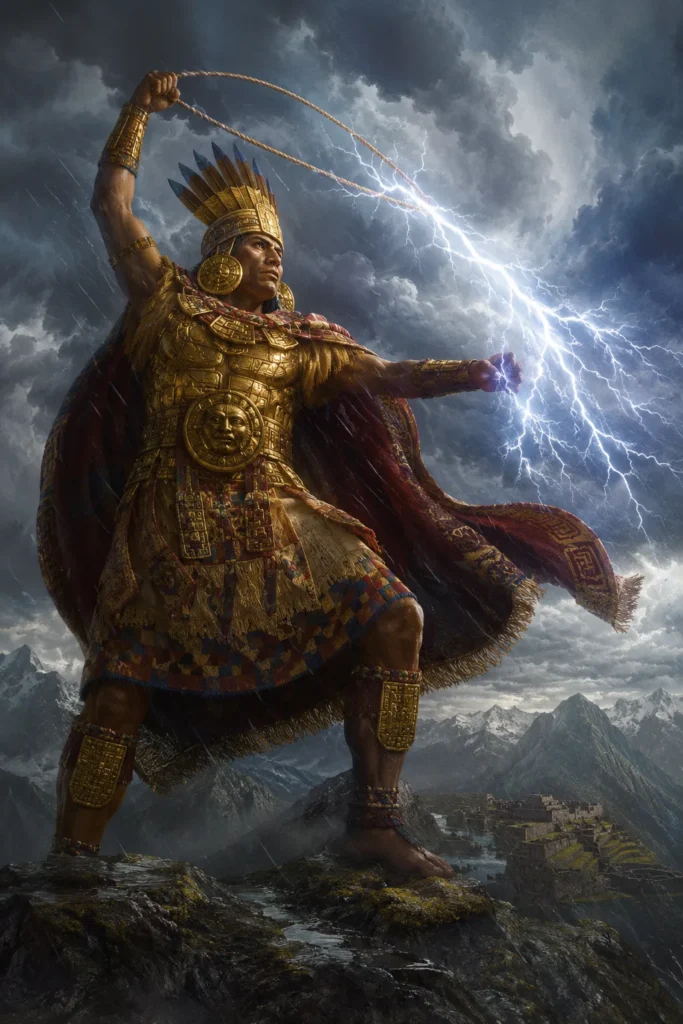
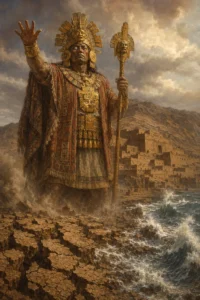
Illapa - gods from the Andes-Inca tradition, historical illustration

Historical Phases, Pre-Inca and Inca

Long before the Inca, Andean societies developed religious complexes: Caral as the oldest temple site in the New World (from around 2600 BCE), Chavín de Huántar (1200 to 500 BCE) with the Lanzon stele as its central cult object, Moche (100 to 800 CE) with huaca pyramids and sacrificial practice, and Tiwanaku on Lake Titicaca as a cosmological center with its Sun Gate and Viracocha iconography.

The Inca (about 1438 to 1533 CE) understood themselves as the successors and synthesizers of these traditions.

Inti, Pachamama, Viracocha: the Inca Pantheon

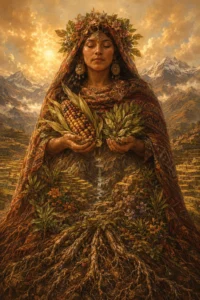
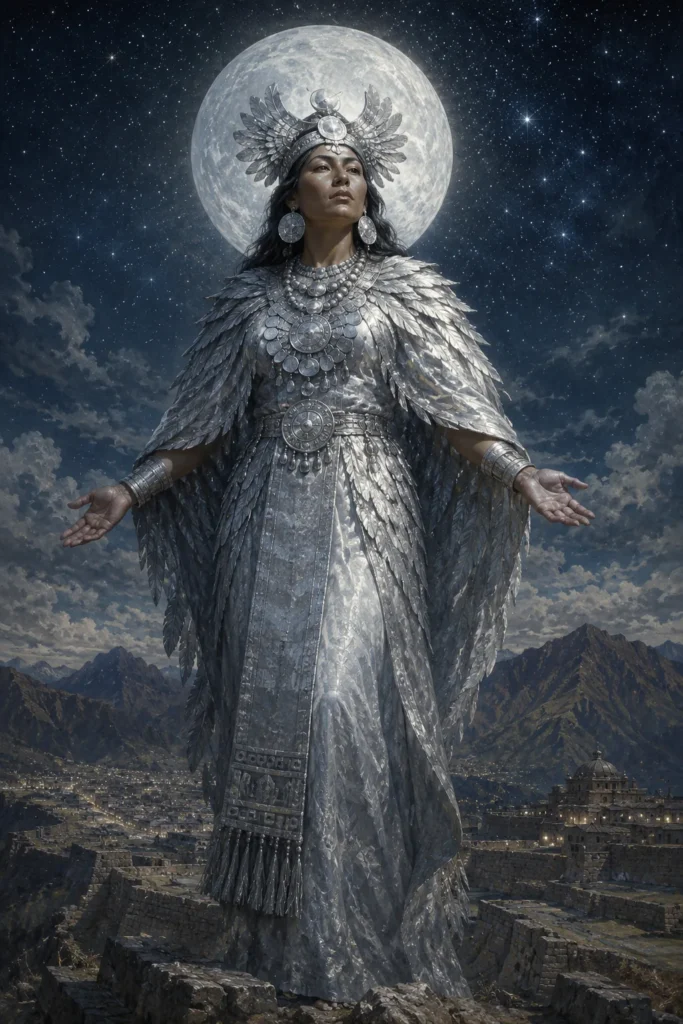
Inti, the sun god, is regarded as the father of the Inca ruling dynasty. Pachamama (Mother Earth) is the central female deity, responsible for the fertility of the fields and the animals.

Viracocha appears as the creator of all things; he rose from Lake Titicaca, formed the sun and moon, and created humankind. Mama Killa (moon goddess) is the sister and consort of Inti. Pachakamak is a distinct pan-Andean deity (earth, earthquakes); his sanctuary near Lima was a place of pilgrimage over millennia.

Apus, the Mountains as Living Beings

In Andean thought, the mountains (Apus) are not features of the landscape but living beings with personality, gender and hierarchy. Important Apus include Ausangate (Cusco region), Salkantay, Illimani (La Paz), Huayna Picchu and Chimborazo (Ecuador).

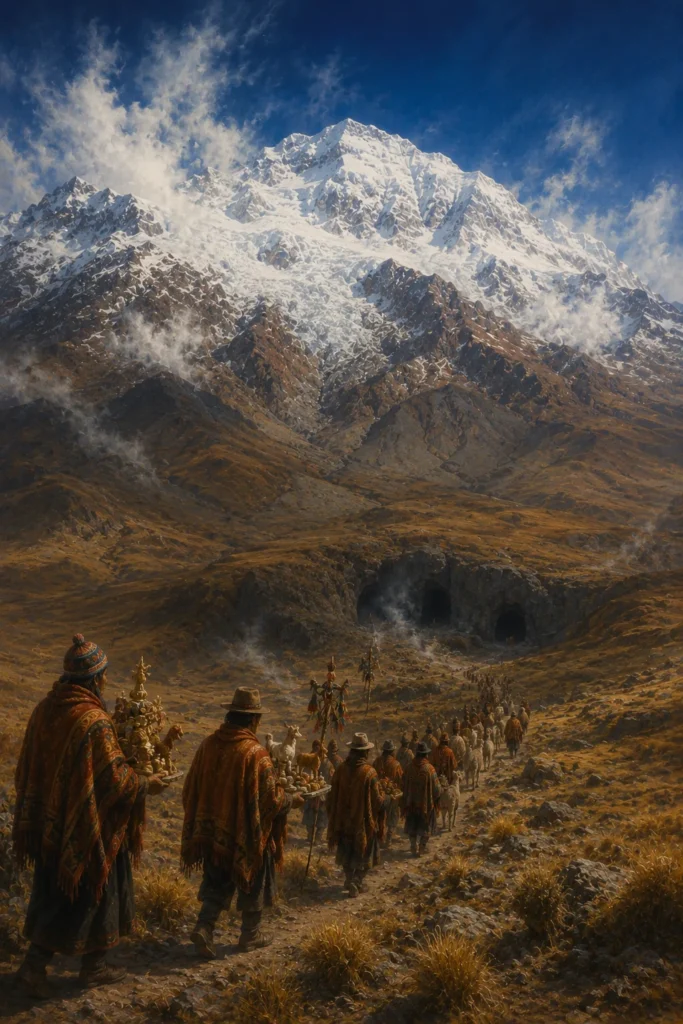
They are honored with despacho offerings (ceremonial bundles containing coca leaves, corn silk, sweets and sweet wines). This practice is still alive today in rural Quechua- and Aymara-speaking communities.

Chakana, the Andean Cross

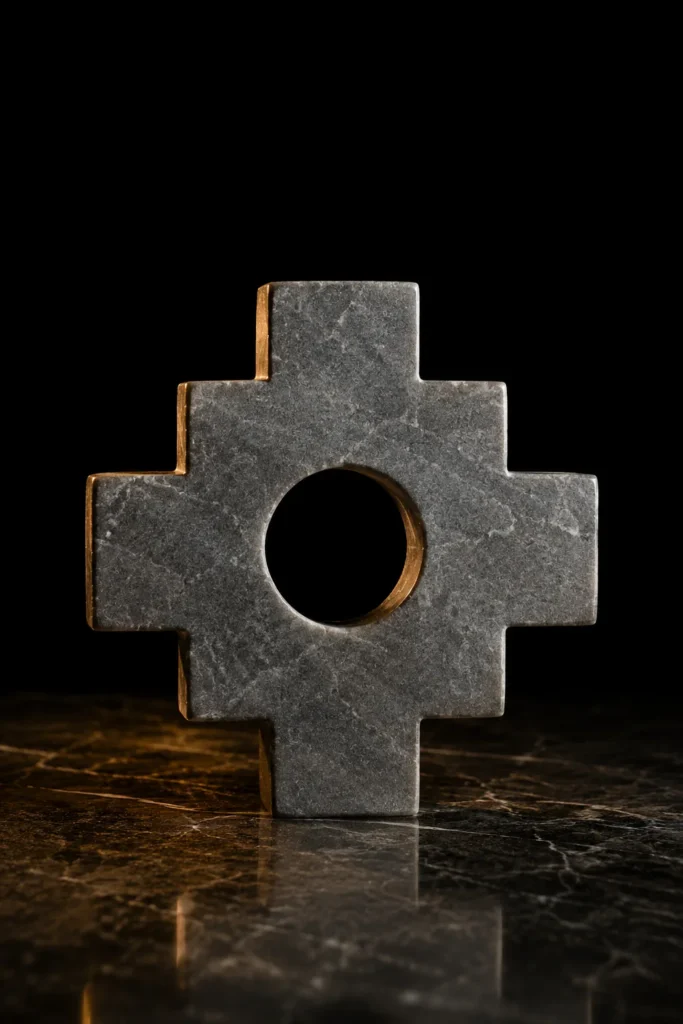
The Chakana, the stepped four-cornered Andean cross, is the most distinctive symbol of Andean cosmology.

It represents the three worlds, Hanan Pacha (the upper world, stars, gods), Kay Pacha (the middle world, humans) and Uku Pacha (the underworld, the dead, seed), as well as the four cardinal directions and the central virtues (Ayni, reciprocity; Munay, love; Yachay, knowledge; Llank’ay, work). Portable silver Chakana pendants are widespread today.

Protective Objects: Aguayo, Despacho, Mesa

Protective and ritual objects: the aguayo (a woven cloth of alpaca or sheep wool with symbolic patterns, worn, used as a carrying cloth and in ceremonies), despacho bundles (ritual offering packages for Pachamama), and the mesa (a ritual table with stones, feathers and figurines).

Coca leaves are ubiquitous: consecrated, chewed, burned as incense, and laid out as an oracle (coca reading). Quipus (knotted cords) originally served administrative purposes but also had a ceremonial function.

Spanish Conquest and Syncretism

With the Spanish conquest (Pizarro, 1532), the Inca religion was officially suppressed, yet in practice it was preserved through syncretism.

Andean popular piety today combines Catholic veneration of saints with Pachamama rituals: during Holy Week, pilgrims ascend to Apu Qoyllur Riti; on All Saints’ Day, despachos are prepared for the dead; and the Virgin of Copacabana is also Pachamama. In religious studies, this is a paradigm of the resilience of indigenous traditions.

Sources and Research

Important works: Frank Salomon and Stuart Schwartz, South America (Cambridge History of the Native Peoples); Catherine Allen, The Hold Life Has; Tom Zuidema on calendar structure; Gary Urton on quipus.

Spanish chroniclers: Garcilaso de la Vega (himself of mixed descent), Cristóbal de Molina, Bernabé Cobo. The sources are often colored by their colonial context and must be read critically.

Before the Inca: the Andean Cultures

Within the long history of the Andean cultural region, the Inca empire was a late and short-lived phenomenon. In its imperial form it lasted only about a century before the Spanish conquest. Before it, numerous cultures had developed over millennia, whose religious ideas the Inca empire in part adopted and in part reshaped.

Among the early centers is the temple complex of Chavín de Huántar in the Peruvian highlands, whose visual art spread widely around the middle of the first millennium BCE.

On the northern coast of Peru, the Moche later emerged with their expressive ceramics and their sacrificial rituals, as did the kingdom of Chimú with its great adobe city of Chan Chan. In the highlands around Lake Titicaca lay the center of Tiwanaku, whose monumental architecture and iconography strongly influenced later Andean thought.

These cultures shared basic features such as the veneration of mountains, water sources and ancestors, the importance of textiles as carriers of meaning, and a pronounced relationship between the living and the dead. At the same time, they differed considerably in language, political form and visual idiom.

The Inca themselves presented their rule in their own origin narratives and incorporated older sanctuaries into their own religious system. Research therefore stresses that much of what is regarded as typically Inca rests on older Andean foundations. Related topics are treated in the hub Mythology of Mesoamerica.

The Andean Worldview: huaca, ayllu and Reciprocity

In Andean thought, the landscape itself is animate. Mountains, rocks, springs, lakes and special places are regarded as huaca, as carriers of a power of their own and as recipients of veneration.

The high mountain peaks, called apu, are regarded as powerful protective beings who watch over weather, herds and people. This idea closely links religion with the concrete geography of the highlands.

The earth is addressed as Pachamama, a female principle of fertility and nourishment. The term pacha denotes both space and time, so that a precise translation is difficult.

A widespread division of the world distinguishes an upper, a middle and a lower sphere, which are conceived not strictly as good and evil but as interrelated domains.

The basic unit of society was the ayllu, a kinship and economic group bound together by common ancestors, common land and common sanctuaries.

Religious practice and social order can scarcely be separated here, because the ancestors, often preserved as mummified bodies, continued to be regarded as members of the community and were included in festivals.

A guiding principle is reciprocity, the regulated mutual exchange. Among people it is expressed in labor obligations and the exchange of gifts; between people and powers it takes the form of offerings.

A common form is the despacho or earth offering, in which selected objects, leaves and foods are assembled into a bundle and presented to the earth or to the mountains. Reciprocity is thus not a mere custom, but the basic pattern according to which the relationship between human beings and the cosmos is conceived.

Sources: chronistas and khipu

The Andean cultures had no book script in the narrower sense. The most important means of record was the khipu, a system of knotted cords used above all to record numbers, administrative data and probably also narrative content.

Research can largely read the number-related khipu, while a possible narrative use remains disputed. For religious history, this means that there is no indigenous textual tradition comparable to the Mesoamerican one.

The main written sources therefore date from the colonial period and were composed by Spaniards or by Andeans trained in the Spanish literary tradition. Among the early chroniclers are Pedro de Cieza de León and Juan de Betanzos.

Especially valuable is the extensive work of Felipe Guamán Poma de Ayala, an indigenous author who around 1615 composed an illustrated chronicle with sharp criticism of colonial rule. The mestizo Inca Garcilaso de la Vega, in turn, wrote from the perspective of his half-Inca descent.

A distinct group of sources are the so-called idol-extirpation records. In the seventeenth century, ecclesiastical campaigns in the archdiocese of Lima conducted systematic proceedings against Andean cults.

The resulting interrogation records, for example in the circle of Francisco de Ávila, provide, against their intention, detailed descriptions of local religion, including the text of Huarochirí written in the Quechua language, one of the few indigenous collections of Andean myths.

All of these sources are colored by the circumstances of their creation. The chroniclers fitted Andean ideas into European categories, and the extirpation records arose under coercion.

Modern research, such as the work of Frank Salomon or Sabine MacCormack, therefore reads them critically with regard to their sources and supplements them with archaeology and with ethnographic fieldwork in present-day Andean communities.

Andean Religion in the Present

The Spanish conquest and the subsequent missionary efforts did not extinguish Andean religion but forced it into new forms. In many highland communities of Peru, Bolivia and Ecuador, practices persist to this day that combine older ideas with Catholicism.

Saints of the Church are linked with mountains and places, and pilgrimage festivals coincide with the agricultural and festal calendar.

Earth offerings to Pachamama and to the mountains remain widespread, especially at the beginning of the planting season, at the building of a house, or at the start of important undertakings.

Specialists, known under various designations in the Quechua- and Aymara-speaking regions, carry out such rites, interpret signs, and treat illnesses understood as a disturbed relationship with places and powers.

Some of these practices have, in recent decades, entered the tourist and esoteric market. Terms such as Pachamama or Apu are marketed internationally, and ceremonies are staged for paying visitors. Religious studies here calls for a distinction between the lived practice of local communities and its commercial appropriation.

At the same time, the Andean tradition has gained political significance. In Bolivia and Ecuador, terms such as Pachamama and the ideal of the good life, sumak kawsay or suma qamaña, have entered constitutional texts and political programs.

How far this reflects lived religion, or is rather a state symbolic project, is discussed controversially. An appropriate account thus presents Andean religion as a living, contested and regionally very diverse field, not as a lost Inca heritage.

Related key terms: Pachamama Inti Viracocha Mama Killa Apus Chakana Aguayo Quechua Aymara Cusco Tiwanaku Sacsayhuamán Despacho.

Protective Objects in this Cultural Tradition

Andean cultures, from Chavín to the Inca, use Chakana pendants, aguayo weavings, despacho bundles and coca leaves as portable protective objects; the Apus mountains are venerated with stone cairns (apachetas) along the paths.

iWell Guard takes its place within this cultural-historical line of portable protective objects, in a contemporary material architecture, made in Germany. 41 layers, solid gold, platinum, silver. 30-day right of return.

Personal experiences may vary. Not a medical device. No promise of healing.

iWell Guard is not a medical device and does not replace medical or psychotherapeutic treatment. The religious-studies content is cultural-historical contextualization, not a recommendation for spiritual practice.

Protective Symbols from the Andes

The encyclopedia of protective symbols covers several signs and objects from the Andes on dedicated pages: Chakana. A cross-cultural overview is offered by the page on protective symbols.