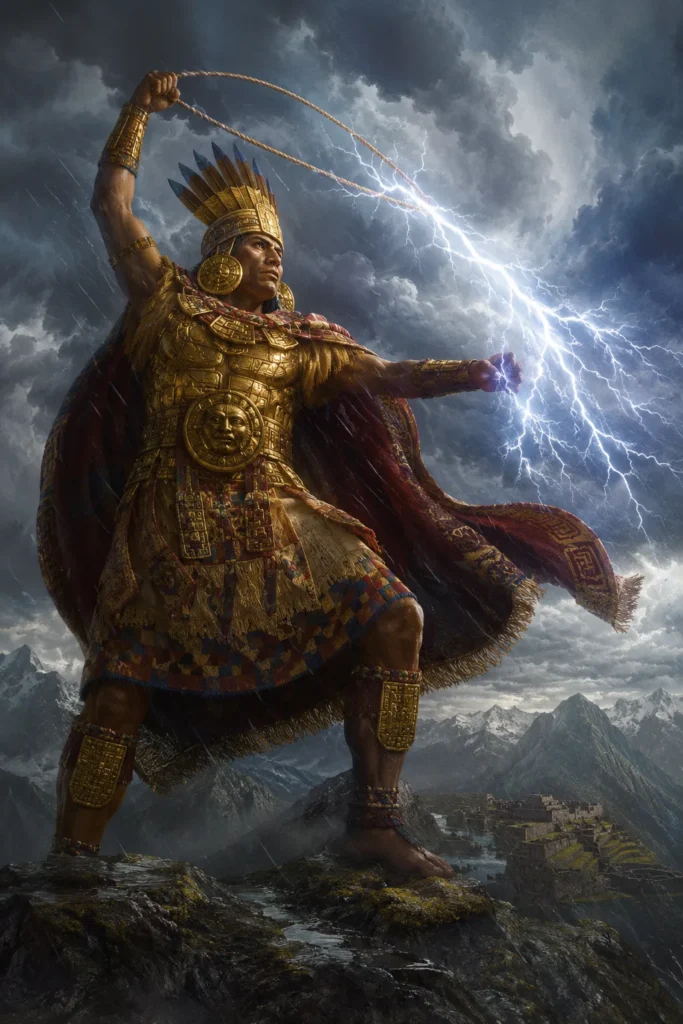
Illapa (Quechua Illapa, also Yllapa) is the god of thunder, lightning, and rain of the Inca. For the Andean farming communities of the highlands, he was the most important high deity in everyday life, as all maize and potato cultivation depended on his rainfall.
Illapa, the Inca god of thunder, is a central figure of the weather cult in pre-Columbian Andean civilization.
Illapa ranks alongside Inti, Viracocha, and Mama Killa among the four highest deities of the Inca state cult. He has his own temple area in the Coricancha of Cusco, and his insignia, thunder bolts and slings, were preserved in the pre-Hispanic collection of mallqui mummies.
In terms of religious studies, he belongs to the widespread thunder-and-storm deities that occupy a prominent place in nearly every agrarian high culture.
Unlike the state-imperial Inti cult, the veneration of Illapa remains alive to this day in modern Quechua- and Aymara-speaking villages. The rural practices surrounding lightning, thunder, and rain form an important part of ongoing religious practice in the Andean highlands.
Catherine Allen, Joseph Bastien, and Frank Salomon have repeatedly pointed out in their ethnographic works that Illapa is often more present for the farmer than the higher solar theology of Inti.
Illapa is described in some sources as a triadic figure, a threefold form consisting of Chuqui Illapa (Brother Illapa), Catu Illapa (Brother Catu), and a third aspect that varies depending on the chronicler.
This triple form reminded the Spanish missionaries of the Trinity and encouraged in earlier religious studies the thesis of a pre-Christian intimation of the Trinity. Pierre Duviols has criticised this reading and pointed to the genuinely Andean multiple-form character of cosmic beings.
From an archaeological-iconographic perspective, the veneration of a thunder deity in the Andes reaches far beyond the Inca period. Wari ceramics show warriors bearing thunderbolts, and the Chimu culture of northern Peru knew a comparable thunder god under the name Ni, who was, however, more strongly associated with the maritime sphere.
This prehistory shows that the Inca state theology of Illapa did not emerge from nothing but was built upon a long Andean storm-and-thunder tradition.

The name Illapa is semantically ambiguous in Quechua. Diego Gonzalez Holguin, in his Vocabulario (1608), gives the following meanings: el rayo (lightning), el trueno (thunder), el relampago (sheet lightning). The word thus designates all three phenomena of atmospheric light as aspect-manifestations of a single deity.
Noteworthy is the close connection to the Quechua term illa, which designates a kind of luminous numinous quality (see also Illatiqsi Wiraqucha as an epithet of Viracocha). The root meaning of illa points to a bright luminous radiance that signals numinous presence. Illapa would accordingly be the numinous luminous flash across the sky.
In the Aymara region, the corresponding god is called Tunupa or Illapa, with regional variations. Colonial sources sometimes distinguish between Illapa (weather aspect) and Catu Illapa (hail aspect).
The Inca later incorporation of Illapa is also recognizable in Inca ruler epithets: the Inca Yupanqui Tupac bore the epithet Yupanqui-Illapa, expressing his connection to the thunder aspect of the deity.
In the most recent linguistic-historical studies of Quechua theology, the etymology of illa as radiance, reflection, luminous trace has been developed further.
Cesar Itier has pointed out that illa in Inca-period terminology does not merely refer to sheet lightning, but to a more fundamental numinous category: the flashing of a divine presence in the world. The small stone amulets illa (pastoral protective figurines) bear the same name, which illustrates the semantic depth of Illapa’s name.
Illapa is depicted in colonial descriptions as a celestial warrior who creates lightning by hurling a golden sling and strikes thunder with a club. He sometimes wears a star-studded cape and carries a water jug from which he pours the rain. This iconography is transmitted by Cristobal de Molina and Polo de Ondegardo.
On surviving Inca textiles and in colonial Cusquena painting, Illapa often appears as a warrior with sling and thunderbolt, occasionally riding a puma.
The connection to the puma has a topographical basis: in the Coricancha there was the stone block of Puma Punku (Puma Gate) as a reference point for the Illapa cult. Art historian Teresa Gisbert systematically described the Illapa warrior depiction in her works on colonial Andean iconography.
In the process of Christianization, Illapa was quickly equated with Saint James (Santiago), who in the Spanish tradition appears as a mounted saint wielding a lightning sword.
This syncretism can still be observed today in Andean feast days: where the ladino peasant festival of Santiago Mataindios is celebrated, the indigenous substrate understanding includes the presence of Illapa. The Santiago de Murayoc tradition of Jurochiri is a well-known example.
The most important narrative about Illapa is preserved in the Huarochiri Manuscript and describes his relationship to the water goddess (an aspect of Mama Cocha).
Illapa hurls his lightning bolt to strike the water-jug goddess in the sky; the rain pours out from the shattered jug. This aetiology of rain is a standard element of Andean mythology.
A second narrative connects Illapa with the celestial llama constellation (the Yacana constellation, which was central in Inca astronomy).
When the Yacana constellation stands low in the southern sky at midnight, it drinks the water from the Milky Way according to the myth, thereby diminishing it. Illapa then shatters the water-jug goddess to bring rain back to the earth.
Gary Urton systematically presented this astro-mythological construction in At the Crossroads of the Earth and the Sky (1981).
A third narrative, transmitted by Polo de Ondegardo, describes the calling of Inca-period altomisayoq priests through a lightning strike. Anyone struck by lightning who survived was regarded as a priest called by Illapa himself and was granted the right to speak oracles and perform healings.
This tradition of calling is still alive today among the modern paqo specialists of Quechua-speaking villages. Juan Nunez del Prado described this lightning-strike calling in his ethnographic studies.
A fourth narrative connects Illapa with Inca criminal law: anyone who swore by a thunder oath (illapamanta) to tell the truth was not permitted to lie, because Illapa himself would punish the false statement with a lightning strike.
Inca justice used this divine oath in particularly grave cases as an instrument for finding the truth. Polo de Ondegardo and Cobo report on the high credibility attributed to an illapamanta statement.
The Illapa cult was institutionalized in the Coricancha temple in Cusco. In the so-called Pucamarca, a dedicated temple precinct on the southeastern outskirts of Cusco, stood the main cult image of Illapa, a golden male statue holding a thunderbolt and sling.
This idol was seized by the Spanish in 1572 in Vilcabamba together with the Punchao and has since been lost.
The most important Illapa rites were performed during the rainy season, between September and March. When the rains failed, priests and communities organized large processions of supplication along the ceque lines, during which black llamas were sacrificed on the mountain ridges surrounding the city.
Black llamas were the specific sacrificial animal of Illapa because the black color corresponded to the rain cloud.
Cristobal de Molina describes a particular custom: on rainless days a black llama was kept without water for three days, so that it would weep from thirst and thereby, through its weeping, draw the rain clouds near.
The most important feast dates were Capac Raymi in December and the Citua purification festival in September, both closely tied to the onset of the rainy season. Brian Bauer and Tom Zuidema systematically elaborated the ritual-calendrical position of Illapa in the Inca imperial year in their works.
In the Inca imperial year, the Illapa rites stood in complex correspondence with agricultural cycles. Before sowing in August, Illapa was asked for regulated rainfall; in December and January for moderate rain without erosion; in March and April for a gentle transition to the dry season.
This calendrically differentiated weather theology reflects intimate knowledge of peasant religious practice and has been interpreted by modern Andean ethnology as religious micromanagement of agricultural risk.
The practical protective relationship to the veneration of Illapa is surprisingly ambivalent: on one hand, Illapa was invoked against drought, hail, and frost, while on the other hand people also sought protection from Illapa himself, particularly from his lightning strikes.
This ambivalent protective relationship is characteristic of thunder deities and is also found in the Thor, Indra, and Baal cults.
Concrete protective practices include burning wax candles during the first storm of a season, erecting small stone cairns (apacheta) on mountain ridges, and avoiding certain locations (isolated trees, high rocks) during a thunderstorm.
A very specific practice is the Toldo ritual: if lightning has struck a house, the entire house is declared uninhabitable for three years, as it is considered to have been touched by Illapa himself and thus numinously charged.
Apotropaically against hail, consecrated candles are placed at house entrances in some villages to this day and crosses are planted in the fields, which are now syncretistically connected with images of the Virgin Mary or with Saint James.
From a religious ethnology perspective, this represents a direct continuation of pre-Hispanic Illapa practice under a Christian guise. Olivia Harris described this persisting hail-protection practice in the Aymara highlands in Of Bread and Blood (2000).
Illapa fits into the worldwide pattern of thunder deities. Structurally comparable figures include the Germanic Thor, the Greek Zeus, the Vedic Indra, the Baltic Perkunas, the West Asian Baal Hadad, the Japanese Raijin, and the Mesopotamian Adad.
In all these cases, the thunder deity is a male warrior figure with a projectile weapon (hammer, thunderbolt, sling) who is responsible for rainfall and awakens those called through lightning strike.
Within the Americas, Illapa shows particularly close similarities to the Aztec Tlaloc, the Maya god Chaak, and the North American Thunderbird figure. The Thunderbird concept is especially interesting in that it likewise associates thunder with a being that can fly and generates storms with its wings, structurally comparable to Illapa’s water-jug goddess.
The colonial syncretic connection of Illapa with Saint James (Santiago) has received considerable attention in the history of religions literature.
The Spanish Santiago tradition itself features Santiago Matamoros, who rides with his sword against the Moors; in the Andes this figure became Santiago Mataindios (Slayer of Indians) and could function simultaneously as a Christian equestrian saint and as an Andean thunder deity, a doubly capable figure.
Particularly important from a religious studies perspective is the fact that Illapa was not primarily a warrior god like Thor or Indra. His main dimension lay in the bestowal of weather.
The warrior iconography is secondary and essentially a theological consequence of his thunderbolt attributes. This distinction, weather-giver rather than warrior, is a genuinely Andean theological point that sets the Inca Illapa apart from comparable thunder deities and reflects the agricultural core orientation of Andean civilization.
In the modern Quechua- and Aymara-speaking highlands, the practices associated with Illapa continue to thrive largely under Christian forms.
The paqo and yatiri specialists of modern Andean villages frequently still derive their calling from a survived lightning strike; such cases have been repeatedly documented in the archaeo-ethnological literature (e.g. Inge Bolin: Rituals of Respect, 1998).
In folklore research, the Santiago-Illapa syncretism is a classic example of the doble nivel de discurso (double level of discourse) of Andean religion: on the surface the Christian tradition of saints, beneath it the indigenous thunder deity, inseparably fused in practical ritual performance.
Sabine MacCormack systematically described this double level in Religion in the Andes (1991).
In academic astronomical research, the connection between Illapa and the Yacana llama constellation continues to be studied as an important element of the Inca sky.
Gary Urton, Tom Zuidema, and more recent scholars working in Zuidema’s tradition have shown how central Andean astronomy structured the weather theology. From a religious studies perspective, Illapa remains a key case for understanding the Inca-period intertwining of the high cult and peasant religion.
In recent decades, Bolivia’s and Peru’s movimiento andino has drawn Illapa into the discourse on indigenous climate resilience. As the rainfall patterns of the Andes shift in consequence of climate change, the Illapa theology in the villages serves as a cultural resonance chamber in which these shifts are negotiated in religious terms.
Anthropologist Karsten Paerregaard described in Pilgrims of the Andes (2017) the ritual adaptations of highland farmers to climate change and showed how the Illapa reference plays a role in this process.
The following selection lists central works of Andean ethnology and archaeoastronomical research that are central to understanding Illapa.
Illapa, the god of thunder, lightning, and rain, was among the highest deities in the state cult of the Inca Empire and stood close to the sun deity Inti and the creator god Viracocha in the religious hierarchy.
The Spanish chroniclers of the sixteenth and early seventeenth centuries report that Illapa possessed his own sanctuary in Cusco and that he was assigned his own chamber in the great sun temple, the Coricancha.
The particular importance of Illapa is explained by the dependence of Andean agriculture on rain. As lord of the weather, he decided between drought and fertility, and in times of drought processions of supplication and sacrifices were directed to him.
The chronicler Bernabe Cobo, in his Historia del Nuevo Mundo (completed 1653), describes the weather deity in detail and names the associated conceptions of lightning as a projectile and thunder as the sound of a celestial sling.
In the state cult, Illapa was also a deity to whom especially grave sacrifices were offered in times of crisis, including within the framework of the capacocha, the most significant sacrificial ceremony of the Inca. From a religious studies perspective, Illapa is thus not a mere nature demon but a high deity integrated into the political and ritual center of the empire. His veneration linked the concern for rain with the legitimation of Inca rule, as the ruler presented himself as intermediary between the people and the great celestial powers. The close relationship with Inti and Viracocha shows that the Inca conceived of their supreme deities as a unified whole.
Everything known about Illapa derives from sources produced after the Spanish conquest, and this situation of transmission must be kept in mind with every statement.
The Inca had no writing in the European sense; their administration and, in part, their knowledge were stored in the quipu, the knotted cords, which are only of limited value for religious content. The written accounts were composed by Spanish clerics, officials, and a number of authors of indigenous or mixed descent.
Among the most important chroniclers are Pedro de Cieza de Leon, Juan de Betanzos, who had married an Inca woman and thereby had privileged access, the Jesuit Bernabe Cobo, and the mestizo Inca Garcilaso de la Vega, whose Comentarios Reales (1609) depict the Inca world from an inside perspective but with temporal distance and apologetic tendency.
A separate group of sources consists of the reports on the extirpacion de idolatrias, the ecclesiastical persecution of indigenous religion, such as those by Francisco de Avila and Pablo Jose de Arriaga.
These sources are indispensable, yet they view Illapa through a Christian lens. Some chroniclers equated him with the Apostle James because the latter was associated in the Spanish tradition with thunder and the clamor of battle, which led to a conflation that persisted into the colonial period.
Others fitted the Andean world of deities into European frameworks or suppressed what struck them as offensive.
From a religious studies perspective, the transmitted image of Illapa is therefore always a filtered one. Modern scholarship, as in the work of Pierre Duviols and in studies on the colonial history of Andean religion, works to look behind the filter, but can only partially reconstruct the original conception.
In the religious order of the Inca Empire, Illapa was regarded as the supreme lord of weather, to whom farmers and herders alike brought requests for timely rain and protection from devastating hail.
Related key terms: Illapa Yllapa thunder god lightning Yacana Santiago Pucamarca Capac Raymi paqo.
iWell Guard connects with the cultural-historical tradition of wearable protective objects, in the tradition of Andes / Inca and many other cultures worldwide. 41 layers, real gold, platinum, silver, crafted in Germany. 30-day return policy.
Individual experiences may vary. Not a medical product. No healing promises.
Against its influence, cross-cultural tradition names these protective means:
Compare in the Protection Compass →Recommended protective means
The simplest protective means in this collection: 41 layers of fine gold 999, platinum, silver and silicon, manufactured in Ruhla, Thuringia. It requires no activation, is bound to no person, and is effective within a radius of around 50 meters, even without being worn.
Related Beings

Inari Ōkami is the Japanese kami of rice, success and foxes. Thousands of red torii define the Fu...

Pachakamak, oracle god of the central Andean Pacific coast, was the patron of the most significan...

Szélanya, the wind mother of Hungarian folk belief. Origin, role in incantations and religious-st...

Simbi are the water spirits and serpent loa of Vodou. Guardians of freshwater springs, healing an...

Lalahon, the harvest and volcano goddess of the Visaya, attested by Loarca in 1582. Origin, the l...

Pakaa, the Hawaiian wind master and inventor of the sail. Origin, the wind calabash and the relig...