iWell Guard

Buddhist Gods, Buddhas, Bodhisattvas and Protectors

Beings from the Buddhist tradition on iWell Guard. The Buddhist tradition has existed since the 5th century BCE with three main currents (Theravada, Mahayana, Vajrayana). Beings appear above all as protectors of the teaching and as daimons of the cycle of existence.

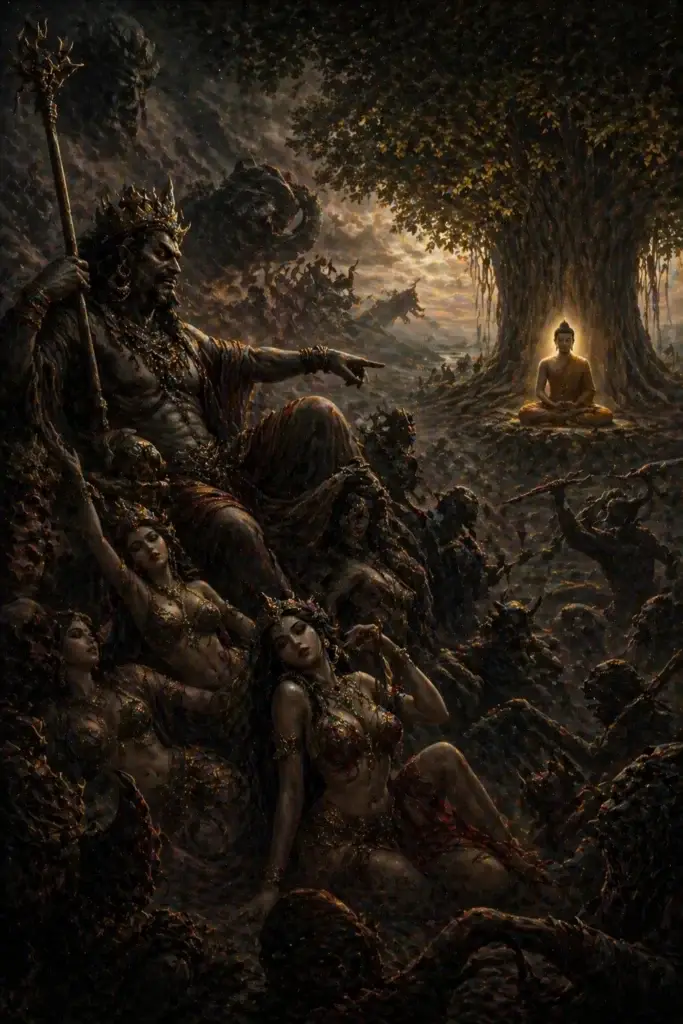
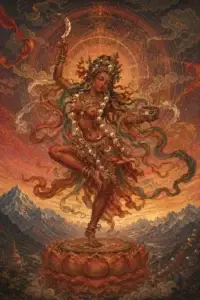
Mara - deities from the Buddhist tradition, historical illustration

Sutras, Buddhas and Gods of Compassion

Buddhism began as a non-theistic doctrine of liberation, and the historical Buddha himself taught no creator god. Yet over the 2,500 years since his teaching, diverse cosmological systems have developed: Tibetan Vajrayana with hundreds of Buddha aspects, East Asian Mahayana with celestial Bodhisattvas, South Asian Theravada with local protective spirits.

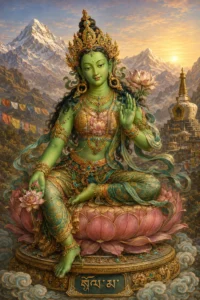
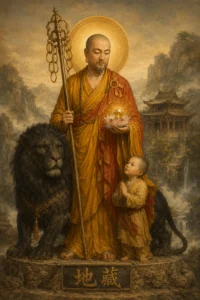
At the center stands the Bodhisattva doctrine: enlightened beings who postpone their entry into Nirvana in order to help all living beings toward liberation. Avalokiteshvara, Tara, Manjushri and Kshitigarbha are not gods in the theistic sense, but embodiments of compassionate enlightenment energy. They can be invoked, meditated upon and ritualized.

Alongside these, Buddhism also recognizes genuinely demonic beings: pretas, naraka guardians, hungry ghosts, asuras. These, however, are not “evil” in the Christian sense, but beings who have fallen into an unfavorable rebirth through their deeds.

Liberation applies to them just as it does to humans: a conceptual openness that makes the system especially interesting for the comparative study of religion.

Classification

Period: Since the 5th century BCE (Buddha Shakyamuni), in three waves: Theravada, Mahayana, Vajrayana.

Distribution: India, Sri Lanka, Southeast Asia, East Asia, Tibet, Mongolia, and global in the 20th century.

Sources: the Pali Canon (Tipitaka), Mahayana Sutras (Lotus Sutra, Heart Sutra), Vajrayana Tantras, the Bardo Thodol.

Pantheon and classes of beings: Buddhas, Bodhisattvas, demonic naraka guardians, hungry ghosts (preta), protective deities (Dharmapala).

History and Pantheon

Buddhism arose in the 5th century before our era and developed into three main currents: Theravada (southern Buddhism), Mahayana (northern Buddhism) and Vajrayana (Tibetan Buddhism). The core teaching of the historical Buddha Gautama Siddhartha rests on the Four Noble Truths and the path to liberation from suffering.

Its cosmological structure comprises six or eleven realms of existence, from the gods down to the beings of hell; the cycle of existence (Samsara) is perpetuated by Karma.

In Mahayana the Pantheon expanded considerably: Bodhisattvas such as Avalokiteshvara (compassion) and Manjushri (wisdom) are venerated as cosmic beings. In Vajrayana, protective deities often take on fearsome aspects to symbolize the overcoming of obstacles. These traditions are not dogmatic but decentralized and highly diverse from region to region.

Beings in Everyday Life

Buddhist practice runs through the daily life of devout communities: morning meditation, offerings in temples and at home altars, and observance of monastic rules across many cultures. Protective rituals against malevolent beings and harmful influences are firmly rooted in the Theravada tradition; protective recitation rituals (Paritta) belong to everyday spiritual hygiene.

Festivals such as Vesak (the Buddha’s birthday) and Losar (Tibetan New Year) incorporate rituals for prosperity and protection. The veneration of Bodhisattvas and local protective deities is common in private homes. Shamanic and spiritist elements have syncretized with Buddhism in many eastern cultures, particularly in Tibet and Southeast Asia.

Significance Today

Buddhism is a living world religion with about 500 million adherents, spread across Asia and increasingly in Western countries. It retains its theological and cosmological traditions while continually adapting them to modern contexts.

Western reception often focuses on meditation and mindfulness, yet strips away the full mythological and ritual system. Academically, Buddhist cosmology remains a source for comparison with modern physical models. In Tibet and the Himalayan regions, oral traditions and tantric practices survive under diaspora conditions.

Frequently Asked Questions about the Buddhist Gods and Buddhas

How many gods are there in Buddhism?

Strictly speaking, Buddhism recognizes no gods in the monotheistic sense, and the Buddha taught no creator god. But the Buddhist traditions encompass hundreds of venerable figures: 5 Dhyani Buddhas (transcendent Buddhas), 8 great Bodhisattvas, 21 Tara aspects, 5 Dharmapalas (protectors), and countless local protective spirits.

The Tibetan Vajrayana Pantheon, with its Yidam deities and Dakinis, counts roughly 1,000 principal figures, all understood as manifestations of Buddhahood.

Who is the most important Buddha?

Siddhartha Gautama (ca. 563-483 BCE) is the historical Buddha, the founder of Buddhism, whose teaching all schools follow. In Mahayana and Vajrayana there are additionally transcendent Buddhas: the 5 Dhyani Buddhas (Vairocana at the center, Akshobhya in the East, Ratnasambhava in the South, Amitabha in the West, Amoghasiddhi in the North).

Amitabha is centrally venerated in East Asian Pure Land Buddhism, Vairocana in Japan (the Daibutsu of Nara, 752 CE).

What are Bodhisattvas?

Bodhisattvas are enlightened beings who voluntarily renounce final Nirvana in order to help all other beings toward liberation.

The eight great Bodhisattvas are Avalokiteshvara (compassion), Manjushri (wisdom), Vajrapani (power), Ksitigarbha (deliverer from the hells), Samantabhadra (commitment), Maitreya (future Buddha), Akashagarbha (treasury of the sky) and Sarvanivarana-Vishkambhin (remover of obstacles). In Mahayana, becoming a Bodhisattva is the true goal, higher than the striving for individual enlightenment (Arhat).

What distinguishes Theravada, Mahayana and Vajrayana?

Theravada (South and Southeast Asia) is the oldest school, its main goal being individual enlightenment as an Arhat through rigorous meditation and the teaching of the Pali Canon. Mahayana (East Asia) emphasizes the Bodhisattva ideal, enlightenment for all beings.

Vajrayana (Tibet, Bhutan, Mongolia) is tantric Mahayana with special visualization and Mantra practices (Yidam, Dakini, Mandala). In Vajrayana, enlightenment can be reached within a single lifetime; Milarepa is the archetype.

What are Dharmapalas?

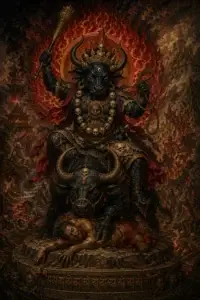
Dharmapalas are protectors of the Buddhist teaching. They often have fearsome appearances (Mahakala with a bloody mouth, Yamantaka with a buffalo head), yet a benevolent intention: they protect practitioners from obstacles and drive off negative energies.

The eight great Dharmapalas (in Tibet) are Mahakala, Yamantaka, Yama, Hayagriva, Vaishravana, Palden Lhamo (the only female figure), Tsangpa Karpo and Damchen Dorje Legpa. In China and Japan they take gentler forms; the Niō temple guardians of Japan are their counterparts.

What is the Tibetan Book of the Dead?

The Tibetan Book of the Dead (Bardo Thödol, “Liberation through Hearing in the Intermediate State”) is a Vajrayana text that describes in detail the phases between death and rebirth (Bardo).

According to tradition it is read aloud to the dying and the deceased so that their soul may recognize the right Buddhas and beings of light and find a favorable destiny.

Its authorship is attributed to Padmasambhava, and it was rediscovered in the 14th century by Karma Lingpa. C. G. Jung wrote the foreword to the first English translation in 1927, and the text profoundly shaped the Western reception of Buddhism.

Further Reading

The Buddha and the First Schools

The historical Buddha, Siddhārtha Gautama (6th to 5th century BCE), taught the Four Noble Truths and the Eightfold Path.

After his Parinirvana, various schools developed: Theravada (today Sri Lanka, Burma, Thailand) preserves the Pali Canon; Mahayana (East Asia) developed the Bodhisattva ideal; Vajrayana (Tibet) integrates tantric practice and a complex system of wrathful and peaceful Buddhas.

Bodhisattvas and Buddha Fields

In Mahayana the cast of figures expands. Bodhisattvas, enlightened beings who postpone their own completion in order to help others, become central figures of veneration.

Avalokiteshvara (compassion, reinterpreted in East Asia as the female Guanyin/Kannon), Manjushri (wisdom), Maitreya (future Buddha) and Ksitigarbha shape popular piety. Buddha fields are pure worlds into which a practitioner can be reborn.

Vajrayana and Tantric Practice

Tibetan Buddhism integrates pre-Buddhist Bön elements and the Indian tantric tradition. Wrathful deities (Mahakala, Yamantaka, Palden Lhamo) appear terrifying; they embody the powerful aspect of enlightened energy. The five Buddha families structure the Mandala system. Tantric practice requires formal initiation by a qualified teacher.

Buddhism in the West

The West encountered Buddhism systematically only in the 19th century. The second wave, after the Second World War, brought Zen (D. T. Suzuki) and Tibetan Buddhism (after 1959).

The third wave, from the 1970s onward, is the Vipassana and mindfulness movement, which has adapted Buddhist meditation practice in secular form. This has given rise to a distinctly Western, secular variety.

State of Research

Buddhist religious studies are methodologically differentiated into Theravada (Pali Canon research), Mahayana (above all the Chinese and Japanese tradition) and Vajrayana (the Tibetan tradition). Standard works are Edward Conze, “Buddhism: Its Essence and Development” (1951), Heinrich Dumoulin, “Geschichte des Zen-Buddhismus” (1985-1990), and Robert Buswell and Donald Lopez, “The Princeton Dictionary of Buddhism” (2014).

Protective Objects in this Cultural Tradition

Buddhist practitioners use Mantra malas, incense, consecrated texts worn as pendants, and small Buddha or Bodhisattva figures.

iWell Guard fits into this culture-historical line of wearable protective objects, in a contemporary material architecture, made in Germany. 41 layers, solid gold, platinum, silver. 30-day right of return.

Personal experiences may vary. Not a medical device. No promise of healing.

Buddhist mythology places gods, asuras, pretas and beings of hell within the wheel of the six realms of existence, while at the same time describing the Bodhisattvas and Dharmapalas who accompany practitioners on the path to liberation.

Protective Symbols from Buddhism

The lexicon of protective symbols covers several signs and objects from Buddhism on their own pages: Ashtamangala, Dharmachakra, Endless Knot and Mala. A cross-cultural overview is offered by the page on protective symbols.