Yamaduta, Spirit of the Buddhist Tradition
By Ralf Ittermann · last reviewed on
The death messengers of Yama, executors of karmic verdicts.
Yamadūtas in the Naraka System
Yamadūtas are the death messengers of Yama, lord of the dead in the Vedic, Hindu, and Buddhist traditions. In the Garuda Purana and the Naraka system of the Mahabharata, they collect the soul immediately after the moment of death.
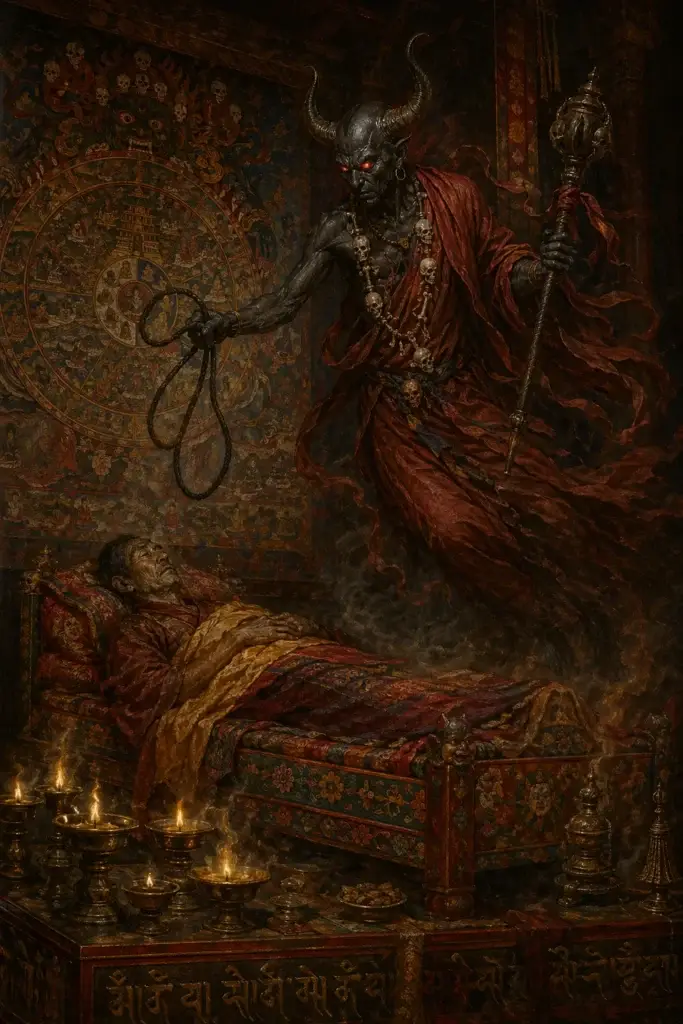
Their duties include: identification of the soul, severing the bonds of life, escorting the soul across the Vaitarani river, and delivering it to Yama’s court in Yamapuri.
There the scribe Citragupta weighs merits and transgressions; Yama pronounces judgment. Penalties lead to one of the 28 Narakas (hells): Raurava (the hell of screaming), Maharaurava, Tamisra, Andhatamisra, Kalasutra.
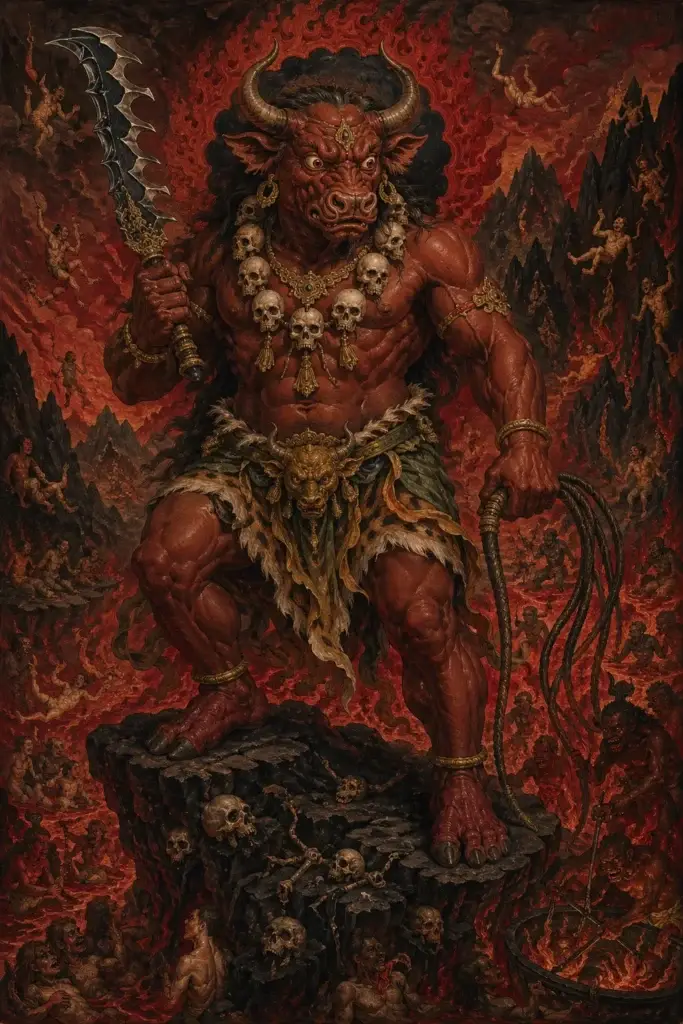
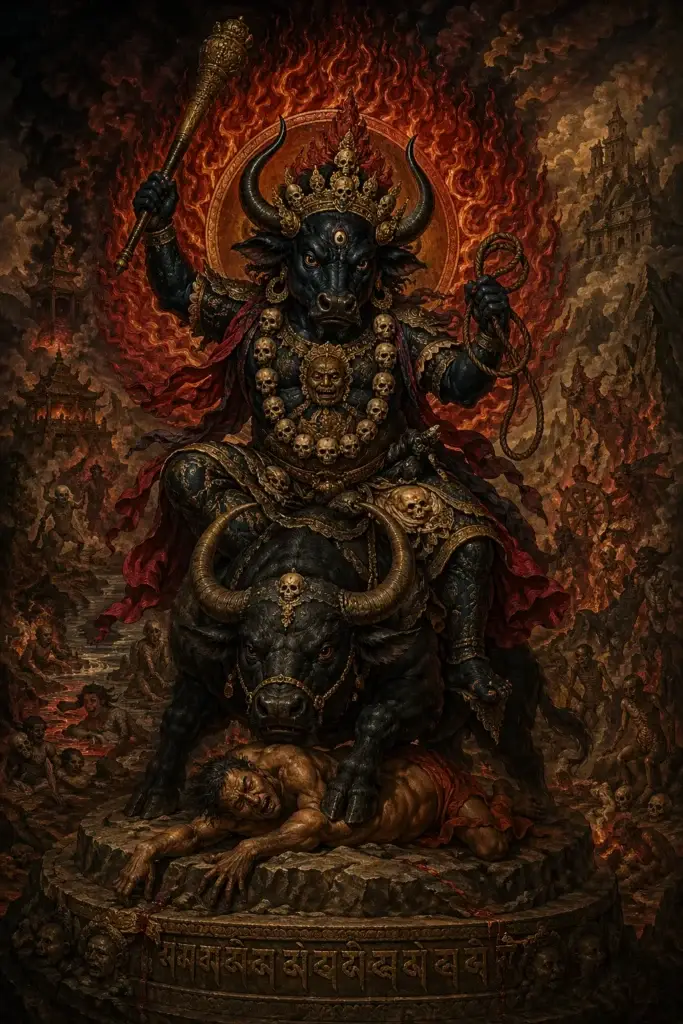
The Buddhist reception (Mahayana, Vajrayana) preserves this framework but adds the possibility of liberation through mantra recitation and intermediate-state practices (Bardo, Tibetan Book of the Dead). Iconographically, Yamadūtas are dark-skinned, carry a noose and club, and ride water buffalo.
Yamaduta is a spirit of the Buddhist tradition.
Yamadūtas are the death messengers in the service of Yama, lord of the dead in the Indo-Buddhist tradition. At the moment of death they appear to escort the soul and bring it before Yama’s court.
There the karma is weighed; Yama pronounces judgment; the Yamadūtas execute it, either in the celestial realms or in the Narakas (hells). The figure connects Indian and Buddhist traditions of the cult of the dead; in East Asia it merges with local underworld conceptions.
The Devadūta Sutta (“Discourse on the Divine Messengers”) in the Pali canon presents a scene narrated by the Buddha: a deceased person is brought before Yama; Yama asks whether the person had not seen the “divine messengers,” namely old age, illness, death, and the sight of corpses, which should have prompted reflection and change.
The Yamadūtas are therefore not only executors but also pointers toward life’s meaning. This dual role gives the figure considerable theological depth.
The Garuda Purana and the Topography of Yamaloka
The most detailed account of the Yamaduta is found in the Garuda Purana (8th to 10th century), where Yama’s messengers are classified by rank and function. They are not simply guardians or couriers but jurors and documentarians of karmic judgment.
Each deceased person is escorted by their personal Yamaduta from the world of the dying to Yamaloka, where Yama holds court.
The topography of Yamaloka itself, as described in various Puranas, reveals a bureaucratic structure: the gate, the road, the hall of justice, the various hell realms. The Yamaduta are administrators of this topography, not its guards.
Quick Overview: Yamaduta
Type: Death messengers, hell executors
Origin: Service of Yama, lord of the dead
Texts: Devadūta Sutta, Jatakas, Abhidharmakosha, Tibetan Book of the Dead
Period: Vedic-Buddhist to the present
East Asian form: messengers of Yanluo in the Chinese underworld system
Classification
Vedic background (Yama in the Rigveda), Buddhist elaboration in the Pali canon and Mahayana sutras. The Abhidharmakosha (Vasubandhu, 4th/5th century CE) systematizes cosmology. The Tibetan Book of the Dead (Bardo Thodol, 8th century or later) contains detailed Yamadūta imagery. Chinese and Japanese references appear in Buddhist underworld literature.
The Indian subcontinent, Theravada countries, East Asia (in China as messengers of Yanluo, as Niu Tou “Ox-Head” and Ma Mian “Horse-Face”), Tibet with the Vajrayana expansion, and Japan with the Emma variant.
Devadūta Sutta (Anguttara Nikaya and Majjhima Nikaya), Visuddhimagga (Buddhaghosa), Abhidharmakosha (Vasubandhu), Bardo Thodol, Chinese underworld narratives (Di Yu literature), Japanese Jigoku-zoshi.
Designations and Spellings
Sanskrit: yamadūta, “messenger of Yama”; yamapāla, “guardian of Yama”; yamapuruṣa, “man of Yama”.
Chinese: 牛頭馬面 (Niu Tou Ma Mian, “Ox-Head and Horse-Face”, popular pair form).
Japanese: Jigoku no Kishi, Yama as Emma.
Tibetan: Shinje’i pho nya.
The specialization in East Asia is noteworthy: the pair Ox-Head and Horse-Face is a distinctly Chinese development. Both are depicted as powerful underworld officials of Yanluo Wang and are prominent in folk-religious temples.
Characteristics
Appearance
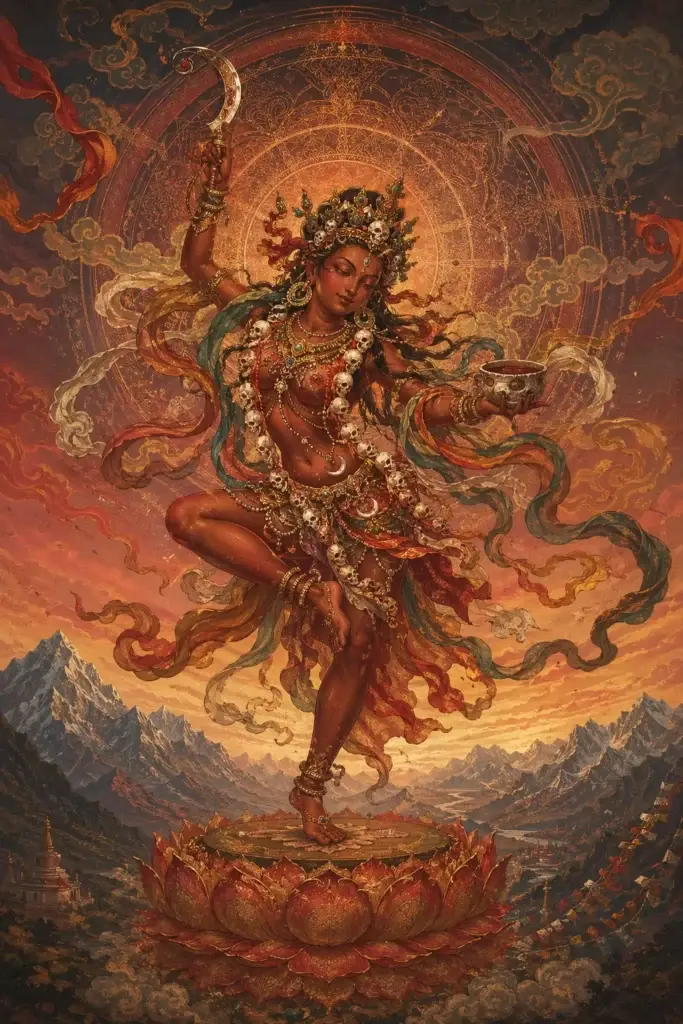
In the Indian tradition, often depicted with a flame aura, weapons, and chains. They may be partly or fully therianthropic in form. In Chinese iconography, specified as Ox-Head and Horse-Face, armed with clubs or tridents. In Tibetan thangkas, they appear wrathful, dancing, adorned with skull symbols.
Behavior
They appear at the moment of death, bind the soul, and escort it to Yama. In the Narakas they execute karmic penalties, not out of personal cruelty but as a functional assignment. In the Devadūta reading, they are simultaneously symbolic: life itself warns through old age, illness, and death.
Sphere of Action
The intermediate realm during the dying process, Yama’s court, and the Narakas (hells). In the East Asian tradition they are also assigned to specific underworld offices; each of the ten hells has its own officials.
Mythological Classification
In the Vedic tradition, Yama is the first mortal to enter the underworld and thereby became its lord. His messengers are functionaries within a cosmic system, not autonomous demons. The Buddhist adoption retains this functional role.
Physical Marks and the Function of Terror
In passages from the Mahabharata and later Puranas, Yamaduta are described with specific physical features: black skin, red eyes, serpentine hair or flames instead of hair, and iron weapons. These features are not arbitrary but functional: they are intended to shock the living into self-reflection about their own lives.
The appearance is apotropaic and contemplative at once. The sight of a Yamaduta marks the transition from life to accountability. In tantric commentaries, the terror function is made even more explicit: the Yamaduta is a conscious embodiment of karmic consequences, not a biological entity.
Profile: Yamaduta
The most important aspects of the Yamadūta at a glance.
In the service of Yama, lord of the dead. Vedic-Buddhist foundation. In East Asia elaborated under Yanluo/Emma, with its own hierarchy of officials.
The dying at the moment of death, the deceased in the intermediate state, and hell beings for the execution of judgment. Indirectly, all the living as a reminder.
In Indian tradition, depicted with a flame aura and weapons. In Chinese tradition, specified as Ox-Head and Horse-Face. In Tibetan tradition, wrathful, dancing, adorned with skull ornaments.
They collect dying souls, escort them to Yama’s court, and execute karmic verdicts. Functional in nature, not personally cruel.
Not defense but right conduct: ethical action, taking refuge in the Three Jewels, invocation of Ksitigarbha (Bodhisattva of hell beings). In the Tibetan tradition: Phowa practice (consciousness transfer at the moment of death).
Death and Mortuary Rites
Preparation for Death
In the Theravada tradition: recitation of Paritta and Metta suttas for the dying. Mahayana: recitation of Amitabha mantras to be reborn in the Pure Land rather than in Yama’s realm. Vajrayana: Phowa as a specific death meditation for exiting the cycle of rebirth.
Post-Death Rites
The Tibetan Book of the Dead provides instructions for the deceased for the 49 days of the Bardo, including explicit encounters with Yamadūtas. The Chinese tradition observes the “seven-sevens” mortuary ritual (49 days with weekly ceremonies). Japanese Obon and similar rituals aim to ease the condition of the dead.
Ethical Dimension
The Devadūta teaching holds that life itself sends its messengers: old age, illness, the sight of a corpse. Those who heed them have little to fear at Yama’s court. Those who ignore them find themselves in corresponding rebirths.
Parallels and Reception
Antiquity and Mesopotamian Parallels
The Mesopotamian Gallu as an executive organ of the underworld, the Greek Keres as death demonesses, and Egyptian Amduat companion figures on the solar journey through the underworld.
East Asian Development
The Chinese Niu Tou Ma Mian and Japanese Emma officials have, in popular belief, a concrete bureaucratic hierarchy with correspondence and examinations. The Di Yu system (“earth prison”) is one of the most elaborate underworld administrations in the world.
Modern Reception
Bollywood films featuring Yamraj figures, Japanese anime with Shinigami motifs, Korean dramas with Grim Reaper figures: all vary the Yamadūta motif in contemporary form.
Yamaduta and the Islamic Mala’ika al-Mawt
A notable parallel exists between the Hindu Yamaduta and the angels of death in the Islamic tradition, the Mala’ika al-Mawt. Both traditions describe heavenly beings that appear at the moment of death. Both assess the deeds of the deceased on the basis of religious or karmic records.
Both are fearsome in outward appearance yet just in their function. The Islamic Mala’ika, however, are moral agents of God, whereas the Yamaduta represent more neutral administrative forces. This distinction reflects a difference in theodicy: in Hinduism, karma is self-executing; in Islam, it is God’s grace that decides justice.
The Yamaduta as Messengers of the God of Death
The name Yamaduta means literally “messenger of Yama”. Yama is the lord of the dead, a figure originating in Vedic religion who spread across South and East Asia through Buddhism and Hinduism.
The Yamaduta are his subordinates, sent to gather the souls of the deceased and bring them before the court of the lord of the dead. They are therefore not independent powers but functionaries within a cosmic order.
In Buddhist texts, the Yamaduta appear in several roles. An important passage is the Devaduta Sutta of the Pali canon, where the focus is on the “divine messengers,” namely old age, illness, and death as warning signs that should prompt every person to reconsider.
Beyond this, there are more concrete descriptions of hell messengers who seize the deceased and bring them before Yama. Yama then confronts the dead with the fact that they had seen the admonishing signs of aging, illness, and death during life, but had not taken them to heart.
This interlocking of frightening imagery with ethical admonition is characteristic of the Buddhist treatment of the Yamaduta. They are terrifying figures, but their terror serves a didactic purpose. Research on Buddhist cosmology emphasizes that the hell descriptions in Buddhism were not intended as ends in themselves but as vivid illustrations of the law of karma.
The Yamaduta do not execute arbitrary punishment; they carry out what the deceased’s own deeds have brought about. The true judge is ultimately the law of action and consequence.
Yamaduta in Hell Imagery and Temple Art
The Buddhist visual arts of Asia have depicted the Yamaduta in numerous works, above all in the great hell scenes found in temples, on murals, and on scroll paintings. These pictorial programs portray Yama’s judgment of the dead and the punishments of the various hells with often stark vividness.
The Yamaduta appear as the executing guardians and tormentors, frequently with animal features such as ox or horse heads, an iconography that is particularly pronounced in the East Asian tradition.
Such hell scenes served a clear didactic function. They were placed in locations where lay people would see them, and they illustrated the consequences of unwholesome action in a way that was comprehensible even without knowledge of the texts.
In Thailand, in the Tibetan tradition, in China, Korea, and Japan there are respective regional variants of this pictorial tradition, each filling the common basic schema with local characteristics.
In the East Asian variant, the Indian inheritance combines with the concept of the ten kings of the underworld, so that Yama appears there as one of ten judges, comparable to the Korean Yeomra.
For the study of religion, this pictorial tradition is an important source because it shows how the doctrine of karma and the judgment of the dead was communicated to lay people in their everyday world.
In these images, the Yamaduta are not abstract theological concepts but vivid, fearsome figures. Art-historical research also uses the surviving hell images to trace the spread of certain ideas across time and space, since they allow the paths of transmission of Buddhist cosmology between regions to be read off.
Yamaduta and Yamadut in Hinduism
The concept of Yama’s messengers is not confined to Buddhism but is also firmly rooted in Hinduism, where the messengers are frequently called Yamadut.
A particularly well-known narrative, transmitted in several Puranas, concerns Ajamila. Ajamila is a man who has led a wayward life and is to be collected by Yama’s messengers at the hour of death.
In the moment of dying, however, he calls the name of his son, which happens to coincide with one of the names of the god Vishnu. Thereupon the messengers of Vishnu, the Vishnudut, appear, confront the messengers of Yama, and free Ajamila.
This narrative is theologically instructive. In the Vaishnava tradition it is cited as evidence of the redemptive power of the divine name: even the unintentional utterance of the name is said to have salvific effect.
In this story, Yama’s messengers embody the strict logic of action and retribution, while Vishnu’s messengers embody the grace that can break through that logic. The confrontation between the two groups of messengers is presented in the texts as a genuine disputation on justice and grace.
For the study of religion, this episode shows that the Yamaduta were weighted differently in the various religious currents of India depending on theological standpoint. Within a framework strictly oriented to karma, they are the inescapable executors.
In currents oriented toward devotion and grace, they become an authority that can be superseded by turning to the redeeming deity. The Yamaduta thus serve as a useful indicator of how a shared mythological concept is classified and evaluated differently within distinct religious systems.
Research Literature
Further standard works in the literature index.
The protective practice described here represents a scholarly classification of historical traditions. iWell Guard builds on this cultural-historical lineage of wearable protective objects and represents a contemporary form of it. More about the iWell Guard →