Preta, Spirit of the Buddhist Tradition
By Ralf Ittermann · last reviewed on
Preta is a spirit of the Buddhist tradition.
Hungry ghost with a needle-thin throat, a karmic figure of greed.
Preta
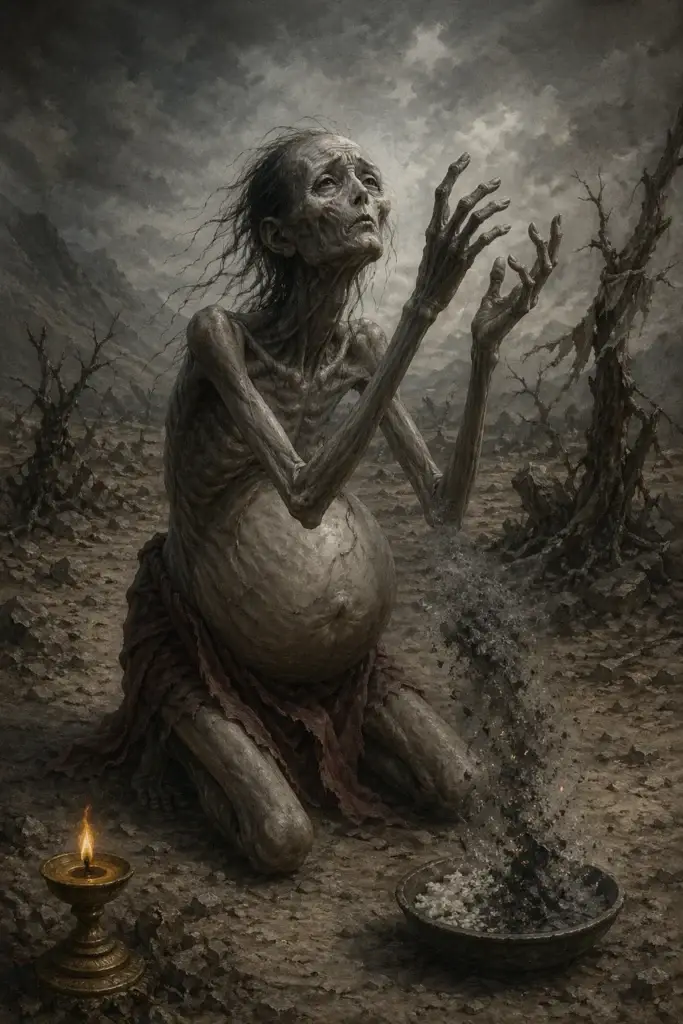
The Preta (Pali: Peta) is one of the most distinctive figures in Buddhist cosmology. A hungry ghost with a distended belly and a needle-thin throat, capable of seeing and desiring, yet unable to eat or drink.
The figure has become an image for the consequences of karmic greed: those who in life refused to give, were miserly, or withheld alms are reborn as pretas and suffer the corresponding deprivation.
In the Petavatthu texts (part of the Pali Canon), Buddhist masters recount encounters with pretas confessing their former deeds. The Ullambana Sutra (Mahayana) recounts how Maudgalyayana sees his deceased mother in the preta state and can only save her through the collective offering power of the Sangha.
From this narrative developed the Hungry Ghost Festival celebrated worldwide (Ullambana, Chinese Yulanpen, Japanese Obon). The figure is thus, unlike many other demons, closely linked to the ritual practice of the annual calendar.
At a Glance: Preta
Type: Hungry ghost, Buddhist rebirth
Origin: Karmic consequence of miserliness, envy, greed, and misappropriation of alms
Texts: Petavatthu (Pali), Ullambana Sutra, Jatakas
Period: 5th century BCE to present
Central Festival: Hungry Ghost Festival / Ullambana / Obon
Classification
Elaborated in the Pali Canon from the 3rd century BCE with the Petavatthu. Mahayana expansion through the Ullambana Sutra (early common era, translated into Chinese in the 3rd century CE).
The Hungry Ghost Festival became established in China from the Tang period onward, and in Japan as Obon from the Nara period. The tradition continues unbroken into the modern era.
Theravada: Sri Lanka, Thailand, Myanmar, Laos, Cambodia (there connected with local ancestor cults). Mahayana: China, Korea, Japan, Vietnam (particularly active there). Vajrayana: Tibet, Mongolia. Hungarian, Mongolian, and Kazakh Buddhist communities. Modern diaspora communities worldwide.
Petavatthu (Pali, part of the Khuddaka Nikaya), Vimanavatthu (as a complementary counterpart), Ullambana Sutra (Sanskrit/Chinese), Jatakas, Tibetan Book of the Dead traditions, modern ethnography on the Hungry Ghost Festival.
Name and Variants
Sanskrit: preta; Pali peta; feminine pretani.
Chinese: 餓鬼 (E Gui, “hungry spirit“).
Japanese: Gaki.
Tibetan: yidag.
Etymology: from pra-i “to go forth”, originally “the deceased”, later specialized to the hungry ghost class.
The term illustrates the semantic development well: in Vedic times, preta simply denoted the deceased in the intermediate phase before rebirth. Buddhism specified: certain dead become hungry ghosts depending on their karma. From this specialization arose the class of pretas.
Characteristics
Appearance
A vast distended belly, tiny mouth and needle-thin throat, emaciated limbs. Hungry, with a ravenous gaze, often with a flaming mouth (all liquid turns to fire). Thirty-six classes of pretas according to classical demonology, each with specific forms of suffering.
Behavior
Constantly seeks food but cannot eat. Cursed to be perpetually hungry. Sees water that turns to pus; sees food that ignites. Drawn toward the scent of offerings.
Domain of Activity
Its own Pretaloka (preta realm) within Buddhist cosmology, sharing space with the human world but perceiving it differently. Often found near former places of life. In China, traditionally “released” from the underworld during the seventh lunar month.
Mythological Classification
Not a created being, but a consequence of rebirth. Arising from miserliness, envy, theft of alms, and misuse of religious offerings. The duration of preta existence is determined by the karmic weight, often very long; some texts speak of kalpas.
Profile: Preta
The most important aspects of the Preta at a glance.
Karmic rebirth arising from miserliness, envy, and misuse of offerings. Not a created being, but a form of existence within Buddhist cosmology.
Former humans with accumulated negative karma. In later traditions, also bound to specific places and families (ancestral pretas).
Distended belly, tiny mouth, needle-thin throat, emaciated limbs. Flaming mouth in some descriptions. Thirty-six classes, each with specific forms of suffering.
Eternally hungry, unable to eat. Pursues the living out of craving, drawn toward offerings. Can cause illness in households that neglect their ancestors.
Offerings and the Ullambana ritual (for named pretas), recitation of the Ullambana Sutra, offering of water and rice. In Vajrayana: Tsok ritual with shared offerings dedicated to all sentient beings.
E Gui (Chinese), Gaki (Japanese), Edimmu, Pishacha, and Christian purgatory figures as structurally related transitional souls.
Rites and Festivals
Ullambana / Hungry Ghost Festival
In the seventh lunar month (usually August), the gates of the underworld open according to tradition, and pretas enter the world. The faithful bring offerings, recite sutras, and set up altars. Buddhist and Daoist traditions converge in one of the largest popular religious festivals of East Asia.
Obon in Japan
Ancestors are received during the Obon period (usually August 13 to 16). Bon Odori dances, fires at household doors, and visits to graves mark the occasion. The connection to the maternal figure’s liberation (the Mulian/Maudgalyayana myth) carries strong emotional resonance.
Ritual in Everyday Life
In Theravada: water offerings to the pretas during the pindapata meal. In Vajrayana: sur smoke offerings, daily “Feeding the Pretas” as part of offering practice. In Mahayana: submitting the names of deceased relatives to monasteries for regular Sutra recitation.
Parallels and the Modern Period
Hungry Ghosts Across Cultures
E Gui (China) and Gaki (Japan) are direct translations of the same figure in East Asian form. Pishacha (Hinduism) shares the hunger motif with the corpse-eater specific. Edimmu and the Roman Lemures are structurally related transitional souls.
Psychological and Ecological Interpretation: Modern Buddhist teachers (Thich Nhat Hanh) also interpret pretas psychologically as a state of perpetual dissatisfaction despite material possessions. Ecologically, the Preta is read as an image of insatiable consumption, a contemporary teaching figure of considerable resonance.
Popular Culture: Japanese anime and manga regularly cite Gaki motifs. The Hungry Ghost Festival has become commercialized but retains religious importance. In Western fantasy, pretas are adapted as a distinct monster type.
The Grounding of Preta Existence in Karmic Thought
Rebirth as a preta (Pali peta) is regarded in the Buddhist cosmos as the consequence of a clearly defined cluster of actions.
Texts such as the Petavatthu, a collection of fifty-one ghost narratives in the Khuddaka Nikaya of the Pali Canon, attribute birth in the hungry ghost realm primarily to miserliness, avarice, the refusal of alms, and the withholding of food from those in need.
The punishment mirrors the deed: those who gave nothing in life suffer as beings with a needle-fine gullet and a vast belly, never able to be satisfied.
This mirroring is no accident, but an expression of the Buddhist teaching that karmic effects correspond to the nature of their causes.
The Petavatthu tells of women who served spoiled food to guests and must now consume pus and excrement themselves, or of a man who insulted monks and now wanders with a rotting mouth. The commentary by Dhammapala, the Petavatthu-atthakatha, assigns each story to a specific transgression, making the collection a moral textbook.
The temporal limitation is important. Unlike rebirth in a hell realm, which encompasses immensely long but still finite periods, the preta state is one that can be shortened by remaining good karma or by the transfer of merit from the living.
The hungry ghost realm thus occupies an intermediate position among the six realms of existence, between hell beings and animals. It is a place of deprivation, not of active torment.
Buddhist ethics draws a twofold lesson from this. On one hand, the image of the pretas serves as a deterrent against miserliness. On the other, it grounds the central practice of giving (dana): generosity is the path that leads precisely away from the hungry ghost realm.
The Preta is thus less a figure of horror than a teaching figure through which the relationship between action and consequence becomes concrete.
The Ghost Festival and the Transfer of Merit
The ritual provisioning of the hungry ghosts is one of the oldest and most widespread practices in Buddhism. Its canonical foundation is found in the Tirokudda Sutta of the Khuddaka Nikaya, in which the Buddha explains that gifts given to the monastic community in the name of deceased relatives can benefit those reborn as pretas.
The mechanism is known as the transfer of merit (pattidana): the living generates merit through a good deed and explicitly dedicates it to the deceased, who rejoices and is thereby relieved.
From this idea, the great ghost festival developed in East Asia. In China it is called Yulanpen and is observed in the seventh lunar month; in Japan it is Obon.
Its basis is the Yulanpen Sutra, which tells the story of the monk Maudgalyayana: with supernatural sight he sees his deceased mother suffering as a hungry ghost, and he cannot liberate her alone, only through a collective offering by the entire monastic community at the end of the rain retreat.
The festival thus unites filial piety with Buddhist soteriological logic.
In practice, during the festival, food, drink, and symbolic money are displayed, sutras are recited, and lamps are lit. In the Theravada Buddhist world of Sri Lanka and Southeast Asia, corresponding alms are given to monks in the name of the dead, often on the seventh day, after three months, and after a year.
Tibetan Buddhism has the ritual of sur, a smoke offering of burned food whose aroma is meant to nourish the hungry ghosts, since their constricted throat cannot receive solid food.
These rituals show that in lived Buddhism, the Preta is not a distant teaching figure but a being with whom an ongoing relationship exists. The deceased remains part of the family, and providing for them is an obligation of the bereaved.
The Iconographic Depiction in the Wheel of Life
The most widely found image of the hungry ghosts appears in the bhavachakra, the Buddhist wheel of life that adorns the entrance of many Tibetan monasteries. The circle is divided into six segments, one of which depicts the realm of the pretas.
The iconographic convention is fixed: thin limbs, a bloated belly, a long thin neck, and a tiny mouth, often no larger than a needle’s eye. This anatomy renders the punishment physically visible; the hunger is unassuageable because the body cannot absorb food.
Frequently the painting shows a Buddha appearing to the pretas, offering them healing teaching or nourishment. This figure is usually depicted in red or yellow and indicates that even in the hungry ghost realm, the path to liberation is not entirely closed.
The landscape of the preta realm appears as a barren, parched plain, occasionally with rivers that turn to pus, blood, or fire when the pretas attempt to drink.
Tibetan texts differentiate the hungry ghosts further. A common classification distinguishes pretas with external obstacles, who simply cannot find food; pretas with internal obstacles, whose bodies prevent its ingestion; and pretas for whom the food itself constitutes the torment. This systematization is found, for example, in Gampopa’s Jewel Ornament of Liberation from the twelfth century.
In East Asian art, hungry ghosts also appear outside the wheel of life. The Japanese illustrated scroll Gaki-zoshi from the Heian period, now held in museums in Tokyo and Kyoto, depicts in a series of scenes hungry ghosts haunting cemeteries, latrines, and offering sites, living unnoticed among ordinary people.
This scroll is regarded as a major work of medieval Japanese painting and attests to how concretely the concept was anchored in everyday life.
Pre-Buddhist Roots and the Vedic Preta
The term preta is not of Buddhist origin but derives from the older religious vocabulary of India. Literally it means “the one who has gone forth” or “the departed”, formed from the prefix pra and a root meaning “to go”.
In the Vedic and early Hindu texts, preta initially designated simply the recently deceased, who exists in an intermediate state before being transformed through funerary rites into a pitr, an ancestor.
This transition is precisely governed in Hindu ritual. The shraddha rites, food offerings for the dead, are intended to transfer the restless preta into the ordered community of the ancestors.
If they are omitted, or if someone dies a bad death, the deceased may remain as a restless preta. In this conception, the Preta is not a distinct realm of existence but a dangerous transitional phase that must be concluded through correct ritual.
Buddhism adopted the term but reshaped it. What had been a temporary intermediate state became one of the six fixed realms of the cycle of rebirth, into which one is fully reborn through specific karma.
The connection to funerary rituals was retained but shifted from the obligation to create an ancestor to the possibility of transferring merit to a suffering being.
This shared root explains why Hindu and Buddhist funerary practice often resemble each other and are difficult to separate in the lived religiosity of South Asia.
It also shows that the Buddhist Preta did not arise from nothing, but incorporated an old Indian idea into a new cosmological system. Anyone wishing to understand the figure must take this layering into account: the Vedic prehistory and the Buddhist reinterpretation.
Spread and Transformation in the Buddhist Cultures of Asia
With the spread of Buddhism, the notion of the hungry ghost also traveled and adapted to local conditions. In the Theravada countries of Sri Lanka, Myanmar, Thailand, Laos, and Cambodia, the connection to the Pali Canon and the Petavatthu remained strong.
Here the preta concept partially merged with indigenous spirit beliefs, such as the Thai phi, so that the Buddhist hungry ghost is not always sharply distinguished from other restless dead.
In China, the idea encountered an already highly developed ancestor culture. The hungry ghost, Chinese egui, became closely associated there with concern for neglected or childless dead. Those who have no descendants to make offerings risk becoming a hungry spirit.
The ghost festival of the seventh month became one of the most important festivals of the year, during which the gates of the underworld open and the spirits roam. Here Buddhist soteriology merged with Daoist and popular religious elements.
Tibetan Buddhism systematized the hungry ghosts in its graduated path texts and developed its own ritual form with the smoke offering sur. The figure of the yidak, as the Preta is called in Tibetan, is firmly anchored in popular consciousness because the wheel of life is visible at every monastery entrance.
In Japan, finally, the hungry ghost received an art-historically significant expression in the Gaki-zoshi and remained present in the Obon festival. The term gaki even entered modern Japanese as a colloquial term of abuse for a greedy or unruly child, evidence of how deeply the religious concept penetrated everyday language.
This cultural breadth shows that the Preta did not remain a rigid teaching figure but became a living, adaptable element of the Buddhist world.
Further Links
Sources and Literature
Further standard works in the literature index.
The protective practice described here represents a scholarly classification of historical traditions. iWell Guard draws on this cultural-historical lineage of wearable protective objects and represents a contemporary form of that tradition. Learn more about iWell Guard →
Frequently Asked Questions about Preta
What are pretas in Buddhism?
Preta (Sanskrit for “the departed”, Tibetan Yi-dvags) are the hungry ghosts in Buddhism, one of the six realms of rebirth. They are beings with an enormous stomach and a tiny mouth or needle-thin throat: they can never be satisfied, because every morsel of food turns to ash the moment it reaches their mouth.
In the Bhavachakra (the Tibetan wheel of life) they are depicted according to a fixed iconographic convention. Karmic cause: miserliness, avarice, and selfishness in life. Those who denied food to others in this life are reborn in the next as a starving Preta.
What is the Buddhist hungry ghost festival?
The Hungry Ghost Festival (Chinese Yulanpen, Japanese Obon, Korean Baekjung) is one of the most important popular Buddhist festivals in East Asia, observed in the seventh lunar month. It traces back to the story of Maudgalyayana, a disciple of the Buddha, who finds his mother in the preta realm and cannot feed her directly.
The Buddha teaches him that offerings made through the Sangha (monastic community) at the end of the rain retreat can reach the hungry ghosts. From this arose the great East Asian festival with offerings for the deceased, dance performances (Bon Odori), and symbolic lantern floating.