Pishacha, Demon of the Hindu Tradition
By Ralf Ittermann · last reviewed on
Corpse-eater of the Indian night. Hindu tradition describes the Pishacha as a demon that feeds on corpses and nocturnal terror.
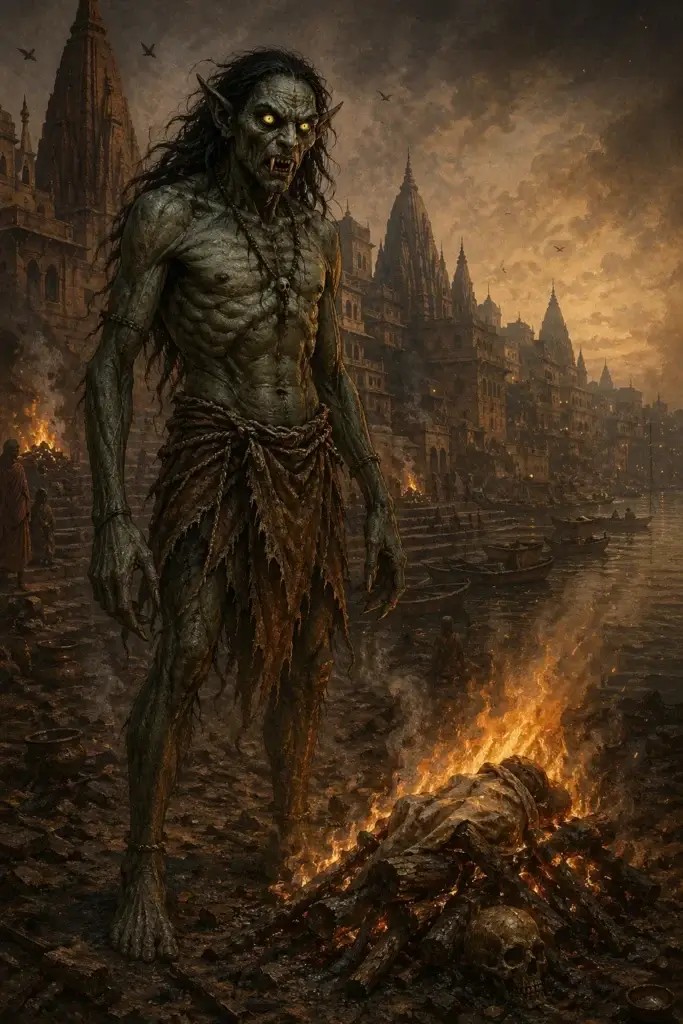
Pishacha
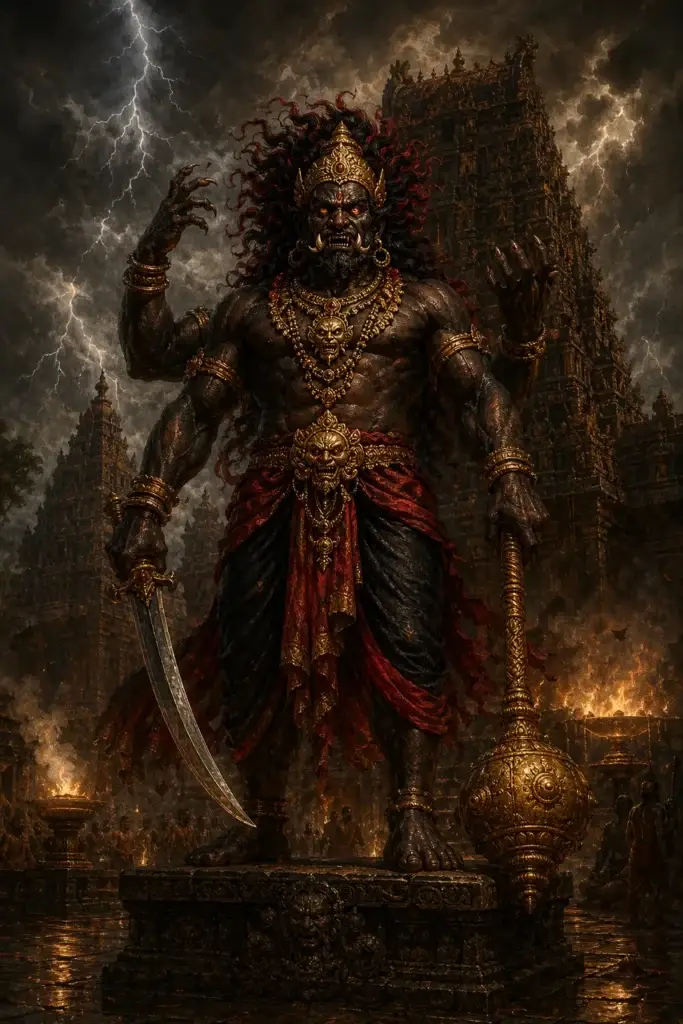
In Hindu demonology, the Pishacha is the specialized flesh-eater, a figure that haunts cremation grounds, battlefields, and desolate roads in search of raw meat and corpses to consume.
Unlike the Vetala, which inhabits bodies, or the Rakshasa, which fights, the Pishacha devours. Its iconography is defined by hunger and decay: protruding ribs, thin limbs, a large mouth, smeared with blood.
Already in the Atharvaveda (1st millennium BCE), Pishachas appear alongside Rakshasas and Yatudhanas as a class of demonic nocturnal beings to be warded off ritually.
Later tradition develops them further, in Tantric literature, in popular tradition, and in regional traditions of northwestern India, where a distinct language (“Paishachi”) was associated with them. Modern reception extends into Bollywood horror films, which employ Pishachas as a classic figure of terror.
Pishacha in the Atharvaveda and Early Ritual Classifications
The Pishacha (Sanskrit: flesh-eating demons) are first explicitly categorized as a demonic class in the Atharvaveda (presumably around 1000 BCE).
The Atharvaveda distinguishes various demonic types according to their activities and degrees of danger; Pishacha are considered particularly dangerous because they are active at night, seek out corpses, and attack living humans. The texts document protective rituals against Pishacha attacks, including specific mantras and offerings.
The etymological root pish- refers to cutting or tearing, reflecting the associated violence. In the Vedic cosmological hierarchy, Pishacha stand below rakshasa (more powerful demons), next to bhuta (simple spirits) and preta.
This hierarchical classification reflects not primarily moral rankings but degrees of power and controllability. The Vedic texts show that priests, through correct ritual practice, could resist Pishacha attacks and even compel demons to participate in ritual service.
Short Profile: Pishacha
Type: Flesh-eater, nocturnal demon
Origin: According to some Puranas, born from Brahma’s wrath
Texts: Atharvaveda, Mahabharata, Puranas, Tantras
Period: Vedic era to the present
Region: Particularly prominent in northwestern India (Paishachi language)
Classification
Earliest attestations in the Atharvaveda. Individual references in the Mahabharata. The Puranas systematize. Northwestern Indian traditions develop the Pishacha languages (“Paishachi”), in which distinct texts were transmitted (now lost, but preserved in Sanskrit translations).
The Indian subcontinent. Paishachi languages primarily in the northwest (present-day Pakistan and Kashmir). Southeast Asian reception in Thailand (pisaj) and Indonesia.
Atharvaveda (especially Book 4), Mahabharata, Puranas, Pishacha-Vidya (Tantric exorcism traditions), medieval Sanskrit collections such as the Brihatkatha.
Name
Sanskrit: piśāca.
Regional forms: Bengali Pishach, Tamil Pisasu, Thai Pisaj.
Etymology: uncertain, possibly related to “piśita” (flesh), which supports the flesh-eater function.
Paishachi: a distinct Old Indian middle language in which Pishacha stories (Brihatkatha of Gunadhya) were transmitted.
The connection to the Paishachi language is linguistically remarkable: entire literary traditions were attributed to this class of demons. The Brihatkatha of Gunadhya (originally in Paishachi) was one of the most influential Indian narrative collections and forms the basis of the Kathasaritsagara.
Characteristics
Appearance
Emaciated and thin, with protruding ribs and pointed knees. Large mouth, long tongue, bloody teeth. Matted hair, naked or in rags. Eyes glow in the night. Hands with long nails are formed for grasping and tearing.
Behavior
Consumes raw meat and corpses. Preferred locations: battlefields, cremation grounds, cemeteries, desolate roads at night. Attacks on the living occur when they are alone and unprotected. Pishachas can enter humans and cause illness (Pishacha-Graha in the Ayurvedic tradition).
Sphere of Influence
At night, in impure places, particularly after wars and epidemics. Regionally: northwestern India as a concentrated Pishacha region. In Ayurvedic demonology: certain mental illnesses (paranoia, states of delusion) are interpreted as Pishacha possession.
Mythological Origin
According to some Puranas, born from Brahma’s wrath. Other traditions make them descendants of Kashyapa by a Rakshasi. Frequently named in the same breath as Rakshasas and Yatudhanas, forming a triad of Vedic nocturnal demons.
Pishacha in the Manusmriti
The Manusmriti (Laws of Manu, ca. 200 BCE), one of the earliest Hindu legal codifications, mentions Pishachas only in passing, for example in the Paishacha marriage and in rebirths.
Profile: Pishacha
The most important aspects of the Pishacha at a glance.
Born from Brahma’s wrath according to the Puranas, or sired by Kashyapa with a Rakshasi. Vedic nocturnal demon triad together with Rakshasas and Yatudhanas.
People at battlefields and cremation grounds, solitary travelers at night, psychologically vulnerable individuals (Ayurvedic Graha doctrine).
Gaunt, with protruding ribs, large mouth, long nails. In rags or naked, matted hair, bloody teeth, glowing eyes.
Consumes corpses and raw meat, attacks the living in impure places, causes mental illness through possession.
Atharvaveda mantras against Pishachas, purification rituals after contact with Shmashana, Ayurvedic treatments for possession, invocation of Rudra (Shiva) as lord of nocturnal beings.
Warding Off and Ayurveda
Vedic Mantras
The Atharvaveda contains specific Pishacha-warding hymns. These are employed in ritual purifications and at threshold sites. Mantras addressed to Rudra (Shiva) as lord of nocturnal beings are considered particularly effective.
Ayurvedic Psychiatry
The Bhutavidya (Sanskrit: “science of spirits”) of Ayurveda recognizes Pishacha-Graha as a form of possession that produces psychiatric symptoms. Treatment combines herbal medicine with ritual purifications, mantras, and social integration.
Everyday Practice
Do not visit cremation grounds alone; avoid raw food in impure places; perform ritual purification after funerals. Protective threads, yantras, night oils with specific herbs. Do not leave food remains on plates at night.
Parallels and Reception
Antiquity and Further Parallels: The Arabic Ghul is the closest functional parallel: a desert flesh-eater with the ability to transform. The Greek Empusa shares nocturnal seduction with proximity to corpses. Preta and E Gui in the Buddhist-Chinese tradition share the hunger motif.
Literary and Linguistic Tradition: The Paishachi language and Gunadhya’s Brihatkatha represent one of the most remarkable cases in literary history: an entire narrative tradition is attributed to a class of demons. The original is lost, but it entered world literature through Sanskrit translations (Somadeva’s Kathasaritsagara).
Modern Reception: Bollywood horror draws on Pishachas as a classic figure of terror. Fantasy role-playing games (Dungeons & Dragons, India-inspired settings) incorporate them as a monster type. In modern Indian literature, the Pishacha myth remains present as a symbol of decay and hunger.
Garuda Purana and the Soteriological Implications
The Garuda Purana (presumably 8th to 10th century CE) addresses Pishacha in the context of karma doctrine and the topography of the afterlife. According to the Garuda Purana, certain human sinners are reincarnated as Pishacha after death as karmic punishment.
Specifically, those who ate meat, those who deceived others, and certain perpetrators of violence are transformed into Pishacha. This soteriological significance transforms Pishacha from mere nuisances into manifestations of karmic justice.
The Garuda Purana describes the tormenting conditions of Pishacha existence: insatiability, isolation, and constant hunger. This description functions as a moral lesson for the living.
Notably, the Garuda Purana also allows for Pishacha liberation: through asceticism or veneration of deities, Pishachas could be freed from their demonic form. This demonstrates that even the lowest demonic entities are not permanently condemned within Hindu soteriology.
The Pishacha in the Classification of Indian Spirit Beings
In Indian tradition, the Pishacha is not an isolated singular being but part of a graduated system of supernatural entities. Classical texts generally place it among the lower, impure spirits, alongside beings such as the Vetala, the Bhuta, the Preta, and the Rakshasa.
Within this series, the Pishacha is regarded as particularly low and impure, often as the most degraded of the flesh-eating spirit beings.
Some texts trace the various spirit beings back to different lineages or acts of creation. In epic and Puranic literature, Pishachas appear partly as their own class of beings from the outset, and partly as deceased persons who have entered this state through a grave transgression or an impure death.
This ambiguity, Pishacha as an innate nature of being and Pishacha as a punitive state of a human soul, runs through the entire tradition and was never fully resolved.
Characteristic is the connection of the Pishacha with corpses, cemeteries, pollution, and the consumption of raw meat. In the ritual-theoretical logic of Hinduism, where purity and impurity are fundamental ordering categories, the Pishacha marks the outermost pole of impurity.
It is, in a sense, personified pollution. Scholarship in religious studies has noted that such spirit beings function to make the boundaries of social and ritual order visible: they embody precisely what the ordered world excludes.
The Paishachi Language and a Lost Work
A singular connection exists between the Pishacha and the history of ancient Indian languages. The Indian grammatical tradition recognized a lower language form designated as Paishachi, meaning literally “the language of the Pishachas”.
It was considered the most impure and least esteemed of the Middle Indian language forms, far below Sanskrit and also below the other Prakrit languages.
Paishachi became famous through a work that the history of Indian literature records as a great loss: the Brihatkatha of Gunadhya, a substantial narrative collection that, according to tradition, was composed in Paishachi. The original work has not survived.
We know it only from later Sanskrit adaptations, primarily from Somadeva’s Kathasaritsagara of the 11th century and from Kshemendra’s Brihatkathamanjari. Legendary accounts of its origin surround the Brihatkatha and its supposed original version composed in the language of spirits.
Linguistically, it remains disputed whether Paishachi was ever a real spoken language or a literary construction, a deliberately low-marked idiom for a particular type of narrative content. Some scholars suspect behind it a real, socially stigmatized dialect of a peripheral region; others consider it an artificial category created by grammarians.
For the study of religion as it pertains to the Pishacha, however, the finding is instructive regardless: it shows how deeply the conception of the Pishacha as the impure and the low penetrated Indian thought. It structured not only the spirit world but also the hierarchy of languages itself.
Pishacha Possession and Its Treatment in Ayurvedic Medicine
Classical Indian medicine treated spirit possession as a subject in its own right. Within Ayurveda, the Bhutavidya, the doctrine of spirits, forms one of the eight branches of medical knowledge.
The major medical compendia, above all the Charaka Samhita and the Sushruta Samhita, treat possession by various spirit beings as a recognized cause of illness and distinguish the individual spirit types according to their symptoms.
Possession by a Pishacha has its own clinical picture in these texts. Characteristic are uncontrolled behaviors regarded as impure: craving for inedible or impure food, residence in polluted places, disheveled appearance, incoherent speech, and an overall deteriorated condition.
The medical texts assign each spirit being a typical syndrome, enabling the treating physician to infer the type of spirit from the patient’s behavior.
The proposed treatment combined medical and ritual measures. These included purification procedures, fumigations, the recitation of protective formulas, offerings to the relevant spirit being, and behavioral prescriptions for the patient. The boundary between medicine and ritual was not sharply drawn in this tradition.
Research in religious studies and medical history regards the Bhutavidya as an important testimony to the fact that the Indian spirit world was not merely the subject of mythology but provided a practical explanatory model for mental and physical ailments.
The Pishacha was thus not only a figure of terror in narrative literature but a diagnostic category within a fully developed system of healing.
Further Links
Bibliography (Selection)
Further standard works in the literature index.
The protective practices described here represent a scholarly classification of historical traditions. iWell Guard draws on this cultural-historical line of wearable protective objects and constitutes a contemporary form of it. Learn more about iWell Guard