Vetala, Spirit of the Hindu Tradition
By Ralf Ittermann · last reviewed on
Vetala is a spirit of the Hindu tradition.
The corpse-possessor: a spirit suspended between death and life.
Vetala
The Vetala is one of the most distinctive figures in Indian demonology.
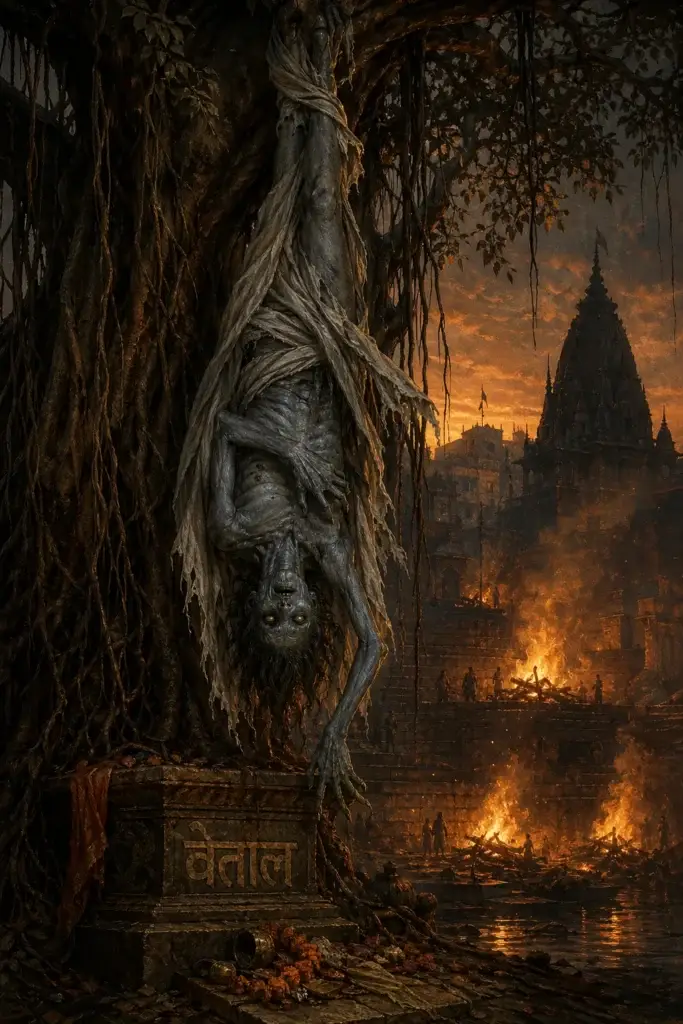
A spirit that possesses fresh corpses and thereby acquires paradoxical mobility and the ability to speak: the body is dead, yet the Vetala acts through it. In the classical tradition, they hang upside down in trees at cemeteries and cremation grounds (shmashana), waiting for opportunities to enter fresh corpses.
Literarily, the Vetala is most famous through the Vetalapanchavimshati, “Twenty-Five Tales of the Vetala”. In this cycle, King Vikramaditya is commissioned by an ascetic to fetch a Vetala from a tree.
The Vetala narrates riddle stories, and Vikramaditya must solve them. The collection belongs to the Kathasaritsagara (11th century CE, Kashmir) and traveled into Persian, Arabic, and European literature. Richard F. Burton’s English translation (1870) brought the motif to worldwide attention.
Vetala in the Vetala-pancha-vimsati and the Kathasaritsagara
The two central literary sources for Vetala are the Vetala-pancha-vimsati (Twenty-Five Tales of the Vetala) and the Kathasaritsagara (Ocean of the Streams of Story, 11th century). In the Vetala-pancha-vimsati, the Vetala is portrayed as a demon that inhabits a dead body and compels a king to exchange riddles with him at night.
The king must retrieve the corpse anew for each answered question; each time the Vetala leaves the body and hangs itself from a tree once more.
The framing is folkloric: the Vetala’s riddles are moral and legal dilemmas. The Vetala series represents a transitional form between folk narrative and philosophical fable.
At a Glance: Vetala
Type: Corpse-possessor, spirit of the dead
Origin: Unreleased soul of someone who died suddenly
Texts: Kathasaritsagara, Vetalapanchavimshati, Tantric texts
Period: Classical to present
Location: Cemeteries, cremation grounds, trees in their vicinity
Classification
First attestations in epic and Puranic literature. Classical literary form in the Kathasaritsagara (11th century). Tantric traditions employ Vetala motifs in cremation-ground rituals. Regional variants: Bengali, Tamil, and Marathi. Modern reception in literature and popular culture.
The Indian subcontinent. Through the Kathasaritsagara and its translations, the material spread widely: into Persian, Arabic, English, and German. Burton’s English version influenced Western horror and fantasy literature.
Kathasaritsagara (Somadeva, 11th century), Vetalapanchavimshati, regional Tamil and Bengali collections, Tantric ritual texts, modern fiction.
Name and Variants
Sanskrit: vetāla.
Other languages: Bengali Betal, Tamil Vetalam, Hindi Betaal.
Related terms: preta (hungry ghost), bhuta (spirit in general), pishacha (corpse-eater).
Distinction: The Vetala enters corpses but does not consume them as the Pishacha does.
The Vetala is not a created being but a particular kind of unreleased soul, neither reborn nor liberated, suspended in the gap between death and life. Tantric sadhakas deliberately seek out the Vetala in order to bind it as a servant through a binding ritual (Vetala-Sadhana).
Characteristics
Appearance
The animated corpse: decomposing, discolored, with unnatural movements. In some traditions the Vetala hangs upside down from a tree. Its eyes glow; it can speak even though its body is dead.
Behavior
Possesses fresh corpses, moves them, and speaks through them. Waiting on ascetics at the cemetery, it narrates riddles and stories. Those who handle the Vetala correctly win its services; those who fail are killed or driven mad.
Domain
Shmashana (cremation grounds), cemeteries, places of the dead, and nearby trees. Active at night and during the “magical hour” (between 3 and 5 in the morning). Not bound to inhabited places.
Mythological Origin
No single mythic genealogy. Vetalas arise through sudden death, refused rites, or violent loss. In Tantric interpretation they are “gap beings”: souls that are neither liberated nor reborn.
Ritualized Invocation and Occult Practice
Alongside the literary tradition there exists a ritual-magical tradition of Vetala invocation. Tantric sadhanas describe how a yogi or siddha deliberately summons a Vetala to obtain magical powers. The invocation requires offerings (usually animals or blood), specific mantras, and a ritual procedure that involves necromancy.
A Vetala brought under control is said to grant magical powers, invisibility, flight, and the ability to foresee the future. This is, however, dangerous: Vetalas are unreliable during invocation and may turn against the summoner. Tantric texts warn against the ignorance of beginners who attempt Vetala practices.
Profile: Vetala
The most important aspects of the Vetala at a glance.
Unreleased soul of someone who died suddenly. A “gap being” between death and rebirth. Not a created being but a state of existence.
Cemetery visitors, ascetics at cremation grounds, Tantric sadhakas, grave robbers. Not life-threatening to bystanders; dangerous only to those who seek it out.
Decomposing corpse with unnatural movements, glowing eyes, and a speaking voice. Often hovering upside down in a tree.
Moves corpses, poses riddles, and can be made a servant in Tantric rituals. Primarily dangerous to those who deliberately seek it out.
Specific Tantric binding rituals (Vetala-Sadhana). Mantras addressed to Shiva as lord of the shmashana. Rudraksha, Kali yantra, and ritual ash (vibhuti).
Approaches in Tantra and Folk Belief
Tantric Vetala-Sadhana
Advanced Tantric practitioners seek out the Vetala deliberately at the shmashana. The Vetala is bound through specific mantras and made into a servant; it can then bestow siddhis (supernatural abilities). The practice is dangerous and in classical tradition is permitted only under the supervision of a guru.
Vikramaditya Cycle
The 25 tales of the Vetala follow a fixed pattern: Vikramaditya carries the Vetala on his shoulder; the Vetala narrates a story ending in a riddle and demands an answer.
If Vikramaditya knows the answer and stays silent, his head shatters; if he answers, the Vetala flies back to the tree. The pattern repeats until a solution satisfies both parties.
Folk Warding
Specific Vetala amulets are rare in everyday life. General cemetery protection rules apply: not alone, not at night, not unprepared. Circumambulation, mantra recitation, and ritual purification after contact.
Parallels and Reception
Worldwide Parallels: Revenant motifs in numerous cultures share the basic pattern. The Vetala is distinguished by its “possession” of another’s corpse, a variant particularly close to the Chinese Jiangshi and the Slavic Upyr.
Literary Reception: Burton’s English translation (1870) brings the Vetalapanchavimshati into Western literature. Rudyard Kipling’s India stories cite the motif. Modern Indian literature (R. K. Narayan) and comics (Betaal series) keep the figure alive.
Popular Culture: Bollywood horror films (Vikram Aur Betaal), fantasy role-playing games (Dungeons & Dragons), modern fantasy novels. The Vetala is, alongside the Rakshasa, one of the most internationally recognized Indian demonic figures.
Psychological Functions of the Vetala Myth
In psychoanalytic and cultural-historical readings, the Vetala is understood as a representation of instinctual drives, particularly sexual energy. The fact that the Vetala animates a dead body illustrates the occult mobilization of life energies beyond rational control.
The riddle structure of the Vetala cycle can be read as a symbol of the unconscious, which resists mastery by intellect.
With each answer the Vetala slips away: grasping it is impossible. The motif of the corpse-bearer also reveals an ambivalence toward body and death in Indian philosophy: the body is not the person but an instrument that can be inhabited by many forces.
The Vetala-Pancavimshati: Twenty-Five Riddle Tales
The best-known literary context in which the Vetala appear is the Vetala-Pancavimshati, the “Twenty-Five Tales of the Vetala”. This frame cycle belongs to the most widely disseminated narrative works of Indian literature and has been transmitted in several Sanskrit versions as well as in countless regional-language adaptations.
Well-known Sanskrit versions are found embedded in Somadeva’s Kathasaritsagara and in Kshemendra’s Brihatkathamanjari, both from the 11th century, as well as in an independent version by Shivadasa.
The frame narrative is famous: a king, called Vikramaditya in many versions, receives from an ascetic the commission to fetch a corpse from a tree on a charnel field.
Inside the corpse dwells a Vetala. As often as the king carries the body, the Vetala begins to tell a story that ends with a baffling question.
If the king knows the answer yet stays silent, his head will burst. If he answers the question, the Vetala returns with the corpse to the tree and the game begins anew. Only at the final story does the king have no answer, allowing the cycle to end.
The individual tales are casuistic riddles, often moral or legal dilemmas: which of several parties bears the greater guilt, who has the greater claim, which action is the more honorable.
Scholarship values the Vetala-Pancavimshati as an important source for Indian legal and moral concepts. The Vetala itself figures here less as a figure of terror than as a shrewd, superhuman interlocutor: a spirit that tests the king through knowledge.
The Vetala as Animated Corpse
The defining characteristic of the Vetala in Indian tradition is its relationship to the corpse. The Vetala is a spirit that possesses a dead body and moves it, without that body being alive in any proper sense.
It thus hangs at the threshold between death and life, bound to cemeteries, charnel fields, and cremation sites. This connection with the dead makes it a ritually impure being and places it among the group of lower spirits that also includes the Pishacha and the Bhuta.
The Vetala’s capacity to enter a corpse and animate it made it simultaneously dangerous and useful in the traditional imagination. Dangerous, because a dead body moved by a Vetala on a charnel field was a threatening encounter.
Useful, because the texts report that a magician or ascetic could make a Vetala serviceable. A Vetala brought under control is regarded as a valuable helper that procures knowledge for its master, protects him, or fulfills his wishes.
Precisely this motif forms the background of the frame narrative of the Vetala-Pancavimshati: the ascetic who sends the king wants the Vetala for his own magical ritual.
Religious-studies scholarship connects this concept with Tantric currents in which the charnel field served as a site of spiritual practice and engagement with the impure as a path to power.
The Vetala thus stands at an intersection: it belongs to the world of the feared cemetery spirits and, at the same time, to the world of ritual specialists who seek to master what is feared.
Pathways through World Literature
The Vetala-Pancavimshati is one of the Indian narrative works with the broadest international reception history. Through Persian and Arabic intermediaries, as well as through direct translations, the material reached many literatures.
In Europe the cycle became known in the 19th century through several translations. Particularly influential, if very free, was the English adaptation by the explorer and Orientalist Richard Francis Burton, published in 1870 under the title Vikram and the Vampire.
Burton’s title is simultaneously a lesson in the problems of translation. Equating the Vetala with the European vampire is a gross simplification. The Vetala is not a blood-drinking revenant in the manner of the Slavic vampire but a corpse-possessing spirit with its own distinct cultural logic.
Burton’s word choice has nonetheless exerted a lasting influence and continues to shape popular representations in which the Vetala is incorrectly described as an Indian vampire. Religious-studies scholarship urges caution here: such equations conceal more than they explain.
The riddle frame of the Vetala-Pancavimshati has, moreover, had a career of its own. The structure of a narrative that culminates in a question to which the listener must respond is found in many storytelling traditions, and the Indian cycle is regarded as one of the most influential models of this type.
In India itself the material remains alive to the present day, in comic adaptations, in film and television, where the dialogic contest between king and spirit is retold again and again.
The Vetala is thus one of the few Indian spirit beings that lives on primarily as a literary figure rather than as a cultic object of veneration or fear.
Further Links
Bibliography (Selection)
Further standard works in the literature index.
The protective practice described here is a religious-studies classification of historical traditions. iWell Guard draws on this cultural-historical lineage of wearable protective objects and represents a contemporary form of it. More about iWell Guard .
Frequently Asked Questions about Vetala
What is a Vetala in the Hindu tradition?
Vetala (Sanskrit Vetāla) is in the Hindu-Buddhist tradition a vampiric-zombie-like being: a spirit that can inhabit and animate fresh corpses. Vetalas are associated with cemeteries, cremation sites, and the dark side of Tantra.
They are often very old, wise, and capable of prophecy; accordingly, they are invoked by tantrikas and yogis in the cemetery ritual (Smashana Sadhana). In the famous Indian tale cycle Vetala Panchavimshati (The 25 Tales of the Vetala), a Vetala serves as the narrator.
What is the Vikram-and-Vetala motif?
The Vetala-Panchavimshati cycle (also Baital Pachisi, 11th century) is one of the most famous frame narratives of India.
King Vikramaditya promises a yogi to cut a corpse from a tree and carry it to him, but the corpse is animated by a Vetala, who at each carrying narrates a tricky riddle story and poses a question at the end.
Vikram must answer, or his head will burst; but as soon as he speaks, the Vetala flies back to the tree. He must therefore repeat the process 24 times. The motif has inspired generations of Indian and Western storytellers.