iWell Guard

Love Spells, Rituals to Attract Affection

Love spells are ritual or magical techniques for producing or manipulating affective bonds, documented in Egyptian papyri, Greek iamboi, Indian Tantra texts and European witchcraft traditions. They operate through sympathetic magic, symbolic action, verbal incantation or the use of substances.

The boundary between psychological effect, social performative, emotional infection and ontological magic remains contested in cultural history and requires theoretically informed, differentiated judgment. They draw on analogy, sympathetic magic and psychologically suggestive mechanisms in complex interweaving.

PracticeCross-cultural

Table of Contents

Love spell: magical influencing of affection

This page provides an overview of love spell practices.

In the iWell Guard encyclopedia, love spell practices are documented in terms of the ethnology of religion, without promises of healing or claims of efficacy.

Quick Overview (Definition List)

Type: Magical practice / love spell Class: Love spell Distribution: Cross-cultural (antiquity, Middle Ages, modern global) Main features: Influencing of the will, substance magic (powder, tincture), ritual, target specificity Related sub-categories: Practices, magic, incantation, witchcraft

The magical practices were aimed at love and desire.

From antiquity to the Renaissance, love spell practices in a historical depth line.

Concept and Demarcation

Love spells differ from personal magic in that they are not merely intention (affirmations, visualization), but employ external means: herbs, liquids, objects, words with magical power. They differ from love itself in that they are coerced or manipulative.

A love spell is an assault on the autonomy of the target, and this is the ethical core of the controversy. In contrast to protective magic (which is defensive) or self-improvement magic, the love spell is directed at another and is invasive.

Cultural-Historical Examples

The ancient Greeks practiced defixiones, inscribed lead or clay tablets that were buried in the earth in order to activate supernatural forces.

Many defixiones were love spells: names were inscribed, and supernatural beings were asked to bind two people together or to provoke jealousy. In Egypt, love spells are documented in papyri, often combined with images or names and offerings.

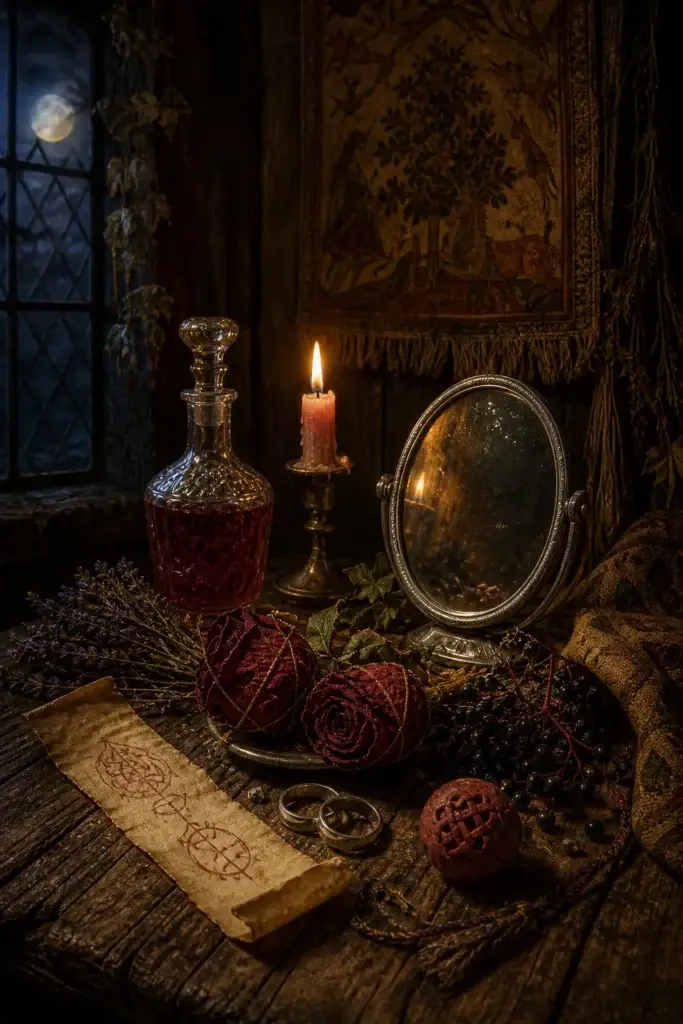
In medieval Europe, the love spell was frequent: witches were accused of brewing love potions, manipulating wax figures, or creating magnetic bonds through words. One well-known form was the sperm powder (bodily secretions or hairs of the target placed in food or drink) that was intended to produce attraction.

In modern Hoodoo and in Afro-Caribbean traditions (Santeria, Candomble), love spells are common, using herbs, oils, candles and prayers to spirits and loa. In modern New Age magism, love spell kits are commercially available.

Source Situation

Love spells are documented in ancient sources (Greek defixiones, Egyptian papyri, Roman magical texts), in medieval demonological texts, in witch trial records and in folklore collections.

Academic research (Christopher Faraone, Richard Gordon) has examined ancient defixiones and their love spell functions. Modern practical magicians document their own love spell recipes and successes in books and online.

Present-Day Significance / Related Beings

Love spells remain popular in esoteric and occult communities, especially among people who feel desperate in matters of love. The ethical problem remains central: love spells are conceptually a form of manipulation and control of the will. Paranormal research has produced no evidence of successful love spells.

Psychologically, love spell rituals can have a therapeutic effect (through the placebo effect and hope), but can also lead to obsession or feelings of guilt. Related practices are separation spells (driving a partner away) and emotional magic in general.

Phenomenology and Psychological Classification

In cultural history, love spells are a phenomenon associated above all with asymmetrical relationship constellations: one person desires another whose affection they cannot, or will not, obtain through direct courtship.

The defixion tablets from the Hellenistic Mediterranean are as a rule directed by men at women; in the folk-magical love practices of Europe both directions are found, and in the Hoodoo traditions there are differentiated forms for very different constellations, from winning back a lost partner to binding an unfaithful one.

From the perspective of the psychology of religion, the love spell is an attempt to establish control in a situation in which direct influence is felt to be inadequate; in the sources, this asymmetry is almost always linked to desperation, jealousy or a claim of possession.

Ethical and Legal Aspects

From a present-day perspective, the question of manipulation is central. A practice whose aim is to bend the will of another person without their consent is ethically problematic, regardless of whether one regards its magical efficacy as given or not.

In the history of religion and society, the love spell has therefore been prohibited or sanctioned in many legal systems, from the Roman lex Cornelia through medieval canon law to the early modern witch persecution.

On iWell Guard we report on the practice as a cultural-historical phenomenon; we do not evaluate it and give no instructions. The phenomenological description does not replace ethical judgment.

Related Practices in the iWell Guard Encyclopedia

Love spells are closely connected with the love potion as a material variant, with the general harmful magic tradition as a form of practice, with the Goetia (in which individual demons such as Asmodeus or Sitri were invoked for love influence) and with the classes of beings succubus and incubus, which in the older tradition of the history of religion were likewise understood as beings of sexual influence.

Those who wish to deepen the cultural-historical context will find in the articles on Aphrodite, Eros, Freya and Erzulie Freda the gods and goddesses who in the various traditions were responsible for the sphere of love and attraction.

Source-Critical Note

Anyone holding a historical love spell text, whether an Egyptian defixion, a late medieval grimoire recipe or a modern Hoodoo manual, should distinguish two levels: the ritual-practical instruction and the situation of the sources in the history of religion.

The ritual-practical instruction is as a rule formulated performatively: invocation, material, gesture, without theoretical justification.

The embedding in the history of religion, that is, what a love spell practice meant theologically and socially in a particular culture, becomes accessible only through the secondary literature and through comparison with the surrounding religious practice in each case.

We link the most important specialized works in the bibliography under Literature; for the late antique magic, the collection of the Greek Magical Papyri (Karl Preisendanz, Papyri Graecae Magicae) is in particular the central edition.

Geographical Distribution in Comparison

Love spells are attested across cultures in almost all societies that are well documented in the history of religion, from the Mesopotamian incantation corpus through the Greco-Roman defixiones to the East Asian folk belief texts and the Hoodoo traditions of the African diaspora.

The constancy of this phenomenon is striking in the history of religion: while gods, pantheons and ritualized forms of practice look very different from culture to culture, folk-magical love influence is structured remarkably similarly in its basic structure (invocation of a higher power, use of a personal connection to the desired person, sympathetic gesture).

Theories in the anthropology of religion interpret this either as a cultural universal reaction to a universal relationship asymmetry (so Wendy Doniger) or as evidence of very old, prehistoric forms of practice that have been preserved in the later cultures under different surfaces.

Methodological Notes on Working with Sources

Anyone who wishes to research historical love spell texts should read the older secondary literature with caution; until well into the 1970s, love spells were frequently dismissed as a trivial, superstitious practice and not taken seriously.

More recent research (Christopher Faraone, Daniel Ogden) has rehabilitated the status of ancient love magic as an independent cultural complex and worked it up in detail.

The situation is comparable in research on the early modern period: the older picture of “superstitious peasant magic” has been replaced by socially differentiated studies (Lyndal Roper, Eva Labouvie). Anyone reading the central texts should take into account the respective stage of research of the literature cited.

Summary

Love spells are one of the most productive fields of research in the history of religion within the more recent scholarship on antiquity, because they exemplify the interweaving of ritual practice, social asymmetry, theological norm and literary construction.

Anyone who deepens the subject gains a key to understanding folk-magical practice as a whole, for the structures that become visible in the love spell texts are encountered again in many other areas of folk magic.

Selected Bibliography on Love Spells:

  • Versnel, Henk S.: Beyond Cursing. The Appeal to Justice in Judicial Prayers. In: Faraone/Obbink (eds.), Magika Hiera. Oxford 1991.
  • Faraone, Christopher A.: Ancient Greek Love Magic. Harvard University Press, Cambridge 1999.
  • Frazer, James George: The Golden Bough. The Secret of the Beliefs and Customs of the Peoples. Rowohlt, Reinbek 1989.

Note: This selection serves as orientation; detailed articles follow their own curated list of sources.

iWell Guard and Protective Traditions

Across all documented cultures, protective objects can be found that people wore on the body, from Pazuzu amulets in Mesopotamia through the Hamsa in the Mediterranean region to the Mezuzah on Jewish doorposts and to Christian protective medallions. iWell Guard takes up this tradition in a contemporary material architecture, made in Germany, 41 layers, solid gold, platinum, silver. 30-day right of return.

Personal experiences may vary. Not a medical device. No promise of healing.