


Incubus, male night demon
The incubus is a being-class with deep roots in the history of religion, drawing on Mesopotamian, Jewish-apocryphal, ancient Greek, and medieval Christian layers. This overview presents the sources, the scholastic doctrine, the witch-trial theology, and modern phenomenological research. This overview situates the Incubus within medieval Lore, tracing scholastic doctrine and witch-trial theology alike.
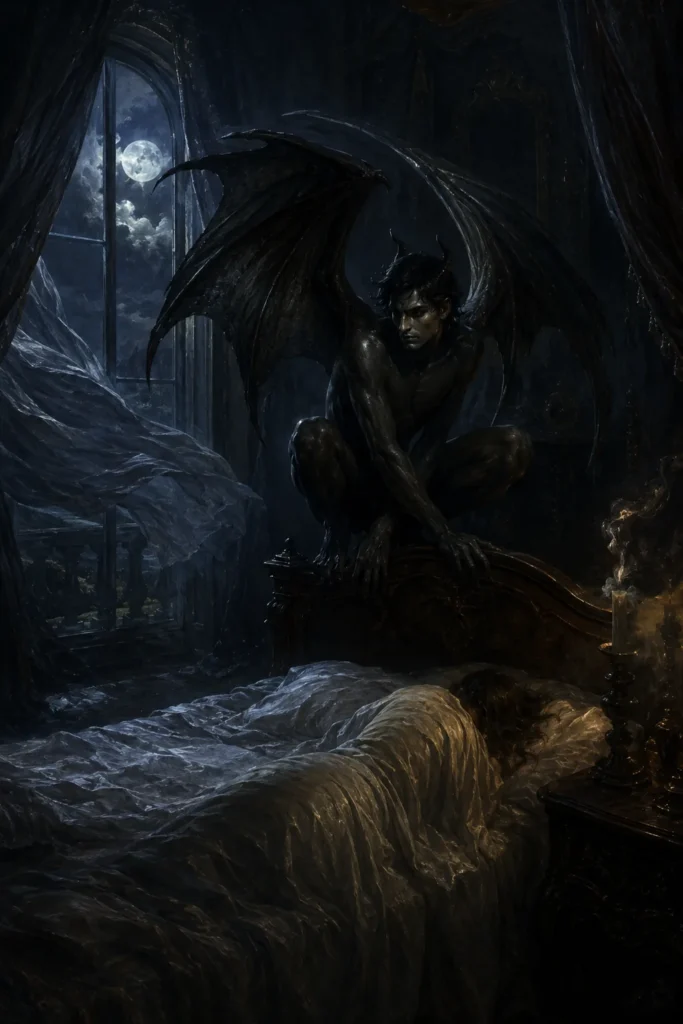
Incubus
Female night demon that assaults sleeping women. Counterpart to the incubus in Christian-medieval demonology. Connects with older traditions of female seducer demons (Lilith, Empusa, Lamia).
The incubus appears as a male night demon in several medieval demonologies.
The incubus is one of the best-documented being-classes in comparative demonology. The term derives from the Latin succuba (from succubare, to lie beneath) and designates a female nocturnal apparition that acts upon sleeping men.
The concept did not originate in the Christian Middle Ages; it has a clearly traceable prehistory in the Mesopotamian Lilitu tradition and in the Jewish doctrine of Lilith, which displays incubus-like characteristics since late Antiquity.
At iWell Guard we treat the incubus as a figure that has grown through the history of religion and carries clearly distinguishable layers: Mesopotamian-Akkadian in the oldest witnesses, Jewish-apocryphal in Late Antiquity, Christian-theological in High-Medieval scholasticism, early-modern juridical in the witch-trial corpus.
The theological framework was established by Augustine in De civitate Dei (XV,23) and systematized by Thomas Aquinas in the Summa Theologiae (I, q. 51, a. 3).
Both address the ontological question of how a corporally intangible spirit can exert sexual influence; Thomas follows the double-solution that the same demon first collects seed as a succubus and then transfers it as an incubus. This construction remains the standard model of Catholic demonology up to the Malleus Maleficarum (Sprenger and Institoris, 1487).
Mythological Classification
The incubus appears in the religious-historical tradition in several parallel strands that only coalesce into a unified figure in the early-modern synthesis.
Mesopotamian-Jewish Strand
The Lilitu of the Akkadian tradition is a nocturnal apparition that appears in the exorcism tablets of the second millennium BCE as a disturber of sleep and a threat to infants.
In the late-antique Jewish tradition she becomes Lilith and develops, in the Alphabet of Ben Sira (8th-10th century), a biography of her own as Adam’s first wife, who leaves Eden over a dispute about sexual position and returns ever since as an incubus figure.
This narrative layer is elaborated in the medieval Kabbalah (Zohar, 13th century) and connected with the bowl inscriptions of Jewish-Babylonian magic.
Greek-Roman Strand
In Greco-Roman tradition, the incubus can be linked to the circle of Pan, the fauns, and the sileni, male hybrid creatures who were credited with intrusive sexual behavior. The Latin term incubus, derived from the verb meaning to lie upon, captures this idea of a being that settles on a sleeping woman. This represents an independent line of tradition involving male figures of the night.
Empusa is attested in Aristophanes (The Frogs) and in Philostratus’s Life of Apollonius of Tyana; Lamia appears in Pseudo-Apollodorus and in the Christian Apocrypha as a threat to children. This tradition flows into the medieval incubus doctrine through the patristic adaptation of ancient mythology.
Early-Modern Synthesis
With the Malleus Maleficarum (1487), Johann Weyer’s De praestigiis daemonum (1563), Nicolas Remy’s Daemonolatria (1595), and Henri Boguet’s Discours des sorciers (1602), the incubus doctrine becomes a fixed component of witch-trial theology.
The methodological consequences are severe: the incubus charge is among the most frequent counts in early-modern witch persecutions. Historical research (Brian Levack, Wolfgang Behringer, Wolfgang Schild) has documented the connection between incubus theology and persecution dynamics in detail over recent decades.
Sources
From the perspective of religious studies, the incubus is not a single being-figure but a being-class with various hierarchical levels and functional specializations. The developed classifications are found primarily in early-modern demonology and in the Lemegeton corpus.
Hierarchy and Specialization
The Malleus Maleficarum distinguishes between incubus apparitions without lasting attachment (a single nocturnal visitation) and bound incubus relationships (the witch-pact construction). The witch-trial corpus largely adopts this distinction.
In more recent ritual-magic literature, particularly in the writings of Stephen Skinner and Israel Regardie, incubus beings are further subdivided by sphere of influence (love incubus, energy-draining incubus, control incubus), by provenance (Jewish, Christian-Western, Asian, such as the Japanese Yuki-Onna or the Chinese Hu-Li-Jing), and by form of binding.
Phenomenological Research
Owen Davies, Paranormal, 2009; David Hufford, The Terror that Comes in the Night, 1982) explains a portion of incubus reports through REM atonia and hypnopompic hallucinations.
This explanation covers the phenomenological layer (pressure on the chest, inability to move, sensory impressions) but leaves the cultural-historical layer open (Why does the figure appear in nearly all cultures as female, sexual, nocturnal, and threatening to infants?).
The prevailing position in religious studies today is that the phenomenological and the cultural-historical explanations are not mutually exclusive but address two layers of the same complex.
Liturgical and Ritual-Magic Approaches
The Catholic tradition has maintained a developed exorcism apparatus against incubus apparitions since the 16th century, codified in the Rituale Romanum (1614). The ritual-magic tradition (from early-modern Solomonic magic to modern Chaos Magic) developed protective sigils, invocation formulas for binding, and dissolution rites.
The iWell Guard position classifies the incubus in the category of nocturnal energy-draining beings and refers to the protective function of the mantra (see Function Overview) as a methodological response.
Contemporary Reception
Relation to Other Cultural Beings
The incubus is merely the most prominent form, within the Western medieval tradition, of a cross-cultural being-schema. Related beings are found in nearly all religiously well-documented cultures: Lamia in the Greek-Roman tradition, the Japanese Yuki-onna in one variant, the Slavic Mara in some readings, the Hebrew Naamah as Lilith’s sister in Jewish mysticism.
This kinship is instructive from a history-of-religions perspective: it shows that the concept of a female, sexually threatening nocturnal being is not a specific product of Christian demonology but a figure found very widely in cultural anthropology.
The Christian elaboration, with the polarization of incubus and succubus and its connection to witch beliefs, is by contrast historically specific and confined to the late Middle Ages and the Early Modern Period.
Theological Deep Structure
In scholastic theology, the question of whether a demon can appear as a man and have physical relations with a woman is anything but incidental. The incubus in particular forces the scholars into precise definitions, since the possibility of conception is part of the picture here, which puts greater strain on doctrine than mere seductive harassment.
Thomas Aquinas develops a nuanced answer in the Summa Theologiae (I, q. 51): demons can assemble bodies from air and matter, with which they collect male seed as a succubus and reintroduce it elsewhere as an incubus.
This construction resolves the theological problem of demonic procreative capacity: they do not procreate themselves but serve as vehicles; the result (for example, the Antichrist in medieval conception) is therefore not a demonic being but a human conceived through demonic mediation.
This theological deep structure explains why incubus and succubus could be conceived in medieval theology not as two separate beings but as two modes of the same being.
Religious Studies Bibliography
Anyone wishing to engage academically with the incubus topic will find the theological tradition worked through in the Russell series (“Lucifer”, “Mephistopheles”).
The history-of-religions connection to the Lilith tradition is treated systematically in Patai (“The Hebrew Goddess”, 1990); the sleep paralysis research in Owen Davies’s “Paranormal Experiences” and in the sleep-medicine review literature. The more recent feminist reading is accessible in Jane Caputi and in the “Encyclopedia of Witches and Witchcraft”.
Note on Further Research
Those wishing to go deeper into religious studies research will find detailed references to specialist literature on the directory pages of the “Index Religionum” and in the “Encyclopedia of Religion”.
Research on the Zohar, 13th c.) refines the construction: Lilith becomes the queen of Sitra Achra, the other side. The Christian Middle Ages adopt this idea and identify Lilith with the incubus.
Contemporary Reception and Sexuality
Frequently Asked Questions about the Incubus
What is an incubus?
\nAn incubus is a male sleep demon from the Jewish-Christian and medieval European tradition that sexually assaults sleeping women. The name derives from the Latin incubus (the one who lies upon). The idea is closely connected to the phenomenon of sleep paralysis and the nocturnal sensation of pressure on the chest.
\nHow did people in the Middle Ages ward off incubus and succubus?
\nIn medieval popular belief, spoken prayers, holy water, crucifixes, and relics were considered protection. Scholastic theology (Thomas Aquinas) discussed the phenomenon with controversy. Apotropaic practices included iron objects at the bedside, the sign of the cross on the threshold, and reciting the Lord’s Prayer before sleep.
\n