


Death Deities, Rulers of the Underworld
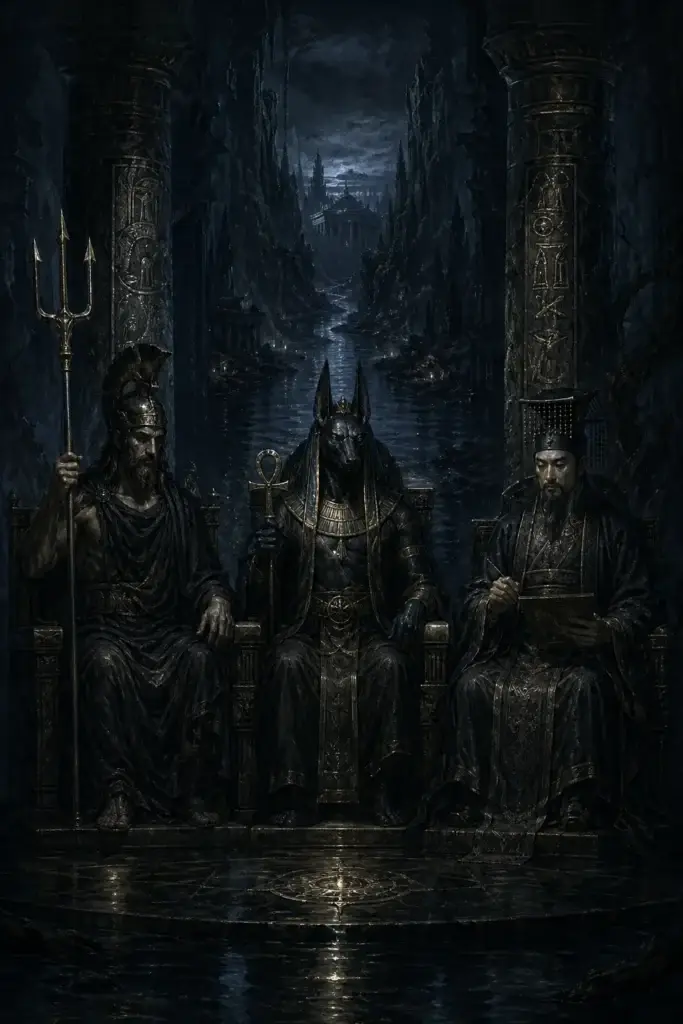
Deities that rule over the realm of the dead, the afterlife or the transition from life to death. Hades, Anubis, Yamaraja: rulers and guardians of the underworld across cultures.
In comparing death deities, recurring functional patterns emerge across cultures.
Table of Contents
Quick Overview (Definition List)
Type: God / ruler of the afterlife Class: death deities Distribution: all major pantheons Main characteristics: rule over the underworld, judgment of souls, neutrality/justice, often grim or distant Related sub-categories: high deities, anti-gods, protective deities
Definition and Distinction
Death deities differ from mere personifications of death in that they exercise active authority: they judge, they organise the afterlife, they enforce rules. They are not evil demons but rather administrators of a necessary domain.
Unlike high deities, who rule over everything, death deities hold limited authority: only over the dead and their realms. They also differ from vengeful spirits or demons, who act from personal motives; a death deity acts out of duty.
Function and Distinction
Death deities are divine instances whose primary responsibility is the domain of death, the underworld and the deceased. They differ from spirits of the dead (deceased humans) and from death messengers (intermediaries) through their divine status and their position within the respective pantheons.
Research in the history of religion (Hans-Peter Hasenfratz, Die Religion der Germanen, 1992; Walter Burkert, Griechische Religion, 1977) shows that death deities occupy an independent place in developed pantheons, often as brothers or sisters of the higher gods (Hades as brother of Zeus, Hel as daughter of Loki, Anubis and Osiris in Egypt).
Cultural-Historical Examples
The Greek Hades is rich and powerful, but not malicious; he rules over his underworld with strict rules and expects respect. He is also the god of riches, of the minerals hidden beneath the earth; his realm is not a mere place of punishment.
The Egyptian Anubis with the jackal head is lord of mummification and judge of the dead; the famous weighing scene shows Anubis weighing the heart of the deceased against the feather of truth.
The Egyptian Osiris (originally a god of fertility) became king of the underworld after his ritual dismemberment and restoration by Isis: a god who is himself dead and therefore leads the dead.
The Hindu Yamaraja is a stern judge with his son Chitragupta, who records every deed; Yamaraja sits in the south and can only be appeased through particular merits.
The Germanic Hel is an androgynous goddess, half alive, half dead, who rules over Hel (her underworld of the same name): neutral, not cruel, but inescapable. The Mesopotamian Nergal is god of plague and the underworld, a feared but necessary ruler.
Examples from the Advanced Civilisations
The Greek tradition knows Hades as ruler of the underworld with his own realm, who does not act against the living but administers the deceased. The Egyptian tradition knows Anubis as guide of the dead into the afterlife and Osiris as judge and king of the realm of the dead, the Duat.
The Norse tradition knows Hel as ruler of the realm of the dead of the same name and Ran as the goddess who gathers those drowned at sea.
The Hindu tradition knows Yama as the first mortal and thus the first king of the dead.
The Chinese tradition knows Yanluo Wang as king of the ten hells, a later synthesis of Indian Yama conceptions and Chinese folk tradition. The Aztec tradition knows Mictlantecuhtli as ruler of the ninth and deepest layer of the underworld.
Source Material
Death deities are documented in all ancient mythologies. The Greek sources (Homer, Hesiod), the Egyptian literature (Book of the Dead), the Hindu tradition (the Puranas, the Mahabharata), the Germanic sagas and the Mesopotamian tablets all mention and describe their death deities in detail.
The Tibetan Buddhist tradition knows Yama as a judge-king figure in depictions of the Bardo.
Significance Today / Related Beings
iWell Guard Position on Death Deities
In the iWell Guard classification, death deities are a tradition pill of the god class. They are not associated wholesale with black magic; their function within the respective pantheons is legitimate in terms of the history of religion and is anchored in the respectful tradition of venerating the dead.
The protective mantra apparatus is not directed against death deities as such, but against the necromantic invocation of death deities to harm living hosts. A detailed treatment of necromantic practice is offered at /nekromantie/.
Further standard works in the literature index.