Beings from the Jewish tradition on iWell Guard. A Jewish tradition since antiquity. Angelology of the Hekhalot literature and Kabbalah, demonology from the Talmud and Midrash.
Judaism is structurally monotheistic: the one God of the Torah stands at the center, without a pantheon. Nevertheless, the Jewish tradition knows a rich spectrum of spiritual beings: angels (Malachim), demons (Shedim, Mazzikim), and, in the mystical tradition, more complex hierarchies.
The angel doctrine is well attested in the Bible, with Michael, Gabriel, Raphael and Uriel as the four archangels, and the Seraphim and Cherubim as heavenly beings around the throne.
The later rabbinic and kabbalistic tradition expanded these structures: Metatron as the “lesser YHWH”, Sandalphon as his counterpart, and alongside them angels of the individual spheres (Sefirot).
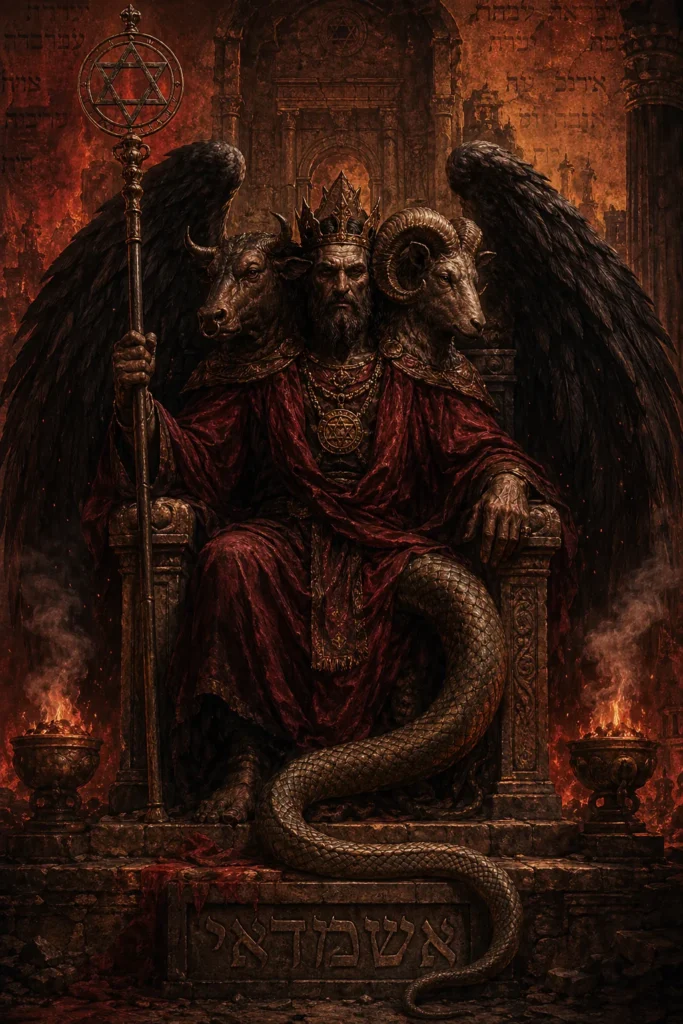
The demonology derives from post-exilic Judaism with Babylonian influence: Lilith as a night demon, Asmodeus as king of the Shedim, Azazel as a wilderness demon.
Medieval Jewish magic (Sefer Raziel, Sefer Yetzirah) and Kabbalah (Zohar, the Lurianic school) developed elaborate systems of protection and conjuration. Trachtenberg and Scholem are the standard scholarly authors on this layer.

Period: from antiquity to the present, with ancient, talmudic, medieval-kabbalistic and Hasidic phases.
Distribution: the Near East, the Mediterranean region, Central and Eastern Europe, North America, and the worldwide diaspora.
Sources: Tanakh, Talmud (Bavli, Yerushalmi), Midrash literature, Sefer Hekhalot, Zohar, Hasidic literature.
Pantheon and classes of beings: archangels (Michael, Gabriel, Uriel, Raphael, Metatron), demons (Lilith, Asmodai, Samael, Shedim).
Judaism is the oldest Abrahamic monotheistic religion and arose in the Levant around 2000 BCE. The Hebrew Bible (Tanakh) documents a development from early polytheism to a strict monotheistic monotheism. Angels (Malachim) are messengers of God, not autonomous powers. With the Babylonian Exile (6th century BCE), angelological speculation intensified.
The Hekhalot mysticism (3rd to 6th century) developed techniques for the visual experience of the heavenly thrones. Kabbalah (from the 12th century onward) systematized metaphysical teachings (Sefirot, divine names) for magical knowledge.
Later Hasidic movements democratized mystical experience. Judaism is decentralized and has had no priestly caste since the destruction of the Temple in 70 CE; rabbis took over spiritual authority.
Jewish everyday practice long centered on the study of the Torah, prayer and observance of the 613 commandments (Mitzvot). Mystical practices were long a matter for an elite, but became more widespread through Hasidism. Amulets and protective rituals (Tefillin, Mezuzah) are religious objects with a supernatural protective power.
Exorcism practices have existed since antiquity and were documented in the Middle Ages and the early modern period. Shamanic moments (prophecy, miraculous deeds) are attested in the Bible, but were later theologically marginalized.
Popular Judaism in numerous cultures integrated local beliefs in spirits and demons. Priestly-mediumistic roles existed early on (priests with Urim and Thummim), but were displaced.
Judaism remains a living religion with around 15 million adherents. Conservative and ultra-Orthodox schools preserve mystical and kabbalistic traditions. Reform-oriented Judaism has abandoned or secularized them. Madonna and other public figures have popularized an exoticized Kabbalah esotericism that has little in common with traditional practice.
Academically, Jewish mysticism is intensively studied. Literature and cinema use Jewish supernatural figures (Golem, Dybbuk) as cultural tropes. Zionist movements have partly secularized and politicized religious traditions. The trauma of the Holocaust has shaped modern Jewish spirituality.
The Jewish tradition is grounded in the Hebrew Bible (Tanakh) and the oral Torah, which was put into writing from the 2nd century CE in the Mishnah and from the 5th century in the Talmud.
The Torah knows a single God (YHWH) and is at the same time remarkably open regarding angels, demons and supernatural beings. In post-biblical literature the system was expanded.
The kabbalistic tradition, traceable from the 12th century in Provence and Spain, built on older mystical currents. The Zohar (13th century) became its central work. The ten Sephirot structure reality from Keter (Crown) to Malkhut (Kingdom). Alongside this, Kabbalah knows the Sitra Achra, the other side, with Lilith, Samael and the Qlippoth.
The rabbinic demonology is surprisingly rich. The Talmud mentions various classes of demons: Shedim, Mazzikim, Lilin. Lilith, introduced as Adam’s first wife in the Alphabet of Ben Sira, became the most prominent figure.
Asmodeus appears in the Book of Tobit as a demon of marital dissolution, and in the Talmud as king of the demons. This material fed substantially into Christian and Islamic demonology.
Further standard works in the literature index.
The Jewish tradition knows a number of named demons from the Talmud, Midrash, Hekhalot literature and medieval Kabbalah. A demon of Jewish mythology is rarely named directly in the Hebrew Bible, explicitly only Azazel (a wilderness demon in the atonement ritual) and Lilith (Isaiah 34:14). Among the post-biblical demons are Lilith (a night demon), Asmodai (king of the demons), Dybbuk (the spirit of a deceased person that possesses a living human) as well as the general classes of the Shedim and Mazzikim.
Shedim and Mazzikim are the general classes of harmful spirits in rabbinic literature. They operate in the interstices between the human and the spirit world, preferably at night, in impure places and during ritually sensitive transitions. The Talmud treats them as really existing but not to be feared powers, provided one observes the Halakha and the purity commandments.
The Jewish tradition protects with the Mezuzah on the doorpost, Hamsa pendants worn on the body, Tefillin straps during prayer and Shemhamphorasch name formulas.
iWell Guard fits into this cultural-historical line of wearable protective objects, in a contemporary material architecture, made in Germany. 41 layers, solid gold, platinum, silver. 30-day right of return.
Personal experiences may vary. Not a medical device. No promise of healing.
The mythology of Judaism is composed of biblical narratives, rabbinic interpretation, the Aggadah of the Talmud, as well as kabbalistic and mystical traditions.
In terms of religious studies, it encompasses accounts of creation, angelic hierarchies, demonic figures such as Lilith and Asmodai, and eschatological motifs. These traditions are not uniform but grew out of centuries of discourse among the Torah, Midrash and later mysticism.
The lexicon of protective symbols treats several signs and objects from Judaism on their own pages: Chai, Star of David, Kabbalistic Amulet, Lilith Amulet, Red Thread, Shiviti and Seal of Solomon. A cross-cultural overview is offered by the page on protective symbols.