Lilith Amulet: the Jewish childbed protective amulet
By Ralf Ittermann · last reviewed on
The Lilith Amulet is a Jewish protective amulet for the childbed. It bears names and formulae against the demoness Lilith and is meant to protect the new mother and newborn during the perilous days after birth.
As a childbed protective amulet, the Lilith Amulet has served since the Middle Ages: it is fixed above the cradle or at the new mother’s bed and is meant to ward off Lilith’s nocturnal assault and her child-killing helpers.
Classification
The Lilith Amulet is a protective amulet from the tradition of Judaism. It belongs to the objects meant to protect the Jewish childbed from danger.
The amulet is directed against a particular figure, against the demoness Lilith. According to a widespread conception, Lilith especially threatens the new mother and the newborn.
The Lilith Amulet bears written texts. On it stand names, formulae and verses meant to work against Lilith and to preserve those in need of protection.
The amulet was used in the days around the birth. It was fixed at the new mother’s bed, on the walls of the room or at the child’s cradle.
In religious studies the Lilith Amulet is a good example of an apotropaion, an object that protects by warding off. It is directed against a precisely named danger.
This page treats the Lilith Amulet from the perspective of protection in childbed. It presents the figure of Lilith, the structure of the amulet and its use.
Lilith in Jewish tradition
Lilith is a figure of Jewish tradition. She is understood as a demoness who becomes especially dangerous to women in childbed and to newborns.
The roots of Lilith reach far back. Related demonic figures are already known from the ancient Near Eastern world. They are connected with the threat to mothers and children.
In Jewish tradition Lilith became a figure in her own right. A well-known narrative links her with the creation story and interprets her as a first woman before Eve.
This narrative is not part of the Hebrew Bible itself but of a later tradition. Its age and its origin are disputed among scholars.
In later Jewish tradition, above all in the mystical tradition, the figure of Lilith was further elaborated. She became an important demonic figure.
In connection with the protective amulet, one trait of Lilith is especially significant: her dangerousness for the childbed. The Lilith Amulet is directed against this danger.
The danger of childbed
The Lilith Amulet can only be understood against the background of the dangers connected with birth. These dangers were very real in earlier conditions.
The birth and the days that followed were a time of great peril for mother and child. The mortality of new mothers and of newborns was a bitter experience over a long period.
This experience underlies the conception of a demonic threat to the childbed. What threatened mother and child was made tangible in the figure of Lilith.
The days around the birth were therefore regarded as an especially perilous time. They called for particular caution and particular means of protection.
The Lilith Amulet is an answer to this peril. It was meant to preserve the new mother and the newborn through the dangerous time.
A factual view recognizes in it the serious background of the amulet. It arose from concern for mother and child in a time when birth was bound up with great danger.
Structure and texts of the amulet
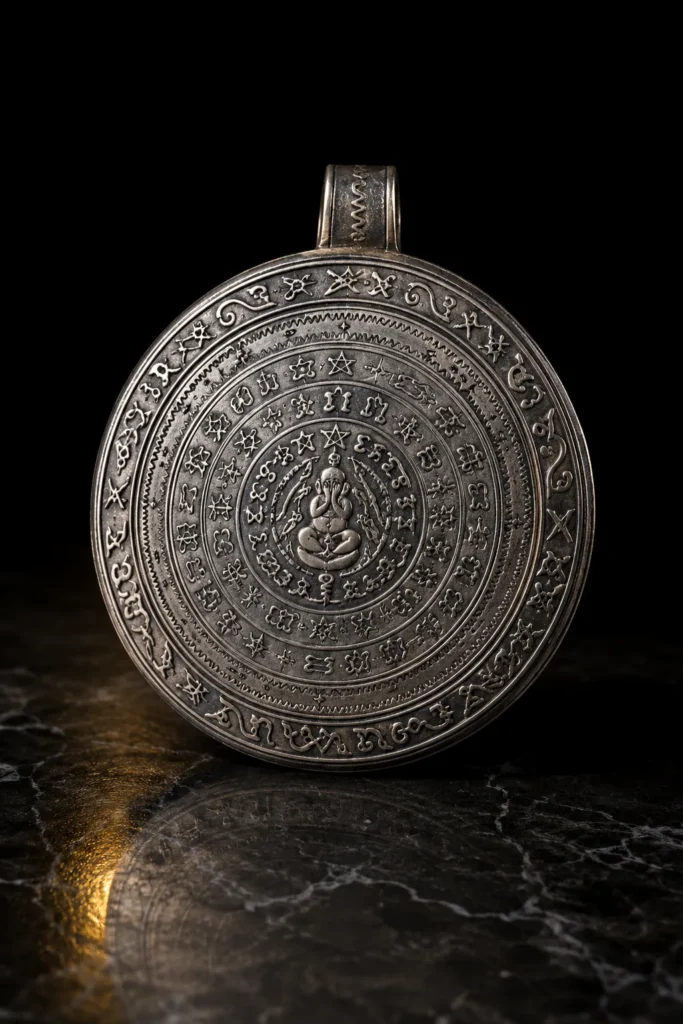
The Lilith Amulet is a written amulet. Its essence lies in the texts that stand upon it. They make the amulet what it is.
The amulet was written on parchment, on paper or on a firm surface. Some amulets are plain, others artfully designed and furnished with images.
Among the texts are holy names, verses from the Bible and formulae directed against Lilith. Frequently the amulet bears the explicit instruction to Lilith to keep away.
A well-known tradition names three angels who work against Lilith. Their names are written on the amulet, since according to the narrative Lilith has bound herself to yield before these names.
Some amulets also bear pictorial representations, such as the figure of Lilith herself or that of the protecting angels. Image and text then work together.
The Lilith Amulet thus belongs among the written talismans. Its power lies in the written word, in the names, the verses and the formulae directed against the demoness.
Use in childbed
The Lilith Amulet was used in the days around the birth. It was brought into service when the new mother and newborn were regarded as especially at risk.
The amulet was fixed at the new mother’s bed. Amulets could also be attached to the walls of the room, to the door and to the child’s cradle.
At times the room was equipped with several amulets. They surrounded mother and child, as it were, with a circle of protective signs.
The amulet remained in its place during the perilous time. After the first days or weeks, when the greatest danger was regarded as past, it lost its immediate task.
Alongside the amulet, the Jewish tradition knew further customs for the protection of the childbed. The amulet was one means among several, yet an especially widespread one.
The use of the Lilith Amulet was thus closely bound to a particular stage of life. It was a means of protection for the time of birth and the first days thereafter.
The amulet in the Jewish tradition of protection
The Lilith Amulet belongs to a broad Jewish tradition of protection. This tradition knows numerous amulets and protective signs for various purposes.
An important feature of this tradition is the trust in the written holy word. Names of God, biblical verses and formulae are regarded as powerful and are written on amulets.
The Lilith Amulet is one expression of this tradition. It applies the written word to a particular task, to the warding off of danger in childbed.
Closely related is the Kabbalistic amulet, which arises from the mystical tradition of Judaism. The page on the Kabbalistic amulet presents this form.
The mystical tradition of Judaism has especially elaborated the figure of Lilith and the doctrine of the protecting names. Many Lilith amulets are shaped by this tradition.
The Lilith Amulet is thus not an isolated object. It belongs to a rich tradition of Jewish protective amulets and shares with them the trust in the written holy word.
Lilith and related figures
The figure of Lilith, against whom the amulet is directed, does not stand alone. Demonic figures that threaten the childbed are known from several cultures.
In the ancient Near Eastern world there were demonic figures connected with the threat to mothers and children. One of them is Lamashtu. The page on Lamashtu presents this figure.
Lamashtu was regarded in ancient Mesopotamia as a threat to pregnant women and newborns. Against her, special amulets were worn that were precisely opposed to her.
Between Lilith and such older figures there are connections. Scholarship sees in the ancient Near Eastern world one of the backgrounds out of which the conception of Lilith developed.
Beyond Judaism, too, further cultures know demonic figures that threaten the childbed. Concern for mother and child has brought forth similar images in many traditions.
Lilith is thus the Jewish expression of a widespread conception. The Lilith Amulet belongs to a family of means of protection that answer the same concern across cultures.
Protection through warding off and names
The Lilith Amulet follows a distinctive working principle. It is an apotropaion, an object that protects by warding off. Its protection is directed against a precisely named danger.
The idea of warding off is essential here. The amulet is meant to keep Lilith away. It does not protect in general, but turns a particular threat away from those in need of protection.
The means of warding off is the written word. The names, the verses and the formulae on the amulet are regarded as powerful enough to drive the demoness away.
The names play a special role. According to tradition, Lilith yields before certain names, for she has bound herself to flee before them. To write these names on the amulet means to set them against Lilith.
The Lilith Amulet thus joins two ideas, the warding off of a named danger and the power of the written holy name.
In this the Lilith Amulet resembles other written talismans that work through names and formulae. Its distinctive feature lies in its precise orientation toward a particular figure and toward a particular situation in life.
Reception today
The Lilith Amulet is today above all a historical and a religio-historical object. In collections of Jewish amulets it is represented many times over.
In parts of the Jewish world, above all in traditionally minded communities, the custom of the childbed amulet has remained alive into the present.
At the same time, the figure of Lilith has undergone its own, new reception. In more recent times she was taken up and reinterpreted from various quarters.
Especially in feminist readings, Lilith was reinterpreted as a figure of independence. This modern interpretation is clearly to be distinguished from the traditional conception of the demoness.
A factual view keeps these levels apart. The Lilith of the protective amulet is the dangerous demoness of the childbed, not the reinterpreted figure of more recent reception.
The Lilith Amulet thus remains a striking example of an evil-averting amulet. In it are joined concern for mother and child, belief in the power of the written name and the warding off of a precisely named danger.
Literature (selection)
Related key terms: Lilith Amulet, Lilith, childbed, demoness, apotropaion, new mother, guardian angel, Judaism, Lamashtu.
iWell Guard and traditions of protection
iWell Guard stands in the cultural-historical line of wearable protective objects, to which the Lilith Amulet also belongs. A modern companion for people who live with protective symbols: made in Germany, 41 layers of solid gold, platinum and silver, with a 30-day right of return.
Personal experiences may vary. Not a medical device. No promise of healing.