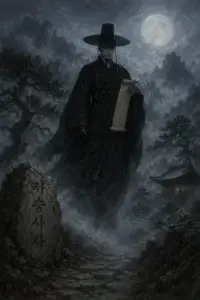
Death Messengers, spirits that announce death
Spirits that announce death or escort the deceased. Banshee, Dullahan, Reaper tradition, found across cultures between this world and the next.
Banshee, Valkyrie and further death omens are among the classic beings of this class.
Table of Contents
Quick Overview (Definition List)
Type: spirit / supernatural messenger Class: Death Messengers Distribution: Cross-cultural (Ireland, Scotland, England, Wales, Scandinavia, Eastern Europe) Main characteristics: announcement of death, lamentation, ritual behaviour, often female Related sub-categories: spirits of the dead, hauntings, vengeful spirits
Concept and Distinction
Death messengers differ from spirits of the dead in that they have not died themselves; they are independent supernatural entities whose task is to foretell deaths.
They also differ from death deities (such as Hades or Yamaraja), who act as rulers over the afterlife; death messengers, by contrast, are messengers at the threshold. In contrast to demonic spirits, which act malevolently, death messengers have an ambivalent or even protective function: they prepare, warn, and make rites of passage possible.
Classification and Distinction
Death messengers differ from spirits of the dead and death deities through their communicative function: they announce death without causing it. This function is distinct in the history of religion and is attested in practically all developed cultures under their own designations.
The communicative layer makes death messengers a class of beings in their own right, situated between spirits, angels and deities; they are neither pure deceased nor divine instances, but mediators between the spheres.
Cultural-Historical Examples
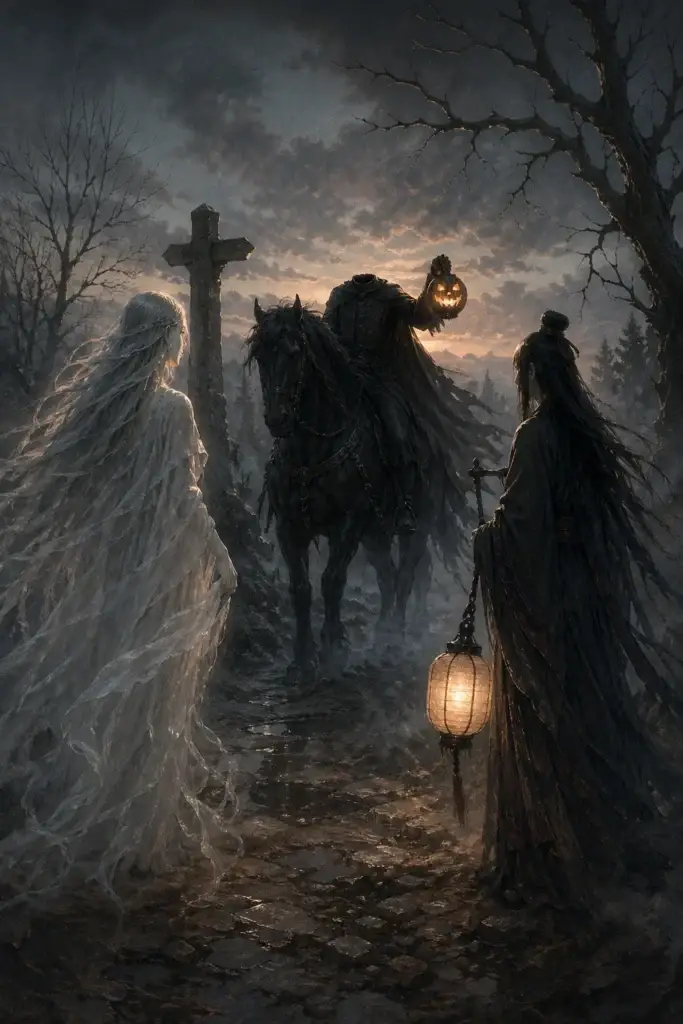
The Irish banshee (Bean Sidhe, “fairy woman”) is the prototypical example: a female spirit figure, often with long red or white hair, who sounds at night in a possessing, wailing lamentation before a death. The banshee’s wailing is unnatural, heart-rending, unmistakable, and is regarded as an absolute omen.
Some clans had their own banshee; her arrival at a house meant certain death within days. The Germanic Disir or Norse Dís (plural) are female fate spirits who, in Germanic sagas, visit warriors and announce their approaching death.
The Valkyrie of Scandinavian mythology functions similarly, a warrior from the afterlife who selects and chooses the fallen. In the Slavic sphere, certain Rusalki or Leshy are regarded as announcers of death.
In Scotland and northern England, the Wee Woman or White Lady is often described as a death messenger, a pale female figure who appears before accidents or deaths. In the French cultural sphere, Fées or fairy sightings are sometimes portents of family deaths.
A Comparative Cultural Spectrum
In the Irish-Celtic tradition, the banshee (from bean sídhe, “fairy woman”) is the paradigmatic death messenger, whose lament announces the approaching death of a family member.
Walter Yeeling Evans-Wentz systematically documented the tradition in The Fairy-Faith in Celtic Countries (1911). In the Scottish variant Bean Nighe (washerwoman), the death messenger washes the dying person’s clothing in a river.
In the Germanic-Scandinavian tradition, the werewolf or the Mahr appears in a similar function. The Japanese tradition knows the Shinigami (death god), who accompanies the souls of the dying; the Korean Jeoseung-Saja has the same function. The African Yoruba tradition knows the Egungun masked figures as mediators between the living and the deceased.
Source Situation
Death messengers are central in Irish, Scottish and English folklore collections (19th and 20th century), in Germanic sagas (recorded from the 13th century onward, the tradition older), in medieval chronicles (Bede, Geoffrey of Monmouth) and in ethnographic studies.
Irish literature (W.B. Yeats, Lady Gregory) idealised the banshee in the Romantic period. Psychological and ethnological works interpret belief in death messengers as a cultural response to premonition and collective processes of mourning.
Present-Day Significance / Related Beings
iWell Guard Position
In the iWell Guard classification, death messengers are a sub-class of the spirits whose communicative function distinguishes them from hostile classes of beings.
They do not fall under the defensive apparatus of the mantra (layers 2 and 3), but are rather placed under the invocation of positive beings (layer 8), insofar as their communication serves preparation and not harm.
The encounter with a death messenger is not primarily a threat, but a process of mediation that can be taken up respectfully in your own conduct of life.
Further standard works in the literature index.