


Hell Beings, Punishers and Guardians of the Underworlds
Hell beings are the punishers and guardians of the underworlds, ranging from Egyptian guards of the judges of the dead to Buddhist Naraka overseers, Tibetan Dharmapalas, and Christian princes of hell.
This overview covers inhabitants of the underworlds and hellish spheres, from Hades to the Islamic Jahannam.
Hell beings are demonic entities specifically associated with realms of the underworld, fire, and punishment. They are especially pronounced in dualistic and Abrahamic traditions, but also appear in Buddhism, Hinduism, and shamanic cultures. Their function is often the execution of punishment and the maintenance of cosmic order.
Table of Contents
Concept and Definition
Hell beings differ from demons in general in that they are bound to a specific place, an underworld or a damned location.
The concept of “hell” is itself culture-dependent: in Christianity a place of eternal damnation, in Buddhism a plane of existence within the cycles of Samsara, in Zoroastrianism a sphere of evil substances, and in the mythology of Scandinavia (Muspelheim, Niflheim) spatially concrete fire realms.
One difference from other types of demons: while local demons may be bound to rivers, houses, or trees, hell beings are anchored in cosmic and eschatological terms. They belong to a system beyond visible life. This also distinguishes them from spirits, which are typically bound to earthly places or to the still unredeemed dead.
Hell Beings as a Class of Beings
In the iWell Guard classification, hell beings are a distinct subclass of demons whose primary location and sphere of activity is the underworlds or hellish spheres of the respective tradition.
They differ from spirits of the dead through their divine-demonic status; they differ from death deities through their subordinate position within the hierarchical system of the underworld. In the tradition of religious history, they are frequently administrators or executors of the punishments that the various conceptions of hell provide for certain categories of the dead.
Examples from Cultural History
In Mesopotamia, the Galla were regarded as brutal underworld demons who dragged the dead into the realm of Ereshkigal, not as psychopomps but as ruthless executors. The Mesopotamian poem Enuma Elish describes them as cold and feared.
Buddhism knows various beings in the Naraka realms: the Naraka guardians are not morally neutral but carry out automatic retribution, not as judges but as cosmic mechanisms personified. They torment not out of malice but as the immediate consequence of karmic guilt.
In Christianity, hell beings (demons, devils, satanic hierarchies) have been understood since Origen and Augustine as fallen angels or evil intelligences subject to a lower power. They are not simply evil but directed against the divine order.
The Aztec pantheon knows Mictlantecuhtli, the ruler over the realm of Mictlan, not devilish in the Christian sense but necessary: a place for the dead, administered by a deity who is neither good nor evil but structurally unavoidable.
In Greece, the poets describe demons such as the Erinyes or Keres, who act from Tartarus and carry out blood vengeance or the execution of fate.
State of the Sources
Mesopotamian texts are found in the Enuma Elish and in descriptions of the underworld from Sumer. Buddhist cosmology is documented in the Abhidharmakosa and in Tibetan descriptions of hell, especially in the Bardo Thodol.
Christianity draws on apocalyptic literature (Revelation), Augustine, the Church Fathers, and later Dante Alighieri’s Divina Commedia. Aztec sources are the Codex Borbonicus and Sahagun. Classical sources: Hesiod, Virgil, Apuleius.
Modern demonology draws on these traditions, often syncretizing them (the Faust legend combines Christian and classical topoi) and popularizes them through literature and media culture.
Deeper Layers in the History of Religion
Conceptions of hell beings are closely linked in the history of religion to the eschatology of the respective culture. They presuppose a conception of the afterlife in which not all the dead share the same status, but in which a moral or ritual differentiation takes place.
In the early cultures (Sumer, Akkad, early Egypt) this differentiation is still weakly developed; the underworld is the fate of all the dead, with only slight distinctions.
With ethical and religious differentiation (in Hellenism, in late Egypt, in Judaism), a distinct “hell” region increasingly arises for the morally condemned, with its own guardian and torturer beings.
Medieval Synthesis
The elaborated Christian-medieval conception of hell, with the devil, a demon hierarchy, and nine circles of hell, is in the history of religion a late synthesis: it combines Jewish apocalyptic (4 Ezra, the Enoch apocalypses), Greek conceptions of Tartarus, and Egyptian and Mesopotamian substrates.
Dante’s “Divina Commedia” (early 14th century) is the most influential literary synthesis, shaping the popular imagination to this day. Research in religious studies (Alan Bernstein, “The Formation of Hell”, 1993) has worked out this process of synthesis in detail.
Comparative Research
Comparative research shows that hell beings in non-Abrahamic traditions often play functionally similar roles without being theologically identical.
The Buddhist Naraka guardians, the Hindu Yamadutas, the Japanese Oni, and the Chinese hell guardians fulfill comparable narrative functions: they embody the ritual and ethical consequence of moral action. The synthesis in religious anthropology by Mircea Eliade and in the Encyclopedia of Religion provides an overview.
Spheres of Hell in the High Cultures
The Mesopotamian tradition knows the Kur or Irkalla, the realm of Ereshkigal and Nergal, with the Galla as brutal underworld demons who execute the right to return the dead.
The Egyptian tradition knows the Duat with its various gates and guardians that the deceased must pass on the way to the judgment of Osiris; each gate has its own guardian demon with its own name, documented in the Pyramid Texts and the Book of the Dead.
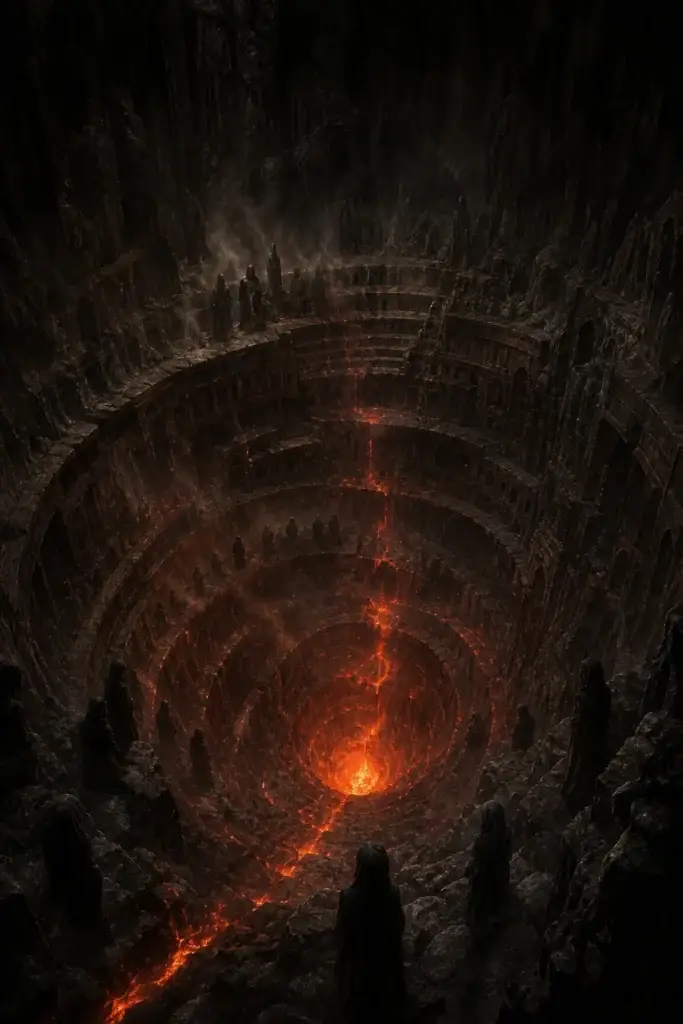
The Greek tradition knows Hades with its guardians (Cerberus, Charon) and the Erinyes as executors of punishment. From the 12th century onward, the Christian tradition develops, with Dante’s Divina Commedia, the most elaborate architectural model of hell, with nine circles and differentiated demon hierarchies.
The Buddhist tradition knows the Naraka as spheres of hell with guardian demons presided over by Yama. The Hindu tradition knows analogous spheres of hell with their own guardians.
The Japanese tradition combines both currents with the conception of the ten kings of hell (Juo) and the Oni who serve here. The Islamic tradition knows Jahannam with various levels, whose guardians are Malik and his helpers.
Contemporary Significance / Related Beings
Hell beings undergo a reinterpretation in modern esotericism and popular culture: they are understood less as a theological reality than as a psychological or metaphorical representation of inner conflicts.
In Western esoteric traditions (Golden Dawn, Goetia), some hell beings are cataloged as forms of intelligence that can be evoked and are linked to correspondences in planetary magic. This view differs markedly from traditional theologies, in which hell beings are feared as real, uncontrollable powers.
Body of Sources
Standard works on the history of hell in religious studies are Alan Bernstein, The Formation of Hell (Cornell University Press, 1993; comparative), Eileen Gardiner, Visions of Heaven and Hell before Dante (Italica Press, 1989), and Anthony Reardon, Hell. A History (2014).
For the Mesopotamian tradition, Wolfram von Soden, Akkadisches Handworterbuch (1965ff.); for the Egyptian, Erik Hornung, Tal der Konige (1982).
The Jewish-Christian-Islamic tradition is systematically treated in Jeffrey Burton Russell, The Devil. Perceptions of Evil from Antiquity to Primitive Christianity (1977), Satan. The Early Christian Tradition (1981), Lucifer. The Devil in the Middle Ages (1984), and Mephistopheles. The Devil in the Modern World (1986).
Beings in This Category


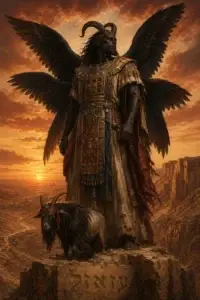


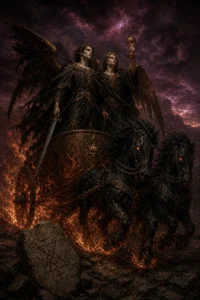





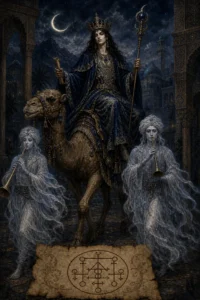


In the comparison across the history of religion, hell beings from Christian, Buddhist, Hindu, and ancient Near Eastern tradition show recurring functions as punishers, gatekeepers, and executors of the judgment in the afterlife.
iWell Guard and Traditions of Protection
The hell beings presented here are a religious-studies classification of cross-cultural conceptions of the underworld.
iWell Guard continues the millennia-old line of wearable protective objects, from Pazuzu pendants in Mesopotamia to Hamsa and evil-eye amulets in the Mediterranean region, to the Mezuzah on Jewish doorposts and to Christian protective medallions.
A contemporary form of this, made in Germany, with a clearly documented material architecture (41 layers, real gold, platinum, silver). 30-day right of return.
Not a medical device. No promise of healing. Personal perceptions may vary.