iWell Guard

Beelzebub, God of the Christian Tradition

Beelzebub is a god of the Christian tradition.

“Lord of the Flies”: a demonized foreign deity of the Philistines.

Table of Contents

Beelzebub - Gods from the Christian tradition, historical illustration
Beelzebub

Beelzebub is one of the most striking cases of a figure’s transformation in religious history: originally a local god of the Philistine city of Ekron (Baal-Zebub, “Lord of Exaltation”, later mocked as “Lord of the Flies”), he became a chief demon in biblical and Christian tradition.

The Gospels identify him with the prince of demons; medieval grimoires rank him alongside Satan.

His reception illustrates how monotheistic polemic transforms foreign deities into demons. The name “Lord of the Flies” is likely a deliberate distortion of Baal-Zebul (“Baal, the Prince”), evoking decay, flies, and putrefaction.

As a culturally significant figure, he continues to appear in folk belief, literature (William Golding’s “Lord of the Flies”, 1954), and popular culture to this day.

Stages in the History of Religions

Beelzebub is one of the best-documented examples in the history of religions of a deity’s pejorative transformation: a god originally venerated within a foreign tradition, converted into a demonic figure through Jewish and later Christian polemic.

The earliest evidence is the city deity of Ekron, one of the five Philistine cities, named in the Book of Kings (2 Kings 1:2, 6) as Baʿal-Zebub (“Lord of the Flies”).

King Ahaziah of Israel seeks healing advice from Baʿal-Zebub in that passage, a request the prophet Elijah comments on with contemptuous derision.

The original form may have been Baʿal-Zebul (“Lord of the exalted house”, temple lord), which Jewish polemic distorted into Baʿal-Zebub; this is now the standard scholarly view since William F. Albright (Yahweh and the Gods of Canaan, 1968).

Beelzebub at a Glance

Type: Demonized foreign deity, chief demon
Origin: Philistine city of Ekron
Texts: 2 Kings 1, Gospels, Testament of Solomon, grimoires
Period: Bronze Age to the present
Function: Chief demon, prince of flies, tempter

Classification

Period of the Texts

Earliest evidence for the Philistine Baal-Zebub deity in 2 Kings 1 (9th century BCE). Demonization in the Second Temple period. Prominent role in the New Testament. Elaborated figure in early modern grimoires (Lemegeton, Pseudomonarchia Daemonum).

Geographic Range

Originally the Levant (Ekron), then the entire Jewish-Christian world. Modern reception worldwide through literature and popular culture.

Source Situation

2 Kings 1; Gospels (Matt 10:25; Matt 12:24; Mark 3:22; Luke 11:15); Testament of Solomon; early modern grimoires; Milton’s Paradise Lost; modern literature.

Name and Spelling Variants

Biblical Hebrew: Baʿal-Zebub (“Lord of the Flies”), 2 Kings 1:2.
New Testament Greek: Beelzeboul / Beelzebul.
Original Philistine: likely Baʿal-Zebul (“Baal, the Prince”).
Medieval Latin: Beelzebub.

The shift from Zebul (“Prince”) to Zebub (“Fly”) is likely a mocking distortion by the biblical authors. The motif of the fly fits the demonological semantics of decay, putrefaction, and plague, and remains iconographically influential.

Description

Appearance

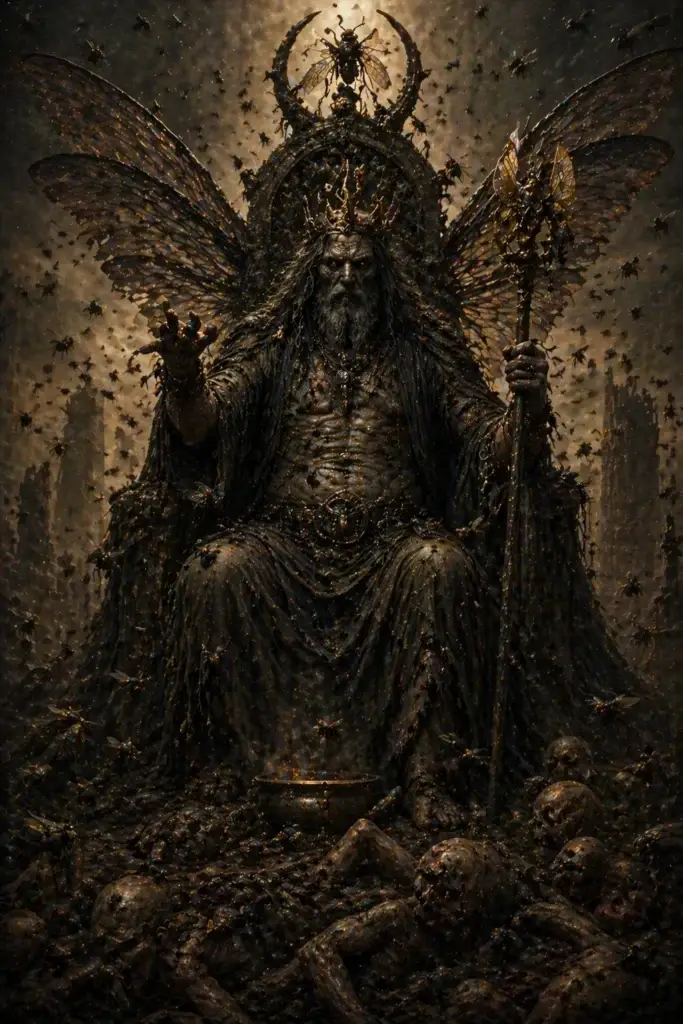
The Bible provides no physical description. In the Middle Ages: a giant fly or a horned figure with fly wings. In the Testament of Solomon: the only male demon, with bronze skin, ruler over flies. In grimoires: calf-shaped or with three heads.

Behavior

As chief demon, he commands other demons. Tradition assigns him the deadly sin of gluttony. In witch trial records, he is frequently named as a personal pact partner.

Domain

Cosmically, the second principal figure of hell (alongside Satan/Lucifer). Thematically: gluttony, greed, pestilence, plague. In Ekron he was originally a healing god; after demonization, a bringer of disease.

Mythological Origin

A Philistine local deity, likely with healing functions (2 Kings 1: King Ahaziah consults him regarding his recovery). Biblical polemic demonizes him; later tradition elaborates the demonic figure.

The Synoptic Gospels and Patristic Tradition

In the New Testament, Beelzebub appears five times (Matthew 10:25; 12:24.27; Mark 3:22; Luke 11:15.18.19). In the Synoptics, he is the supreme demon, whose power Jesus’ opponents claim he uses to cast out other demons.

The Pharisees accuse Jesus of working with Beelzebub’s aid; Jesus’ response (the well-known argument “If Satan’s kingdom is divided against itself…”) places Beelzebub virtually in identity with Satan.

This identification became standard in the later patristic tradition (Tertullian, Origen, Augustine). In medieval demonology, the Compendium maleficarum (Francesco Maria Guazzo, 1608) presents a hierarchy in which Beelzebub is the vice-demon after Lucifer; in some Goetia lineages he is the second or third among the Goetia kings.

Profile: Beelzebub

The most important aspects of Beelzebub at a glance. Details on his name, description, means of warding, and parallels can be found in chapters 2, 3, 5, and 6.

Tradition

Originally the god of Ekron (Baal-Zebul). Recast as chief demon through biblical polemic. The name shift to “Lord of the Flies” is a deliberate distortion.

Object of Influence

Those changing religious allegiance and apostates (New Testament context); in medieval tradition: the gluttonous, witch-pact partners, and plague victims.

Appearance

A giant fly or a horned figure with fly wings. In grimoires: calf-shaped or three-headed. Bronze skin in the Testament of Solomon.

Function

Commands other demons, causes pestilence and gluttony, appears in pact narratives. As the Philistines’ oracle god: healing or prophecy, later inverted into its opposite.

Warding off Beelzebub

Exorcism, avoidance of the name, sacraments. Particularly in the 17th century, court records name him as a pact partner; confession and absolution by a priest were prescribed.

Counterparts

Baal figures (Canaanite, as the original layer), Mammon (Christian greed demon), Asmodai (Jewish tradition), and more broadly: the motif of demonized foreign deities.

Warding in Everyday Life

Warding Rituals

Exorcism in church tradition. The Benedictus Medal, which addresses all chief demons at once. Older folk practice: crosses and holy water at sites of plague.

Conjurations

Grimoires (Lemegeton, Pseudomonarchia Daemonum) list Beelzebub with seal, rank, and retinue. Scholastic theology condemns such binding formulas, while the literature on them continues to proliferate.

Amulets and Protective Symbols

As with Satan: cross, crucifix, Benedictus Medal. During plague periods specifically: plague-saint medals (Sebastian, Roch), which symbolically trace the fly-plague back to Beelzebub.

Reception

Middle Ages and Early Modern Period: In grimoires, he holds second rank after Satan/Lucifer. In witch trials, he frequently appears as a pact partner. In exempla collections, he is a plague-bringer.

Milton: Milton’s Paradise Lost (1667) makes Beelzebub Satan’s closest confidant and a rhetorically gifted counselor in Pandemonium.

Modern Era

William Golding’s Lord of the Flies (1954) uses Beelzebub as a symbol of inner degradation. Heavy metal, fantasy, and film have taken up the figure, mostly as an embodiment of demonic dissolution.

Primary Source Corpus

Key works on Beelzebub research: Joachim Tubach, Im Schatten des Sonnengottes (Otto Harrassowitz, Wiesbaden 1986), for the Ugaritic-Canaanite prehistory. William F. Albright, Yahweh and the Gods of Canaan (Doubleday, Garden City NY 1968), foundational for Jewish polemic against the Baal tradition. Marvin H. Pope, Job (Anchor Bible, 1973), for the Old Testament discussion.

Jeffrey Burton Russell, The Devil: Perceptions of Evil from Antiquity to Primitive Christianity (Cornell University Press, Ithaca 1977) and Satan: The Early Christian Tradition (1981), for the patristic treatment. Joseph Peterson (ed.), The Lesser Key of Solomon (Weiser, Boston 2001), for the Goetia tradition.

Baal-Zebub of Ekron: the Biblical Starting Point

The name Beelzebub traces back to a specific passage in the Old Testament. In the Second Book of Kings, chapter 1, the ailing King Ahaziah of Israel sends messengers to consult Baal-Zebub, the god of Ekron.

Ekron was one of the five main cities of the Philistines. The prophet Elijah intercepts the messengers and announces the king’s death for having consulted a foreign god rather than the God of Israel.

The name Baal-Zebub means literally “Lord of the Flies.” Scholarship largely regards this as a derisive distortion of an original title.

A likely original form is Baal-Zebul, “exalted lord” or “Prince Baal,” where zebul is connected with the term for an elevated dwelling or princely seat. The biblical authors would have deliberately distorted the honorific title into “Lord of the Flies” to ridicule the foreign cult.

This interpretation is also supported by the Ugaritic texts, in which Baal appears with the epithet zbl. It has not been definitively proven, but it remains the most widely accepted explanation.

What stands firm is this: at the beginning stands not a demonic figure but a West Semitic storm deity perceived by Israel as a hostile foreign god.

That a regional Baal cult from the Philistine city of Ekron became a central figure of later demonology is a textbook example of how a religion reinterprets the gods of its neighbors. The once-venerated lord becomes a despised idol and, finally, a demon.

From Foreign Idol to Prince of Demons: Development in the New Testament and Beyond

In the New Testament, the name appears in slightly altered form as Beelzebul.

In the Synoptic Gospels, Jesus’ opponents accuse him of casting out demons with the help of Beelzebul, who is there called the “chief of demons.” Jesus refutes the charge with the well-known argument that a kingdom divided against itself cannot stand.

At this point the transformation is already advanced: the former Philistine god is now a leader of demons, practically identified or closely linked with Satan. The Gospels themselves establish the identification by moving from Beelzebul to Satan in the course of the argument.

In post-biblical Christian tradition, Beelzebub was elaborated into an independent figure within the hierarchy of hell.

Medieval and early modern demonologies assigned him a high rank, often as one of the most powerful fallen angels directly after Lucifer or Satan. In some of these systems he was even listed as the true supreme lord of hell.

These hierarchies are not a unified doctrine but products of speculative literature that varies from author to author.

The line in the history of religions remains clear: a West Semitic Baal, mocked as a foreign god by the Hebrew Bible, declared a prince of demons in the New Testament, and elaborated into a fixed element of infernal topography in the Christian Middle Ages.

Beelzebub in Exorcism Manuals and Witch Trials

In the early modern period, Beelzebub gained practical significance in two contexts: exorcism and witch trials. Exorcism manuals used to interrogate allegedly possessed individuals listed demon names. Beelzebub was among the names the exorcist was expected to elicit, since knowledge of the name was believed to confer power over the demon.

The most famous case is that of Loudun in France, where in the 1630s nuns of a convent were considered possessed. In the records of this and similar cases, Beelzebub appears among the demons named.

Historical research, including Michel de Certeau’s influential study of Loudun, has shown how strongly such cases were shaped by social conflict, theological rivalry, and the expectations of the exorcists.

In witch trials, Beelzebub appeared at times as the demon with whom the accused were alleged to have made a pact. Caution is warranted here as well: the testimonies were produced under torture or the threat of torture and followed the prompts of the interrogators.

A separate strand is the so-called grimoire literature, magical handbooks with purported instructions for conjuring spirits. Works such as the Grand Grimoire or the Höllenzwang writings name Beelzebub among the infernal princes who can be conjured.

These texts are late compilations, often early modern or even more recent, with no ancient basis; they document popular conceptions of magic, not an ancient tradition.

The Fly as Image: Iconography and Literary Reception

The literal meaning “Lord of the Flies” has strongly shaped the imagery surrounding Beelzebub, even though it was originally a mockery. In Christian art and literature, the fly became his attribute. Flies were regarded as creatures of decay, carrion, and disease, fitting the notion of a demon associated with putrefaction and defilement.

In some medieval and early modern depictions, Beelzebub appears as a vast fly-like or insect-like creature; in others, as a winged demon of conventional form. There is no unified iconography; artists followed the demonologies of their time and their own imagination.

The literary reception is wide-ranging. John Milton’s Paradise Lost of the 17th century introduces Beelzebub as the highest-ranking fallen angel after Satan, his wise and dignified counselor. Milton thereby gives him a literarily elaborated personality that reaches far beyond the brief biblical notes.

In the 20th century, William Golding’s novel Lord of the Flies (1954) brought the name to a wide readership without allowing the demon himself to appear: the title refers to the pig’s head impaled on a stake, swarming with flies, and to the evil that, in Golding’s view, lies within the human being itself.

In modern culture, Beelzebub is thus less a concrete figure than a symbol of decay and of the evil that comes from within.

Further Links

Recommended internal links:

Bibliography (Selection)

A selection of key works on Beelzebub:

  • Tate, Marvin / Haas, Peter (eds.): Baal Worship in the Old Testament. Studies 1991.
  • Duling, Dennis C.: “Testament of Solomon.” In: James Charlesworth (ed.): Old Testament Pseudepigrapha, vol. 1. New York 1983.
  • Russell, Jeffrey Burton: Satan, vol. 2. Ithaca 1981.
  • Forsyth, Neil: The Old Enemy. Princeton 1987.
  • Gaster, Theodor H.: “Beelzebul.” In: Dictionary of Deities and Demons in the Bible. 2nd ed. Leiden 1999.

Frequently Asked Questions about Beelzebub

Who is Beelzebub?

Beelzebub (Hebrew: Baal-Zebub, Lord of the Flies) was originally the city god of the Philistine Ekron, mocked in 2 Kings 1:2-6. In the New Testament, Beelzebub is one of the epithets for Satan (Mark 3:22).

In the medieval grimoire system (Lemegeton, Malleus Maleficarum), Beelzebub appears as one of the highest princes of hell, often second after Satan or Lucifer.

What role does Beelzebub play in demonological literature?

In the Malleus Maleficarum (1487) and in the Lemegeton (the Solomonic book), Beelzebub is one of the most powerful of the 72 princes of hell.

Johann Weyer, in his Pseudomonarchia Daemonum (1577), assigns him supreme command over the eastern army of hell. In the popular Christian imagination, he is the Lord of the Flies, a mythic reference to the stench of decay and disease.

Classification & Protection

VLEVEL
The Protection Compass assigns this being to influence level V, Profound influence.

Against its influence, cross-cultural tradition names these protective means:

Compare in the Protection Compass →

Recommended protective means

iWell Guard

The simplest protective means in this collection: 41 layers of fine gold 999, platinum, silver and silicon, manufactured in Ruhla, Thuringia. It requires no activation, is bound to no person, and is effective within a radius of around 50 meters, even without being worn.

All protective means at a glance →