Legion, demon of the Christian tradition
By Ralf Ittermann · last reviewed on
Legion is a demon of the Christian tradition.
“For we are many” – collective possession in Gerasa.
Legion is the name of a group of demons encompassed in the New Testament account of the Gerasene demoniac (Mk 5:1-20; Lk 8:26-39; Mt 8:28-34).
At Jesus’s command, they enter a herd of pigs, which immediately rush into the sea. The scene has become the paradigm of Christian exorcism and has shaped the image of collective possession.
The name “Legion” refers to the Roman military unit of up to 6,000 soldiers, establishing the group and mass dimension of the phenomenon.
In later theological and psychological interpretation, Legion serves as a model case: possession as multiple overlay, inner fragmentation, and dissolution of personality. Modern psychology of dissociative disorders occasionally takes up the narrative as a guiding motif.
Synoptic Tradition and Political Connotation
The Legion narrative appears in all three synoptic Gospels (Mark 5:1-20; Matthew 8:28-34; Luke 8:26-39) and describes the healing of a possessed man in the region of the Gerasenes (or Gadarenes) on the eastern shore of the Sea of Galilee.
The central scene is the dialogue between Jesus and the possessed man: Jesus asks for the name, and the answer is Legion, for we are many.
The term Legion (Greek legiōn, Latin legio) designated in the first century a Roman troop of approximately 5,000 to 6,000 soldiers.
The choice of precisely this term for a demonic self-designation has prompted a political reading in scholarship (Paul W. Hollenbach, Jesus, Demoniacs, and Public Authorities, 1981): the narrative contains an anti-Roman subtext in which the Roman occupying power is symbolically expelled.
This reading is followed by Ched Myers (Binding the Strong Man, 1988) and John Dominic Crossan in later Jesus research.
Overview: Legion
Type: Collective demon (a group under one name)
Origin: The Gerasene demoniac
Texts: Mk 5, Mt 8, Lk 8, patristic commentaries
Period: 1st century to the present
Motif: Paradigm of multiple possession and Christian exorcism
Context
The synoptic Gospels (Mk, Mt, Lk) all recount the scene; Mk 5 is considered the oldest version. Patristic commentaries (Origen, Augustine) elaborate the interpretation. Modern exegesis and psychology regularly refer to Legion as a model case.
The region of the Gerasenes on the eastern shore of the Sea of Galilee is the narrative setting; the city of Gerasa (present-day Jordan), however, lies about 55 km from the lake, and the place names vary in the manuscripts. Legion is present as an exemplary case in Christian mission and popular piety worldwide.
Synoptic Gospels, patristic sermons, medieval exempla, iconographic depictions, modern exegesis, psychoanalytic and psychological interpretations (Jung and others).
Name and Interpretation
Greek: Legiōn, from Latin legio.
Context: The possessed was not a single demon but a collective, “for we are many” (Mk 5:9). The name is therefore a functional designation, not the proper name of an individual demon.
The number “Legion” also alludes to the Roman occupying power. The aspect of political interpretation, Legion as a symbol for Roman rule that “occupies” the land, is highlighted in modern postcolonial exegesis.
Characteristics
Appearance
No distinct iconographic tradition. The scene is always depicted: Jesus on the shore, the possessed man among the tombs, the herd of pigs rushing into the sea.
Behavior
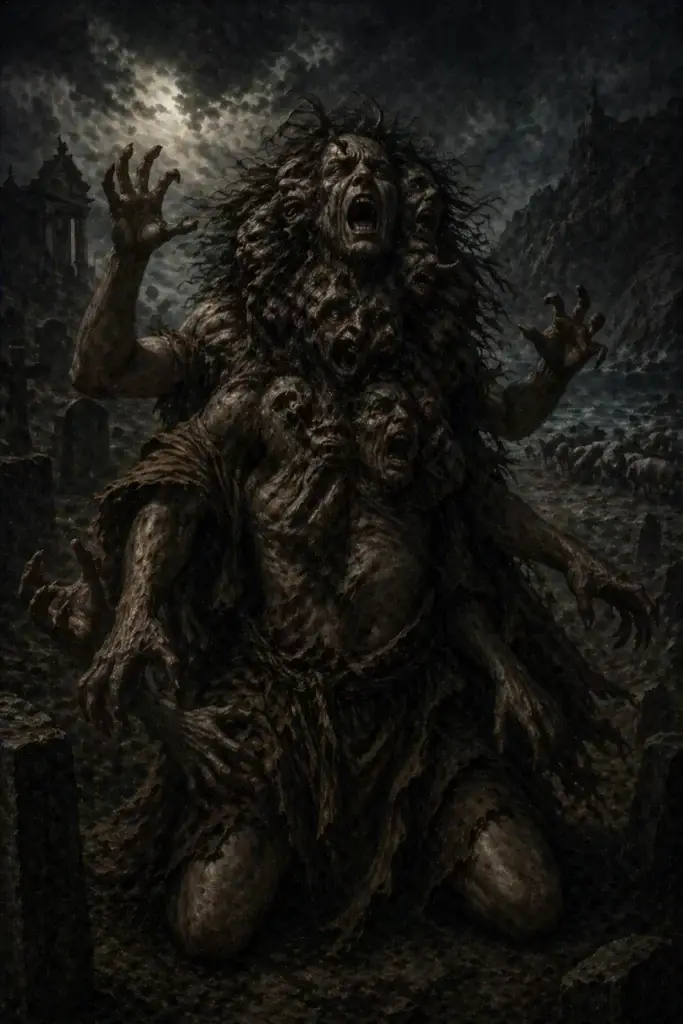
The possessed man lives in rock tombs, can no longer be bound, cries out day and night, and injures himself with stones. After the exorcism: restored to health, clothed, and in his right mind.
Domain
A single individual who becomes the bearer of collective possession. Symbolically: the destruction of social integration (living among tombs), bodily self-harm, isolation.
Narrative Function
The most detailed exorcism of Jesus in the Gospel of Mark and thus the foundation of the Christian exorcism tradition. The herd of pigs underscores both the reality of the demons (they continue to act even after expulsion) and their destructibility.
Patristic and Medieval Reception
Origen, in his commentary on Mark, interprets the Legion narrative allegorically: the many demons correspond to the many sins that make a single person into a multiplicity, while healing signifies the re-unification of the person in Christ. This allegorical reading remains standard in the patristic tradition.
In medieval popular theology, Legion becomes the prototype of manifold possession, in which multiple demons inhabit a single person. The exorcism apparatus of the Rituale Romanum (1614) provides for a special interrogation practice in such cases, requiring that the number, names, and circumstances of entry of the demons be established.
Profile: Legion
The key aspects of Legion at a glance.
Not a single demon but a collective (“for we are many”). The name “Legion” derives from the Roman army, comprising up to 6,000 soldiers.
Individual people who become bearers of multiple possession. In later psychological interpretation: dissociative states and fragmentation of personality.
No distinct iconography; the scene is always depicted: Jesus, the possessed man, and the herd of pigs rushing into the sea.
Causes radical social and physical isolation: living among tombs, self-harm, and screaming day and night.
Direct exorcistic command of Jesus. In church tradition, the model case for the exorcism ritual: invocation, demand for the name, command of expulsion.
Dybbuk (Jewish possession), jinn possession (Islamic), Buddhist conceptions of possession, modern dissociative disorders.
Reception
Patristic and Medieval Period
Origen interprets Legion allegorically as the multitude of vices; Augustine views the episode as proof of Christ’s real power over demons. Medieval exempla use the scene as a model case of spiritual liberation.
Modern Period
Psychoanalysis and depth psychology interpret Legion as an image of inner fragmentation. Postcolonial exegesis sees in the number a reference to the Roman occupying power. The film title Legion (1998) is just one of many popular-culture echoes.
Exorcism Practice
The question “What is your name?” (Mk 5:9) continues to be used to this day in the Rituale Romanum as a central element. The demand for the name is regarded as the classic instrument for identifying and expelling demons.
Cross-Traditional Parallels
Jewish Tradition
The Dybbuk as a possessing spirit is the closest structural parallel. Both traditions employ the question of the name as a central instrument of exorcism.
Islamic Tradition: Possession by jinn, with ruqya as the expulsion ritual. Functionally parallel, theologically independent.
Secular Interpretations: Dissociative identity disorder (“multiple personality”) in modern psychiatry is the secular successor. The underlying idea of an inner multiplicity is preserved.
Comparative Religious Studies
Structurally related are the Jewish Dybbuk tradition (elaborated within Kabbalistic thought from the 16th century onward, with the standard work by Gershom Scholem, On the Kabbalah and Its Symbolism, 1965) and the Islamic tradition of jinn possession. Both recognize the phenomenon of multiple possession without using the specific Legion term.
The Haitian Vodou tradition knows the phenomenon of “monté” riding by several Lwa in succession; the Afro-Brazilian Candomble tradition similarly knows possession by various Orixá. The overall picture from the history of religions is that the phenomenon of multiple possession is documented in virtually all developed cultures with their own terminology and their own ritual treatment; the Christian-evangelical Legion narrative is a single case within a broad phenomenological spectrum of religion.
The Gerasene Demoniac in Detail
The only New Testament passage in which the name Legion appears is the account of the possessed man in the territory of the Gerasenes.
It is found in Mark 5:1-20, in shorter form in Luke 8:26-39, and considerably abbreviated in Matthew 8:28-34, where there are two possessed men. Mark offers the most detailed version and is regarded by the majority of scholarship as the oldest.
Mark portrays the man as one who lives among the rock tombs, cannot be restrained by any fetter, and beats himself with stones day and night. When Jesus asks him for his name, the unclean spirit answers: My name is Legion, for we are many.
The spirit begs not to be driven out of the region but to be allowed to enter a herd of pigs. Jesus grants this; the roughly two thousand pigs rush down the slope into the sea and drown. The healed man afterward sits clothed and in his right mind at Jesus’s feet.
Noteworthy is the precise word choice. Legion is not a Hebrew or Aramaic term but the Latin loanword for the largest unit of the Roman army, several thousand men. The number of pigs roughly corresponds to the strength of a legion.
Many commentators, such as those in the tradition of Gerd Theissen, read this language as a deliberate allusion to the Roman occupying power. The narrative thereby acquires, alongside its healing dimension, a political connotation, though the text does not make this explicit.
Legion as Multiplicity: Theology and the History of Interpretation
Legion is, in the strict sense, not the proper name of a single demon but the self-designation of a multitude. This has occupied the history of interpretation from the outset.
The Church Fathers, among them Origen and later Augustine, interpreted the multitude of spirits as an expression of the inner dividedness of a person ruled not by one but by countless powers of sin.
The healing thus becomes an image of restoring a unified person ordered by God, a reading supported in the text by the detail of being “in his right mind”.
In medieval and early modern demonology, Legion was occasionally understood as a concrete prince of hell, but this is a later development running against the plain sense of the biblical passage.
The major demon catalogues of the early modern period, such as Johann Weyer’s Pseudomonarchia daemonum of 1577, do not list Legion as an individual spirit, because the name itself designates multiplicity.
The historical-critical exegesis of the 20th century shifted the emphasis. It asks less about the identity of the demon than about the function of the narrative in the early Christian community.
Debated are the geographic difficulty that Gerasa lies far from the lake, the role of pigs as animals considered impure by Jews, and the question of whether anti-Roman liberation hopes are encoded in the episode.
These debates remain open. What can be stated is that Legion in the Bible itself is not an independent being with a biography but a cipher for overwhelming, multiplied power.
Pigs, Rock Tombs, and Impure Land
The Legion narrative is densely permeated with motifs of ritual impurity, and this is no accident. The possessed man lives among rock tombs, a place that transmits impurity according to Jewish purity law.
He is on the eastern side of the lake, in a predominantly non-Jewish area known as the Decapolis. And the spirits enter a herd of pigs, which were considered impure by Jews and would not have been kept in a Jewish environment at all.
This accumulation signals to the ancient reader that the scene takes place at a site of extreme impurity, beyond the ordered, pure world. Scholarship views this as a deliberate narrative device.
Here Jesus crosses multiple boundaries: the geographical boundary of the lake, the ethnic boundary into pagan territory, the ritual boundary into the impure. The Markan scholar thereby gives the healing an additional significance: it becomes a sign that the power of the Kingdom of God extends even beyond the borders of Israel.
Remarkable is the ending. While in many Markan narratives Jesus commands silence, here he explicitly instructs the healed Gerasene to go and proclaim in his city what has happened. The man formerly possessed by Legion thus becomes the first herald in pagan territory.
The behavior of the inhabitants, who ask Jesus to leave out of fear, also belongs to the narrative purpose. The episode is not merely an exorcism report but a theologically composed scene about purity, boundary, and the reach of divine power.
Research Literature
Further standard works in the literature index.
The protective practices described here represent a religious-studies classification of historical traditions. iWell Guard draws on this cultural-historical lineage of wearable protective objects and represents a contemporary form of it. Learn more about iWell Guard.
Frequently Asked Questions about Legion
Who or what is Legion in the New Testament?
Legion is the name in the Gospel of Mark (5:9) of a demon or group of demons that possesses a man in Gerasa. In response to Jesus’s question about its name, the demon answers: Legion, for we are many.
A Roman legion numbered approximately 6,000 soldiers, so the name underscores the collective nature of the possession. Jesus expels the demons and sends them into a herd of pigs, which rush into the lake.
How is Legion interpreted in modern demonology and popular culture?
In modern theology, Legion is often read as an image of psychological multiplicity, addiction, or collective possession, not necessarily literally. In popular culture (horror films, heavy metal songs), Legion is a favored name for powerful aggregate demons, because the biblical verse offers a striking collective antagonist figure.
Theologically, what is important is that the story of the Gerasene demoniac primarily demonstrates the power of Jesus, not the power of the demon.