Baphomet, Figure of the Christian Tradition
By Ralf Ittermann · last reviewed on
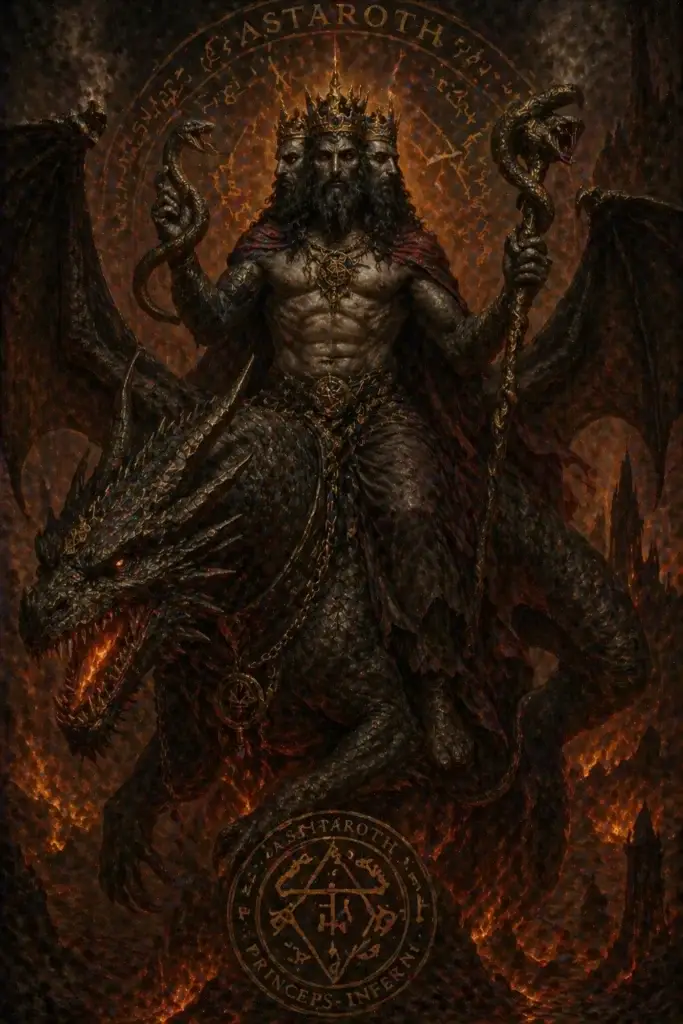
Baphomet is described as a demon, but is not an independent demon of Christian theology, rather a being of complex significance within the history of religion. Its importance lies in embodying the church’s fear of heresy, magic, and dualist heretics, especially the Templars, and reflects medieval concepts of evil transcendence.
Baphomet
Baphomet was depicted as a headless or goat-headed being. Central myths connect it with the Templar trials of the fourteenth century, in which accusers claimed that Templars had venerated the being.
Later, the occult Romanticism of the nineteenth century adopted Baphomet as a symbol, which consolidated its demonic form in Western iconography.
Quick Overview: Baphomet
Primary sources derive from the records of the Templar trials (1307, 1314), in particular testimony before the papal commission. Secondarily, the letters of Jacques de Molay and the historiographic critique of older Templar hagiographies document the origins of the Baphomet myth. The state of research shows broad skepticism toward historical Templar idol cults; scholarship (Finke, Barber, Selwood) regards Baphomet rather as a construct of the accusers than as actual veneration.
Historical Classification
Between the layers of sources lies a gap of roughly 550 years: after the Templar trials of the early 14th century, Baphomet largely disappears from the record until scholars and esotericists of the 18th and 19th centuries took up the material again.
The goat-headed figure known today is entirely a creation of Lévi from 1856 and not a continuation of medieval veneration. Yet the figure remains very much alive: as a symbol in occult groups, as a provocation in music and art, and as a statue of the Satanic Temple in current debates over religious freedom in the United States.
The spread of Baphomet rests not on trade or the migration of a cult, but on the circulation of texts and images: the trial records made the name known throughout Europe, Lévi’s book was translated and his engraving widely reproduced, and in the 20th century occult organisations, record covers and finally the internet ensured a uniform image worldwide.
Precisely because almost all modern depictions go back to the same model of 1856, the figure is so uniform across countries.
The source situation for Baphomet is disparate: the records of the Templar trials (1307, 1314, French archive and the Vatican) are primary sources but are burdened by judicial contexts involving torture.
Further mentions in late medieval demonologies or in the Welsh Mabinogion tradition are not attested. Secondarily, Scholem (kabbalistic context), Barber (Templar history), Finke and Selwood (critique of the Templar trial), and Lévi (nineteenth century: the rehabilitation of Baphomet within occultism) addressed the figure.
Designation and Spellings
Baphomet is depicted in the various sources and artistic traditions with certain recurring iconographic elements that remain relatively constant across decades and across different geographic regions. These elements are not purely decorative or chosen at random but are deeply symbolically encoded and carry great meaning.
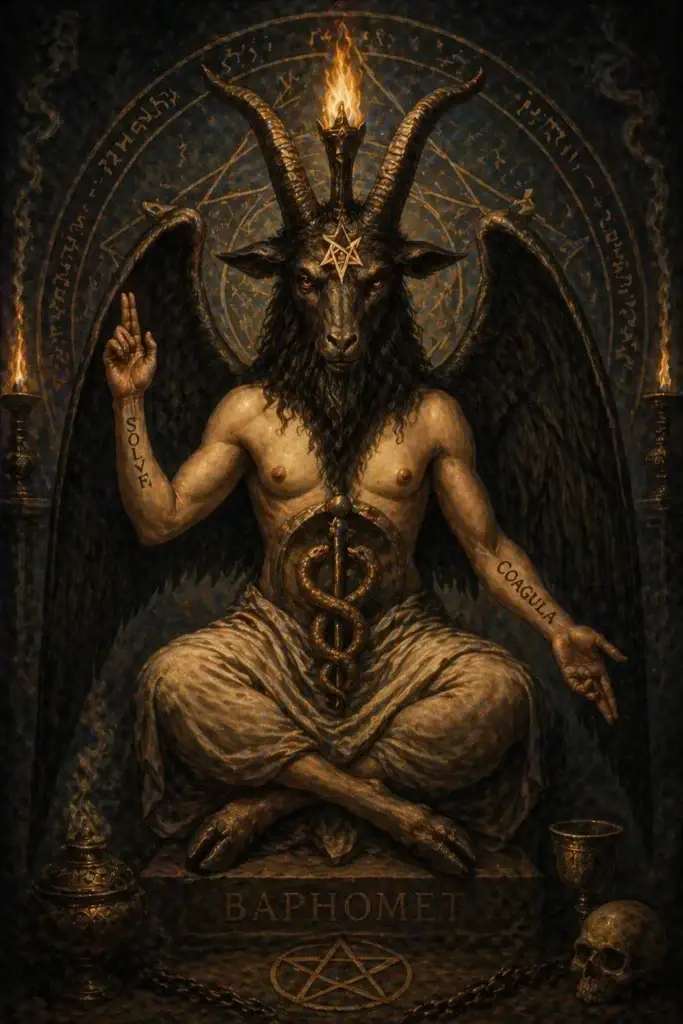
Lévi’s 1856 drawing of Baphomet is a deliberately constructed symbolic image whose elements he explained himself. These include the goat’s head, the torch between the horns, the female breasts, the caduceus, the inscribed arms bearing Solve and Coagula, and the gesture pointing up and down. They are meant to represent the union of opposites, that is, spirit and matter, male and female, above and below.
Anyone familiar with Lévi’s writings can decode every detail of this figure as a statement of his occult system of teaching. Later uses, such as the Sigil of Baphomet of the Church of Satan (1966), take up this imagery and reinterpret it.
Description
Baphomet was never part of the religious practice or everyday faith of Christendom, but appears only in the accusation.
According to the current state of research, a regulated Baphomet cult never existed: as an accusation term the name first appears in the interrogation records of the Templar trial from 1307 onward, where confessions about the worship of an idol were obtained under torture and contradicted one another. It was only Eliphas Lévi who, in 1856, designed a fully developed figure with fixed symbolism in his treatise on magic, and only modern occult groups that turned it into a systematically used sign with rules for its use.
The career of the name unfolded in clearly separable stages, each with its own function: in the Templar trial, the accusation of Baphomet worship served the prosecution and the destruction of the order; in the nineteenth century, Lévi used the figure as a teaching image for his magical system; and in the twentieth century it became an emblem of satanist and occult movements. This is therefore not a continuous practice but a series of repeated reuses of the same name for entirely different purposes: legal accusation, esoteric didactics, and ideological self-presentation.
Profile: Baphomet
The Profile records Baphomet’s religious classification across six dimensions: origin in the Middle Ages, target audience of inquisitors and later occultists, iconographic features, defensive contexts within Christian practice, and finally parallels with other demonic figures in Judaism and Islam. This overview orders the disparate traditions.
Baphomet derives from the French Middle Ages, specifically from the Templar trials under King Philip IV (1307, 1314).
The first documented mention as an accusation term is found in the interrogation records of 1307. The geographic origin lies in France, with secondary evidence from Cyprus (a Templar center) and Poitiers (the papal curia). The dating is precise: October 1307 as the first wave of persecution.
Baphomet was directed primarily at inquisitorial authorities and accusers as a charge against the Templar knighthood. The target group comprised wealthy landowners who were to be destroyed as heretics.
Later, a group of Romantic occultists of the nineteenth century (Lévi, Blavatsky) adopted Baphomet as a symbol of the counterculture against ecclesiastical orthodoxy. The occasion was less a cult than a legal accusation and an artistic representation.
Baphomet’s iconographic features vary: in the Templar records it is described as a head, skull, or stone head. In the Romantic occult culture of the nineteenth century (Éliphas Lévi), Baphomet becomes an androgynous, anthropomorphic being with goat features, a pentagram on the forehead, wings, and esoteric symbols.
Its attributes are a staff, a flame, and dual sexuality. The typical depiction follows Lévi (1856, Dogme et Rituel).
Baphomet is a syncretistic figure with two primary layers: (1) the fourteenth-century Templar inquisition and (2) the modern Romantic-occult reception by Éliphas Lévi (1856).
In the Christian context, Baphomet was regarded as a demonic being that justified protective practices: Templar adherents had to make abjurations, and inquisitorial exorcisms were ritually performed.
For later occultists, Baphomet was a figure of respect within a heterodox spirituality, not a harmful demon. The defense consisted of the orthodox affirmation of faith and ecclesiastical anathema.
Similar figures are found in the Jewish tradition (Azazel, the demonic scapegoat of Leviticus 16), in Islamic demonology (Iblis, the adversary of God), and among Mesopotamian harmful demons (Shedu, Lamia types).
Parallel are Christian demonic figures such as Beelzebub, Mammon, or the demonic spirits of the apocryphal literature (Enoch, Tobit). The kinship lies in the function as an embodiment of heresy, resistance to transcendence, and inversion of orthodox order.
Defense in Everyday Life
Templar rituals and magical reconstruction
The Templar trials (1307, 1314) document accusations of Baphomet worship.
Pentagrammatic symbolism
Lévi’s Baphomet bears a pentagram on its forehead.
Protective amulets and anti-occult stigmatization
In the Christian context, Baphomet became an anti-amulet.
Baphomet, Parallels in Other Cultures
Jewish tradition: Baphomet has no direct Jewish equivalent. Distantly related is Azazel (Leviticus 16), the scapegoat demon onto which Israel loads ritual sins, or the figure of Samael in the Kabbalah (Scholem, Sefer ha-Bahir), a dualist prince of the demonic spheres. They share the function as an abject of healing through expulsion.
Greco-Roman world: In antiquity, Baphomet corresponds distantly to Pan, the demonized woodland god with goat features, or to the Lamiae demons of the later demonic canon. The iconic demon Typhon likewise carries within it a cosmic opposition to order. The goat-headed iconography connects Pan and Baphomet through the ancient satyr type.
Mesopotamia: Mesopotamian demonology knows no precise parallel. Distantly related are the Shedu demon or the chaotic beings of the Marduk and Enuma Elish mythology (Tiamat, Kingu). Like Baphomet, these embody cosmic opposition to divine order. The ritualized nature of combating them corresponds to Christian exorcism practices.
India/Asia: No direct equivalent. Distantly related are the Asuras (Hinduism), demonic counter-powers against the Devas, or Yakshas with their liminal nature (Schmoldt, mythology). They share with Baphomet the function as a dualist counterpole to order, but not the specific embodiment of the heretic characteristic of the West.
The Templar Trial and the Origin of the Name
The name Baphomet is attested as Bafomet for Muhammad as early as in Provençal poetry of the twelfth and thirteenth centuries (Gavaudan, around 1195); as an accusation term it appears in the early fourteenth century, in connection with the trial against the Order of the Templars.
After the arrest of the Templars in France in October 1307, the investigating authorities raised numerous accusations, among them the charge that the knights had venerated an idol. In the interrogation records the name Baphometh, or similar spellings, appears repeatedly for this purpose.
Historical scholarship largely agrees that this alleged idol did not constitute an actually venerated cult. The Templars’ statements were made for the most part under torture or the threat of torture and contradict one another in nearly every detail.
Sometimes a bearded head is mentioned, sometimes a cat, sometimes a figure with several faces. This inconsistency is regarded as strong evidence that the accusations were constructed in order to break up the order, which was politically and financially inconvenient.
There are several explanatory approaches to the origin of the name. The most widespread, advanced by historians such as Malcolm Barber in The Trial of the Templars (1978), sees in Baphomet an Old French corruption of Mahomet, the medieval form of the name of the Prophet Muhammad.
Since the Templars were in contact with the Islamic world in the Holy Land, the charge of a secret defection to Islam came readily to the accusers.
Other suggestions, such as a derivation from Greek, are considered less likely. It should be noted: Baphomet does not begin its history as a venerated figure but as an element of an indictment.
Éliphas Lévi and the Invention of the Goat
The image of Baphomet best known today, a seated figure with a goat’s head, wings, female breasts, and a torch between the horns, is not a medieval tradition.
It stems from the nineteenth century and was conceived and drawn in 1856 by the French occultist Éliphas Lévi, whose civil name was Alphonse Louis Constant, in his work Dogme et rituel de la haute magie.
Lévi called his figure the Baphomet of Mendes or the Sabbatic Goat. For him the image was not a demon but a symbol. He interpreted its individual components as an expression of a cosmic equilibrium: the animal and the human, the masculine and the feminine, the upper and the lower.
The gesture of the arms, one pointing upward, one downward, he took from the hermetic formula “as above, so below.” Lévi’s Baphomet was thus a deliberately constructed allegory of the union of opposites, not an object of worship.
Later currents of occultism took up the image and shifted its meaning once again. In the founding phase of modern magical orders, Baphomet was used in part as a cipher for hidden knowledge.
Research into the religious history of modernity, such as the work of Wouter Hanegraaff on Western esotericism, emphasizes that this appropriation has less to do with the historical Templars than with the nineteenth century’s need to create its own symbolic counter-tradition.
The line from the Templar trial to Lévi’s drawing is therefore not a continuous tradition but a subsequent linking of two quite different processes.
Baphomet in Modern Religious History
In the twentieth and twenty-first centuries, Baphomet has become a fixed component of modern alternative-religious and subcultural symbolism. The Church of Satan, founded in 1966, used a stylized form of the goat’s head within a pentagram as its emblem, the so-called Sigil of Baphomet.
Here the figure is reinterpreted once again, this time as a sign of a deliberately anticlerical, world-affirming attitude that sets itself apart from the Christian concept of sin.
Baphomet received particular public attention through the Satanic Temple, a US organization that since the 2010s has employed a large bronze statue of Baphomet as a means of political dispute.
The statue was used, among other things, to raise the legal question in the United States of whether religious monuments may stand on public ground. In this context, Baphomet is less a believed figure than a legal and rhetorical instrument for defending the separation of state and religion.
In parallel, Baphomet appears frequently in film, music, and games, often as a bogeyman of evil. This use in popular culture scarcely connects to Lévi’s symbolism anymore but rather to a diffuse image of the demonic.
From the standpoint of religious studies, Baphomet is thus an instructive case: a figure that arose from a medieval accusation, was reinvented in the nineteenth century as a philosophical symbol, and in the present serves, depending on the group, as provocation, as profession of faith, or as a mere horror motif.
The comparison with other demonic figures shaped by Christianity shows how strongly meanings can migrate over the centuries.
State of Research and Persistent Misunderstandings
The scholarly assessment of Baphomet is clear at its core but is constantly overlaid in popular perception. Three points are regarded as established. First: there is no evidence of an actual Baphomet cult of the Templars.
The accusations arose in the context of a politically motivated trial. Second: the well-known goat image stems from Éliphas Lévi and is a good five hundred years younger than the Templar trial. Third: today’s use in alternative-religious groups is a deliberate, modern appropriation.
Despite this clarity, several misunderstandings persist. Widespread is the assumption that the Lévi image is medieval or even a depiction of the real Templar idol.
Equally persistent is the notion that Baphomet is an independent demon of Christian theology, although it does not appear in the classical demon catalogs of the Middle Ages and the early modern period. Attempts to derive the name from secret letter codes are likewise regarded as speculative in serious scholarship.
What remains open in historical research is above all the detailed question of how exactly the name came about in the interrogation records of 1307 and whether individual Templars already knew it before the trial. The source situation permits no final judgment here.
From the standpoint of religious studies, Baphomet is less interesting as a believed being than as a case study of how a name, through accusation, artistic invention, and subcultural appropriation, was repeatedly recharged over seven centuries without ever having possessed a continuous cultic reality.
Further Links
Scholarly Literature
- Éliphas Lévi: Le Dogme et le Rituel de la Haute Magie. Paris 1854/56.
The protective practice described here is a religious-studies classification of historical traditions. iWell Guard ties into this cultural-historical line of wearable protective objects and represents a contemporary form of it. More about the iWell Guard →