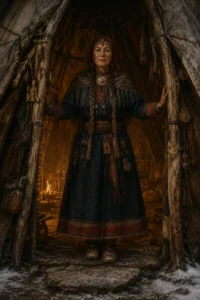
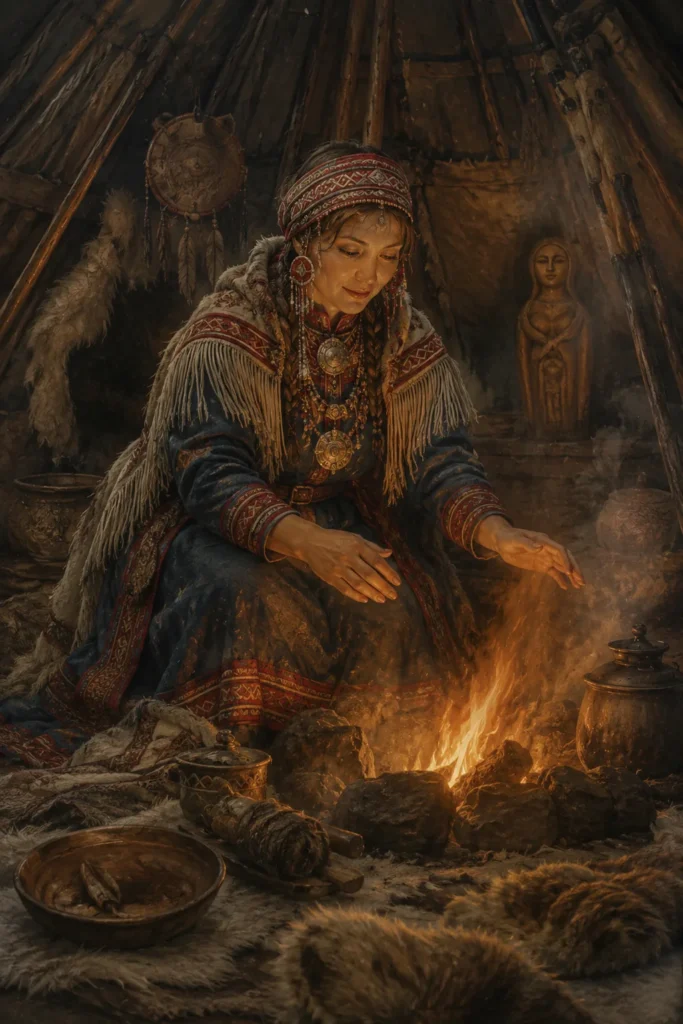
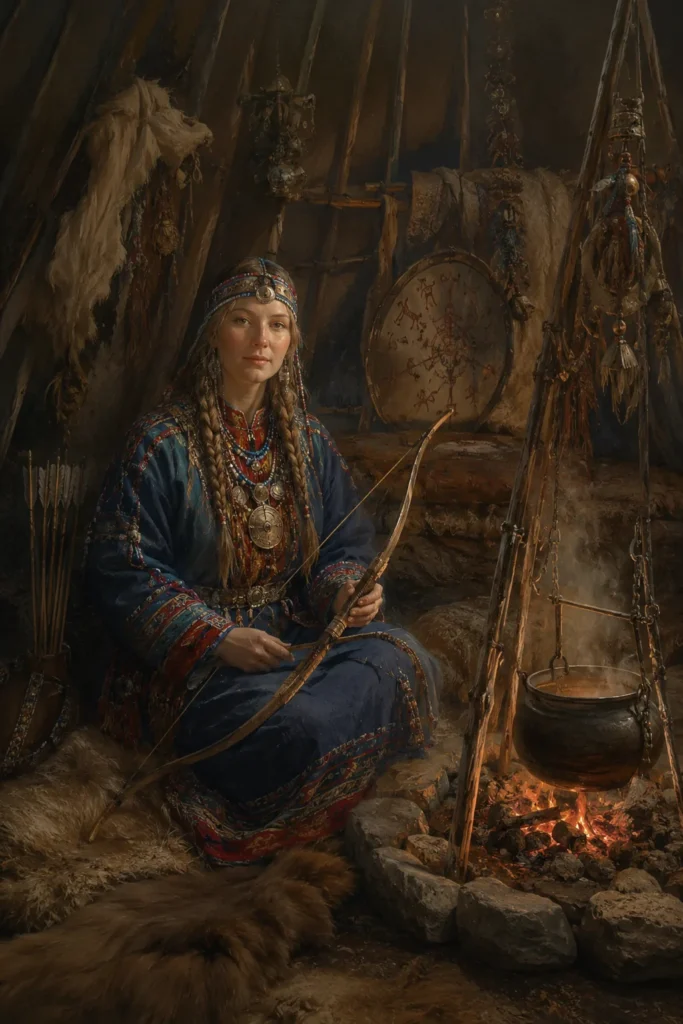
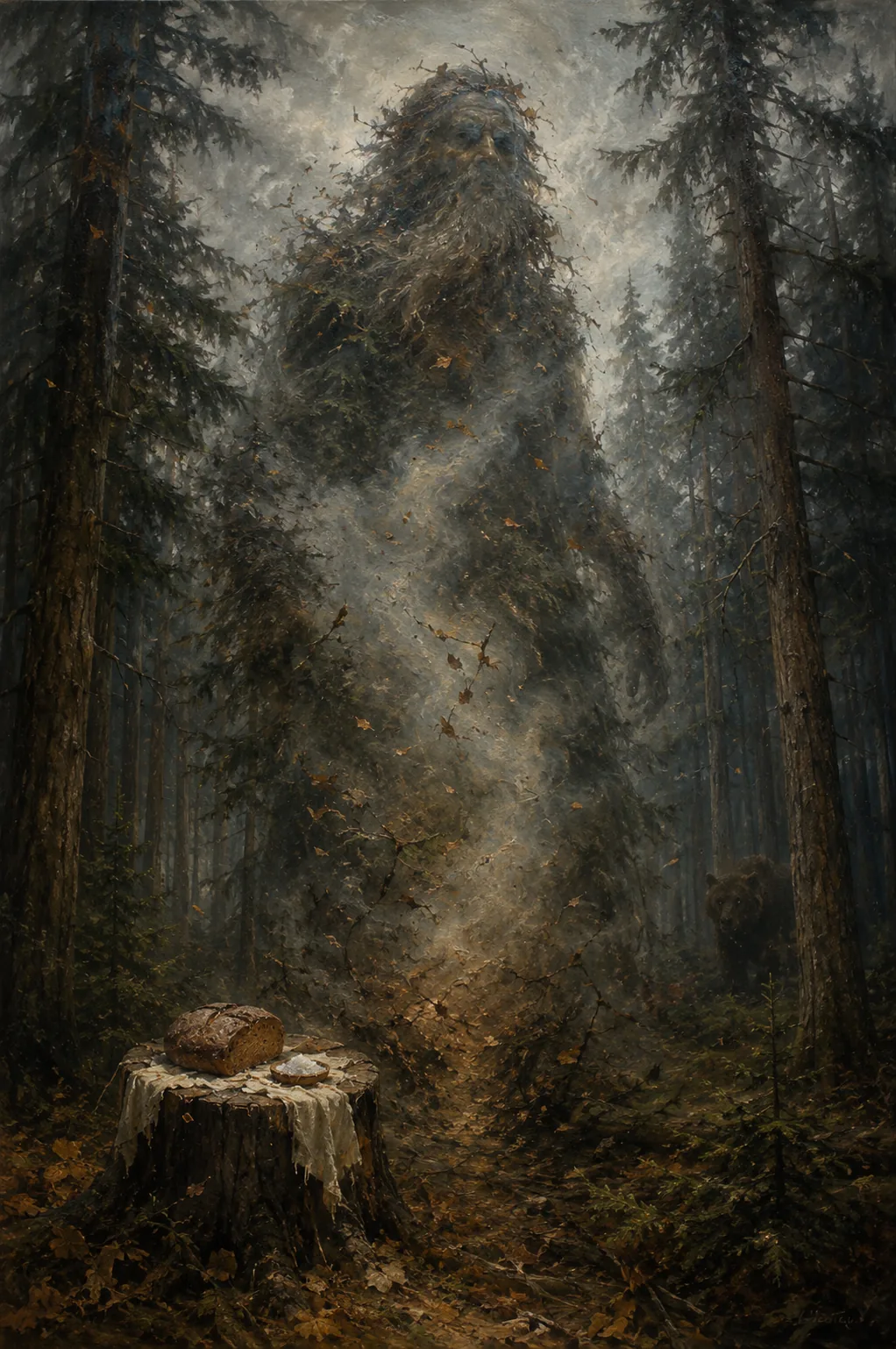
The Sami in Lapland, spread across Norway, Sweden, Finland and Russia, maintain the only indigenous tradition in Europe that preserved shamanic practice within reach of Christian missionary activity until the 17th century.
The noaidi shamans, their drums with sun, moon and god diagrams, and the sieidi sanctuaries in the tundra form a distinct Finno-Ugric layer of religion.
The Sami pantheon is closely tied to nature, hunting and the forces of the landscape.
Sami noaidi shamanism forms the backbone of pre-Christian religion in Sápmi.
The Sami gods are arranged in three spheres, the upper world around Radien-attje, the middle world with the thunder god Horagalles and the underworld beneath Jábmiidáhkká, and they are still passed down today in the noaidi tradition of Lapland.
The Sami speak their own language family with nine living languages; Northern Sami is the largest. They are related to the Finno-Ugric languages (Finnish, Hungarian, Estonian). The Sami settlement area, Sápmi, comprises the northernmost parts of Norway, Sweden and Finland and the Kola Peninsula in Russia.
Traditional way of life: reindeer nomadism, fishing, coastal economy. Today around 80,000 to 135,000 Sami live in this region, with their own parliaments in Norway, Sweden and Finland.
Three spheres order the Sami divine world: Radien-attje above, the thunder god Horagalles in the middle, Jábmiidáhkká below. The noaidi tradition of Lapland keeps this knowledge alive to this day.
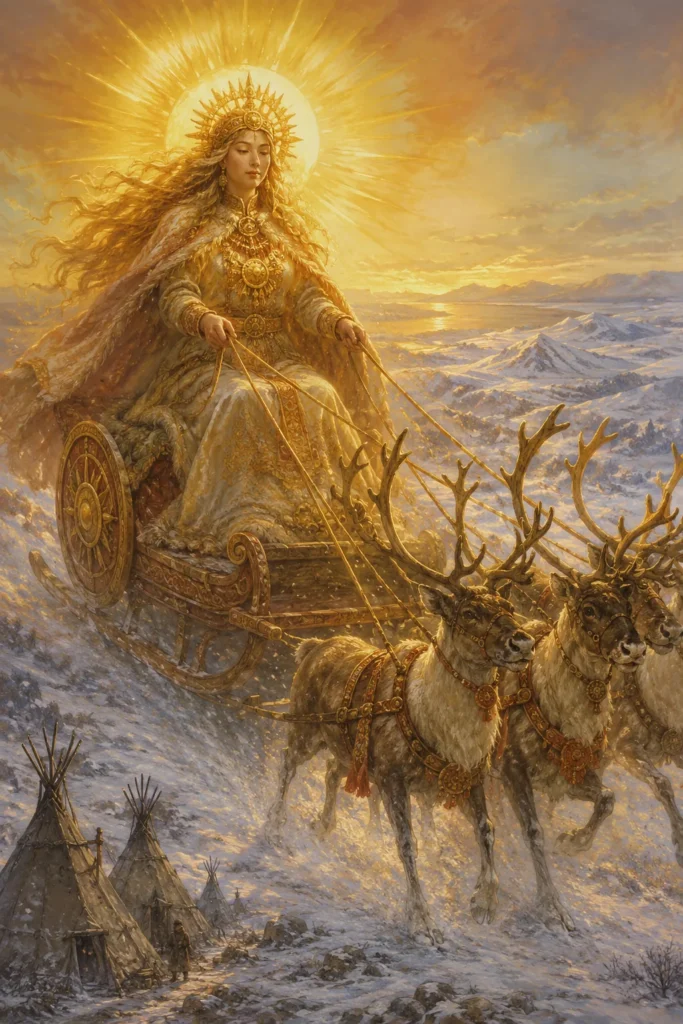
Beaivi (Pejvve) is the solar deity, mythical mother of the Sami; Mánnu the moon god; Ráhka the thunder deity (parallel to the Norse Thor); the Akka deities are female household goddesses of various spheres (Sara-Akka at the doorway, Uksakka at the hearth, Juksakka as protector of male children).
Stallo are man-eating giant-like beings from the wilderness. Saivo is the mythical other world, sometimes imagined as an underworld beneath sacred mountains or lakes.
The noaidi (in older sources noaide, Swedish „Trollkarl“, Latin „magus“) is the religious specialist. He induces his trance practice through the drum, joik (traditional song) and concentration. Soul journeys lead into the three worlds: the upper world to the gods, the lower world to the deceased, the middle world to the healing of the land.
Healing, weather prediction, uncovering theft and protecting the reindeer herds were his tasks. In the 17th and 18th centuries, noaidi drums were systematically collected by missionaries and in part burned.
The drum of the noaidi (govadas, gievrie) has an oval or round shape, a membrane of reindeer hide, painted with red alder-bark dye. The painting shows a cosmological diagram: the sun at the centre, gods, animals, mountain guides, the deceased.
The „hammer“, usually of reindeer antler, is moved across the membrane when struck, and a pointer ring (vuorbi, „frog“ of bone) jumps across the fields; the answer is read from where it comes to rest. About 70 Sami drums survive, in Sweden’s National Museum, the Nordiska Museet and Sami museums.
The Sami are the indigenous people of Lapland, around 80,000 people in Norway, Sweden, Finland and Russian Karelia. They speak Sami languages (Uralic). Since 1989 they have been a state-recognised indigenous population.
Horagalles is the Sami thunder god, patron of the Sami and of the reindeer pastures. His name derives from the Old Norse Thor-karl, a borrowing from the Germanic Thor.
The Sami shaman drum was the central tool of the noaidi (shamans). The gods, spirits and cosmic realms were painted onto the drum hide. In the 17th and 18th centuries most drums were burned by Christian missionaries.
Norwegian, Swedish and Finnish missionaries brutally suppressed Sami religion between 1600 and 1900; shamans were executed, drums burned. Only in the 20th century did a renaissance begin, and today few Sami openly practise the old religion.
Seita (also sieidi) are special stones, cliffs, trees or wooden posts venerated as the seat of land spirits. They received offerings: reindeer blood, bones, antlers, coins, tobacco.
Important sieidi sites: Stállogárgu in Finnmark, the Áhkka massif in Sweden, Lake Inari in Finland. Each family clan had its own sieidi relationships. From the perspective of religious studies, sieidi veneration is constitutively a relationship to the land, not an abstract theism.
Portable means of protection are rarely developed as material pendants; Sami religion is primarily a ritual relationship to the land. Nonetheless: the gákti (traditional dress) carries symbolic weavings and decorations that encode region, family and status; certain embroideries have a protective character.
The joik, the distinctive song of a person, an animal or a place, is the acoustic form of „protecting“ and „remembering“ a relationship. Drum miniatures, bone pendants and birch-root bands are used in addition.
Christianisation took place between the 17th and 19th centuries, often through violence and the burning of drums (in 1693, 30 drums were publicly burned in Arjeplog). The Laestadian revival movement of the 19th century (founded by the Sami pastor Lars Levi Laestadius) remained the dominant religious identity for many Sami, with its own codes.
Since the end of the 20th century a cultural and religious revitalisation has taken place: the Sami language, the rebuilding of drums, a joik renaissance. Works in religious studies: Håkan Rydving, The End of Drum-Time (1993), Juha Pentikäinen, Anne-Lise Karlsen.
The Sami live in the north of Norway, Sweden and Finland as well as on the Russian Kola Peninsula. This area, often called Sápmi, is divided fourfold among states, and the Sami themselves are not a uniform group either.
There are several Sami languages that are not readily mutually intelligible, among them Northern Sami, Lule Sami, Southern Sami, Inari Sami and Skolt Sami. Accordingly, religious traditions also differed by region and way of life.
Ways of life ranged from reindeer herding through fishing on the coast and on inland lakes to hunting. These economic differences were reflected in religion. Coastal Sami, forest Sami and the groups moving with the reindeer herds had in part different emphases in their cults. Sweeping statements about Sami religion obscure this internal diversity.
Common to many groups was the veneration of natural powers and ancestors, the importance of certain sacred places in the landscape, the offering sites known as sieidi, and the figure of the ritual specialist, the noaidi.
Yet even these shared elements are attested differently from region to region in the sources, and much is known only incompletely.
The best-known religious object of the Sami is the drum, called goavddis or meavrresgárri in Northern Sami. It consisted of a wooden frame or a hollowed-out wooden body with a painted hide. The images on the hide showed deities, spirits, animals, humans and elements of the landscape and represented an image of the world.
The noaidi used the drum in two ways. On the one hand he let a pointer wander across the hide in order to read omens from its movement over the images. On the other hand the drum rhythm put him into an altered state in which his soul could travel to the spirits.
The Sami worldview knew several levels and a multitude of powers. Attested are, among others, solar deities, the thunder god, a series of mother goddesses responsible for birth and children, and masters of the animals, for instance of the bear and of the reindeer.
The dead and the underworld had their place, and the sieidi, often striking rocks or stones, were regarded as places where one could make contact with these powers and offer to them.
There is no certainty about the precise system of this pantheon, because the sources are scattered and in part contradictory. The surviving drums, of which only about seventy have lasted worldwide, are an important source, yet their images cannot always be interpreted unambiguously.
The written tradition on Sami religion comes almost exclusively from outside and predominantly from missionaries. In the seventeenth and eighteenth centuries, Lutheran clergymen in Norway and Sweden composed reports on the practices they combated as pagan.
Among the better-known sources are the writings of the Norwegian missionary Thomas von Westen and his collaborators, as well as later accounts such as that of Knud Leem. These texts are rich, but deeply partisan, for their aim was the eradication of the old religion, not its description.
A second group of sources is the drums themselves, many of which were confiscated in the course of the mission. Some ended up in European collections, others were burned.
Some missionaries had the images explained to them and recorded interpretations, so that for certain drums a contemporary reading has been handed down. The most famous such source is a manuscript that gives the meaning of the figures for a drum confiscated in 1691.
A third source of its own kind is the joik, the traditional Sami song. It was not a religious text in the narrower sense, yet the mission combated it as pagan, and in its forms and contents references to the older world of ideas have been preserved.
Researchers such as Håkan Rydving have shown how strongly the source situation is distorted through the lens of the mission, and they caution that any reconstruction of Sami religion must live with considerable uncertainty.
The Christianisation of the Sami was a long and violent process. There were first contacts as early as the Middle Ages, yet systematic mission set in during the seventeenth and eighteenth centuries. Drums were confiscated and burned, noaidi were persecuted, and in individual cases executions took place.
In the nineteenth and twentieth centuries the religious pressure combined with a state policy of assimilation. In Norway this is known as Fornorsking, as Norwegianisation. Sami language and culture were suppressed in schools and boarding schools.
A particular feature is the role of the Laestadian revival movement, a Lutheran current founded in the nineteenth century by Lars Levi Laestadius, which found wide dissemination among the Sami.
On the one hand it was part of the Christian penetration, but on the other hand it offered space for a religious practice marked by Sami culture, and some regard it as a vessel in which older elements were in part preserved.
Since the late twentieth century there has been a cultural and political strengthening of the Sami, visible in their own parliaments and in the cultivation of the languages. In this context there is also a new interest in the pre-Christian tradition.
It is expressed in research by Sami into their own history, in the reclamation of confiscated drums from museums, and in the artistic reception of old motifs.
One cannot, however, speak of a broad revival of the old religion as lived practice. Most Sami are Christians, and the engagement with the pre-Christian past is above all one of cultural self-assurance and historical reappraisal.



Sami shamanism combines the noaidi, the drum and sieidi stones into a distinct protective practice intended to shield families, reindeer herds and dwelling places against spirits of illness and of nature.
Related key terms: Sami Noaidi Sieidi Seita Pejvve Beaivi Ráhka Mánnu Lapland Drum Joik Reindeer.
The Sami tradition knows the cosmologically painted shaman drum with vuorbi pointers, sieidi stones as stationary sanctuaries and embroidered gákti dress with regional protective codes; portable means of protection are limited, and the relationship to the land is the primary religious bearer.
iWell Guard takes its place in this cultural-historical line of portable means of protection, in a contemporary material architecture, made in Germany. 41 layers, solid gold, platinum, silver. 30-day right of return.
Personal experiences may vary. Not a medical device. No promise of healing.