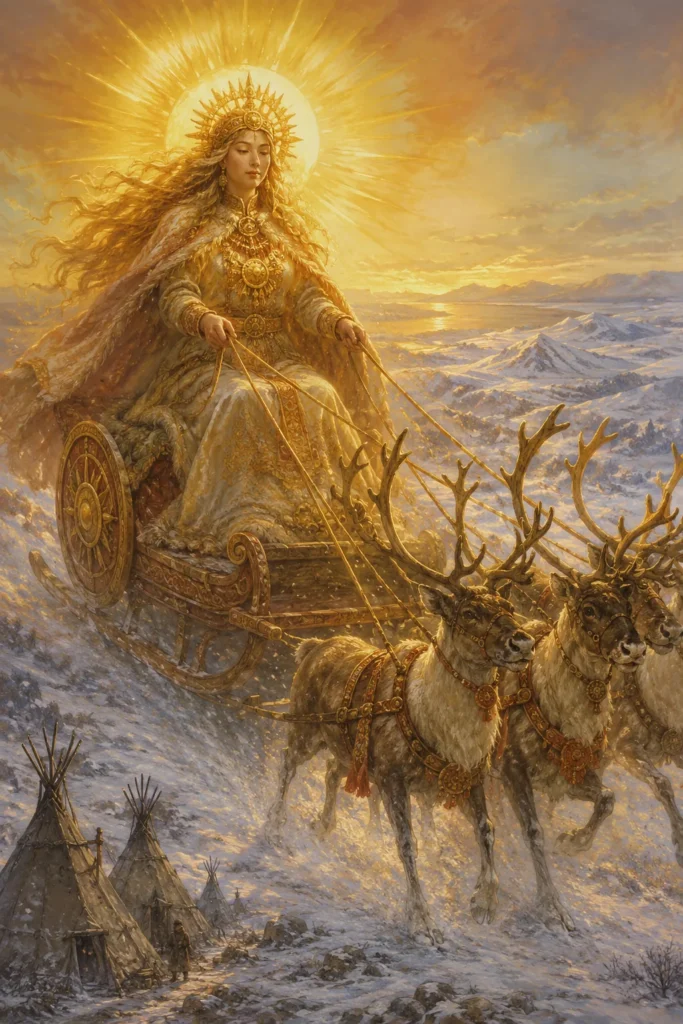
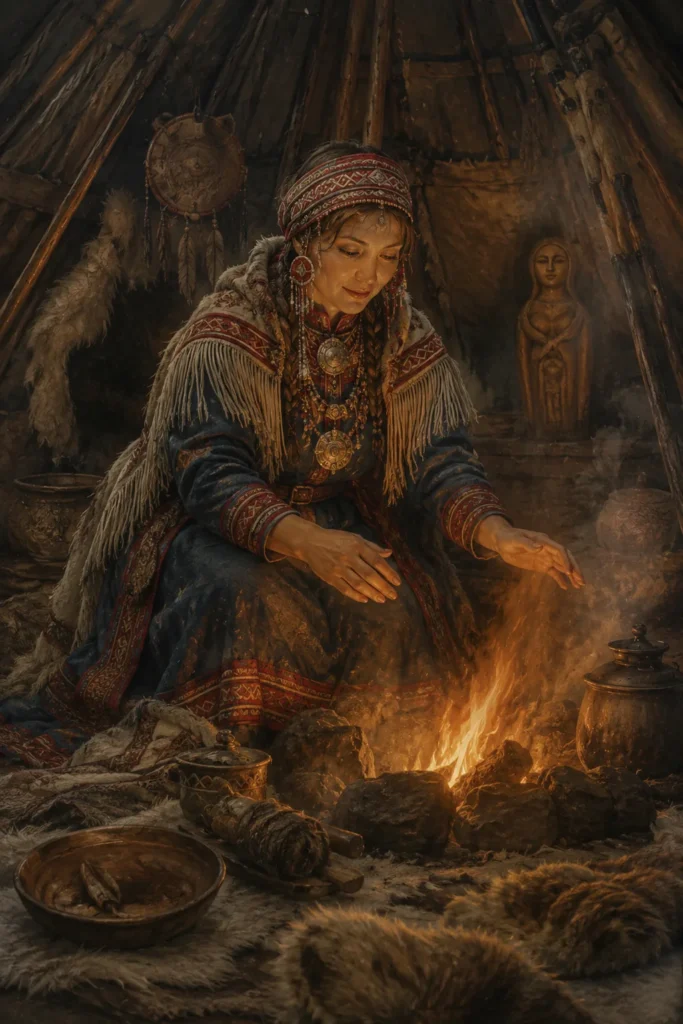
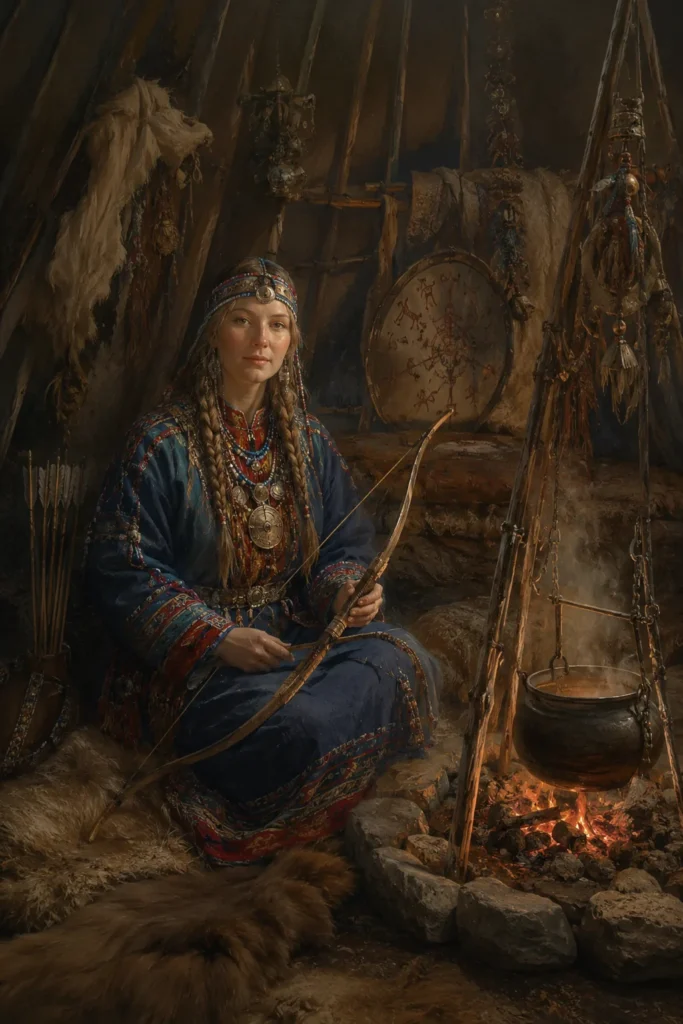
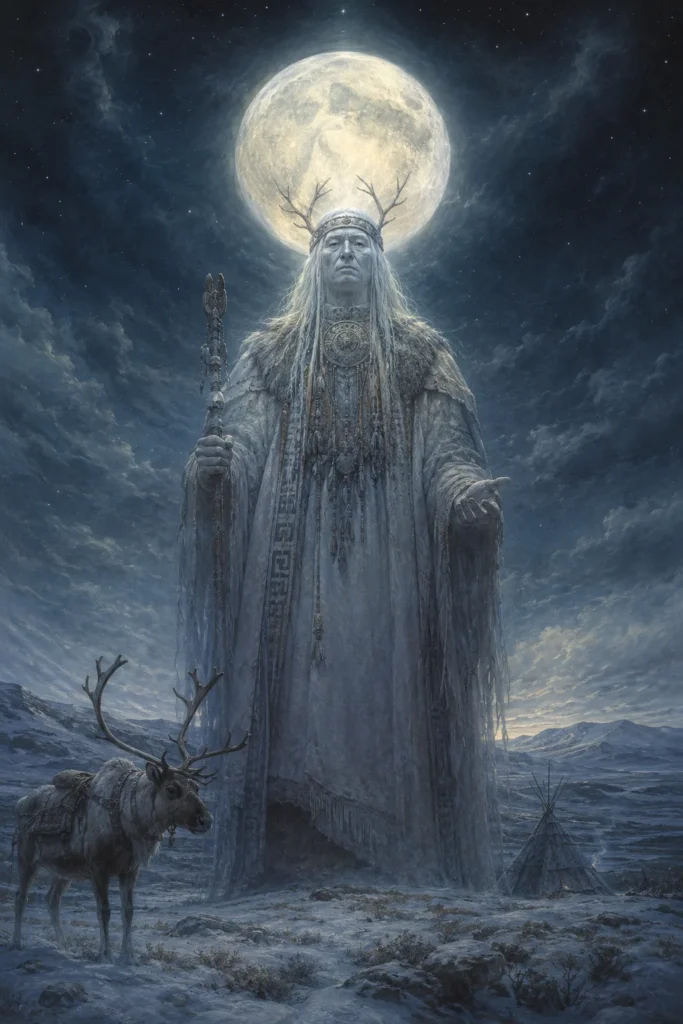
Uksakka - Door Goddess and Guardian of the Threshold in Sámi Religion
By Ralf Ittermann · last reviewed on
Uksakka, also written Ukso-akka or Uksaahka, is the door and threshold goddess of pre-Christian Sámi religion. She belongs to the group of Akkas alongside Sara-Akka, Juksakka and Madderakka, and guards the threshold of the tent or hut.
Profile: Uksakka
Uksakka: the most important aspects at a glance. The following fields summarise origin, function, appearance, veneration, symbols and parallels.
Uksakka, also written Ukso-akka or Uksaahka, is the goddess of door and threshold in the pre-Christian Sami religion and belongs with Sara-Akka, Juksakka and Madderakka to the Akkas. Her name derives from the Sami word uksa for door. The sources on her are scant.
Uksakka guards the threshold of the tent or house, controls who enters and leaves it, and protects the interior from harmful influences. She oversees the transition between inside and outside and is regarded especially as a guardian of small children when they step outside.
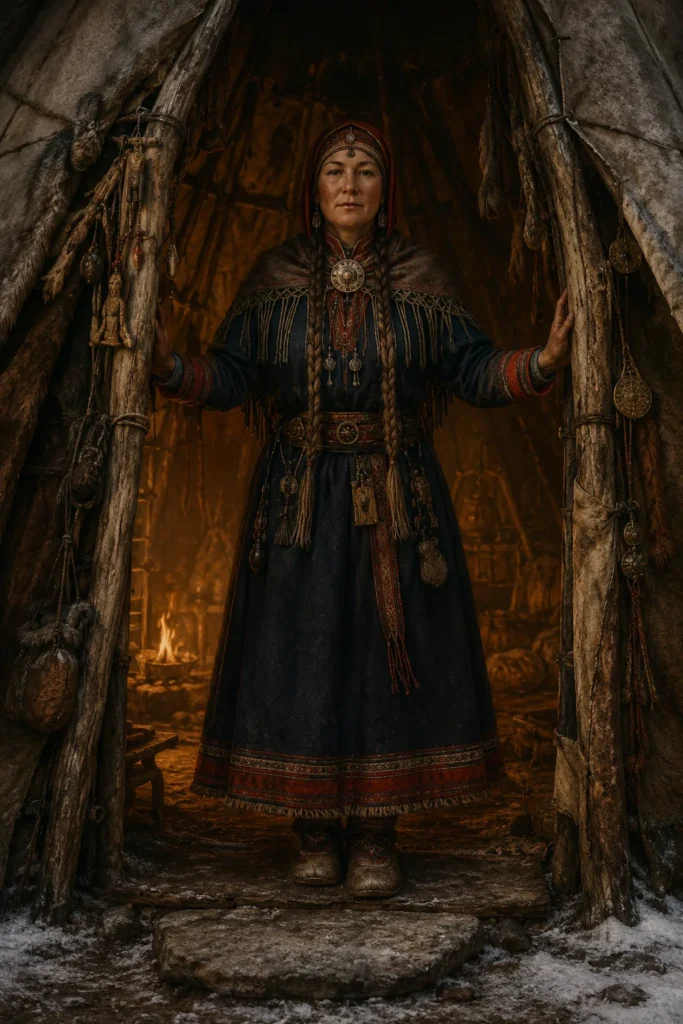
Uksakka is described as an older, strong, protective woman who lives under or behind the door. On the shaman drums she appears in the lower half at the door area, often as a small seated or crouching figure.
On entering and leaving the tent, Uksakka was acknowledged ritually, in some regions by a brief knock on the threshold or certain words. Small offerings such as pieces of cloth, bone fragments and parts of plants were laid on the threshold. Pregnant women crossed the threshold with special care.
Symbolically, Uksakka stands for the threshold, the entrance area and all transitions between inside and outside. The threshold is regarded as a sacred boundary and as a dangerous place of passage where the worlds touch.
Structurally comparable are the Roman Janus, the Greek Hecate and the Hindu Lakshmi at thresholds. A parallel is found in the Hungarian Boldogasszony as a protective function. Uksakka herself is part of the domestic family of protective deities, the Akkas.
Classification and Short Profile
Uksakka is the guardian of the threshold of the Sámi tent (Lavvu, Goahti) or house. Her function is that of a threshold warden: she controls who enters and exits, protects the interior from harmful influences, and ensures the correct transition between inner and outer space.
From a religious-studies perspective, Uksakka belongs to the class of threshold goddesses represented in numerous indigenous religions. Her particular function is the ritual structuring of the threshold as a sacred boundary. The threshold is, in terms of religious phenomenology, a central site where worlds meet.
The sources for Uksakka are sparse. Schefferus, Leem, and Læstadius mention her as an independent Akka alongside the others. Drum images usually depict her in close proximity to the entrance area of the tent, which iconographically underscores her threshold function.
The threshold guardian Uksakka has been treated in more recent scholarship with expanded approaches that bring together ethnographic precision, linguistic source criticism, and comparative perspective. The Sámi knowledge community itself now participates in this research and corrects older Western interpretations that were partly shaped by colonial patterns of thought.
As guardian of the threshold, Uksakka fits into a circumpolar religious topography whose basic patterns recur across vast distances. The fact that this structure remains stable over thousands of kilometres is considered by comparative religious studies to be one of its most remarkable findings and remains the subject of ongoing discussion.
Name and Etymology
The name Uksakka derives from the Sámi word uksa for door or threshold. The root uks- is related in Sámi to the Finnish uksi for door and belongs to the basic Uralic word stock.
The Akka component refers to the older woman or grandmother, the honorific designation for the female protective deities of the Sámi tradition. The combination Uks-Akka thus means literally door-grandmother or door guardian.
Dialectal variants are Uksaahka in Southern Sámi, Ukso-akka in Ume Sámi, and Uksáhkká in Northern Sámi usage. This diversity is phenomenologically typical of religion and reflects the dialectal differentiation of the Sámi language.
From a sociology-of-religion perspective, it is worth asking what function Uksakka had in the social order of the traditional Sámi community.
Since she regulated the transition between the inner and outer space of the tent, her religious significance was directly linked to the lived practice of the household. This interconnection forms a distinct field of religious-anthropological research, systematically investigated in particular by Håkan Rydving and Konsta Kaikkonen.
A further dimension concerns the significance of Uksakka today for Sámi identity politics. In the course of Sámi self-governance and the international legal recognition of indigenous rights, the transmitted protective goddesses are coming to the fore once again.
The interplay between religious research and political recognition is itself an independent area of inquiry that has received increasing attention in recent years.
Description and Iconography
Uksakka is described in the ethnographic sources as an older, sturdy, protective woman who dwells beneath or behind the door. She has mostly not been visualized, but her presence was acknowledged in daily practice through certain rituals.
On the shamanic drums, Uksakka is depicted in the lower drum half near the door area, often as a small seated or crouching figure. Ernst Manker’s drum studies show her consistent iconographic position across most surviving drums.
Symbolically, Uksakka is associated with the threshold, the entrance area, and all transitions between inside and outside. This threshold symbolism is itself a distinct phenomenon in religious phenomenology and is well documented in comparative religious studies as threshold ritual.
Cult and Threshold Practice
Every time the tent was entered or left, Uksakka was acknowledged ritually. In some regions it was customary to knock briefly on the threshold or to speak certain words. Those who brought food or firewood into the tent gave thanks to Uksakka.
Small votive offerings were regularly deposited at the threshold: pieces of fabric, bone fragments, plant parts. This practice is documented in the reports of Schefferus and later missionaries.
From a religious-studies perspective, this threshold practice is a paradigmatic case of a ritualised everyday religion. Uksakka’s significance lay not in dramatic rituals but in the constant small acts of acknowledgement that permeated the whole of life.
Uksakka and Pregnancy
During pregnancy, women had a particular relationship to Uksakka. They had to cross the threshold with special mindfulness and were not allowed to remain standing on it, as this could disturb the child in the womb.
These pregnancy taboos are documented only briefly in the sources. They reflect the religious conception that the threshold is a dangerous transitional site at which the unborn child is especially vulnerable.
From a religious-studies perspective, this connection between threshold and pregnancy is a distinct phenomenon attested in numerous religions. The religious-phenomenological depth of threshold symbolism in relation to birth is well researched.
Uksakka in the Akka System
Uksakka is part of the fourfold Akka theology. While Madderakka is the ancestral mother, Sara-Akka assists at birth, and Juksakka cares for boys, Uksakka is the guardian of the threshold.
This functional differentiation is phenomenologically elaborate. It shows that the Sámi tradition distributes the female protective function into specialised aspects, which is itself a distinct structure from a religious-phenomenological standpoint.
In religious studies, the question has been debated whether Uksakka and Juksakka are independent deities or aspects of a single Akka. The sources are not unambiguous here, and research tends toward viewing the individual Akkas as independent.
Comparison with Other Threshold Deities
Uksakka belongs to the class of threshold deities represented in numerous cultures. Structurally comparable figures include the Roman Janus, the Greek Hecate and the Hindu Lakshmi at thresholds.
Uksakka’s specificity lies in her female personification and her embedding within the Akka system. She is not an external threshold guardian but part of the domestic-familial protective deity family.
Within the Finno-Ugric tradition, a parallel is found in the Hungarian Boldogasszony in her protective function. This structural kinship points to an ancient Finno-Ugric layer.
Mission and Modern Reception
Christian mission partly identified Uksakka with female Christian protective figures, and partly persecuted her as pagan. Threshold practice was suppressed, though the door ritual never disappeared entirely.
In contemporary Sámi cultural revitalisation, Uksakka is a significant figure. Women’s rights movements within the Sámi community emphasise her role as an example of female religious authority in the domestic sphere.
From a religious-studies perspective, the reappropriation of Uksakka is part of a broader rediscovery of the female dimension of Sámi religion. This rediscovery is productive in religious-phenomenological terms and corrects the male-centred focus of older scholarship.
Research and Current State
Research on Uksakka is intertwined with that on the other Akkas. Håkan Rydving, Juha Pentikäinen, Konsta Kaikkonen, and Anna Lia Berthelsen have studied the Akka system systematically.
An independent monograph on Uksakka is still outstanding. Concrete research gaps exist in the precise regional differentiation of door rituals and in the relationship between Uksakka and other threshold deities of the Finno-Ugric tradition.
In religious-phenomenological research, Uksakka is treated as a case study of threshold deities. This classification enables structural comparisons that are productive from a religious-studies perspective.
Lexicon Cross-References
Uksakka connects with Sara-Akka, Juksakka, Madderakka, Beaivi, Mánnu, Ráhka, Stallo, Jabmiidaibmu, and Saivo. The cultural hub Sámi tradition frames the threshold theology. Comparable threshold deities can be found in numerous religions worldwide.
The Threshold as Sacred Site: Uksakka and the Threshold of the Tent
Among the Sámi Akka deities, Uksakka is most closely associated with a specific architectural element of the dwelling tent: the door, or rather the threshold.
Her name is usually derived from a Sámi word for “door” related to Finnish uksi and Estonian uks. Uksakka is thus the “door woman,” whose domain was the transition between the protected interior and the more dangerous outer world.
The threshold held a distinctly symbolic significance in Sámi domestic culture. The tent interior was spatially structured, with the hearth at the centre and a rear area that was particularly protected. The entrance area marked the boundary of the domestic protected space.
Uksakka was regarded as the guardian of this boundary, especially for small children, who when stepping outside were exposed to the outer world and its dangers. In this role she complemented Sarakka, who was associated with birth and the hearth, and Juksakka, who is said to have been responsible for the growing child.
Little is reliably transmitted about specific rites in honour of Uksakka. The sources mention offerings deposited in the area of the door or beneath the threshold, but the accounts are brief and derive from missionary writings.
It is plausible that the veneration of the Akka deities as a whole took rather unobtrusive, everyday forms linked to birth, breastfeeding, and early childhood, and was carried primarily by women. Precisely because this domestic piety was little spectacular, it was recorded only marginally in the missionary reports focused on public cults.
Three Sisters or a System? On the Interpretation of the Akka Triad
In numerous accounts, Sarakka, Uksakka, and Juksakka are described as a closely related group and occasionally as daughters of Maderakka. This ordered structure, in which a mother goddess has three specialised daughters with clearly distributed tasks, appears plausible at first glance. It is, however, a subject of scholarly debate in religious studies.
Critical scholars point out that the neat triadic structure may have originated with the recorders themselves. Missionaries and early scholars tended to translate foreign religions into familiar patterns, and a system of a mother with three daughters each having their own domain corresponded to European ordering schemes.
Whether the Sámi tradition itself actually understood Uksakka, Sarakka, and Juksakka as a fixed group of three, or whether these were regionally differently accented, partly overlapping conceptions, cannot be determined unambiguously from the sources.
For Uksakka specifically, this means: her connection with door and threshold is attested in several independent sources and is considered relatively well established. Less certain is how sharply her function was distinguished from that of Sarakka or Juksakka.
Possibly, across the wide Sámi settlement area stretching from central Norway to the Kola Peninsula, the same protective functions were assigned to different deities in different regions.
Current research therefore prefers a cautious formulation: Uksakka was a female protective deity of the domestic sphere with a particular relationship to the threshold, embedded in a loose network of related conceptions whose precise internal order resists reconstruction.
Literature (Selection)
- Johannes Schefferus: Lapponia (Frankfurt 1673)
- Knud Leem: Beskrivelse over Finmarkens Lapper (Copenhagen 1767)
- Lars Levi Læstadius: Fragmenter i lappska mythologien (Manuscript ca. 1840)
- Håkan Rydving: The End of Drum-Time (Uppsala 1993)
- Juha Pentikäinen: Saamelaiset (Helsinki 1995)
- Konsta Kaikkonen: Sami Pre-Christian Religion (Helsinki 2020)
Related key terms: Uksakka Ukso-akka Uksaahka Sámi door goddess guardian of the threshold Akka system Goahti.
iWell Guard and Protective Traditions
iWell Guard draws on the cultural-historical tradition of wearable protective objects, in the tradition of Sámi and many other cultures worldwide. 41 layers, real gold, platinum, silver, crafted in Germany. 30-day return policy.
Personal experiences may vary. Not a medical product. No healing promises.