Juksakka - Bow Goddess and Protector of Boys in Sámi Religion
By Ralf Ittermann · last reviewed on
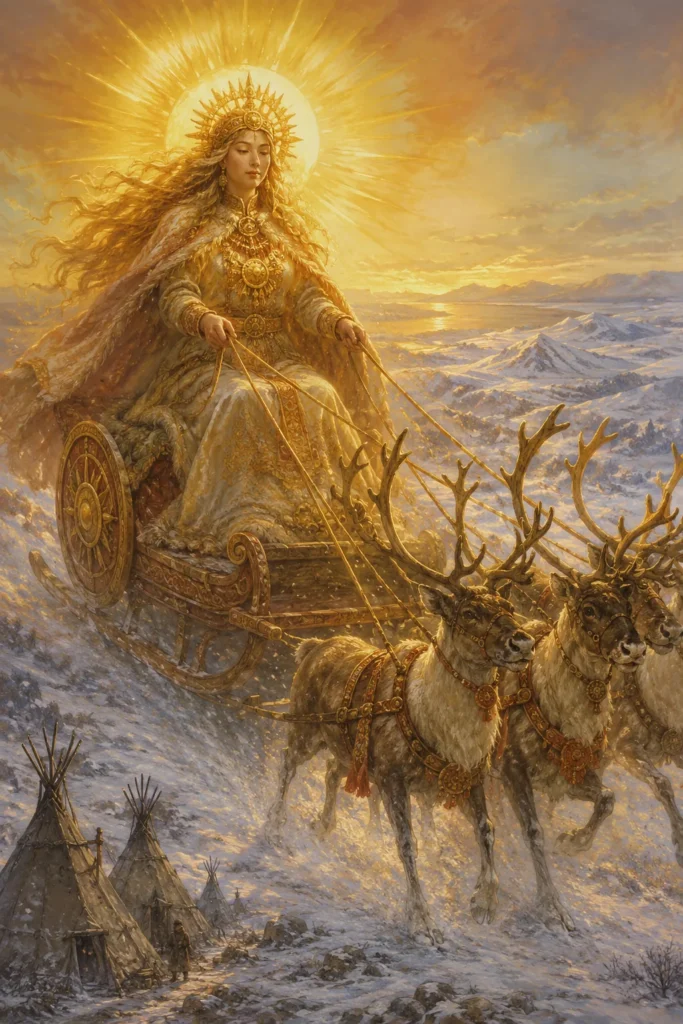
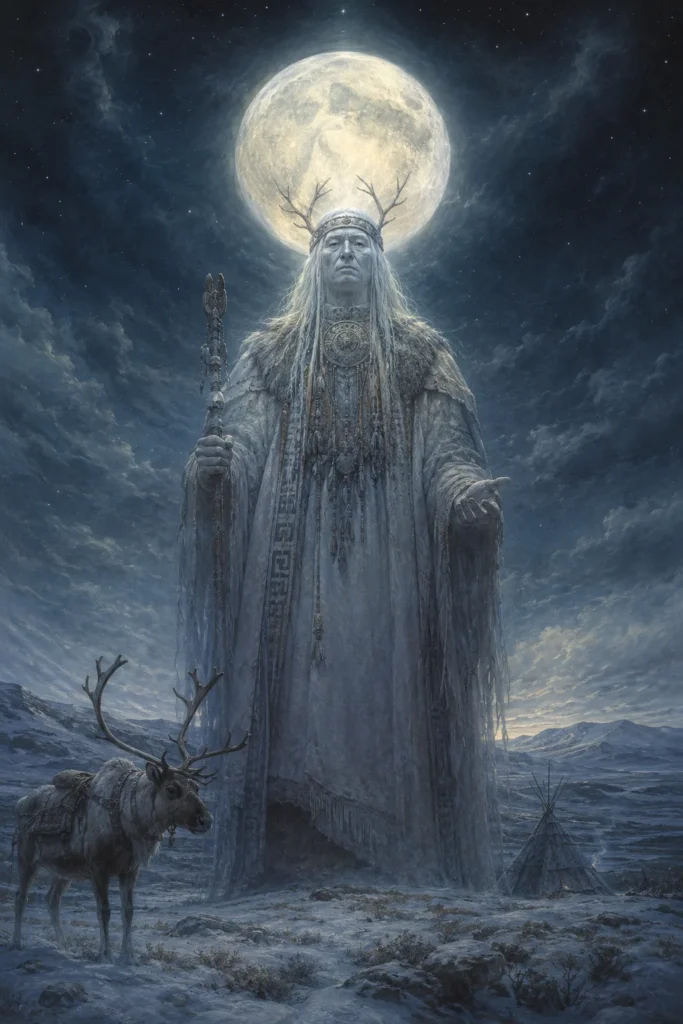
Juksakka, also written Juks-akka or Juksaahka, is the bow goddess of Sámi religion and protector of boys. She belongs to the group of Akkas together with Sara-Akka, Uksakka and Madderakka, and has the specific function of influencing the sex of a child before birth.
Juksakka, the bow goddess and guardian of boys, protects sons and male descendants in the Sámi tradition.
Classification and Short Profile
Juksakka is the special goddess of boys in the Sámi Akka triad. Her primary function involves influencing the sex of an unborn child: she could transform a girl in the womb into a boy when a family wished for a son.
From the perspective of religious studies, this gender-related function is distinct and rarely personalized so clearly in the religious history of the circumpolar region. The constellation reflects the significance of sons in traditional Sámi society, where reindeer herding and hunting were primarily male domains.
The source base for Juksakka is narrow. Schefferus, Leem and Læstadius mention her. Ernst Manker’s drum studies demonstrate her consistent iconographic position.
The bow goddess Juksakka has also been addressed in more recent scholarship using expanded methods that combine ethnographic care, linguistic source criticism and comparative classification. Sámi scholars today contribute to this research themselves and revise older Western attributions that sometimes carried colonial biases.
As protector of boys within the Akka triad, Juksakka fits into the pattern of a circumpolar religious topography that recurs across vast regions. The fact that this framework retains its basic features across thousands of kilometres is one of the most remarkable findings of comparative religious studies and continues to be discussed to this day.
Name and Etymology
The name Juksakka derives from the Sámi word juoksa for bow. The bow was traditionally a male tool associated with hunting and warfare. Juks-Akka therefore literally means bow grandmother or bow guardian, pointing to her function as a warden of the male sphere.
The Akka component, as with the other Akkas, is the common designation for the female protective goddesses. The combination bow-Akka is of interest to phenomenologists of religion because it attributes a male implement to a female deity.
Dialectal variants are Juksaahka in Southern Sámi, Juks-akka in Ume Sámi, and Juksáhkká in Northern Sámi usage. This variety is typical from a phenomenological perspective.
From a sociology of religion standpoint, one may ask what function Juksakka fulfilled in the social order of the traditional Sámi community.
Since her responsibility for boys mirrors the high importance of sons in a society shaped by reindeer herding and hunting, her religious role was closely intertwined with social practice. This entanglement forms its own field of religious anthropology, explored most systematically by Håkan Rydving and Konsta Kaikkonen.
Also of relevance is the contemporary significance of Juksakka for Sámi identity politics. With the growth of Sámi self-governance and the international recognition of indigenous rights, the transmitted Akka goddesses are regaining visibility. How religious research and political recognition interact in this process forms its own field to which scholarship has been paying increasing attention.
Description and Iconography
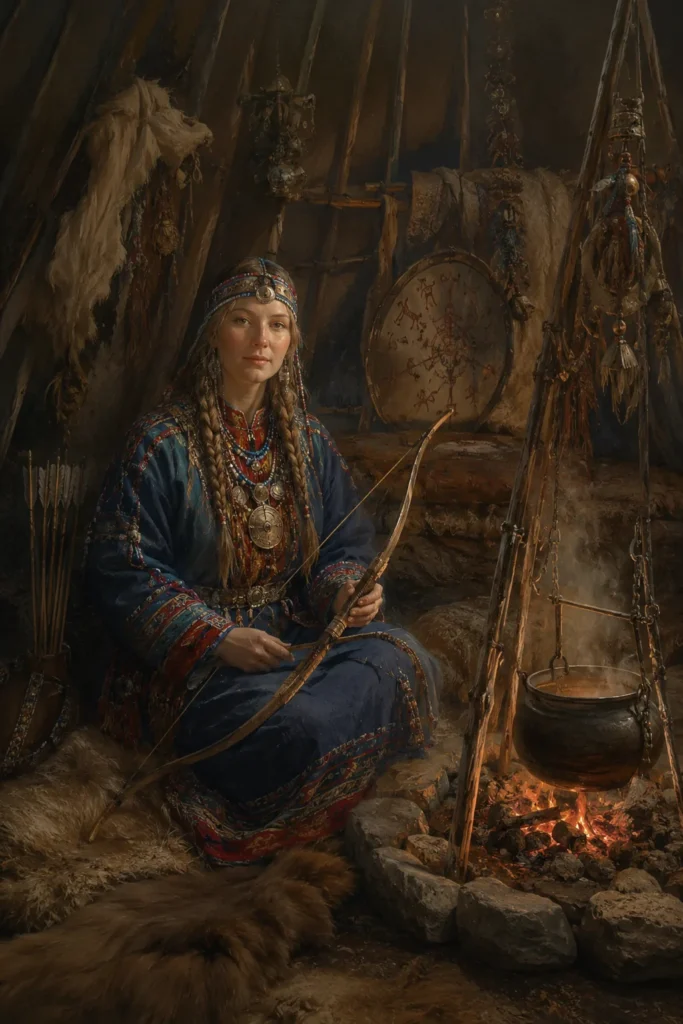
Juksakka is described in the ethnographic sources as a sturdy, sometimes somewhat stern-looking woman holding a bow or arrow. This iconographic association with a male implement is itself a distinct phenomenon in the phenomenology of religion.
On shamanic drums, Juksakka is usually depicted in the domestic level, often with a bow, sometimes with an arrow. Ernst Manker documented this iconography systematically and demonstrated the consistency of bow symbolism across most of the preserved drums.
Symbolically, Juksakka is associated with the bow, the arrow, hunting implements and the male sphere of life. This symbolism crosses the conventional gender assignment of tools and constitutes its own constellation in the phenomenology of religion.
Gender Transformation and Help for Boys
Juksakka’s primary function was the transformation of the child in the womb. When a family wished for a son, Juksakka was invoked to transform the expected daughter into a son. This concept is itself a distinct phenomenon in the phenomenology of religion.
Concrete practices included invocations during pregnancy, special foods for the expectant mother, and symbolic acts intended to win Juksakka’s favour.
From the standpoint of religious studies, this concept of gender transformation is not a simple superstition, but a theologically grounded conception of prenatal plasticity. The phenomenological depth of this concept is considerable and well discussed in comparative religious research.
Juksakka in the Akka System
Juksakka is part of the Akka fourfold theology. While Madderakka is the ancestral mother who receives the soul, Sara-Akka assists at birth and Uksakka guards the threshold, Juksakka is responsible for male children.
This specialised function is elaborated from a phenomenological standpoint. It shows that the Sámi tradition divides the female protective function into differentiated aspects, which is itself a distinct structure in religious phenomenology and sets it apart from many other indigenous traditions.
From a religious studies perspective, the precise differentiation between Juksakka and the other Akkas is not always unambiguous in the sources. Some sources blur the boundaries, others maintain them strictly. This variation is typical in the phenomenology of religion.
Comparison with Other Gender Deities
Juksakka belongs to the rare class of specialised gender deities who can influence the sex of a child. Structurally comparable figures are documented in the Chinese tradition (Songzi Niangniang) and in certain indigenous traditions of Central America.
The specificity of Juksakka lies in her embedding within the Akka system and in her symbolic association with the bow. This combination is distinctive from a phenomenological standpoint.
Within the Finno-Ugric tradition there are parallels in Finnish hunting-protective goddesses, though without the same specialisation in gender transformation. This specificity is a distinctly Sámi feature.
Taboos around the Male Sphere
Juksakka was the addressee of numerous taboos that governed the male sphere of life. Boys were forbidden to eat certain foods, perform certain actions, or speak certain words, as this would offend Juksakka.
These taboos reflect the religious structuring of male initiation. Young men being introduced to hunting had to observe special rituals addressed to Juksakka.
From a religious studies perspective, this taboo structure is a distinct ritual configuration that gave religious shape to male life. It is comparable to the taboo structures of other indigenous initiation deities.
Mission and Modern Reception
Christian mission partly identified Juksakka with female Christian protective figures and partly persecuted her as pagan. The practice of gender transformation was suppressed, effectively putting an end to the associated religious observances.
In contemporary Sámi culture, Juksakka is less visible than Sara-Akka, but she appears in Sámi literature and in the visual arts. The question of gender construction in traditional religion is today the subject of critical reflection.
From a religious studies standpoint, the current discussion around Juksakka is embedded in broader gender-critical debates within comparative religious studies. This discussion is productive from a phenomenological perspective and brings new viewpoints to the older scholarship.
Research and Current State of Scholarship
Research on Juksakka is intertwined with research on the other Akkas. Håkan Rydving, Juha Pentikäinen, Konsta Kaikkonen and Anna Lia Berthelsen have studied the Akka system systematically.
An independent monograph on Juksakka is still outstanding. Specific research gaps remain in the detailed theology of gender and in the psychology-of-religion treatment of the gender transformation concept.
In phenomenological scholarship, Juksakka is treated as a case study of specialised birth goddesses. This classification allows for structural comparisons.
Encyclopaedia Cross-References
Juksakka connects with Sara-Akka, Uksakka, Madderakka, Beaivi, Mánnu, Ráhka, Stallo, Jabmiidaibmu and Saivo. The culture hub Sámi tradition frames the birth theology. Structurally comparable specialised birth goddesses can be found in numerous religions worldwide, for example in the Chinese tradition.
The Akka Group: Juksakka among the Domestic Goddesses
Juksakka belongs to a group of female protective deities of Sámi religion that earlier scholarship subsumes under the collective term akka. The word akka means simply “old woman” or “grandmother” in several Sámi languages and was used for ancestral women as well as for divine beings.
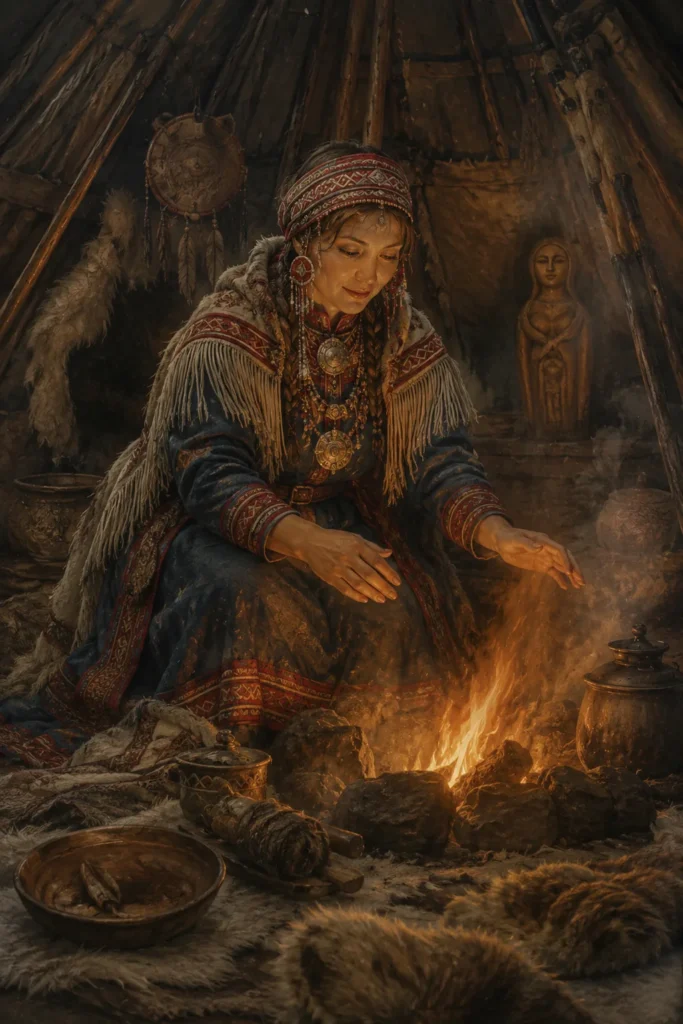
Alongside Juksakka, the sources name Sarakka, Uksakka and the overarching figure Maderakka. These deities were closely associated with the interior of the dwelling tent, with birth and with early childhood.
The name Juksakka is commonly interpreted as “bow woman”, from juoksa and related forms meaning “bow”. Earlier scholarship derived from this the notion that Juksakka was responsible for the child’s sex and could transform a girl in the womb into a boy, thereby determining a future hunter and archer.
This interpretation is widespread in the reference literature, but rests on a rather narrow source base and is regarded by parts of more recent scholarship as potentially overstated.
Within the Akka group a certain division of tasks is recognisable, even though the sources do not present it consistently throughout: Sarakka was associated with birth itself and with the hearth fire, Uksakka with the doorstep and the protection of the child venturing outside, Juksakka with the growing child and in particular with boys.
This differentiation should not, however, be misread as a rigid system. It more likely reflects the efforts of later collectors to impose an orderly overview than a fixed theological doctrine of the Sámi tradition itself.
Source Criticism: Juksakka in Missionary Reports
Almost everything known about Juksakka derives from records produced in the course of Christian mission in the Sámi settlement area. The most important texts belong to the late seventeenth and eighteenth centuries.
Lutheran pastors and missionaries, including Thomas von Westen and his circle in the Norwegian region, collected information about the indigenous religion in order to combat it more effectively. In the Swedish region, accounts by Pehr Högström, among others, have been preserved.
This context of production fundamentally shapes the material. The missionaries regarded the Sámi deities as idols or demons and had no interest in a sympathetic or nuanced portrayal. They questioned informants often under pressure, sometimes in the context of interrogations.
Concepts were pressed into a Christian interpretive framework, and the diversity of regional conceptions disappeared behind homogenising schemes. When the sources ascribe a clearly defined function to Juksakka, one must therefore always ask whether that clarity originates in the Sámi tradition or in the systematising impulse of those who recorded it.
In addition, many of the early reports copied from one another or relied on the same few informants. An apparently broad transmission can, on closer examination, be traced back to a narrow foundation.
Modern Sámi religious scholarship, such as the work of Håkan Rydving, has therefore emphasised that the Akka goddesses should be treated not as established knowledge but as a reconstructed and partly distorted tradition.
For Juksakka this means: the broad outlines of her domestic veneration are plausible, but the details of her alleged responsibilities remain uncertain.
Literature (Selected)
- Johannes Schefferus: Lapponia (Frankfurt 1673)
- Knud Leem: Beskrivelse over Finmarkens Lapper (Copenhagen 1767)
- Lars Levi Læstadius: Fragmenter i lappska mythologien (Manuscript ca. 1840)
- Håkan Rydving: The End of Drum-Time (Uppsala 1993)
- Juha Pentikäinen: Saamelaiset (Helsinki 1995)
- Konsta Kaikkonen: Sami Pre-Christian Religion (Helsinki 2020)
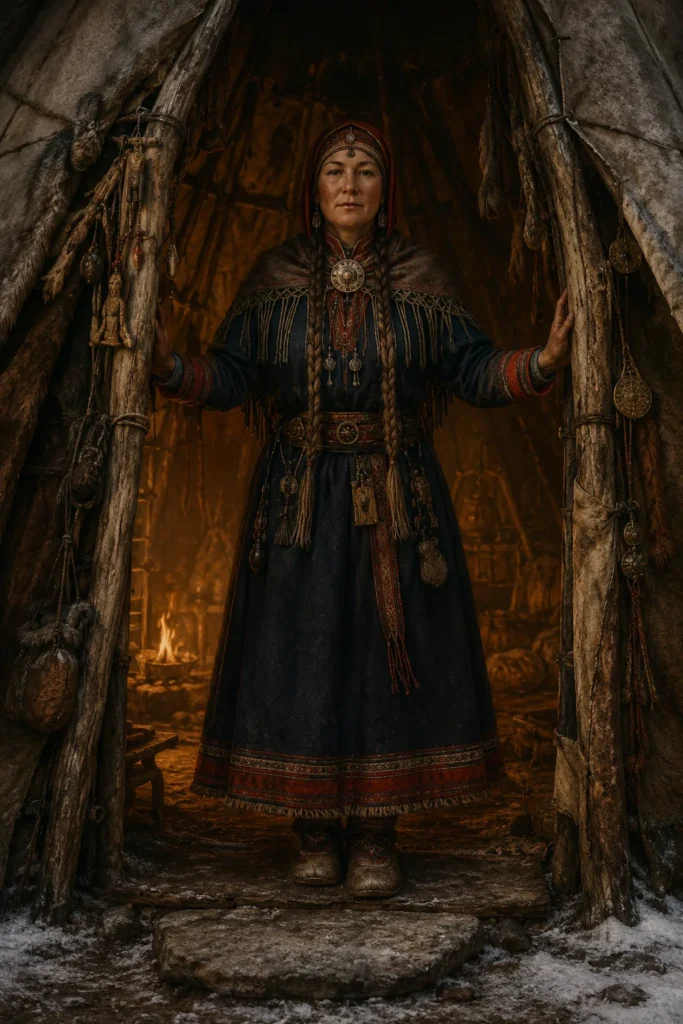
Juksakka is regarded in Sámi religion as the guardian of boys and mistress of the bow in the domestic sphere.
She is counted among the three Akkas, the female protective figures beneath the hearth, and is associated especially with the determination of sex and the protection of growing boys. Earlier accounts place her within the family religion practised in the goahti.
Related key terms: Juksakka Juks-akka Juksáhkká Sámi bow goddess gender transformation Akka.
iWell Guard and Protective Traditions
iWell Guard draws on the cultural-historical tradition of wearable protective objects, following the tradition of Sami and many other cultures worldwide. 41 layers, real gold, platinum, silver, made in Germany. 30-day return policy.
Personal experiences may vary. Not a medical device. No healing promises.