Vir-ava, mistress of the forests on the Volga
By Ralf Ittermann · last reviewed on
Vir-ava is goddess of Mordvin tradition.
The forest mother, who rules over trees, game and hunting luck. The account presents Vir-ava as mistress of the Volga forests, ruling over trees, game and hunting luck.
Vir-ava (also Vir’ava or Virjava) is the forest mother of Mordvin mythology on the middle Volga. Her name combines vir, forest, and ava, woman or mother; according to tradition, she rules over everything that grows and lives in the forest.
She belongs to the class of great ava deities that characterise the female-dominated pantheon of the Erzya and Moksha: Mastorava for the earth, Ved’ava for water, Varmava for wind, Norovava for the harvest, and Vir-ava for the forest. Even the oak god Tumopaz is subordinate to the forest mother.
Type: Forest mother and forest deity of the ava class
Origin: Mordvin mythology (Erzya and Moksha) on the middle Volga
Texts: recorded from the mid-19th century onward (Melnikov, Smirnov, Paasonen, Harva)
Period: documented from the 19th century, with older roots
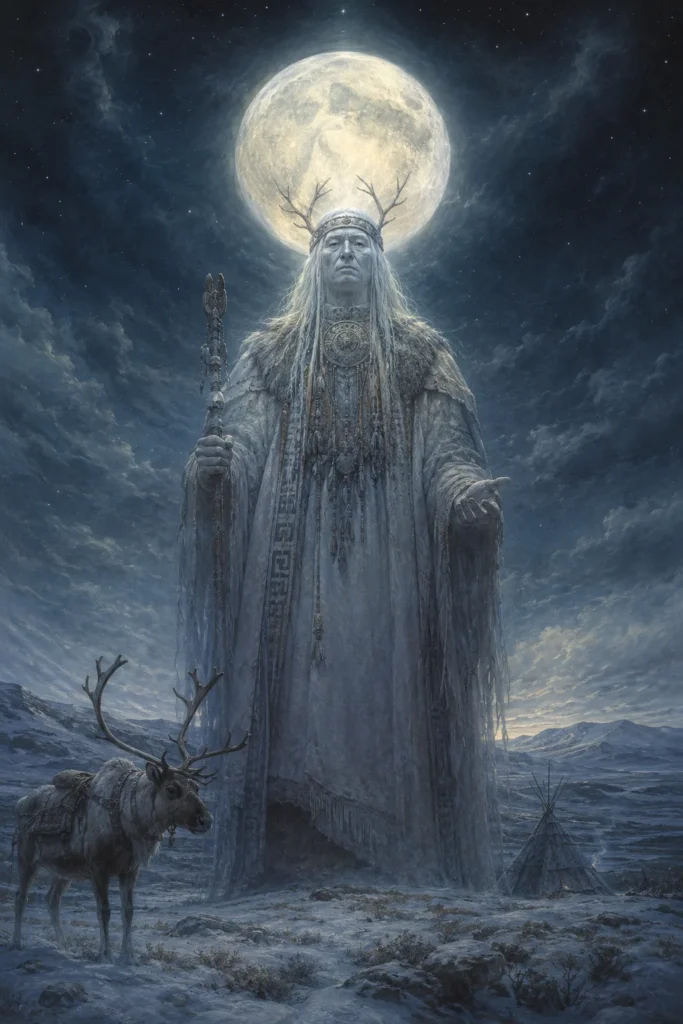
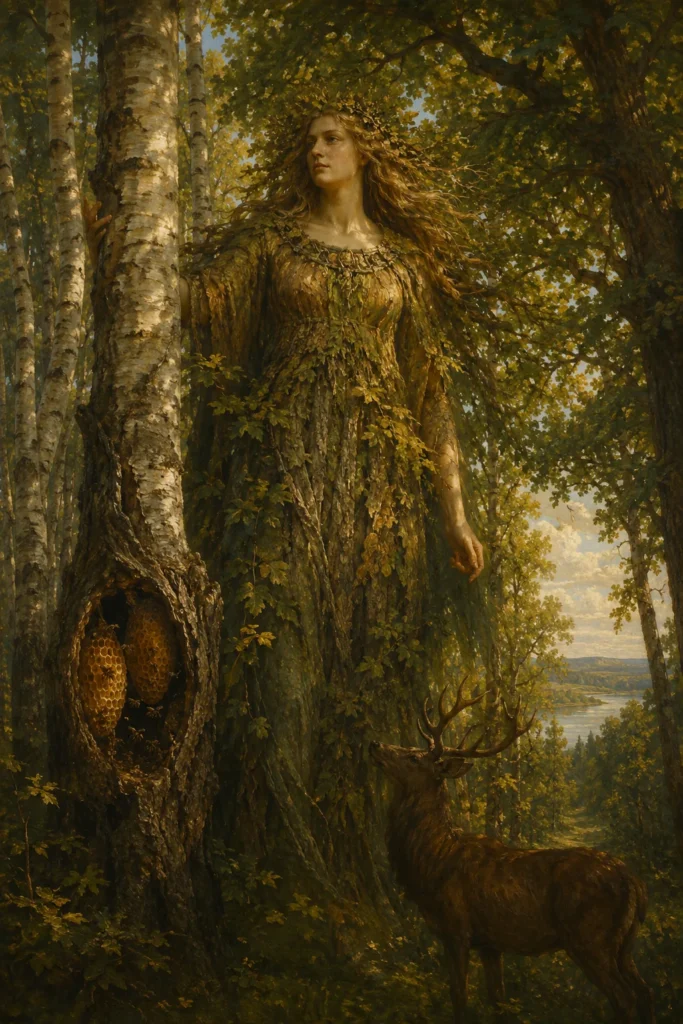
Appearance: shape-shifting female figure, in legends as tall as trees with long, loose hair
Area of origin and sources
Period of the Texts
Written testimonies only begin with the Russian accounts of the 19th century, followed by the Finnish collections of Paasonen; the authoritative German-language overall account remains Harva’s 1952 work.
Area of Diffusion
The Mordvin settlement areas on the middle Volga, divided into the two groups of the Erzya and the Moksha, each with their own languages and traditions.
Sources
Fragmentary and folkloric: Melnikov, Smirnov, Paasonen and Harva; the tradition has been repeatedly reshaped by Christianisation and Russian neighbourhood.
Name and variants
Mordvin: Vir-ava, from vir, forest, and ava, woman or mother: the forest mother. The name ending ava marks the whole class of female protective deities of the Mordvins; alternate forms are Vir’ava and Virjava.
Appearance
Appearance
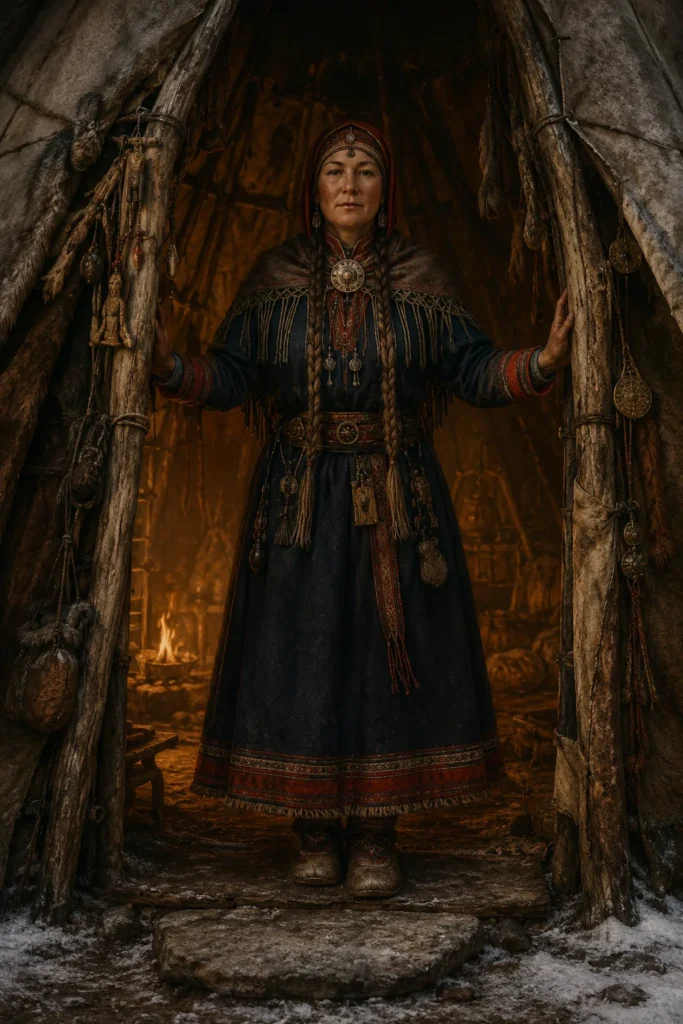
The records show no uniform image. Legends from the 19th century describe Vir-ava as a gigantic female figure, as tall as the trees of her domain, with long, loose hair; elsewhere she appears inconspicuously as a woman by the wayside. She is heard more often than she is seen: calling, laughter and the echo in the forest were regarded as her voice.
Effect
Vir-ava rules over trees and game; hunting success and foraging luck were regarded as her grant. Whoever used the forest carefully had nothing to fear from her. At the same time, the legends also tell of her uncanny side: she leads travellers astray, frightens them with voices and laughter, and makes paths seem never to end. No fixed set of harms is attributed to her; the threat remains situational.
Profile: Vir-ava
The key aspects of the forest mother at a glance.
One of the great ava deities of the female-dominated Mordvin pantheon, alongside Mastorava, Ved’ava, Varmava and Norovava.
Hunters, gatherers and travellers: game, honey and timber of the forest were regarded as her grant.
Shape-shifting female figure, in legends as tall as trees with long, loose hair, elsewhere inconspicuous by the wayside; often present only as a voice and an echo.
Mistress of trees, game and tree spirits; she grants hunting and foraging luck and leads the careless astray.
Invocations before hunting and felling wood, offerings such as bread, salt and first fruits at the forest’s edge, along with village sacrificial festivals (ozks).
The Estonian Metsaema and the Latvian Meža māte are her closest relatives; the Komi forest spirit Vörsa is a spirit, not a deity.
The ava deities of the Erzya and Moksha
The Mordvins consist of the two groups of the Erzya and the Moksha, each with their own languages; a unified Mordvin mythology never developed, which is why research treats both traditions side by side. What they share is the dominance of female protective deities ending in ava: Mastorava for the earth, Ved’ava for water, Varmava for wind, Norovava for the harvest and Vir-ava for the forest.
A myth recorded by Uno Harva has three of these sisters hatch from the eggs of the Great Bird Ine Narmun, whose nest rests on a birch tree: the harvest mother Norovava, the wind mother Varmava and the forest mother Vir’ava. The wind god Varmanpaz is regarded in Erzya tradition as the son of Vir-ava, and the hierarchy of trees shows her standing: even the oak god Tumopaz is subordinate to the forest mother. The source material is fragmentary and has been repeatedly reshaped by Christianisation and by Russian neighbourhood.
Reception and classification
In contemporary Mordvin national culture, the world of the gods lives on chiefly through the artistic epic Mastorava (A. M. Sharonov, 1994); Vir-ava also appears in collections of fairy tales, school materials and the Finno-Ugric cultural movement. Outside Russia, the figure is known almost exclusively in specialist literature.
Vir-ava stands for the characteristic ava class of Mordvin religion: female protective mistresses of individual spheres of life, to whom male figures were long assigned only as helpers or sons. Earlier research (Maskayev) interpreted this as an echo of matriarchal conditions; present-day religious studies judge more cautiously and point out that the Mordvin languages have no grammatical gender and that the gender assignment of the deities remained fluid. Typologically, the Forest Mother combines the Mistress-of-the-Animals type with the mother schema of the Volga Finns.
Requests, offerings and the ozks sacrificial festivals
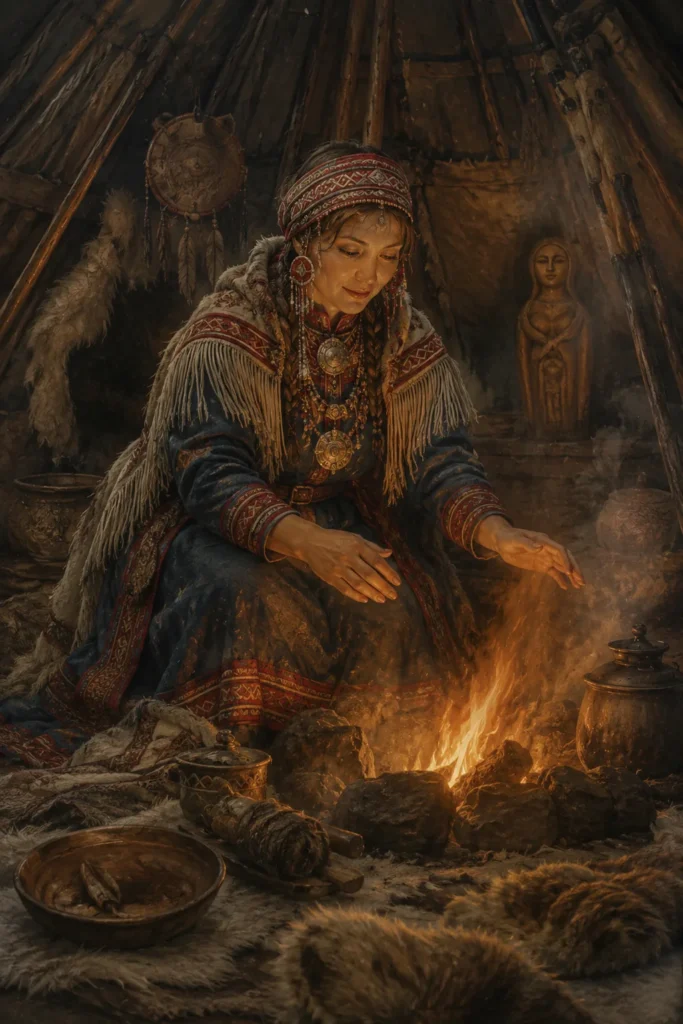
The records mention the request first: before a hunt, wood-cutting or gathering trip, people turned to the Forest Mother with invocations. Small offerings such as bread, salt or first fruits were laid at the edge of the forest or on a tree stump; at the Mordvins’ village sacrificial festivals (ozks), the ava deities as a whole were asked for blessing. As a remedy for getting lost, turning one’s clothing inside out or swapping shoes was common in the Volga region. Rules of respect, no cursing and no boasting in the forest, complete the picture; no formal banishing rituals against Vir-ava have been recorded.
Forest mothers and forest lords compared
The closest relatives are the Estonian forest mother Metsaema and the Latvian Meža mate; research often mentions this East Baltic-Volga Finnic series of female forest mistresses in one breath. In Russian folk belief she is functionally matched by the male Leshy, and the motif of the powerful old woman in the forest links her to Baba Yaga. She is distinguished from the Komi forest spirit Vörsa by rank: Vir-ava is a deity of the ava class with cultic invocation, Vörsa a spirit lord of the hunt with no place in a pantheon.
Frequently asked questions about Vir-ava
Is Vir-ava a goddess or a forest spirit?
Mordvin tradition does not draw a sharp distinction here. Vir-ava belongs to the great ava deities and stands above the tree spirits in the hierarchy, yet in the legends she behaves like a place-bound forest spirit. Her classification as a deity follows her position in the pantheon, as described by Harva.
How dangerous is the Forest Mother?
The legends show her as ambivalent: she grants luck in hunting and gathering, but can lead travellers astray and frighten them. The sources report hardly any deliberate, lasting harm.
Does Vir-ava apply equally to the Erzya and Moksha?
Yes, the name is attested in both traditions, and both know the Forest Mother as mistress of the forest realm. Since the Erzya and Moksha maintain separate traditions, however, individual motifs differ from region to region.
Further links
Literature (selection)
Further standard works in the bibliography.
As the Mordvin Forest Mother, Vir-ava represents the forest as both a giving and an unavailable living space; without her ava class, Mordvin mythology with its female-dominated pantheon cannot be understood.