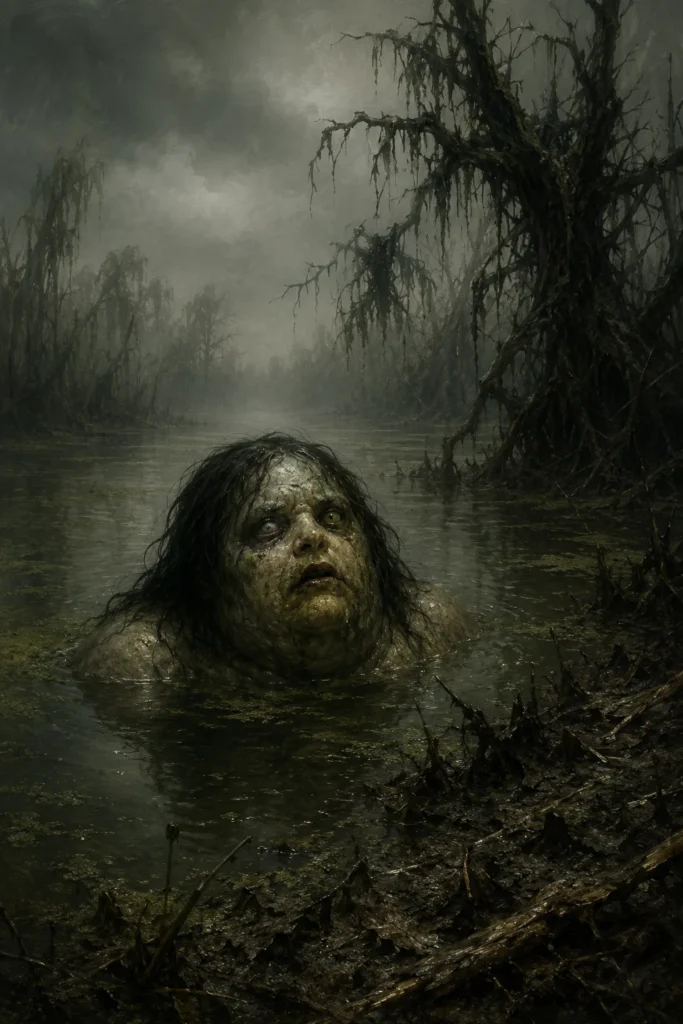
Baba Yaga, demon of the Slavic tradition
By Ralf Ittermann · last reviewed on
Baba Yaga is a demon of the Slavic tradition.
The witch of the chicken-legged hut, an ambivalent primordial figure of Slavic folklore.
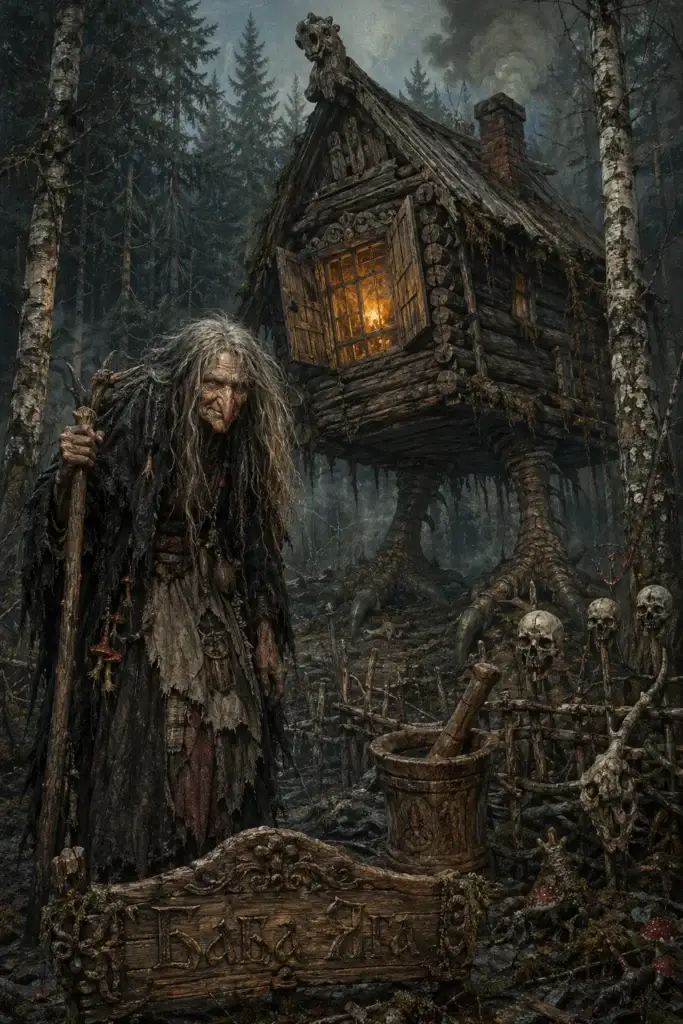
Baba Yaga
Baba Yaga is one of the most distinctive and powerful figures in Slavic folklore. An old witch with iron teeth, thin legs, and a long nose that touches the stove or the ceiling, she lives in a hut on chicken legs deep in the forest.
She flies in a mortar, propelling it with a pestle and sweeping away her tracks with a broom. She may devour humans, or send heroines and heroes on their way with irreplaceable gifts.
Her ambivalence is the central motif. In Vladimir Propp‘s classic analysis (The Historical Roots of the Wondertale, 1946), Baba Yaga is the tester of the hero at the threshold between this world and the next, an initiation–rite motif.
In the West she is known primarily through Russian fairy-tale collections (Afanasyev) and through adaptations (Mussorgsky’s Pictures at an Exhibition, John Wick’s assassin code name). Slavic parallels include the Czech Jezibaba and the Polish Jedza.
At a Glance: Baba Yaga
Type: Ambivalent witch, guardian of the threshold
Origin: Slavic folk tale tradition
Texts: Russian folk tales (Afanasyev), Czech and Polish variants
Period: 18th/19th century to the present
Dwelling: Hut on chicken legs deep in the forest
Context
Period of the Texts
There is no archaeological evidence for pre-Christian Slavic roots. There are no medieval or older written testimonies; the folk tales have been recorded since the 18th/19th centuries. A. N. Afanasyev (1855, 1863) is the primary source; V. Propp’s structural analysis (1928, 1946) shapes modern interpretation.
Mythological Classification
Baba Yaga is one of the most enigmatic figures in Slavic mythology, ambivalent between goddess and demon. She is not clearly evil or good, but a boundary guardian between worlds. She is known from Russian and Ukrainian folk tales. Some scholars view her as a degraded goddess.
Geographic Distribution
East Slavic (Russia, Ukraine, Belarus) as the core region. West Slavic: Czech Jezibaba, Polish Jedza. South Slavic: Bulgarian and Serbian variants. Local overlaps with neighboring folklore traditions.
State of Sources
A. N. Afanasyev, Russian Folk Tales (1855, 1863); Vladimir Propp, The Historical Roots of the Wondertale (1946); Czech and Polish fairy-tale collections; modern ethnology and folkloristics.
Name and Variants
Russian: Baba Yaga (Баба Яга).
Czech/Slovak: Jezibaba.
Polish: Jedza, Baba-Jedza.
Ukrainian: Baba Yaha.
Etymology: baba, “old woman”; yaga, unclear, possibly Proto-Slavic for “fury” or “terror”.
The name variants reveal a pan-Slavic base form with regional variation. In Propp’s analysis she constitutes a universal type of the “mistress of the forest” and “guardian of the threshold,” a motif that also appears in non-Slavic traditions (the witch in German fairy tales, the Cailleach in Celtic tradition).
Description
Appearance
An old woman with iron teeth, a long nose, and thin legs. Often very large when seated (“nose at the ceiling, feet in the corner, teeth at the threshold”). She flies in a wooden mortar, steering it with a pestle and sweeping away her tracks with a broom.
Dwelling
The famous hut on chicken legs deep in the forest. It turns on command, “Little hut, little hut, turn your back to the forest and your front to me,” and opens only for the correct formula. A fence of human bones, posts topped with skulls whose eyes glow.
Behavior
Ambivalent. Prone to devouring (eats children who end up in her hut). But also a tester: whoever greets her properly, obeys, and performs the work is richly rewarded, with fire, information, magical objects, or a path back. Whoever behaves wrongly dies.
Domain
The deep forest, the boundary between this world and the next. Propp sees her hut as a site of initiation; the observance of rituals (bathing, feeding, questioning) as the structural trace of a forgotten initiation rite.
Appearance and Symbolism
Baba Yaga is depicted as an old woman with long, tangled hair, often with an iron nose. She lives in a hut on chicken feet. A mortar and pestle serve as her aerial vehicle. She surrounds herself with palisades of bone. The forest and the night are her domains.
Profile: Baba Yaga
The most important aspects of Baba Yaga at a glance.
Slavic folk-tale figure; according to Propp, a condensed form of an initiation deity. Ambivalent mistress of the forest.
Heroes and heroines on a threshold journey. Children lost in the forest. In some variants: women undergoing initiation.
Old woman, iron teeth, long nose, thin legs. Flies in a mortar with a pestle as rudder, using a broom to sweep away her tracks.
Ambivalent: devours or rewards. Tests a guest through obedience, labor, and correct words. Decides according to ritually correct or incorrect behavior.
Not warding off, but correct conduct. In the forest: do not enter huts uninvited, offer a greeting upon arrival, do not refuse to bathe and eat (rituals of acceptance), and do not flee.
Functionally related to Cailleach (Celtic) as an aging power of nature; to Frau Holle/Holda (Germanic) as an ambivalent mistress of the house; to the Greek Hecate as a threshold being; and to the Yokai of the Japanese mountain forests.
In the broader Slavic tradition: Mokosh as the older maternal earth goddess, Kikimora as her household-spirit counterpart.
Encounter and Initiation
Correct Approach
The hero calls at the threshold: “Little hut, little hut, turn yourself …”. The hut rotates. Upon entry: a formula of courtesy, a request to bathe and eat before being asked. Whoever observes this ritual courtesy is treated as a guest, not as prey.
Baba Yaga as Tester
In many tales (Vasilisa the Wise, Ivan Tsarevich), Baba Yaga sets tasks: sorting grain, carrying water in a sieve, fetching fire. Whoever solves the tasks, often with the help of a small helper, is not devoured but rewarded.
Rewards
Magical objects (a flaming skull that lights the way; a ball that rolls and leads; a towel that becomes a bridge), information, blessings. Baba Yaga cannot be defeated, only respected, and then she gives generously.
Reception
Russian Art and Literature
Ivan Bilibin’s illustrations (1899, 1902) shaped her image worldwide. Mussorgsky’s musical piece in Pictures at an Exhibition. Pushkin, Gogol, and Leskov incorporated the figure into their works. Soviet animated films.
Folkloristics
Propp’s The Historical Roots of the Wondertale (1946) made Baba Yaga the prime example of an initiation residue in the folk tale. This interpretation shaped modern structuralist research.
Modern Popular Culture
International fantasy literature (Naomi Novik, Uprooted, Spinning Silver), the John Wick film series (“Baba Yaga” as a code name), fantasy role-playing games. Baba Yaga is one of the best-known figures in Russian and Ukrainian folk tales.
Baba Yaga in the Folk Tale: Vasilisa the Beautiful
The best-known tale featuring Baba Yaga is the Russian fairy tale of Vasilisa the Beautiful, transmitted among other sources in the celebrated collection of Alexander Afanasyev. It presents the witch figure in her characteristic dual role as both threat and helper.
Vasilisa is sent to Baba Yaga by her stepmother and stepsisters under a pretext, ostensibly to fetch fire, but in truth so that she may perish. She finds the hut of Baba Yaga, which is surrounded by a fence of bones topped with human skulls.
Baba Yaga takes Vasilisa in, but sets her a series of seemingly impossible tasks: she must clean the house, cook, and separate a large quantity of grain or poppy seeds from impurities. Vasilisa accomplishes the tasks with the help of a doll left to her by her late mother.
Baba Yaga eventually lets Vasilisa go and gives her a skull with glowing eyes mounted on a stick. When Vasilisa returns home with it, the light of the skull burns her stepmother and stepsisters to death.
The tale illustrates several traits characteristic of Baba Yaga: her connection to death and the otherworld, her role as a tester who puts the hero to the proof, and the fact that she helps whoever passes the test and destroys whoever fails it or treats her disrespectfully.
She is not an unambiguously evil figure, but an ambivalent guardian of the threshold.
The Hut on Chicken Legs and Other Attributes
Among the unmistakable features of Baba Yaga is her dwelling: a small hut that stands on chicken legs and can rotate.
In many tales the hero must speak a formula for the hut to turn around, for example the command that it should present its back to the forest and its front to the speaker. Only then can the hut be entered.
Scholarship has proposed various interpretations of this hut. The Russian fairy-tale scholar Vladimir Propp, in his study of the roots of the wondertale, connected it with ideas of passage into the otherworld and with ancient initiation rituals.
According to this reading the hut marks the boundary between the world of the living and the realm beyond.
The fact that it opens only upon a formula suggests a threshold that may be crossed only under certain conditions. Some scholars have also compared the elevated hut to certain burial customs in which the dead were interred in raised wooden structures, but this connection remains hypothetical.
Further fixed attributes include the mortar in which Baba Yaga flies through the air, the pestle with which she steers, and the broom with which she sweeps away her tracks.
Her appearance is described as that of an old, gaunt woman with overlarge teeth, a long nose, and sometimes only one leg or a bony leg.
The bone fence with skulls whose eyes glow belongs to many versions. All these features consistently connect Baba Yaga with death, the boundary, and the wilderness. She is a figure of the forest, of the uncultivated, dangerous world beyond the human village.
Scholarly Interpretations: Death Deity, Mistress of Initiation, Power of Nature
Baba Yaga is among the most intensively interpreted figures of Slavic folklore, precisely because her origins remain obscure. There are no medieval or older written testimonies that clearly attest to her as a pre-Christian deity.
All primary sources are fairy tales that were not recorded until the 18th and 19th centuries. It follows that every interpretation of her origins must be regarded with caution.
One widespread interpretive line sees in Baba Yaga the remnant of an ancient deity of the dead or of the ancestors. In its favor is her consistent connection with death, with bones, and with the otherworld.
Another line, represented above all by Propp, emphasizes her role in the tales as tester and donor of the magical gift, and connects her to the schema of initiation: according to this view, Baba Yaga is the guardian of a passage through which the hero must pass in order to reach adulthood or completeness.
A third interpretation understands her as the embodiment of wild nature, the forest and its powers, which is why she also appears as mistress over animals and natural forces, for example over riders who personify day, the sun, and night.
The scholar Andreas Johns, in a comprehensive study of Baba Yaga, has shown that the figure cannot be pinned down to a single interpretation.
She is ambiguous: she helps and harms, tests and rewards. This ambivalence is not an imprecision of the tradition, but apparently an essential characteristic of the figure itself. Whoever wishes to understand Baba Yaga must resist the temptation to simplify her into an unambiguous character.
The Name Baba Yaga and Its Linguistic Puzzles
The name of the figure is only partially clarified linguistically. The first element, Baba, is readily understood in the Slavic languages.
It denotes an old woman or grandmother, and depending on context can carry an honorific or a pejorative sense. In folk culture the word often carries a meaning associated with wisdom, but also with the uncanny.
The second element, Yaga, is by contrast disputed. Several explanations have been proposed, none of which has gained general acceptance. One direction connects the word with roots meaning terror, fury, or illness that can be found in other Slavic languages, for example in words for fright or torment.
Another direction seeks connections to terms for snake or for forest. Still others have proposed links outside the Slavic family, but these are particularly uncertain.
The number of proposals and the absence of a convincing solution indicate that the name is likely very old and that its original meaning has become obscured.
Added to this is the fact that the figure appears in various Slavic language areas under related but not identical names, for example in Polish and Czech traditions, pointing to a shared but early-diversified tradition.
For the history-of-religions perspective, the very obscurity of the name is instructive: it suggests that Baba Yaga is not a late literary invention, but goes back to a long oral tradition whose beginnings elude precise reconstruction.
Sources and Bibliography
A selection of key works on Baba Yaga:
- Propp, Vladimir: The Historical Roots of the Wondertale. Leningrad 1946.
- Afanasyev, Alexander N.: Russian Folk Tales. Moscow 1855, 1863.
- Johns, Andreas: Baba Yaga. The Ambiguous Mother and Witch of the Russian Folktale. New York 2004.
- Hubbs, Joanna: Mother Russia. The Feminine Myth in Russian Culture. Bloomington 1988.
Further standard works in the literature index.
The protective practice described here represents a scholarly classification of historical traditions within the study of religion. iWell Guard connects with this cultural-historical line of wearable protective objects and represents a contemporary form of it. More about iWell Guard →
Frequently Asked Questions about Baba Yaga
Who is Baba Yaga in Slavic mythology?
Baba Yaga is the most famous witch of the Slavic folk tale, an ambivalent, often ancient figure who lives in a house on chicken legs deep in the forest.
She is simultaneously threat and helper: whoever shows courage and passes her tests receives gifts and knowledge from her; whoever betrays her is devoured. Baba Yaga travels in a mortar, steers it with the pestle, and sweeps away her tracks with a broom.
Which symbols belong to Baba Yaga?
Classic Baba Yaga symbols include the house on chicken legs, the mortar with pestle (her means of travel), the broom (for sweeping away tracks), the fence of human bones with skulls on the posts, and the iron cookware.
In the structuralist reading (Vladimir Propp), Baba Yaga is the archetypal guardian of the threshold in the fairy-tale journey: she tests the hero before the passage into the Other World.