The Ala is a demoness of South Slavic tradition.
The hail cloud that destroys harvests and devours the sun and moon. The entry situates Ala within the broader demonology of the Balkans. Ala is feared among the South Slavs as a demon bringing storms and hail.
The Ala, Bulgarian Hala, is a storm and hail demoness in South Slavic folk belief. She drives hail and thunder clouds over the fields, destroys the harvest and devours the sun and moon, which tradition uses to explain eclipses.
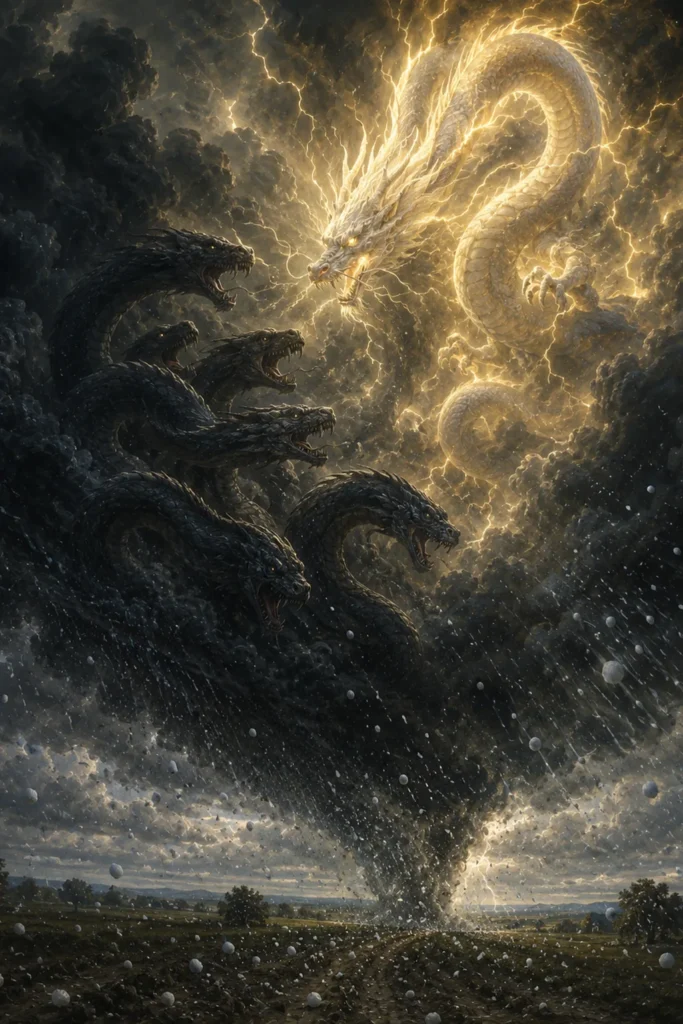
Her adversary is the good dragon, the zmaj, protector of the harvest; his battle against the Ala explains thunder and lightning. In the Christianised version, Saint Elijah takes on the role of the dragon. The figure is widespread in Serbia, Bulgaria and North Macedonia.
Type: Storm and hail demoness, weather and devouring demon
Origin: South Slavic folk belief
Texts: Ethnographic collections by Zečević, Radenković and Georgieva
Period: ethnographically documented in the 19th and 20th centuries
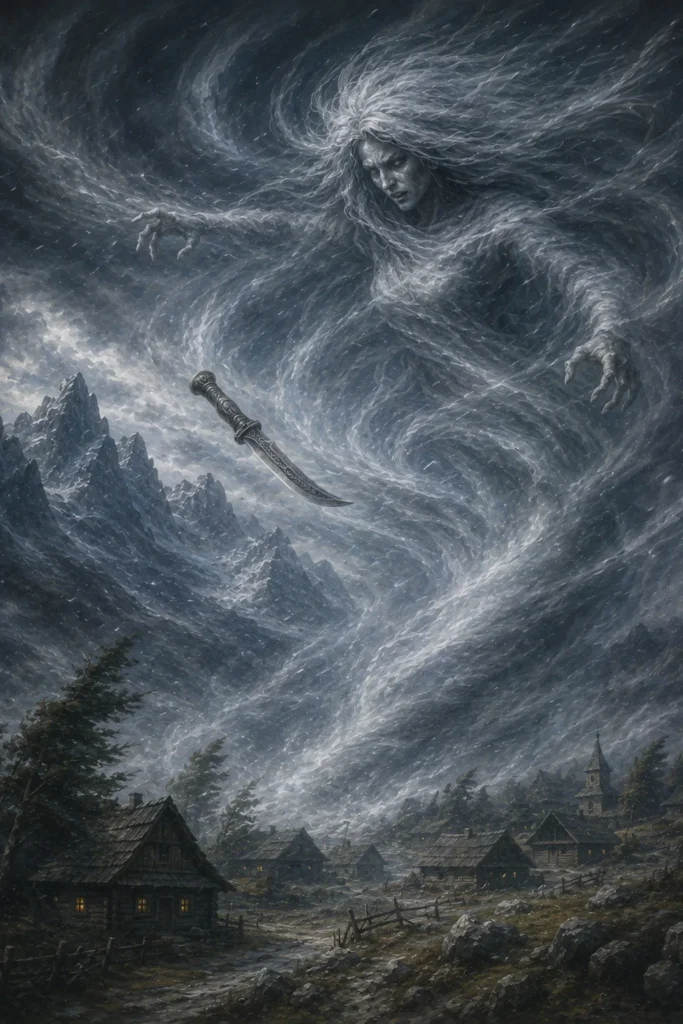
Appearance: black whirlwind or many-headed serpent being
The Ala belongs to South Slavic folk belief; the authoritative documentation comes from 19th and 20th century ethnography.
Serbia, Bulgaria and North Macedonia. The Ala is not pan-Slavic, but limited to this South Slavic region.
Well documented: the works of Slobodan Zečević, Ljubinko Radenković and Ivanichka Georgieva form the foundation of research.
South Slavic: ala, Bulgarian hala. The etymology is disputed: the widespread Turkish derivation from ala, snake, has been disproved, since the original form began with an h. Preferred are Greek chálaza, hail, or Proto-Slavic xala, the raging of the elements.
Appearance
The Ala is vague and highly variable by region: as a black whirlwind, a huge many-headed serpent being, a dragoness, a serpent body with a horse’s head, or as a raven; in Bulgaria winged with a sword-like tail. This diversity is regarded as evidence of her syncretic origin.
Effect
The Ala drives hail and thunder clouds over the fields, destroys and drinks the harvest and carries it to other villages. She is extremely voracious, eats children and devours the sun and moon, causing eclipses; if she succeeded completely, it would be the end of the world. She can also possess people.
The key aspects of the hail demoness at a glance.
South Slavic weather demon, according to Zečević a synthesis of a Slavic bad-weather demon with a pre-Slavic Balkan demon.
Fields, harvest and celestial phenomena: the Ala destroys the grain and threatens the sun and moon, whose eclipses are attributed to her.
Black whirlwind, many-headed serpent being, dragoness, serpent body with horse’s head, or raven; in Bulgaria winged with a sword-like tail.
Hail and storms, destruction of the harvest, eclipses; along with the ability to possess people.
Warding table with bread, salt, a black-handled knife and axe; defensive spells against the cloud; gunshots and bell-ringing during an eclipse.
The good dragon zmaj as arch-enemy; related are the aždaja, the Lamia and the Romanian vlva; on the Polish side, the Wietrzyca.
Even the name leads into the research debate: the long-popular Turkish derivation of ala, snake, has been disproved, because the original form had an initial h. Preferred today are Greek chálaza, hail, or Proto-Slavic xala, the raging of the elements. The Ala is documented in the works of Slobodan Zečević, Ljubinko Radenković and Ivanichka Georgieva.
Zečević interprets the figure as a synthesis of a Slavic bad-weather demon with a pre-Slavic Balkan demon; the striking diversity of her forms of appearance is regarded as evidence of this syncretic origin. Her role in the weather battle, however, is firmly established: the good dragon zmaj defends the harvest against her, and his struggle with the Ala explains thunder and lightning. In the Christianised version, Saint Elijah takes the dragon’s place; alongside him, the dragon-people, the aloviti or zmajeviti ljudi, wage the fight.
The idioms strong as an Ala and voracious, alav, live on in everyday language. The Ala is present in Slavic-inspired fantasy and in folklore blogs; a relief at Visoki Dečani Monastery shows an eagle seizing an Ala.
In religious studies, the Ala is a textbook example of a destructive weather demon that threatens harvest, sun and moon. Three clarifications: the Turkish etymology has been disproved. The Ala is the malevolent weather demon, with the dragon as its benevolent counterpart. And it is not pan-Slavic, but confined to Serbian, Bulgarian and Macedonian tradition.
When hail clouds approached, a table was set outside the house with bread, salt, a black-handled knife and an axe with the blade pointing skywards. Warding spells were spoken directly against the cloud by a woman skilled in magic. If the Ala devoured the sun or moon, it was driven off with gunshots, bell-ringing and incantations: the noise of the whole village stood against the devourer in the sky.
The arch-enemy of the Ala is the good dragon zmaj, protector of the harvest; once Christianised, Saint Elias takes on the dragon’s role. Related figures include the aždaja, the Lamia and the Romanian vlva. The battle against the Ala also plays out through dragon-people, the aloviti or zmajeviti ljudi, in which they resemble the Zduhać. The Polish Wietrzyca is closely related as a damaging storm wind; among the Greek winds, Kaikias is considered a kindred figure.
What is the Ala?
A South Slavic storm and hail demon that destroys harvests and devours the sun and moon, which explains eclipses.
Who fights it?
The good dragon zmaj and, once Christianised, Saint Elias, along with the dragon-people, the aloviti or zmajeviti ljudi.
Is the Turkish etymology correct?
No. The derivation from Turkish ala, snake, has been disproved because of the original initial h; chálaza, hail, or Proto-Slavic xala are preferred instead.
Further standard works in the bibliography.
As a South Slavic weather demon, the Ala unites two terrifying roles in a single figure, hail-bringer and darkness: it takes the harvest from the village’s fields and the light from the sky, and it was against precisely this dual threat that the traditional defences were directed.
Against its influence, cross-cultural tradition names these protective means:
Compare in the Protection Compass →Recommended protective means
The simplest protective means in this collection: 41 layers of fine gold 999, platinum, silver and silicon, manufactured in Ruhla, Thuringia. It requires no activation, is bound to no person, and is effective within a radius of around 50 meters, even without being worn.
Related Beings

La Sayona, the avenging female spirit of Venezuela. Origin, the dying mother's curse, the punishm...

King-demons of the Tibetan tradition: fallen monks, deposed rulers, vengeful spirits. The Gyalpo,...

The Ourea, the primordial gods of the mountains in Hesiod. Origin, their emergence from Gaia and ...

The Moirai, the three goddesses of fate of Greek mythology, spin the thread of life. A religious-...

The Nachtkrapp: nocturnal terror bird of South German-Austrian children's folklore. Origin, appea...

Chaneque, the child-shaped nature spirits of the Nahua. Origin, leading astray, the soul loss sus...