Wietrzyca, the windy one from the halny
By Ralf Ittermann · last reviewed on
Wietrzyca is a demoness of the Slavic tradition.
The malevolent mountain wind that robs speech and breaks bones. Wietrzyca haunts the Polish mountains as a demon feared for her violent gusts.
Wietrzyca, also Wietrznica, is a female storm-wind demon of Polish folk belief, especially among the mountain dwellers of the Tatra around the föhn storm halny. She rides in with the storm, steals objects, can rob people of speech and break bones, and is regarded as a bringer of illness.
Unlike some wind figures in popular reference works, the Wietrzyca is firmly anchored in ethnography: the entire wind-spirit complex of the Górale, together with Świst and Płanetnik, is well supported by sources.
Type: Female storm-wind demon
Origin: Polish folk belief, documented ethnographically
Texts: demonological specialist literature, ethnographic records of the Górale
Period: documented folk belief of the modern era
Appearance: personified evil wind, conceived as female
Traditional context
Period of the Texts
The Wietrzyca belongs to the ethnographically documented Polish folk belief, above all to the belief of the Górale surrounding the föhn storm halny.
Area of Diffusion
The Polish mountain regions, especially the Tatra: the land of the halny, in whose gusts the Windy Woman acts.
Sources
Good: demonological specialist literature from Podgórscy through Pełka to Bartmiński; a major Polish dictionary explicitly lists wietrznica as a demon.
Name and variants
Polish: derived from wiatr, wind, with a feminine suffix, literally the Windy One. The forms wietrzyca and wietrznica refer to the same being; a major Polish dictionary explicitly lists wietrznica as a demon.
Appearance and behaviour
Appearance
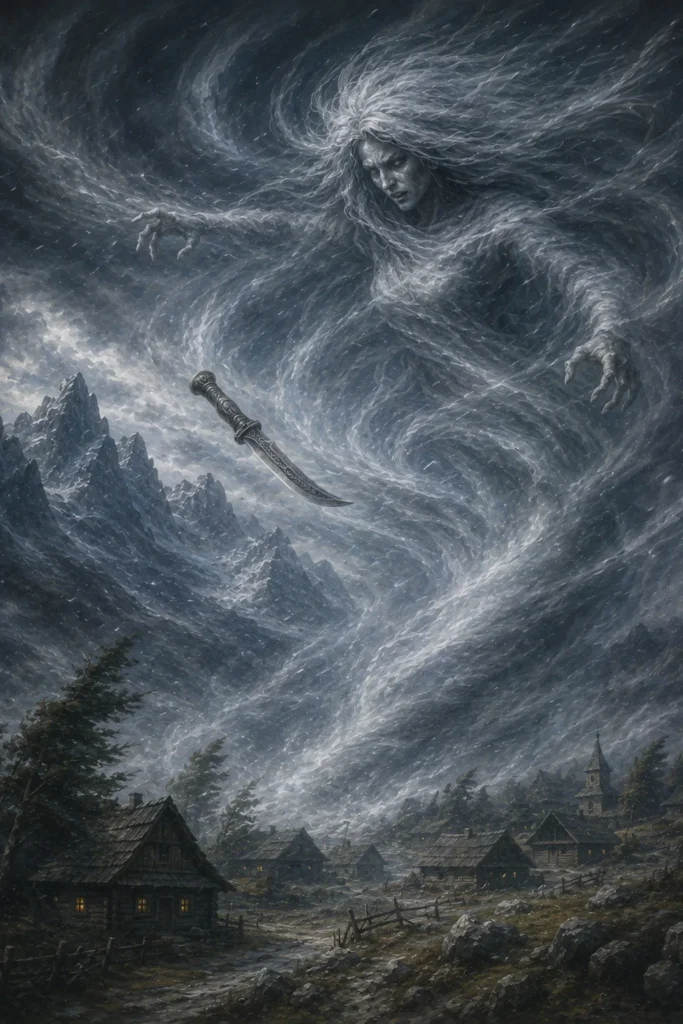
Wietrzyca is a personified evil wind or whirlwind, conceived as female, acting invisibly within the halny; in the wider wind-spirit complex she is also imagined as a dishevelled giant with wings.
Effect
Wietrzyca rides in with the halny storm, steals objects, can rob people of speech and break bones. Generally, the wind is regarded as a bringer of illness, causing erysipelas, eye ailments, gout and bewitchment.
Profile: Wietrzyca
The key aspects of the wind demoness at a glance.
Regional storm-wind demon of Polish folk belief, part of the well-documented wind-spirit complex of the Górale together with Świst and Płanetnik.
Mountain dwellers and hikers: anyone travelling in the halny risks theft, loss of speech, broken bones and illness.
Invisible, personified evil wind or whirlwind, conceived as female; in the wider complex also imagined as a dishevelled giant with wings.
Theft of objects, robbery of speech, broken bones; as a bringer of illness she stands for erysipelas, eye ailments, gout and bewitchment.
Throwing a consecrated knife into the whirlwind; scattering flour or salt into the wind, especially the salt of Saint Agatha; a taboo against spitting into the wind.
Świst and Świstun, the benevolent Płanetnik as a counter-figure, and the South Slavic Ala.
The Windy Woman in the belief of the Górale
The name derives from wiatr, wind, with a feminine suffix, literally the Windy One; a major Polish dictionary explicitly lists wietrznica as a demon. The figure is anchored in ethnography, above all in the belief of the Górale surrounding the föhn storm halny.
The entire wind-spirit complex, which besides the Wietrzyca also includes Świst and the Płanetnik, is well supported by sources. The division of roles is clear: the Wietrzyca is the harmful storm wind, whereas the Płanetnik or Chmurnik is the benevolent cloud-pusher. She is a regional storm-wind demon, not a deity.
Legacy and classification
Wietrzyca is present in Polish bestiaries, in neopaganism, and in fantasy and role-playing games, with a genuine folkloric core.
From a religious-studies perspective, the Wietrzyca is attested folk belief, not an invention, yet also not a deity but a regional storm-wind demon. A common mistake is confusing her with the benevolent Płanetnik; and wietrzyca and wietrznica refer to the same being.
The consecrated knife in the whirlwind
Against the Wietrzyca, a consecrated knife was thrown into the whirlwind; if it struck her, it fell to the ground bloodstained, and the wind subsided. Flour or salt was also scattered into the wind, the salt of Saint Agatha being considered especially effective. A rule of behaviour was added to this: it was taboo to spit into the wind.
Płanetnik, Świst and the Hala
Wietrzyca stands opposed to the benevolent Płanetnik or Chmurnik, the cloud-pusher; related figures are Świst and Świstun. In the Balkans she corresponds to the South Slavic Hala, that is, the Ala. As a harmful storm wind she resembles other wind demons, such as the Hungarian conception of wind-borne illness; among whirlwind figures the Philippine Buhawi is also comparable, and as a storm spirit of water, the Moryana.
Frequently asked questions about the Wietrzyca
What is the Wietrzyca?
A female storm-wind demon of Polish folk belief, connected with the föhn storm halny.
How is she warded off?
By throwing a consecrated knife into the whirlwind, as well as through flour or salt.
Is she a deity?
No. She is a regional wind demon, not a deity.
Further links
Literature (selection)
Further standard works in the bibliography.
As a Polish wind demon and female storm spirit of the Tatra, the Wietrzyca shows how concretely folk belief interpreted the föhn storm: the halny was not merely a weather condition but a rider, against whom one kept a consecrated knife ready.