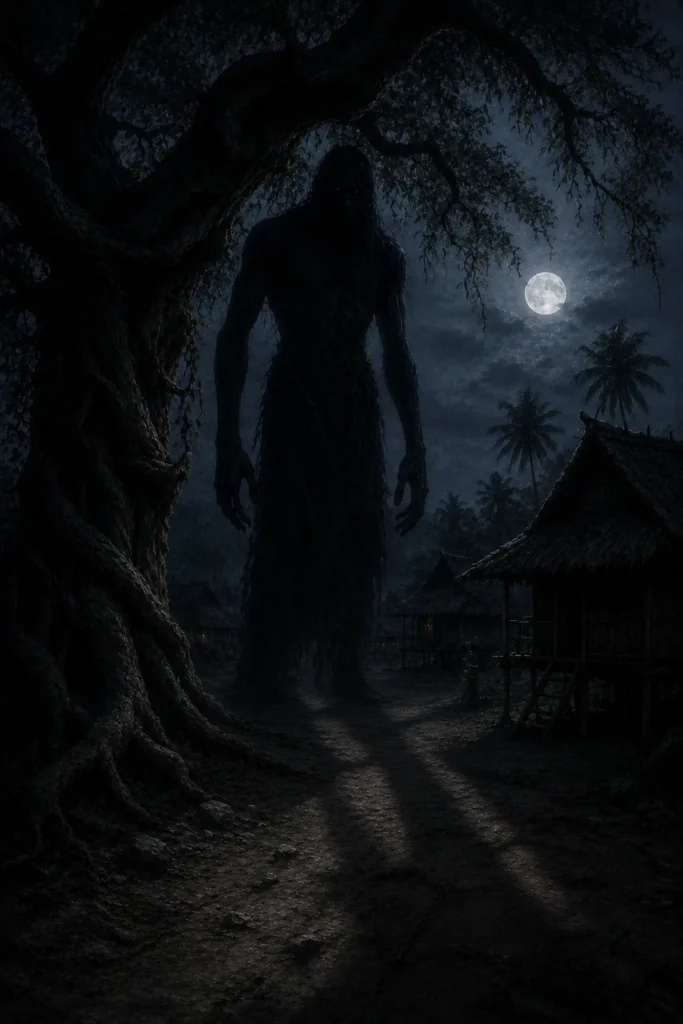
Buhawi, the animated column of wind over the coast
By Ralf Ittermann · last reviewed on
Buhawi is a spirit of Philippine tradition.
The whirlwind that descends as an animated serpent. Buhawi is described as an animated column of wind moving over the coast like a living serpent.
Buhawi is, in Philippine languages, the whirlwind, tornado or waterspout. To classify it honestly: it is primarily a meteorological term, not an attested god’s name.
In folk belief, however, the phenomenon is in many places understood as an animated, serpent- or dragon-like being: a descending something that devastates boats and fields. As an animated natural phenomenon, Buhawi is genuinely destructive and feared, without an appeasing cult.
Type: animated whirlwind, tornado or waterspout
Origin: Tagalog and Visaya region, Philippines
Texts: folk belief and language; historical figure of the 19th century
Period: nature term old, Dios-Buhawi uprising 1887
Appearance: rotating column of wind and water, at times as a serpent

Context of Tradition
Period of the Texts
Folk belief and everyday language carry the word; as a historical figure, the Dios-Buhawi uprising of the 19th century is added.
Area of Diffusion
The Tagalog and Visaya region of the Philippines; those affected are chiefly coastal and field-dwelling people, whose boats and harvests the wind column devastates.
Sources
The nature term is secured, a deity is not documented: Buhawi is primarily a weather word; an early colonial documented wind deity cannot be verified.
Name and variants
Philippine: buhawi means whirlwind, tornado or waterspout in several Philippine languages, with the Tagalog synonym ipo-ipo. It is primarily a meteorological term, not a god’s name.
Appearance and behaviour
Appearance
As a natural phenomenon, Buhawi is the rotating column of wind and water; in folk belief, it at times appears as a descending serpent or dragon. A canonical deity iconography is lacking.
Effect
Buhawi is a destructive whirlwind; in the animated understanding, a descending being that devastates boats and fields.
Profile: Buhawi
The most important aspects of the whirlwind at a glance.
Meteorological term of the Tagalog and Visaya region, in many places interpreted in folk belief as an animated serpent being.
Coastal and field-dwelling people: the rotating column of wind and water overturns boats and devastates the fields.
Rotating column of wind and water, in the animated understanding a serpent or dragon striking down from above; no cult image exists.
Destruction through wind and water; feared as an animated phenomenon, though no appeasing cult exists.
No attested cult deity, no fixed rites; regional apotropaic defensive behaviour exists, but it is local and inconsistent.
The Visayan dragon Bakunawa and the Tagalog Laho; motivically the naga waterspout of Southeast Asia and the whirlwind spirit Yum.
Weather word, serpent interpretation, and a rebel named Dios Buhawi
Buhawi means whirlwind, tornado or waterspout in several Philippine languages, with the Tagalog synonym Ipo-ipo. It is primarily a meteorological term. An early colonial whirlwind deity of this name does not exist; the distinctive dragon-weather figure of the Visayans is the Bakunawa.
Historically well documented, by contrast, is Ponciano Elofre, called Dios Buhawi, whirlwind god: a village leader in Negros Oriental who led a politico-religious uprising and was killed in 1887. The name still lives on today as a cultural figure through this uprising with its anti-colonial and shamanic character.
Afterlife and Classification
As a word, buhawi is everyday, appearing for example in weather reports; as a cultural figure it lives on mainly through the historical Dios Buhawi uprising with its anti-colonial and shamanic character.
From a religious-studies perspective, buhawi is real as an animated phenomenon, destructive and feared, without an appeasing cult. Important clarifications: it is primarily a nature word, not an early colonial wind deity; Dios Buhawi is not a god but the epithet of a 19th-century rebel; and the dragon and serpent association belongs rather to the Bakunawa.
Defence without a cult
There is no attested formal cult deity and no fixed rites against the Buhawi. Regional apotropaic defensive behaviour exists, but it is locally shaped and cannot be documented uniformly; this should be honestly noted. The whirlwind was feared and avoided, not appeased with offerings.
Serpents in the sky: parallels
Buhawi stands alongside the Visayan dragon Bakunawa and the Tagalog Laho, as well as the Austronesian conceptions of the whirlwind as serpent or dragon; motivically it resembles the naga waterspout of Southeast Asia. Comparable on the website are the Arabian whirlwind demon Zauba’ah, the Lakota whirlwind spirit Yum and the Australian Willy-Willy. The monsoon Habagat, by contrast, brings the large-scale rainy season, not the narrow column of wind.
Frequently asked questions about Buhawi
What does Buhawi mean?
Whirlwind, tornado or waterspout; it is primarily a meteorological term.
Is Buhawi a deity?
No. It is a nature word with an animated interpretation; an early colonial wind deity does not exist.
Who was Dios Buhawi?
The epithet of the rebel Ponciano Elofre in the 19th century, not a god.
Further links
Literature (selection)
Further standard works in the bibliography.
As a Philippine whirlwind, Buhawi is first of all a weather word; only folk belief turns it into the waterspout as a serpent striking down from the sky. Between meteorology, folk interpretation and the rebel Dios Buhawi lies the whole range of the name.