Invocation of Demonic Beings
Invocation of demonic entities is a cultic and magical practice for the conjuration, binding, or negotiation with supernatural agents, documented in Sumerian incantation tablets, the Jewish Sepher Razim, and European Golden Dawn grimoires. The practice combines liturgical formulas, symbolic geography, gender management, and psychological induction.
Its functional range of roles extends from healing to harmful magic to mystical gnosis and cosmological insight in occult systems. This takes place through ritual formalities, operative symbols, and psychic techniques across various occult traditions.
Table of Contents
Quick Overview (Definition List)
Type: Magical practice Class: Invocation Distribution: Western magic, grimoire traditions (medieval to modern) Main features: Ritual structure, protective circles, banishing formulas, demon names, assertion of authority Related subcategories: Practices, magic, demonology, conjuration
The invocation of demonic entities follows strict rite rules and protective-circle protocols.
Concept and Distinction
Invocation differs from mere prayer, since it implies compulsion, not petition. It differs from conjuration (a ritual to bring about an appearance) through the intention of control. A priest prays to God; a magician invokes a demon and expects obedience.
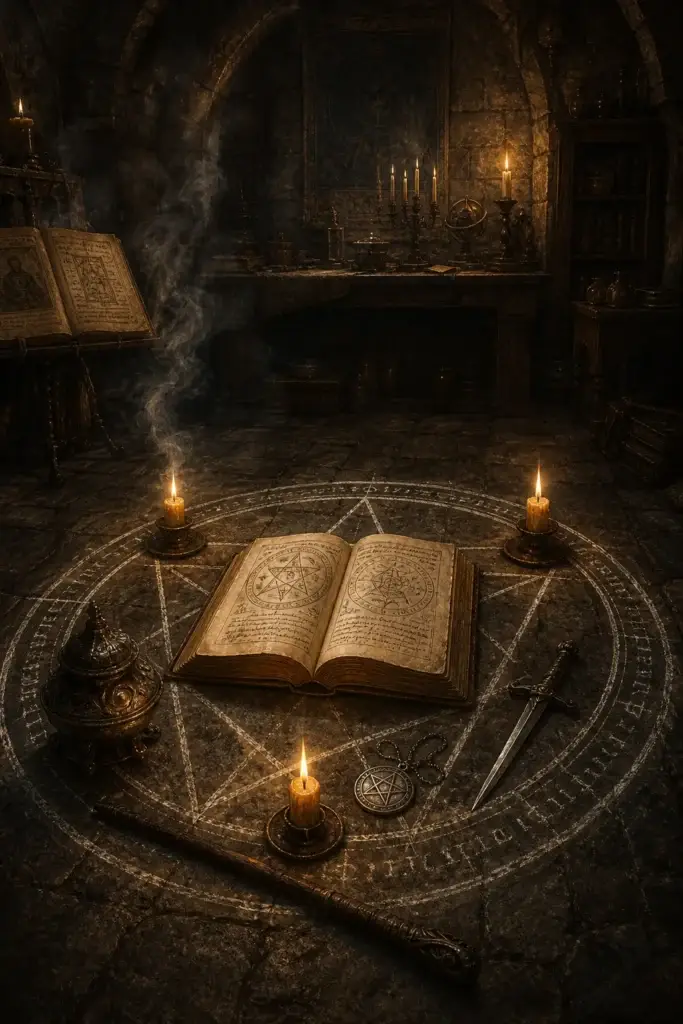
Invocation is also focused specifically on demonic or ambivalent beings; one does not invoke high gods, but rather subordinate entities. The structure is essential: without a protective circle, without a banishing formula, without ritual authority, invocation is dangerous, and the magician risks being controlled by the being summoned.
Ancient Theurgy: Iamblichus and the Art of Invoking the Gods
The Neoplatonic philosopher Iamblichus (ca. 245, 325 AD) is regarded as the founder of systematic theurgy (god-work), which differs fundamentally from magic (demonic influence).
In De mysteriis (On the Mysteries), Iamblichus argues that a prepared theurgist can connect with the gods through prayers, chants, and ritual symbols (sigils, names, sacred geometry) in order to draw nearer to them or to channel magical power.
The gods are not commanded (that would be magic); rather, the human being places themselves in resonance with them. This distinction has shaped all Western esoteric invocation traditions to the present day. The work of Iamblichus shows that invocation is an intellectual and spiritual discipline, not mere magic of the will.
Cultural-Historical Examples
The Lesser Key of Solomon (also Goetia) is the canonical Western invocation grimoire (possibly originating in the 15th/16th century).
Each of the 72 demons has a name, a signature, an hour at which it responds, and a goal (wisdom, wealth, love, destruction). The practitioner draws protective circles, names the demon names in Hebrew or Latin formulas, and demands obedience.
The Picatrix (Arabic 10th c., Latin 12th c.) is an astrological grimoire with invocation practices for planetary spirits and intelligences. The Heptameron (medieval) describes invocations by weekday and hour, with angels and demons.
The Three Books of Occult Philosophy by Agrippa (16th c.) systematizes invocation theology with astrological correlations. In modern practiced magic (Chaos Magic, Golden Dawn, Wicca), invocation practices have been adapted, but the basic structure (protection, name, authority, banishing) remains central.
Jewish Magical Holy-Name Tradition
In Jewish mysticism, especially in the Kabbalah and the Sefer Yetzirah tradition (first millennium AD), invocation is primarily a practice of the Holy Names.
The names of God (Tetragrammaton YHWH, the 72-name tradition Shemhamphorasch) are regarded not as mere words, but as channels of power: whoever pronounces a holy name correctly directs divine energy.
Magical amulet inscriptions, blessings, and means of protection use these names. The Maggid of Mezeritch and other Hasidic masters emphasize that Holy-Name invocation is ineffective or dangerous without inner purification. This tradition emphasizes contemplation and intention over recitation alone.
State of the Sources
Invocation grimoires are documented from the Middle Ages onward. The Goetia is transmitted in several medieval manuscripts and was edited and popularized in the 19th century by S.L. MacGregor Mathers.
Academic research (Owen Davies, Richard Kieckhefer, Nicola Bown) has examined grimoire traditions and their historical contexts. Modern practicing magicians document their own invocation experiences in books and online forums.
Universal Invocation Structure: Preparation, Invocation, Binding
Both ancient theurgy and medieval grimoire traditions share a tripartite structure. The preparation (fasting, purification, drawing the circle, inner alignment with the entity) makes the invoker worthy. The invocation itself (recitation of names, psalms, drawing sigils, incense) draws the attention of the entity.
The binding (prohibition or command, gratitude, closing of the rite) secures the interaction. This three-phase structure is found in Egyptian temple hymns, rabbinic conjuration texts, Christian-Orthodox magical practices, and modern Wicca. It appears to be not a cultural artifact, but a psychological pattern: preparation creates attention, invocation structures communication, binding grounds the experience.
Present-Day Significance / Related Beings
Further standard works in the literature index.
iWell Guard and Protective Traditions
Across all documented cultures, protective objects can be found that people wore on their bodies, from Pazuzu amulets in Mesopotamia, to the Hamsa in the Mediterranean region, to the Mezuzah on Jewish doorposts, and to Christian protective medals. iWell Guard takes up this tradition in a contemporary material architecture, manufactured in Germany, 41 layers, genuine gold, platinum, silver. 30-day right of return.
Personal experiences may vary. Not a medical device. No promise of healing.