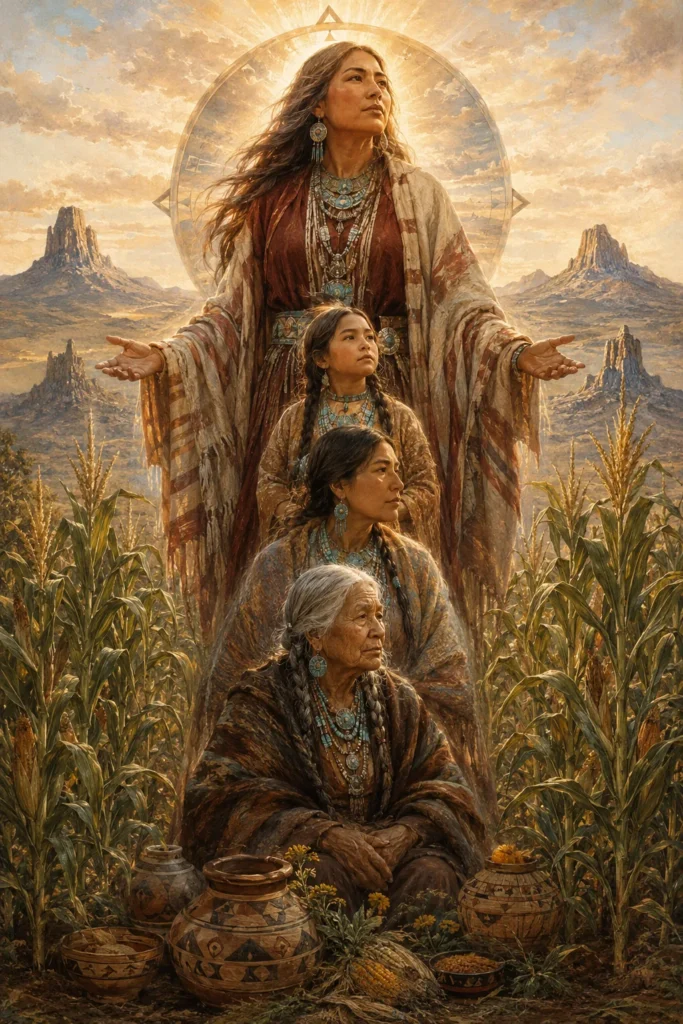
The religious traditions of the Indigenous peoples of North America are as varied as the languages and cultures themselves: Lakota on the Plains, Hopi and Pueblo in the Southwest, Navajo (Diné) as the largest tribal nation, Inuit in the far North, Cherokee in the Southeast, Haida and Tlingit on the Northwest Coast.
Despite their diversity, many traditions share references to the Great Spirit, to animal spirit guides, to the sacred landscape and to portable objects of protection.
The Indigenous religions of North America and their protective traditions are the focus of this overview.
The First Nations have no single shared pantheon; each of the many Nations hands down its own gods and spirits.
Anthropology traditionally divides Indigenous North America into culture areas: Arctic (Inuit, Yupik), Subarctic (Dene), Northwest Coast (Haida, Tlingit, Kwakwaka’wakw), Plateau (Nez Perce), Plains (Lakota, Cheyenne, Crow, Blackfoot), Eastern Woodlands (Iroquois, Cherokee, Algonquian), Southwest (Hopi, Pueblo, Navajo, Apache), Great Basin (Shoshone, Ute), California (Pomo, Chumash).
Each area has its own religious emphases, ranging from shamanic practices and plant medicine to clan-structured cosmology.
The Lakota (one of the three main languages of the Sioux) venerate Wakan Tanka, the “Great Spirit” or, more accurately, “great sacredness”, a pervading principle that appears in many aspects. The Sun Dance is the most important annual ring ritual, combining dance, fasting and physical trial.
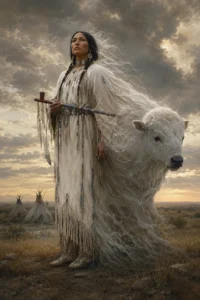
The Vision Quest (Hanblecha), four days of fasting alone in the wilderness, marks life transitions and personal spirit encounter. An important ceremonial pipe: the Chanunpa (sacred pipe), brought by the White Buffalo Calf Woman.
Among the Hopi and the Pueblos of the Southwest, Kachina spirits organise religious life. Kachinas are intermediaries between the world of the gods and the world of humans, embodied in annual dance cycles by masked dancers.
Among the Hopi there are over 300 Kachina figures, each with its own function (rain, fertility, healing of the sick, instruction of the young). Carved Kachina dolls of cottonwood serve religious education. The Pueblo tradition knows the kiva as a space of assembly and initiation.
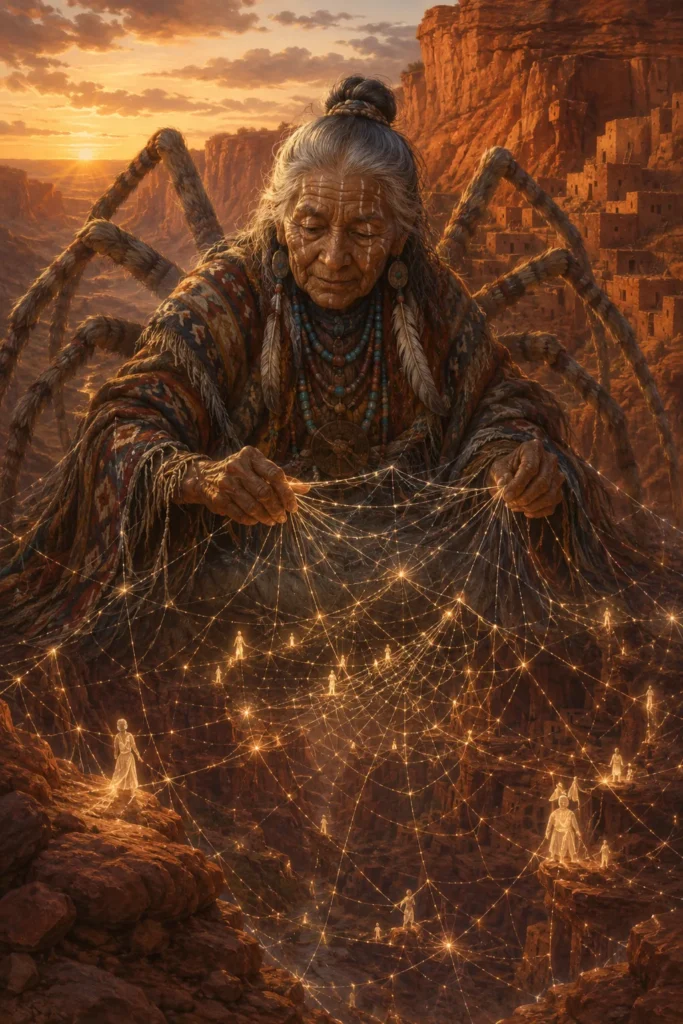
The Navajo call themselves Diné (“the People”). At the centre of their religion stands Hózhó: beauty, harmony, balance. The creation myths tell of an emergence from four underworlds into the present world.
Healing rituals (chants, ways) such as the Blessingway, Enemyway and Nightway are complex ceremonies lasting several days, with sandpaintings (Iikááh), songs and prayers. Sandpaintings are destroyed after use; they are not made for eternity but for the act of healing.
Medicine bundles (medicine bundle / pouch), leather pouches holding personally acquired sacred objects, are central to many Plains and Woodland traditions. Dreamcatchers (originally an Ojibwe tradition) hang above sleeping places and filter dreams through their spider-web pattern.
Eagle feathers count as the most sacred portable objects; their bestowal requires permission and a deed. Turquoise is the central protective stone of the Southwest (Navajo, Pueblo, Hopi jewellery tradition). Animal-spirit fetishes of stone (Zuni) are used in medicine-bundle practice.
There is no single Native American religion; over 500 First Nation tribes of North America each have their own religions. Plains peoples (Lakota, Cheyenne, Crow) centre on Wakan Tanka.
Algonquian language families (Cree, Ojibwe) on Manitou. Pueblo peoples (Hopi, Zuni) on Kachina spirits. The Coyote trickster is widespread across the western Americas. In total there are hundreds of distinct deities and spirits.
Wakan Tanka (Lakota: Great Mystery) is the highest sacred power of the Lakota Sioux. Unlike the Christian God, Wakan Tanka is not a person but an all-pervading reality with seven aspects. The encounter with the White Buffalo Calf Woman is the founding myth of the sacred pipe (Chanunpa) and the seven Lakota rites.
The Sun Dance (Lakota: Wi Wanyang Wachipi) is the most important ritual of the Plains peoples, a four-day ceremony at the summer solstice.
Dancers abstain from food and drink, and some are joined to the Sun Dance tree by wooden skewers through the flesh of the chest and by thongs. The ritual was banned by the US government in 1881 and became legal again in 1978 with the American Indian Religious Freedom Act.
Coyote is the trickster spirit of many western North American peoples (Navajo, Apache, Klamath, Maidu and others), creator and rogue at once. He brings humans fire and maize plants, but is also a seducer and a liar.
His stories often contain erotic and obscene elements, unlike the Christianised Native American tales told for children. In the study of religion, Coyote is the prototypical trickster, related to the West African spider Anansi and the Norse Loki.
The Sweat Lodge (Inipi in Lakota) is a pan-Native American purification practice: a low dome tent of willow with hot stones and water, four rounds with prayers, healing songs and reflection.
The Pipe Ceremony sanctifies gatherings and treaties. The Native American Church (founded in 1918) uses peyote (Lophophora williamsii) as a sacramental plant medicine and is today a large organisation with its own theology.
About 5.6 million Native Americans live in the United States today, with roughly a further 2 million in Canada. Religious freedom was only fundamentally granted by the American Indian Religious Freedom Act of 1978; until then many practices were prohibited.
Standard works in the study of religion: Åke Hultkrantz, The Religions of the American Indians, Sam Gill, Joel Martin, Vine Deloria Jr. (Indigenous perspective).
To speak of the religion of Native Americans is a simplification that scholarship has long regarded as problematic. In North America there existed, and still exist, hundreds of distinct nations with their own languages, social forms and religious ideas. There is no single Indigenous religion, just as there is no single European religion.
To order this diversity, ethnology uses the concept of culture areas, that is, larger regions with similar environmental conditions and cultural traits.
A common distinction is made roughly between the Northwest Coast, the Californian area, the Plateau, the Great Plains, the Subarctic, the Arctic, the Southwest, the Southeast and the Northeastern Woodlands. This classification is an aid, not an Indigenous self-description.
Even within a single area there are great differences. In the Southwest, for example, the settled Pueblo communities of the Hopi and Zuni, with their kiva rites and masked dancers, differ markedly from the Diné, that is, the Navajo, whose healing ceremonies and sandpaintings follow a logic of their own.
On the Northwest Coast, salmon fishing, potlatch feasts and a complex system of crests and rank shaped religion, whereas on the Great Plains it was bison hunting, the vision quest and ceremonies such as the Sun Dance.
A serious account must therefore always ask which nation, which region and which period is being spoken of. Sweeping statements about Native American spirituality miss their subject. Related topics are treated on the individual being pages of this cultural area.

Despite all the diversity, a few patterns of belief can be named that occur in many, though not all, North American traditions.
Widespread is the assumption that not only humans but also animals, plants, places and natural forces can be persons with a will of their own. Scholarship speaks here of a relational or personal ontology, in which the boundary between human and non-human is permeable.
Often there is the idea of an all-pervading power or mystery, named differently in different traditions. Such terms are difficult to translate, and older renderings as Great Spirit often distort more than they explain. The terms each belong within their linguistic and cultural context.
Also widespread is the figure of the trickster, an ambiguous being who is at once culture bringer and troublemaker and who appears, depending on the region, as coyote, raven, spider or mink. Trickster narratives explain the origin of world and order, yet at the same time break norms and reveal their limits.
Equally common is the vision quest, a striving for a formative encounter with a protecting power, usually accompanied by fasting and seclusion.
Healing and purification rituals also play a major role, such as the sweat lodge, as do calendrically fixed communal feasts. It remains important that each of these patterns has its own form, its own rules and its own meanings in every nation.
The North American traditions were handed down orally. Written sources therefore almost always come from outsiders: from missionaries, travellers, administrative officials and, later, ethnologists. Each of these sources carries within it the view and the interest of its author, which makes source criticism a basic condition of any engagement with the subject.
An important but ambivalent role was played by American ethnology around Franz Boas and his students in the late 19th and early 20th centuries.
They collected narratives, songs and ritual descriptions on a large scale, often in the belief that they were documenting a vanishing world. Research owes extensive material to this approach, yet it also arose from the mistaken notion of the vanishing Indian.
Problematic, too, is the fact that many records were made without the consent of the communities and in part preserved knowledge that was properly reserved for initiates.
Today’s Indigenous scholars and communities therefore demand a say in what may be researched, published and exhibited. Laws such as the North American treatment of grave finds and ritual objects have brought changes here.
In addition there is a popular history of appropriation. Since the 19th century, Indigenous ideas have been romanticised, worked into esotericism and mixed with invented elements, for example in the widespread but late and partly non-Indigenous construction of power animals.
The study of religion therefore carefully distinguishes between the historical and present-day traditions of individual nations and what has been made of them in the West.
The religious history of Indigenous North America since colonisation is marked by massive pressure. Loss of land, displacement, epidemics and deliberate policy struck at the religious foundations of many nations.
In the United States and Canada, Indigenous children were placed for generations in boarding schools where languages and ceremonies were forbidden. Certain rituals were at times legally prohibited.
Under this pressure, new religious movements also arose. In the 19th century the Ghost Dance spread, a prophetic movement that hoped for a renewal of the world and the return of the dead, and whose suppression in 1890 led to the massacre at Wounded Knee.
Around the same time the Native American Church arose, combining the ritual use of the peyote cactus with Christian elements and today a recognised, transregional religious community.
Only in the later 20th century did the legal situation improve. In the United States, the American Indian Religious Freedom Act of 1978 expressly placed the free exercise of religion under protection, even though its practical enforcement, for instance regarding access to sacred sites, remains contested.
Since the 1970s a broad revitalisation has been under way. Nations run language programmes, take up ceremonies again and demand the return of sacred objects and ancestral remains from museums.
At the same time, many communities sharply distance themselves from the commercial appropriation of their religion by outsiders. An appropriate account therefore shows Indigenous religion in North America as a living present, borne by self-determined nations, and not as a historical chapter.


Related key terms: Lakota Hopi Navajo Diné Cherokee Haida Tlingit Inuit Manitou Wakan Tanka Sun Dance Vision Quest Medicine Bundle Dreamcatcher Kachina.
Indigenous traditions of North America, Lakota, Hopi, Navajo and many others, know medicine bundles, dreamcatchers, eagle feathers and animal-spirit fetishes of stone as portable objects of protection; the turquoise jewellery of the Southwestern Pueblos is highly prized.
iWell Guard takes its place in this cultural-historical line of portable objects of protection, in a contemporary architecture of materials, made in Germany. 41 layers, fine gold, platinum, silver. 30-day right of return.
Personal experiences may vary. Not a medical device. No promise of healing.
The lexicon of protective symbols treats several signs and objects from the Indigenous cultures of North America on their own pages: dreamcatcher. A cross-cultural overview is offered by the page on protective symbols.