Wakan Tanka (Lakota: Wakan Thanka, Great Sacred Power) is, in the religious understanding of the Lakota and the broader Sioux language family, the highest, all-encompassing numinous reality. It is less a personified deity in the Western sense than an all-pervading sacred power.
Wakan Tanka stands at the center of the religious worldview of the Lakota, Dakota, and Nakota, the three main branches of the Sioux language family.
Unlike the monotheistic God of the Abrahamic religions, Wakan Tanka is not a clearly personified supreme being with its own will, biography, and voice, but rather the all-pervading sacred power (wakan) that is present in all living and non-living things.
The Lakota theologian Black Elk addressed Wakan Tanka in his recorded speeches, especially in the work compiled by John Neihardt, Black Elk Speaks (1932), as Wakan Tanka unsi unkila (the Great Holy One who has compassion on us).
The contemporary Lakota scholar of religion Vine Deloria Jr. showed in God Is Red (1973) that the simple translation of Wakan Tanka as Great Spirit, which has been common in popular literature since the 19th century, misses the genuine meaning.
Structurally, Wakan Tanka belongs to the class of pan-religious omnipotent supreme beings, but is strongly shaped by the Lakota understanding of the sacred power wakan.
The Lakota recognize a wide variety of wakan beings (comparable to the Apu mountain lords of the Andean Inca): the Four Directions, the Thunder Beings (see Thunderbird), the spirits of animals, the ancestral spirits. All are wakan, all are part of the one encompassing sacred power.
Compared to Western monotheistic theology, one important aspect of the Lakota conception is the absence of a clear gender assignment. Wakan Tanka is neither male nor female; the personified wakan aspects instead fall into male, female, and androgynous beings.
This gender neutrality of the highest reality represents a genuine difference from the Jewish-Christian-Islamic tradition with its male God-the-Father image, and has received repeated attention in comparative religious studies.
The Lakota term wakan is one of the central religio-philosophical terms of the Sioux tradition. It literally means sacred, mysterious, or not-fully-comprehensible and is used across the entire spectrum of what we would call numinous.
The Lakota linguist Stephen Riggs compiled a remarkable list of wakan applications in his Lakota-English dictionary (1852), ranging from a woman in childbirth to a lightning strike, from the healer’s tobacco pouch to the death of a beloved horse.
The addition thanka or tanka means great in the sense of encompassing, all-containing. Thus Wakan Thanka is the encompassing, all-containing sacred power.
In Lakota theological texts a distinction is made between wakan kin (the sacred in general) and Wakan Thanka (the one encompassing sacred), where the difference is not numerical (one versus many) but qualitative (part versus whole).
An important theological distinction was made by the Lakota healer Sword (Sword’s Account) in the 1890s in conversations with the anthropologist James Walker: he spoke of sixteen different wakan aspects that together form the unity of Wakan Tanka. This list is systematically documented in James Walker’s work, Lakota Belief and Ritual (1980, published posthumously).
The theological structure of Wakan Tanka is, according to the Lakota healers documented by James Walker (Sword, Finger, Bad Wound, No Flesh), considerably more complex than the simple Great Spirit conception found in popular literature. Lakota theology distinguishes sixteen wakan aspects, arranged hierarchically in four groups of four aspects each.
The uppermost four (Wakan akantu) comprise: Wi (the Sun), Skan (the Moving One, cosmic energy), Maka (the Earth), and Inyan (the Stone, the primordial material). The second group (Wakan kolaya) comprises the associated companion aspects: the Moon (Hanwi), the Wind (Tate), Beauty (Wohpe), and the Thunder Bird (Wakinyan).
The third group (Wakan kuya) consists of the subordinate aspects: the Buffalo Spirit (Tatanka), the Bear Spirit (Hununpa), the Four Winds Spirit (Tate), and the Whirlwind Spirit (Yumni).
The fourth group (Wakan lakolapi) consists of the helpful spirits: the Spirit (Niya), the Shadow (Nagi), the Breath of Life (Naula), and the Sister Spirit (Sicun).
This sixteenfold aspect structure is a genuine theological construction that does not correspond to the superficial assumption of a uniformly monotheistic Lakota religion. Vine Deloria Jr. and the Lakota scholar of religion Joseph Epes Brown have repeatedly emphasized the importance of this structural complexity in their works.
The Sword-Walker texts are methodologically complex to evaluate. James Walker was a reservation physician at Pine Ridge between 1896 and 1914 and during this time conducted extensive conversations with the last Lakota healers of the pre-reservation generation.
The records are one of the most important primary sources, but they are partially distorted by Walker’s own theological background (he was a physician with a Western educational background) and by translation difficulties. More recent research, in particular by Raymond DeMallie and Vine Deloria Jr., has systematically discussed these methodological problems.
The mythological tradition surrounding Wakan Tanka is, compared to many other religious traditions, noticeably sparse in personified narratives.
This is because Wakan Tanka itself is not an acting figure but the background reality in which the acting figures appear. The mythological wealth of the Lakota tradition therefore concerns the individual wakan aspects more than Wakan Tanka itself.
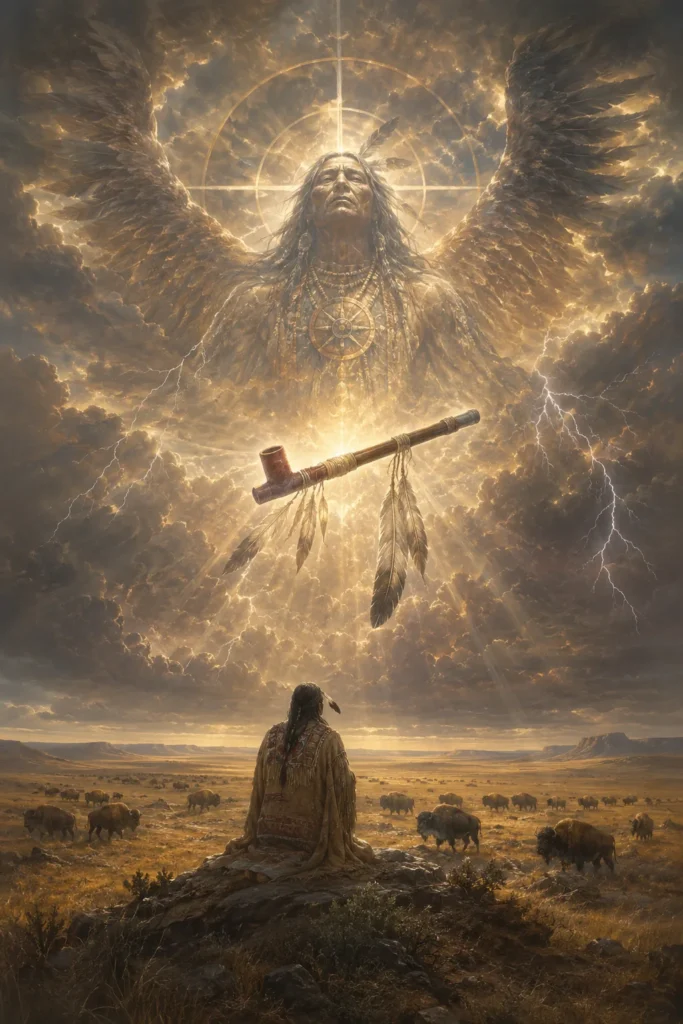
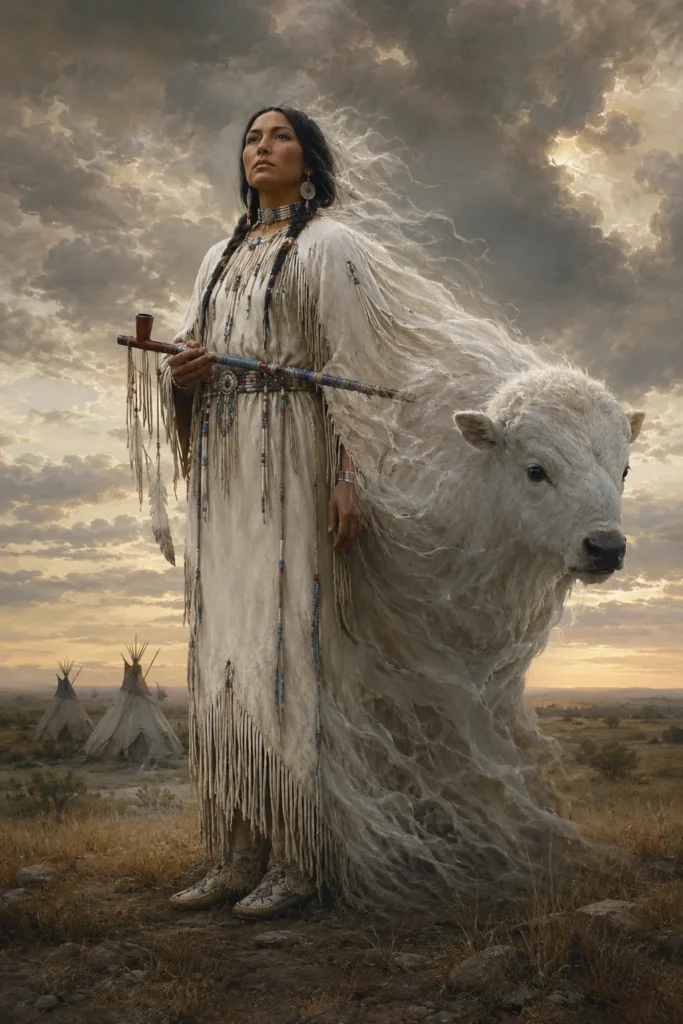
A central mythological constellation is the appearance of the White Buffalo Calf Woman, who, on behalf of Wakan Tanka, brought the seven sacred rites (see below) and the sacred pipe chanunpa into the Lakota tradition.
This narrative, transmitted especially through Black Elk, is the central founding story of the Lakota religion and is retold in almost every Sweat Lodge and Vision Quest ceremony.
A second narrative constellation encompasses the cosmogonic myths surrounding the tunkasila grandfathers (see Tunkasila) and the uncegila water serpent. These myths are preserved in texts recorded by George Bushotter in the late 19th century and were systematically described by the anthropologist James Howard in The Dakota or Sioux Indians (1980).
The Lakota tradition recognizes seven great sacred rites (Owanka wakan), all performed in relation to Wakan Tanka and attributed to the White Buffalo Calf Woman. They are systematically described in the work of Black Elk and Joseph Epes Brown, The Sacred Pipe (1953).
The seven rites comprise: first, the Inipi, the purification sweat lodge, which serves as the ritual preparation for every other rite; second, the Hanblechiyapi, the Vision Quest, in which a young person or adult goes alone into the mountains or onto a hill for several days and nights without food or water, seeking to receive a vision; third, the Wanagi Yuhapi, the Keeping of the Soul (a mourning rite); fourth, the Hunkapi, the Making of Relatives (adoption); fifth, the Ishna Ta Awi Cha Lowan, the puberty initiation of young women; sixth, the Tapa Wankayeyapi, the Throwing of the Ball (a playful representation of cosmic distribution); seventh, the Wiwanyag Wachipi, the Sun Dance.
The latter, the Sun Dance, is the most spectacular and religiously intense Lakota practice. In it, practitioners dance for several days without food or water in a circle around a sacred tree, some of them with bone skewers pierced through the pectoral muscles and attached to the tree with leather thongs.
The dance ends when the skewers tear through the pectoral muscles and the practitioner is pulled free from the connection to the tree. This physical experience is understood as the highest sacrifice to Wakan Tanka and as a gateway to vision.
The seven sacred rites are practiced with varying frequency in modern reservation communities.
The Inipi (sweat lodge) is performed regularly in almost every reservation household; the Hanblechiyapi (Vision Quest) takes place at initiations and in particular life situations; the Wiwanyag Wachipi (Sun Dance) is held annually at the larger reservation gatherings and ranks among the most important collective religious events of the Sioux peoples.
The remaining rites have in some cases become less common, but are being actively revived by a growing movement of indigenous religious renewal.
The Lakota tradition does not practice direct invocation of Wakan Tanka in acute situations of need, because Wakan Tanka as the all-encompassing reality is too general to be directly responsible in individual life circumstances. Protective veneration is directed more toward the individual wakan aspects: the Four Winds, the Buffalo Spirit, the Thunder Bird.
Concrete protective practices include carrying a medicine pouch (chanli) with special stones, feathers, roots, and personal medicine objects; the invocation of the Four Winds in the four cardinal directions at every ritual occasion; purification smudging with buffalo sage (cedar) or sweetgrass; and the ritual use of the sacred pipe chanunpa.
Pipe smoking is not a burning of tobacco but a cosmological act: the tobacco (kinnikinnick) is connected in the pipe with the Four Winds, with earth and sky, and with the ancestors; the act of pipe smoking itself becomes a form of wakan prayer.
In the apotropaic tradition, Lakota shields play a special role. Warriors bore paintings on their shields that had been received in a vision and were connected with the wakan power of a particular animal or being.
These shield paintings were not merely aesthetic decorations but effective ritual objects of protection. Joseph Epes Brown described the Lakota shield tradition systematically in The Spiritual Legacy of the American Indian (1982).
Wakan Tanka has frequently been cited in comparative religious studies literature as an American example of a pan-spiritualist supreme being theology. Structurally comparable concepts include the Polynesian mana, the Melanesian mana, the Chinese qi, the Indian brahman, and the West African nyama or nyam.
Wakan Tanka is not pantheism in the strict sense: the Lakota distinguish between the individual wakan aspects and Wakan Tanka itself, without these being identical to one another.
The scholar of religion Aase Hultkrantz systematically described this distinction in Belief and Worship in Native North America (1981) and showed that Lakota theology corresponds neither to strict monotheism nor to classical pantheism, but to an independent panentheistic theology.
Within North American Native traditions, Wakan Tanka shows close parallels to the Algonquian Manitou, the Cheyenne Maheo, the Apache Yusen, the Navajo Creator, and the Pueblo Creator. In all these cases the concepts are supreme being concepts grounded in an all-pervading sacred power.
A noteworthy religio-historical observation concerns the continuity of Lakota theology within the broader Sioux diaspora. The Mdewakanton Dakota in Minnesota, the Yankton Sioux in South Dakota, and the Assiniboine in Montana and Saskatchewan have each developed their own Wakan Tanka traditions that differ in details but share the structural main line of Lakota theology.
This pan-Sioux continuity has been systematically described by the anthropologist Raymond DeMallie in his extensive Sioux studies.
Since the forced Christianization of reservation-dwelling Native Americans in the 19th century and especially after the violent suppression of the Sun Dance (banned 1881, then 1934) by the US government, the Lakota religion has been in a complex phase of renaissance.
Since the re-authorization of the Sun Dance in 1934 and the broader recognition of indigenous religions through the American Indian Religious Freedom Act (1978), the Lakota religion has experienced a substantial revival.
In academic discourse, engagement with Wakan Tanka has played an important role in the deconstruction of missionary religious descriptions.
Vine Deloria Jr. (God Is Red, 1973; The World We Used to Live In, 2006), George Tinker (American Indian Liberation, 2008), and the Lakota theologian Charles Eastman (The Soul of the Indian, 1911) have defended authentic Lakota theology against Christian-missionary reductions.
From the perspective of religious studies, Wakan Tanka is an important example of how the simple typological classification of indigenous religions (animism, polytheism, monotheism) usually fails to capture the theological richness of the respective tradition.
The genuine Lakota theology is neither animism nor pantheism, but an independent philosophical-religious construction that deserves its place in comparative history of religions. The iWell Guard reference to the Lakota tradition is explicitly observational in nature, with no claims of efficacy.
In the 21st century, Lakota theology has also entered into interreligious dialogue. Lakota spiritual leaders such as Arvol Looking Horse, the current 19th-generation keeper of the sacred White Buffalo Calf Pipe, represent the Lakota tradition at UN assemblies, world religion gatherings, and ecumenical conferences.
These international appearances have contributed to growing global awareness of the Lakota religion, but have also fostered problematic tendencies of spiritual appropriation by Western New Age groups, against which the Lakota Elder Council has repeatedly issued official protests since 1993.

The following selection lists key works on Lakota religion and Native American research that are central to understanding Wakan Tanka.
The expression Wakan Tanka comes from the languages of the Lakota, Dakota, and Nakota and has most often been rendered in English-language literature as Great Spirit or Great Mystery. Both translations are problematic.
Wakan designates a quality of the sacred, the mysterious, or of that which is filled with special power, and tanka means great. The combination cannot be translated into a single divine name without loss.
Early missionary and ethnographic literature tended to understand Wakan Tanka as the name of a single supreme god corresponding to the Christian God. This reading was reinforced by the translation work of missionaries who needed a term for the Christian God.
Twentieth-century research corrected this picture. The ethnographer James R. Walker, who worked with Lakota religious specialists at the Pine Ridge Reservation in the early 20th century, recorded a considerably more complex picture.
According to Walker’s records, compiled together with Lakota informants such as George Sword, Wakan Tanka is not a single being but a collective term for a plurality of sacred powers and beings that can at the same time be conceived as a unity.
Walker’s material speaks of various aspects or classes of the sacred that in their totality constitute Wakan Tanka.
Research continues to discuss how far Walker’s systematic presentation accurately reflects the views of his informants and how far it imposes an order on the material that was not consistently present. What can be established is that a simple equation with a monotheistic God does not do justice to the sources.
The records concerning Wakan Tanka were produced predominantly during a period of massive pressure on the Lakota religion. Following defeat and confinement to reservations, the US government banned central ceremonies from the 1880s onward, including the Sun Dance.
Religious practice took place partly in secrecy. James R. Walker’s collection activity fell precisely in this phase, which means his informants passed on their knowledge under conditions of persecution.
This circumstance shapes the source situation. Some religious specialists deliberately passed on their knowledge because they feared it might otherwise be lost. Other content was withheld.
Research must therefore reckon with the fact that the transmitted accounts contain both gaps and deliberate selection. Added to this is the influence of Christianity, which many Lakota adopted over the course of the 20th century, sometimes alongside the older tradition.
Since the 1970s, in the wake of the American Indian Movement and broader indigenous civil rights movements, a clear resurgence of Lakota religion has been observed. The Sun Dance is again performed publicly, and concepts such as Wakan Tanka are established elements of religious discourse.
At the same time, there are debates within Lakota communities about how tradition should be transmitted and who is authorized to do so, as well as criticism of the appropriation of these concepts by non-indigenous esoteric movements.
For the religious studies presentation, this means that Wakan Tanka is not a closed historical topic but a living and at times contested point of reference for contemporary Lakota identity.
Related key terms: Wakan Tanka Lakota Sioux Sweat Lodge Sun Dance Black Elk Vision Quest Chanunpa.
iWell Guard draws on the cultural-historical tradition of portable protective objects, in the tradition of Native American and many other cultures worldwide. 41 levels, solid gold, platinum, silver, crafted in Germany. 30-day return policy.
Personal experiences may vary. Not a medical device. No health claims.