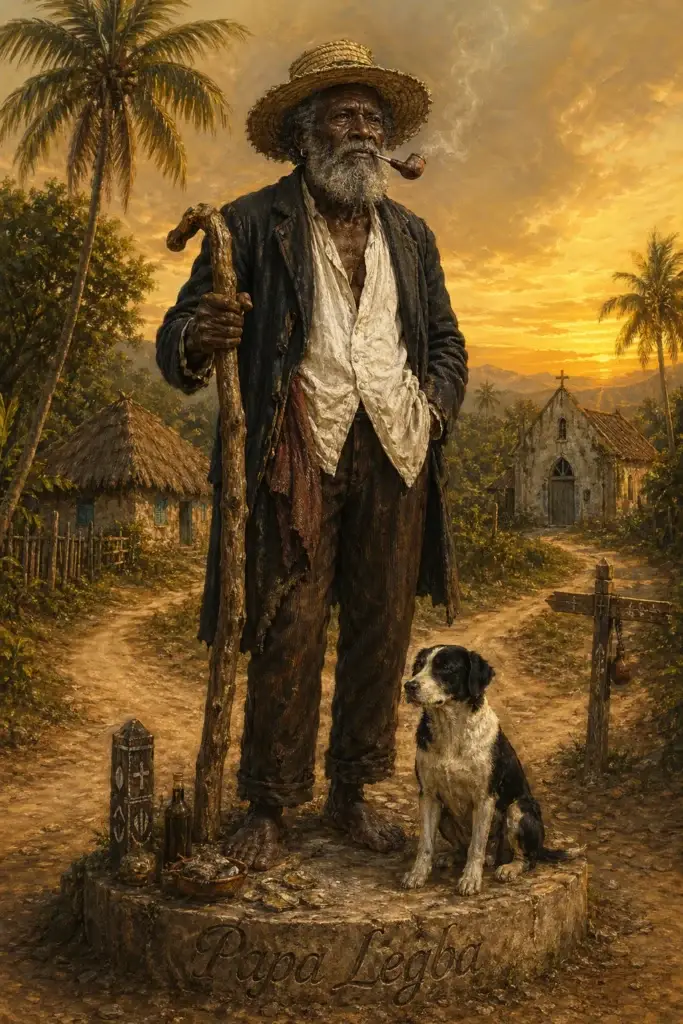
The violent deportation of West African populations into the Caribbean plantation economy gave rise to syncretic religions that fused Yoruba, Fon and Bantu traditions with Catholic veneration of saints. Vodou in Haiti, Santería in Cuba and Candomblé in Brazil are today living religious systems with their own liturgical languages, priestly hierarchies and pantheons.
This overview focuses on the protective practice of the African-Caribbean traditions.
The theological substrates derive from several West African cultures: Yoruba (present-day Nigeria, Benin), Fon (Benin), Ewe (Togo, Ghana), Kongo (Central Africa). Through the transatlantic slave trade between the 16th and 19th centuries, millions of people were deported to Haiti, Cuba, Brazil, Trinidad, Louisiana and further regions of the Americas.
Their religious conceptions adapted to the new conditions and took up elements of the Catholic mission, partly as camouflage in situations of persecution, partly as a religious value in their own right.
In Haitian Vodou the lwa stand as mediators between the remote Bondye and human beings. Important lwa: Papa Legba as guardian of the ways and the first invoked, Erzulie Freda as spirit of love, Baron Samedi as ruler of the cemeteries, Ogou as spirit of war and the forge.
The ritual structure, with a priestly hierarchy of houngan (male) and mambo (female), grades of initiation, and distinct dance and drum rhythms for each lwa, is highly formalized.
Santería (also called Regla de Ocha or Lucumí) is the Cuban form of the Yoruba religion. Here the gods are called orisha: Ogun (smith, war), Yemoja (mother of the seas), Shango (thunder), Oshun (love, fresh water), Obatala (creator).
Each orisha has its own colors, numbers, animals, plants, taboos and a Catholic counterpart. Initiation into an orisha household (ile) is a long process; Ifa priests (babalawo) read with cowrie shells or the Opele oracle.
In Brazil, Candomblé arose from several African nations, Ketu (Yoruba), Jeje (Fon), Angola (Bantu). The orixás are venerated in terreiros, led by mães and pais de santo.
Related traditions: Umbanda (syncretism with Spiritism), Xangô in Recife, Tambor de Mina in São Luís. In Trinidad an Orisha tradition exists with its own character, in Louisiana the Voodoo tradition with a strong Hoodoo magic element.
The protective-magical practice uses gris-gris bags (of African origin, popularized in Louisiana Vodou), cloth bags with prepared contents such as roots, stones, bones and hair. Wanga sachets in Haitian Vodou are prepared for a specific direction of effect.
Mojo hand pendants are central to the Hoodoo tradition. Pakets in Vodou are complexly prepared bundles for specific lwa. These objects are not jewelry but agentive ritual objects whose direction of effect is defined by their preparation and consecration.
The Catholic mission in the Caribbean led to correspondences between African spirits and Catholic saints: Papa Legba with Saint Peter, Erzulie with the Mater Dolorosa, Ogun/Ogou with Saint George, Shango with Saint Barbara.
This double identity initially served as camouflage in situations of persecution and has today become a religious value in its own right. In religious studies it is a prime example of syncretism.
Important works: Maya Deren, Divine Horsemen (1953), Karen McCarthy Brown, Mama Lola (1991), William Bascom, Ifa Divination. In Germany: Bettina Schmidt, Heike Drotbohm. The tradition is primarily oral; written sources arose mainly through ethnographic observation in the 20th century.
The term African-Caribbean religions brings together a range of distinct traditions that scholarship carefully distinguishes. Haitian Vodou arose above all from the religions of the Fon and Ewe of present-day Benin and Togo as well as from Kongo traditions, overlaid by Catholic elements.
Its central beings are the lwa, ordered into families such as Rada and Petwo. More on this in the Vodou hub.
The Cuban Regla de Ocha, in common usage often called Santería, derives predominantly from the Yoruba of West Africa. Its deities, the orisha, were in the colonial period partly associated with Catholic saints.
Alongside this, Cuba also has the Kongo-derived tradition Palo Monte with its own quite distinct logic, which must not be confused with orisha veneration.
In Brazil, Candomblé developed with several subgroups, the so-called nações: Ketu with a Yoruba background, Jeje with a Fon-Ewe background and Angola with a Bantu background.
In the 20th century Umbanda joined them, a younger synthesis of Candomblé, Spiritism and Catholic elements. On the Anglophone islands further forms exist, such as Obeah and the Trinidadian Orisha cult.
These traditions share some basic features, such as trance possession, drum music, grades of initiation and animal sacrifice, but differ considerably in pantheon, ritual language and organization. Older literature spoke indiscriminately of African cults and underestimated this diversity.
More recent works, such as those of J. Lorand Matory on Candomblé, emphasize that the traditions are not mere remnants but have continually developed further in the Atlantic exchange.
Despite all regional differences, many African-Caribbean religions share a three-tiered worldview: a highest, distant creator being, a host of mediating deities and the world of the ancestors.
The creator being, called Olodumare in the Yoruba-derived traditions, is regarded as the origin of everything but rarely intervenes directly in everyday life. Religious practice is therefore directed at the more accessible mediating beings.
These mediators, whether orisha, lwa or vodun, are not abstract principles but personalities with preferences, colors, foods, rhythms and taboos. They embody at once natural forces and social domains, such as war, healing, fertility or justice.
The relationship between human being and deity is reciprocal: the human being nourishes the deity through sacrifice and attention, while the deity protects and guides in return.
The human being is often conceived as a multi-part being. In Yoruba-shaped traditions one distinguishes a bodily part, a breath of life and a personal destiny or head-principle, ori, which is chosen before birth and determines the course of life.
In Haitian Vodou the soul-parts gwo bonanj and ti bonanj are known, which are treated differently after death.
Death does not end the person but transfers it into the status of the ancestors, who remain involved in the life of the community. Some of the deceased can after a time be ritually elevated to venerated ancestral spirits.
Restless or poorly cared-for dead, by contrast, are considered dangerous. These conceptions shape numerous being-pages of this cultural sphere and explain the high significance of burial and commemorative rites.

African-Caribbean religions are as a rule not book religions with congregational structures, but are organized around lines of initiation and house communities. In Cuba and Brazil the temple house, ilé or terreiro, forms the basic unit.
It is led by a priestess or a priest, in Candomblé called mãe de santo or pai de santo, and gathers the initiates into a kind of elective family.
Admission takes place through multi-stage initiations that often involve several days or weeks of seclusion. In the orisha initiation the candidate’s protective deity is determined and ritually anchored in their head.
Whoever is initiated then passes through a longer apprenticeship until they may lead rites themselves. Knowledge is passed on orally and through practical instruction, supplemented by secret ritual notes.
A central role is played by divination. In the Yoruba-derived Ifá system a specialized priest, the babalawo, interprets complex signs with the help of palm nuts or a divining chain, each sign being associated with a body of verses and stories.
Simpler forms such as the casting of cowrie shells are more widespread. Divination clarifies which deity is to be addressed, which sacrifice is to be offered or which taboo is to be observed.
Drums and dance structure the communal festivals. Particular rhythms summon particular deities, who are then embodied by initiated mediums. This possession trance is not an exceptional state but an expected, controlled process through which the deities speak directly with the community, bless, admonish and heal.
Researchers such as Karen McCarthy Brown have shown in long-term studies how closely this religiosity is bound up with everyday life and social networks.
African-Caribbean religions long stood under pressure from colonial administrations, churches and, after independence, also from nation-states. In Haiti, Vodou was repeatedly combated through anti-superstition campaigns; in Cuba and Brazil, drum ceremonies were at times forbidden or placed under police surveillance.
This history of criminalization continues to have effects today and explains the reticent public stance of many communities.
In the popular West a distorted image arose in parallel that associated above all the keyword Voodoo with black magic, dolls and cemetery magic.
This image was shaped by travel literature, occupation reports and above all by the cinema, and has little to do with the lived religion. Serious scholarship clearly distances itself from it and emphasizes the healing, community-building character of these traditions.
Migration has carried the traditions far beyond the Caribbean and Brazil. In cities such as New York, Miami, Paris or Lisbon there are active communities that continue their rites under altered conditions.
In the process there are encounters and intermixings, for instance between Cuban and Nigerian orisha veneration, which have triggered new debates about authenticity and reconnection with Africa.
Since the late 20th century a legal and cultural revaluation has also been observable. Haiti officially recognized Vodou as a religion in 2003; in Brazil, Candomblé houses are in part protected as cultural heritage.
At the same time there are tensions with growing evangelical movements that reject African-Caribbean religion as idolatry. An adequate account must show this present as a contested field, not as a static remnant of the era of slavery. Related topics can be found in the Vodou hub.
The African-Caribbean religious sphere connects West African lwa and orisha pantheons with Creole, Indigenous and Catholic elements and thus forms a distinct practice of protection and healing.
Related key terms: Lwa Orisha Yoruba Fon Vodou Santería Candomblé Gris-Gris Mojo Wanga Pakets Houngan Mambo Babalawo Ifa.
Vodou and related traditions know gris-gris bags, pakets made of consecrated materials, wanga sachets as well as images of the lwa and orisha worn on the body and kept in the home. Hoodoo and Conjure practice works with mojo hand pendants.
iWell Guard fits into this cultural-historical line of wearable protective objects, in a contemporary material architecture, made in Germany. 41 layers, real gold, platinum, silver. 30-day right of return.
Personal experiences may vary. Not a medical device. No promise of healing.