


Necromancy, magical practice
This overview presents necromantic practices from antiquity, the Middle Ages and non-European traditions.
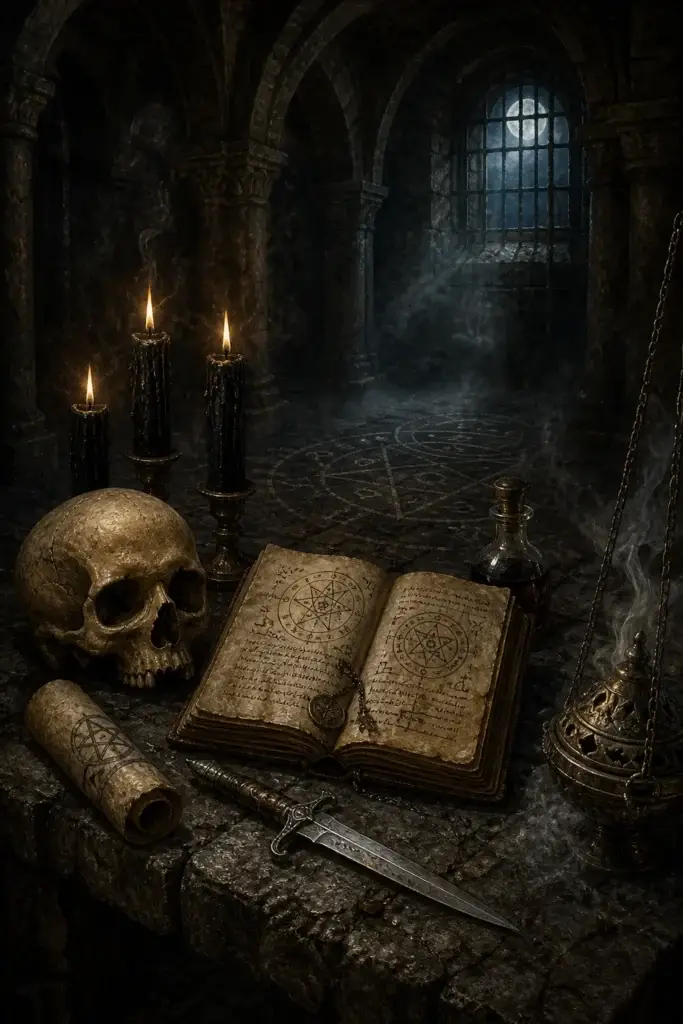
Necromancy is the mantic or magical art of communicating with the deceased or conjuring the dead, attested since cuneiform Mesopotamia, Greek nekyia rituals and European grave offerings. Textual sources range from the Pentateuch through Homer’s Odyssey to early Christian spirit exegesis and Islamic burial traditions.
The practice combines divination, the raising of the dead and a cosmological breach between the realm of the living and the realm of the dead. This practice requires ritual knowledge, the art of divination and the spiritual qualification of the magician or priest.
Table of Contents
Term and Demarcation
Necromancy is not simply spiritism or séance, although these practices are related. Spiritism is passive and communicative, whereas necromancy is active and compelling. The necromancer commands the dead, not the other way around.
A second difference: necromancy often relates to violent or impure dead (the executed, the drowned, those fallen in war) rather than to benevolent ancestors. The quality of the dead is important for the magical power.
Demarcation from the ancestor cult: the ancestor cult is religious and respectful, whereas necromancy is magical and controlling, sometimes even hostile.
The term necromancy derives from the Greek nekromanteía (from nekrós, the dead, and manteía, divination). The core of the practice is the attempt to obtain information about the past, present or future through invocation of the dead.
In the history of religion, necromancy is not an invention of early modern Christianity but a practice with a prehistory reaching far back into the high-culture religions of the Mediterranean world.
Necromancy stands in tension with institutionalized forms of religion: the Jewish Torah expressly forbids it (Leviticus 19:31; Deuteronomy 18:11), the Christian tradition adopts the prohibition, and Islamic sharia likewise contains clear prohibitions.
Despite these prohibitions, necromancy is consistently attested both in practice and in literature across all three religious spheres, which illustrates well the discrepancy between norm and practice in the history of religion.
Cultural-Historical Examples
Ancient Greek necromancy: in the Odyssey, Homer describes the conjuration of Tiresias by Odysseus, a classic example. Hecate is invoked as goddess of necromancy in ancient papyri. Greek necromantic sites often stood at dark places, oracles of the dead such as the Nekromanteion at the river Acheron.
Biblical Saul episode: in the First Book of Samuel, King Saul calls upon the Witch of Endor to conjure the dead prophet Samuel, a historical example of taboo violation and divine condemnation. In Christian theology, this is cited as evidence against necromancy.
Christian goetia: the Lemegeton or Lesser Key of Solomon is a European grimoire (magical handbook) with detailed necromantic procedures. It combines Hebrew, Platonic and demonological elements. The practitioner is to conjure demons and the dead for the purpose of divination or magical power.
Medieval European necromancy: sorcerers’ handbooks describe practices in which the dead are invoked at their graves, formulas written on parchment are used, and body parts (bones, flesh) of the dead serve as magical instruments.
African and Afro-Caribbean traditions: Hoodoo and Vodou involve strong work with ancestors and the dead, not as necromancy in the Western sense but as communication and obligation. Zombification is a form of necromancy.
Ancient Layers
The oldest surviving evidence of necromancy in the Mediterranean world comes from the Mesopotamian tradition (Akkadian conjuration texts for the invocation of the dead, documented by Tzvi Abusch and Daniel Schwemer in the Corpus of Mesopotamian Anti-Witchcraft Rituals).
The Greek tradition prominently knows the nekyia motif: in the Odyssey (Book XI), Odysseus calls upon the shades of the dead at the entrance to the underworld in order to question Tiresias.
The motif is transferred to the Roman tradition by Virgil (Aeneid VI), where Aeneas seeks out his father Anchises in the underworld.
The Greco-Roman practice was institutionally anchored at oracle sites and sanctuaries of the dead (the Nekromanteion at Ephyra, excavated by Sotirios Dakaris); the history of religion situates it within the larger complex of veneration of the dead and hero cults.
In De defectu oraculorum, Plutarch reports on the necromantic oracles and their decline in the imperial period.
Biblical and Rabbinic Tradition
The most famous biblical necromancy episode is the Witch of Endor (1 Samuel 28), who conjures the deceased prophet Samuel for King Saul.
The episode has been extensively commented upon theologically, from the rabbinic tradition (Talmud Bavli, Berakhot 12b) to Augustine (De cura pro mortuis gerenda, ca. 421/22), who discusses the question of whether this was a genuine appearance of Samuel or a demonic deception.
This question shaped Christian necromancy theology well into the 17th century.
State of the Sources
Medieval and Early Modern Tradition
In the Middle Ages, a distinct tradition of ritual-magical necromancy became established, above all in the clerical underground (the so-called clerical nigromancy, examined in detail by Richard Kieckhefer in Forbidden Rites, 1997).
Central sources are the Liber Iuratus, the Liber Razielis and the Munich nigromancy text (Codex Latinus Monacensis 849, ca. 1450).
These texts combine the invocation of the dead, the angel invocation and goetia into a methodical synthesis that is later partly disassembled again in the Lemegeton. The Catholic Inquisition proceeded systematically against this tradition from the 13th century onward, without eradicating it.
A separate layer is formed by so-called theurgy, which in the late antique Neoplatonist tradition (Iamblichus, Proclus) was demarcated from goetia as a legitimate practice of ascent, but which in Christian polemics was frequently identified with necromancy.
This identification is incorrect in terms of the history of religion, but it became established in the theology of the witch trials.
Present-Day Significance / Related Beings
iWell Guard Position on Necromancy
On iWell Guard, necromancy is documented as a practice that can be clearly delimited in the history of religion, without recommending its practice.
It falls under the second layer of the iWell Guard protective field (see the functional overview of the protective mantra): attempts to direct black-magical energies, including necromantic practices, at the wearer are rejected by the protective shield.
Anyone who themselves engages in necromancy falls under the self-application clause of the mantra (point 10), which redirects such energies back to the originator.
The documentation in the history of religion has its own cognitive value, independent of any practical recommendation.
Anyone who wishes to understand the historical depth of the necromancy tradition will find, in the articles on individual figures (the Witch of Endor, Apollonius of Tyana, Edward Kelley), detailed individual accounts with sources, hierarchy and prehistory in the history of religion.
Further standard works in the literature index.
iWell Guard and Protective Traditions
Across all documented cultures, protective objects can be attested that people carried on their bodies, from Pazuzu amulets in Mesopotamia through the Hamsa in the Mediterranean region to the Mezuzah on Jewish doorposts and to Christian protective medallions. iWell Guard takes up this tradition in a contemporary material architecture, manufactured in Germany, 41 layers, genuine gold, platinum, silver. 30-day right of return.
Personal experiences may vary. Not a medical device. No promise of healing.