iWell Guard

Mesopotamian Gods, Sumer, Babylon and the Land of the Two Rivers

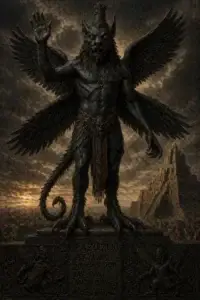
Beings from Mesopotamian mythology on iWell Guard. The Sumerian-Akkadian world of gods and demons, from roughly 3000 to 500 BCE, forms the oldest religion documented in writing in human history. Anu was enthroned as the sky god, the moon god Nanna (Sin in Akkad) watched over the night, and Marduk became the chief god of Babylon. Alongside this, Mesopotamian religion possessed a richly developed demonology: Lamashtu, Pazuzu, Gallu and other harmful beings called for their own system of protective rituals and incantation formulas.
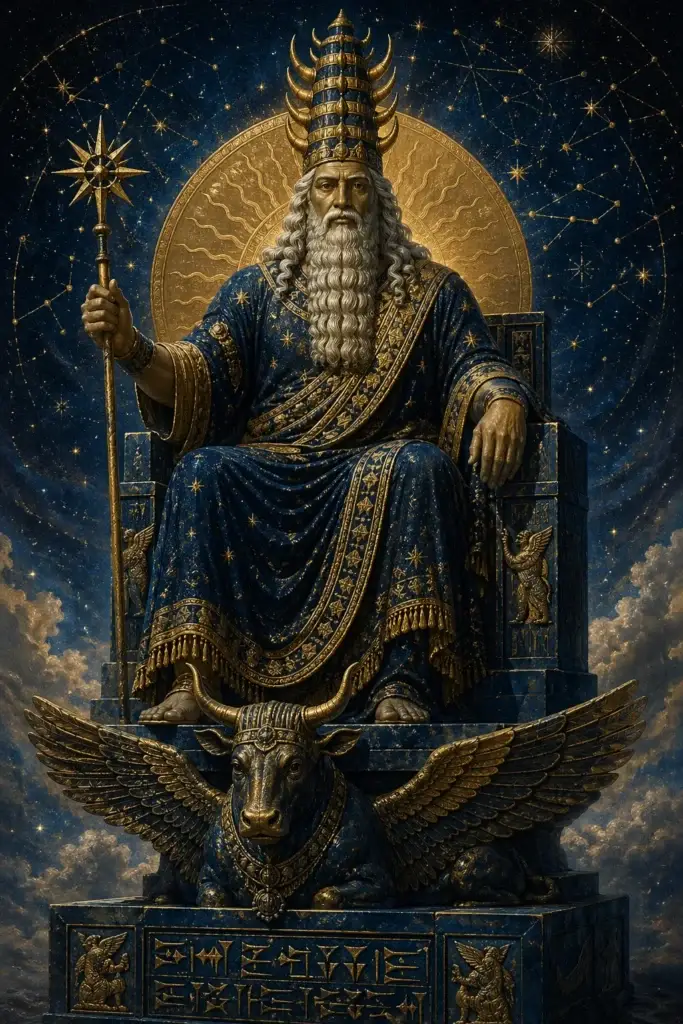
Anu - gods from the Mesopotamian tradition, historical and illustrative

Sumerian Tablets and Akkadian Gods

Mesopotamia is the cradle of documented religion. The Land of the Two Rivers gave rise to the oldest surviving god lists, creation myths and incantations, written on clay tablets in cuneiform from the late fourth millennium BCE onward.

Sumerian and Akkadian are not only languages but two layers of the same pantheon: Inanna becomes Ishtar, Enlil becomes Ellil, Utu becomes Shamash.

The system is hierarchical and city-based. Each Sumerian city had a tutelary god in its temple complex (Eridu with Enki, Uruk with Inanna, Nippur with Enlil), and the political importance of the city mirrors the standing of its god in the pantheon.

The temple inventory at the same time documents both economy and theology: offering lists, divine personnel records, and cultic ritual texts.

The demonology is exceptionally differentiated. Mesopotamia shaped terms and classes of beings that migrated on into the European Middle Ages: Lamashtu as child-killer, Pazuzu as her ambivalent counterpart, and the Gallu as netherworld pursuers. The incantation series Maqlu and Shurpu document the protective practice in detail.

Classification

The Mesopotamian cultures span a period from roughly 5500 BCE (the Ubaid period) to the Hellenization following Alexander (330 BCE). Their spread extended across the Land of the Two Rivers (Sumer, Akkad, Babylonia, Assyria) and adjacent regions.

Religious practices varied diachronically, yet showed coherent divine pantheons and ritual structures. Archaeological sources (cuneiform, artistic monuments) and literary traditions (the Enuma Elish, the Epic of Gilgamesh) document these traditions in great variety.

History and Pantheon

Mesopotamian religion is the oldest religious system documented in writing (from roughly 3000 BCE). It passed through several cultural layers: Sumerian, Akkadian, Babylonian and Assyrian. The di indigetes (city gods) were central; each city-state venerated a patron deity.

The pantheon was hierarchical: the sky god An, the air god Enlil, the water god Enki, and later Marduk as supreme after the Marduk-centered Enuma Elish.

The creation myth (Enuma Elish) describes the cosmic struggle between order (Marduk) and chaos (Tiamat). Temples were at once administrative, economic and cultic centers. With the Persian conquest (539 BCE) the traditional religion gradually disappeared. Written tradition through cuneiform tablets is abundant but fragmentary. The system was complexly hierarchized and regionally variable.

Beings in Everyday Life

Mesopotamian temple cults were priestly and royal: daily offering rituals and rituals for the cosmic upkeep of the world. Exorcisms against evil spirits and demons are documented in cuneiform. Diviners and sign-readers (haruspices) mediated supernatural messages. Household cult with protective spirits and ancestors was widespread. Magic and incantations are attested on tablets.

Trance states and prophecy are documented, though their extent is unclear. Priests, as specialized experts on the spirit world, administered the knowledge of the supernatural.

Offerings (animal sacrifices, grain, libations) were daily practices. Temples functioned as centers of healing and protection. Popular belief in the supernatural was widespread, though documented in writing less than the priestly religion.

Significance Today

Mesopotamian religion is entirely extinct; the tradition was wholly displaced by Zoroastrianism, Christianity and Islam. Academically and archaeologically it is intensively studied and a source for comparative religious studies. Literary classics (the Epic of Gilgamesh) are cultural treasures.

Esoteric Western circles romanticize Babylonian magic and Kabbalah connections. Popular culture draws on Mesopotamian mythology rarely, but increasingly (Dungeons & Dragons, Lovecraft). Its reconstruction is limited by the scarcity of sources. Mesopotamian cuneiform symbolism is instrumentalized in esoteric and neo-Nazi contexts. Scholarly reception remains sober and historical-critical.

Frequently Asked Questions about the Mesopotamian Gods

How many Mesopotamian gods are there?

The Mesopotamian pantheon knows several hundred named gods, taking Sumerian, Akkadian, Babylonian and Assyrian together. The most important god list, An:Anum, names around 2,000 gods, many of them manifestations or local aspects of the same chief gods.

The central chief gods, however, number 12 to 20: Anu, Enlil, Enki/Ea, Ninhursag, Nanna/Sin, Utu/Shamash, Inanna/Ishtar, Adad, Ninurta, Marduk, Nabu, Nergal, Ereshkigal and a few others.

Who is the supreme Mesopotamian god?

In Sumer, Enlil (storm god, lord of the pantheon) was the most powerful god, with Anu (sky) as nominal head. In the Babylonian empire (from roughly 1800 BCE) Marduk replaced Enlil as the chief god, and the creation epic Enuma Elish is Marduk-centered propaganda.

In Assyria, Ashur was the highest god. These shifts mirror political changes of power: the chief god follows the hegemonic city.

What is the divine triad of the Mesopotamians?

The original triad is Anu (sky), Enlil (earth/storm) and Enki/Ea (water/wisdom), the three domains of the cosmos. Alongside it stands the astral triad Nanna/Sin (moon), Utu/Shamash (sun) and Inanna/Ishtar (Venus). These six gods form the upper pantheon that was venerated in almost every Mesopotamian city.

What is the Enuma Elish?

The Enuma Elish (“When on high”, its opening words) is the Babylonian creation epic. It describes how the gods arose from the primeval waters Apsu and Tiamat, how Tiamat and her brood attacked the gods, and how Marduk finally defeated them.

From Tiamat’s body Marduk formed heaven and earth. The epic legitimizes Marduk’s primacy and is the most important source in religious studies for Babylonian theology. Written around 1100 BCE.

Which myths pass from Mesopotamia into the Bible?

Several biblical narratives have Mesopotamian models: the Flood (Epic of Gilgamesh tablet XI, the Atrahasis epic), the creation of humans from clay (Enki and Ninhursag), the Tower of Babel (the Mesopotamian ziggurat tradition), Paradise (the Dilmun myth), and Behemoth/Leviathan (a Tiamat reference).

Scholarship sees a broad Mesopotamian layer in the texts of Genesis and the Psalms, mediated through the Babylonian Exile.

What distinguishes gods, demons and spirits?

Gods (ilu/dingir) are immortal, are venerated in temples and stand above human beings. Demons (rabiṣu, gallu, šēdu, lamaštu) are ambivalent intermediate beings; some protect houses (lamassu/šēdu, protective demons), while others bring illness and misfortune (Lamashtu for infants, Pazuzu paradoxically against Lamashtu).

Spirits (eṭemmu) are the souls of the deceased, who may return discontent; they were provided for with burial rites and food offerings.

What is Mesopotamian religion?

Mesopotamian religion is the polytheistic belief system of the Sumerian, Akkadian, Babylonian and Assyrian cultures between roughly 3000 and 500 BCE. It is the oldest religion documented in writing and knows several hundred named gods, an elaborated demonology and an extensive protective practice drawing on incantation, amulet and temple ritual.

In Depth

City-States and the Hierarchy of the Gods

Mesopotamia is the cradle of the first advanced religions. Sumer, Akkad, Babylon and Assyria built their identity around temple cities, in each of which a city god ruled: Enki/Ea in Eridu, Inanna/Ishtar in Uruk, Marduk in Babylon, Ashur in Ashur.

With the rise of Babylon under Hammurabi, Marduk was moved to the top, and the Enuma Elish recounts mythologically how he defeats the primeval goddess Tiamat and creates the cosmos.

Writing and Transmission

Cuneiform, developed from the late 4th millennium BCE, made Mesopotamia the first religion accessible through text. Sumerian hymns, Akkadian myths (Atra-ḫasis, the Epic of Gilgamesh, the Enuma Elish), incantation series and diagnostic texts survive. The library of Ashurbanipal in Nineveh preserved thousands of tablets and remains the principal source to this day.

The Temple as Cosmos and Economy

The Mesopotamian temple, the ziggurat as a stepped tower, was at once a cosmological model and an economic center. The gods dwelt in the temple statues; offerings and meals were presented to them daily. Temples owned land, slaves, craftsmen and scribes; they organized irrigation, the distribution of seed grain, and trade.

Demonology and Protective Practice

Mesopotamia shaped the world’s demonology like no other culture. The idea that illness, infant death and misfortune are caused by personified demons was carried on from there, by way of Persia, Hellenistic Judaism, early Christianity and the Islamic world, all the way to Europe.

The āšipu exorcists developed a complex system of diagnosis, ritual and amulet magic.

State of research

Mesopotamian religion is very well studied in religious scholarship. Standard works are Thorkild Jacobsen, “The Treasures of Darkness” (1976), Jean Bottéro, “La religion la plus ancienne” (1988), and Stefan Maul for the incantation tradition.

The edition of the Lamashtu incantations by Walter Farber (Eisenbrauns 2014) is the central source basis; Frans A.M. Wiggermann, “Lamaštu, Daughter of Anu” (BiOr 2000) is the most important specialized study.

Means of Protection in This Cultural Tradition

In Mesopotamia, Pazuzu pendants accompanied pregnant women and women in childbed as protection against Lamashtu; incantation tablets and amulet plaques rounded out the protective repertoire.

iWell Guard takes its place within this culture-historical line of wearable means of protection, in a contemporary material architecture, made in Germany. 41 layers, solid gold, platinum, silver. 30-day right of return.

Personal experiences may vary. Not a medical device. No promise of healing.

Sumerian Demons, Protection and Significance

The Sumerian demons formed what was arguably the first systematically elaborated demonology in the history of religion. Unlike later Abrahamic traditions, Mesopotamian thought knew no moral bipolarity of good and evil; demons were powers that operated in a permeable world and had to be controlled through incantation, protective beings or invocation of the gods.

At the center stand Lamashtu (demon of infants and women in childbed), Pazuzu (the paradoxical anti-Lamashtu protective demon), Gallu (netherworld messengers), Lilu and Lilitu (nocturnal seduction demons), as well as Edimmu and Rabisu as lurking demons. Protection was provided by Pazuzu amulets, Maqlu incantation tablets and apotropaic statuettes at door thresholds.

Protective Symbols from Mesopotamia

The lexicon of protective symbols treats several signs and objects from Ancient Mesopotamia on their own pages: Apkallu, Lamashtu plaque, Lamassu, Pazuzu amulet and cylinder seal. A cross-cultural overview is offered by the page on protective symbols.