Shamash, God of the Mesopotamian Tradition
By Ralf Ittermann · last reviewed on
Shamash is a god of the Mesopotamian tradition.
Sun god, guardian of justice, light over all things. Shamash (Sumerian Utu) is one of the most deeply venerated gods of Mesopotamia, not as wild fire but as a radiant, steady force of order.
Each day he travels across the sky in his chariot, sees everything people do in secret, and brings all before judgment. No secret remains hidden from Shamash, and no wrong goes unpunished.
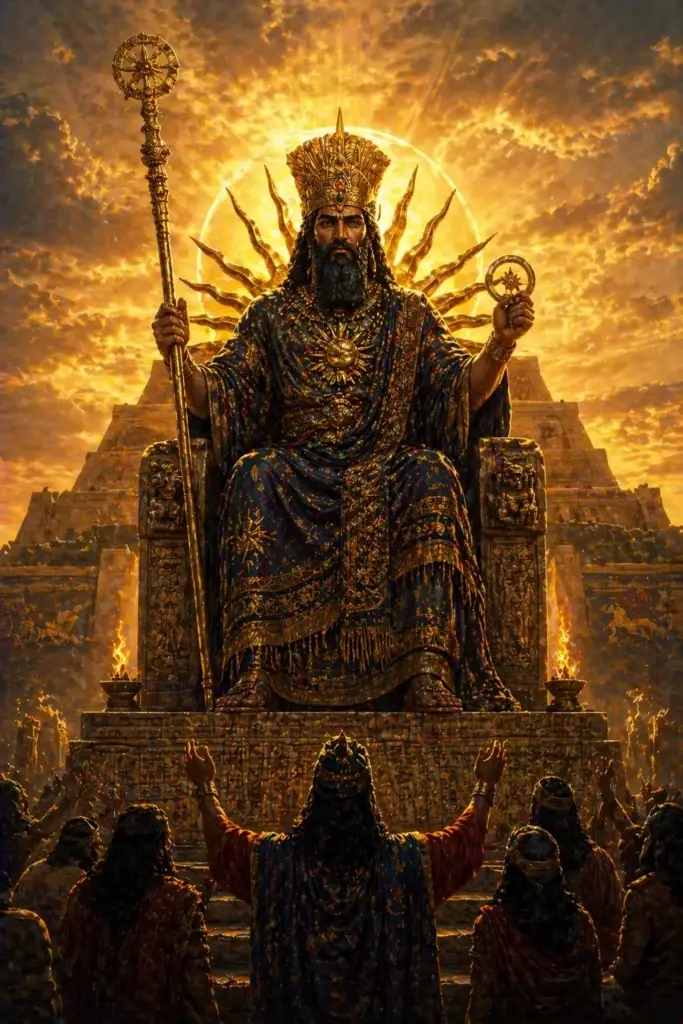
Shamash
Quick Overview: Shamash
Type: Mesopotamian principal deity, sun god and divine judge
Pantheon: Sumer (as Utu), Akkad/Babylon/Assyria (as Shamash)
Function: sun, daylight, law, justice, truth
Main attributes: winged sun disk, saw (cuts apart what is false), staff and ring
Main cult sites: Sippar (principal cult site, E-babbar temple), Larsa, Ur, Nineveh
Family: Sin (moon) as father, Inanna/Ishtar as sister
Historical Classification
Period of the Texts
Utu/Shamash is attested from the early Sumerian period (3rd millennium BCE); the sun god was the principal deity of Sippar and Larsa. The main flowering of the Shamash tradition came in the Old Babylonian period (the Hammurabi stele shows Shamash as the divine judge handing ring and staff to Hammurabi).
He remained central in the Neo-Babylonian and Assyrian empires. With the decline of the Babylonian empire (539 BCE) the cult faded away.
Area of Distribution
Main cult sites: Sippar (today Tell Abu Habba, north of Babylon) with the sun god temple E-babbar (“White House”), Larsa (in the south, likewise an E-babbar temple), Babylon, Nineveh, Mari.
He is mentioned in biblical texts as Shemesh (Beth-Shemesh = “House of the Sun”).
Source Material
Central sources: the Hammurabi stele (ca. 1750 BCE, Shamash handing over ring and staff), the prologue of the Code of Hammurabi, the great Shamash Hymn (Old Babylonian), the tablet of Nabu-apla-iddina (9th century BCE, with a painted Shamash sun disk), and incantation tablets.
Secondary literature: Schwemer, Die Wettergottgestalten Mesopotamiens; Bottéro, La plus vieille religion; Black/Green, Gods, Demons and Symbols.
Name and Spellings
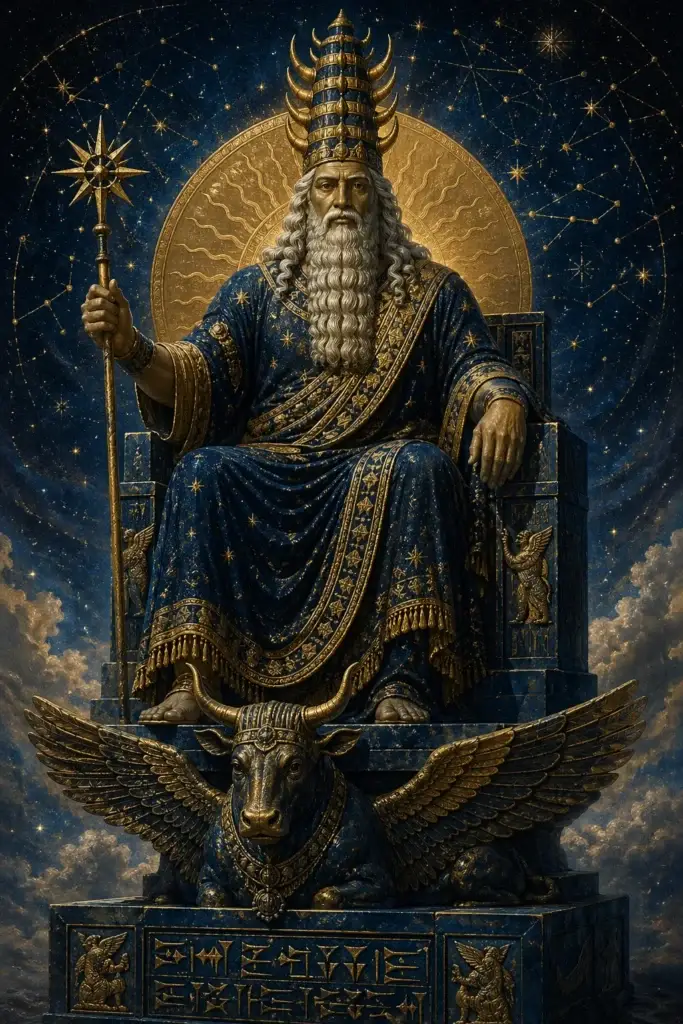
Shamash is depicted as a majestic man with a radiant diadem or sun crown, often with a disk-shaped sun above his head. He sits on a throne or stands in his chariot, drawn by two glowing horses.
Sometimes he carries an aura of flames or is surrounded by rays of light. The sun disk with a four-pointed star and wavy rays (the Shamash symbol) is his distinguishing mark. A judge’s staff or a sword of justice may accompany him.
Description
Shamash is the god of the sun and of justice, two forces that are closely linked. Judges prayed to him before court in order to render just verdicts.
The sick called upon him for healing, since the sun heals and purifies.
His main temple was the E-babbar (House of Radiance) in Sippar, a renowned center of astronomy and legal scholarship. Each day the priests made offerings at sunrise and prayed for his return. Shamash was not only venerated but loved, the most reliable of all the gods.
Appearance and Symbolism
Shamash is depicted as a bearded man within a sun disk or surrounded by radiant light. He often wears royal garments and a crown that represents the sun disk. In his hand he sometimes holds a scepter of justice or the flames of the sun.
His body is golden and luminous. The bull or horse is sometimes counted among his sacred animals, since they follow the sun. Shamash is often depicted with wings or auras of light. The four rays of the sun are his symbol.
Profile: Shamash
The most important aspects of Shamash at a glance. The following fields summarize his origin, function, appearance, veneration, symbols, and parallels.
Shamash is the son of the moon god Sin (Nanna) and of Ningal, and the brother of the goddess of love and war Inanna/Ishtar.
He is the consort of Aya (goddess of dawn). In the theogonic order he belongs to the second generation of the Babylonian pantheon. In the Neo-Babylonian empire he stood nearly equal in rank to Marduk.
Sun god and divine judge. His eye sees everything, which is why he presides over crime and justice. Oaths are sworn “before Shamash”; court verdicts are dinu sha Shamash (judgments of Shamash).
Together with Adad (the weather god) he is the chief proclaimer of divine messages (omen texts). He is the patron of travelers (especially by day) and of the practice of divination. He is the protector of the defenseless: widows, orphans, and slaves.
Anthropomorphic, as a bearded male figure with a tall horned diadem (often with a sun disk) and a long, multi-layered robe. Characteristic attributes: sun rays from the shoulders (or from a sun disk set upon him), a saw (in his hand, which cuts apart what is false), and staff and ring (insignia of judgment).
He is frequently seated on a throne with the sun rays. On the Hammurabi stele he faces the king, handing him ring and staff. Symbol: the winged sun disk.
Area of influence: Shamash was invoked by judges, travelers, diviners, and all who sought justice. Offerings were made before court hearings. He was central to divination: liver inspection (haruspicy) and oil-on-water divination (lecanomancy) were Shamash practices.
Personal invocation: before important decisions, when traveling, and when bringing complaints before a court. Sippar was a pilgrimage destination for those seeking divination and judgment.
Sun rays from the shoulders, the winged sun disk, the saw (cutting apart what is false), staff and ring (judgment insignia), a tall horned diadem, a long robe, and the bull (a secondary animal). Plants: tamarisk. Sacred number: 20. Sacred direction: east (sunrise).
Utu (Sumerian, the forerunner), Shemesh (Hebrew), Re/Ra (Egypt, principal sun god), Helios (Greece), Sol (Rome), Sol Invictus (late Roman), Surya (Hinduism), Amaterasu (Japan, female sun goddess), Mithra (Persian, god of sun and justice). Functionally, all divine judges (Yama, Anubis, aspects of Hades) share functions with Shamash.
Practical Defense
Rituals of Veneration
Shamash, the god of sun and justice, had his main cult center in the E-babbar temple at Sippar (and Larsa). Daily offerings at sunrise (“nuhatim”, baked breads, dates, beer) were the duty of the priestly shangu class.
The prologue of the Code of Hammurabi begins with Anu and Enlil; the invocation of Shamash as guarantor of justice follows only later (cf. Bottéro).
Invocations and Hymns
The “Great Shamash Hymn” (BWL 121-138, Lambert), more than 200 lines long, is one of the most central hymn texts of Akkadian religion. Daily morning invocations began with “Shamash mushtesher kibrat” (Shamash, guide of the four quarters of the world). Before court proceedings, Shamash was invoked as an eyewitness.
Amulets and Protective Symbols
Solar symbols (the winged sun disk, a four-rayed star within a circle) appear on Babylonian seal cylinders (cf. Black/Green, Gods, Demons and Symbols). Solar plaques of carnelian or rock crystal were worn as protection against illness and injustice. The sun ring with twelve rays (Babylon, 7th century BCE) symbolizes the omnipresence of Shamash.
Shamash: Parallels in Other Cultures
Shamash resembles the Egyptian Ra or Aten, both of whom are sun gods with all-seeing sight. With the Greek Apollo he shares aspects of order and healing. The Hebrew god is sometimes described with Shamash functions, as the all-seeing one and the judge.
In Indian cultures he resembles Surya, the sun god, or Mitra, the god of treaties and justice. Across all these cultures, Shamash remains a central figure of order and of light.
The Code of Hammurabi and the Sun as Judge
The best-known link between Shamash and royal jurisdiction appears in the relief image at the upper end of the stele of the Code of Hammurabi, now in the Louvre. It depicts the Babylonian king Hammurabi standing before an enthroned god.
Older scholarship long interpreted the figure as Shamash, because rays grow from the god’s shoulders and he hands over a ring and a staff, insignia that in Mesopotamian visual language were associated with the transfer of legal authority. Some scholars have alternatively proposed Marduk, yet the ray attributes argue for Shamash.
In its content, the scene fits the self-understanding of the text. In the prologue and epilogue of the code, Hammurabi repeatedly states that he established justice in the land, and Shamash appears there as the god who guarantees law and justice.
The sun god sees everything that happens by day, and this all-seeing quality made him, in Mesopotamian thought, the natural guarantor of oath, contract, and verdict.
This role is older than Hammurabi. Already in Sumerian hymns to Utu, the forerunner of Shamash, the god is called upon to uncover wrongdoing and to stand by the oppressed.
In court records and oath formulas of the second and first millennia his name appears regularly. Whoever broke an oath sworn by Shamash exposed himself to his punishment.
The connection between light symbolism and the idea of law, the light that brings what is hidden into the open, is carried through so consistently in the sources that it can be regarded as a basic trait of the Mesopotamian conception of the divine.
At the same time it shows how closely cosmology and social order were linked in this culture.
Sippar and Larsa: The Great Cult Centers
Shamash possessed two main temples, both bearing the name E-babbar, the shining or white house. One stood in Sippar in the north of Babylonia, the other in Larsa in the south.
Both cities were regarded over millennia as the central sites of the sun cult, and their temples were restored and furnished by numerous rulers.
For Sippar the source material is especially good. The excavations yielded extensive temple archives from the Old Babylonian and Neo-Babylonian periods, which give insight into the economy, administration, and personnel of the sanctuary. One frequently cited object is the so-called Sun Tablet of Nabu-apla-iddina, a stone tablet from the ninth century before our era.
In relief it shows the enthroned Shamash and recounts in its text how the king, after a long period of neglect, had a new cult image made for the god after an old clay model had been found. The text thus also documents the concern for the correct restoration of a lost cult image.
In Larsa the Shamash cult flourished under kings such as Rim-Sin. Here too rulers had the E-babbar renewed, and building inscriptions record their endowments. The continuity is remarkable: even the Neo-Babylonian king Nabonidus, otherwise known above all for his promotion of the moon god Sin, attended to the sun temples of both cities.
The doubling of the cult centers in north and south reflects the geographic structure of Babylonia and secured the sun god a nationwide presence that raised him above local ties.
Shamash in Divination and in the Epic of Gilgamesh
Besides his role as judge, Shamash was the god of entrail inspection and of oracular practice. Mesopotamian liver inspection, in which priests read signs from the liver of sacrificial animals, frequently directed its inquiries to Shamash together with the weather god Adad.
So-called extispicy prayers, often referred to in scholarship as tamitu texts or as inquiries to the oracle, formulated concrete questions, for example whether a campaign would succeed, and asked the god to write his answer into the entrails.
Shamash was thus not only the one who uncovered existing wrongs, but also the one who disclosed what was hidden about the future.
In the Epic of Gilgamesh, Shamash appears as a protective god of the heroes. Before the march against Humbaba, the guardian of the cedar forest, Gilgamesh turns to the sun god and asks for support. Shamash then sends winds that beset Humbaba and give the heroes the decisive advantage.
Later, when Enkidu lies dying and pronounces his curse upon the woman who led him into civilization, it is Shamash who rebukes him and reminds him of the good that has come to him. Enkidu then withdraws the curse.
These episodes show Shamash as an ordering, moderating authority within the narrative. He does not intervene arbitrarily, but supports those who turn to him and calls for reflection where excess threatens. His role in the epic thus fits the overall picture drawn by the hymns and legal texts.
From Utu to Shamash: Etymology and Sumerian Roots
The name Shamash is the Akkadian word for sun and belongs to a common Semitic root that also appears in related form in Hebrew as shemesh, in Arabic as shams, and in further Semitic languages.
The god and the celestial body therefore bear the same name, which underscores the close connection between the natural phenomenon and the divine person.
The Sumerian predecessor was called Utu. With the merging of Sumerian and Akkadian religion over the course of the third and second millennia, Utu and Shamash were largely equated, without the older figure disappearing entirely. In bilingual texts both names stand side by side.
Already in Sumerian times Utu was regarded as the son of the moon god Nanna and of Ningal and as the brother of Inanna, the later Ishtar. These family relationships were taken over into the Akkadian texts: Shamash is the son of Sin and the brother of Ishtar.
Notable is the position of the sun as a child of the moon. In many other mythologies the sun is conversely regarded as the higher-ranking or older celestial body. The Mesopotamian arrangement is often explained by the fact that the moon god in Ur possessed a particularly old and prestigious cult.
The genealogy thus reflects the history of the cult centers rather than a systematic astronomy. The spelling of the name is also revealing: the sun sign could be read both as Sumerian Utu and as Akkadian Shamash, so that texts often leave open which language form the scribe had in mind.
Reception: The Sun God in the Study of the Ancient Near East
Shamash is among the deities that became known again early with the decipherment of cuneiform in the nineteenth century.
The stele of the Code of Hammurabi, found in 1901 and 1902 by a French expedition at Susa, made the image of the enthroned god with the shoulder rays one of the most familiar depictions from the Ancient Near East of all.
It is reproduced in countless handbooks and shapes the popular conception of Mesopotamian religion to this day.
In scholarly discussion the question long stood in the foreground of how closely the Mesopotamian sun cult was linked with legal ideas and whether this connection radiated to neighboring cultures.
Historians of religion have discussed parallels to legal metaphors of light in West Semitic and biblical texts, for example where justice and salvation are compared to the rising of the sun.
Such comparisons should be made with caution, since similar metaphors can arise independently, but the Mesopotamian evidence is especially well attested through the quantity of sources.
For modern study the editions of the hymns and prayers are fundamental, among them the great Shamash Hymn, which survives in several textual witnesses and praises the god at length as the all-seeing keeper of justice.
It has been translated and commented upon repeatedly and is regarded as one of the most impressive religious texts of Mesopotamia. Anyone studying the Mesopotamian pantheon can proceed from Shamash to related figures, for example to his father Sin or to his sister Ishtar.
Further Links
Literature (Selection)
Further standard works in the literature index.